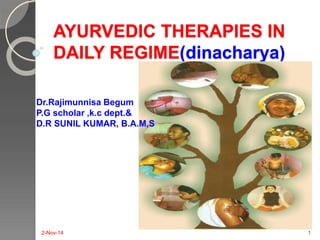
AYURVEDIC THERAPIES IN 
DAILY REGIME(dinacharya) 
Dr.Rajimunnisa Begum 
P.G scholar ,k.c dept.& 
D.R SUNIL KUMAR, B.A.M,S 
2-Nov-14 1
AIMS OF AYURVEDA 
 Prevention of disease & 
maintenance of health 
 Curing the diseased 
“Prevention” is better than “cure” 
2-Nov-14 2
Importance of daily health 
regimes in Ayurveda. 
 “Dinacharya” means the “appropriate 
daily regimes” which should be followed 
the Ayurveda way, for a physically, 
mentally and spiritually healthy life. 
2-Nov-14 3
Dinacharya 
 Right from waking up in the 
morning till sleeping at night, all 
the daily routines have been given 
utmost importance in Ayurveda. 
2-Nov-14 4
AWAKENING FROM SLEEP 
 There is a well known proverb – “Early to 
bed, early to rise makes a person healthy, 
wealthy and wise. 
2-Nov-14 5
According to Ayurveda - 
 One who is desirous of a long, healthy life 
should wake up at the time of – “BRAHMA 
MUHURTA” 
 Brahma muhurta - means approximately 
1to1/2 hour before sunrise. 
 Brahma = Knowledge. ‘Brahma muhurta’ is 
the best time for gaining knowledge 
2-Nov-14 6
ANSWERING NATURE’S CALL 
! 
2-Nov-14 7
 Evacuate your bowels 
 You can train yourself to do this at this time 
 If your digestion is normally sluggish drink a 
glass of warm water 
 Do not avoid answering the nature’s call 
 Do not strain too, if you do not have the urge. 
 After this wash your hands clean and splash 
some clean water on your face 
2-Nov-14 8
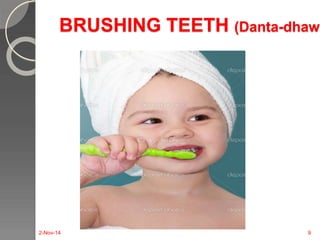
BRUSHING TEETH (Danta-dhawan 
2-Nov-14 9
When to brush teeth? 
 Ayurveda mentions that teeth must 
be brushed – 
 In the morning 
 And also after eating food. 
2-Nov-14 10
What to use for brushing ? 
 According to Ayurveda twigs of the following 
herbs can be used to brush teeth : 
◦ Arka 
◦ Vata (Banyan tree) 
◦ Khadira 
◦ Karanja 
◦ Arjuna 
◦ Nimba- is best among bitter herbs. 
◦ In absence of twigs “powders” of herbs like 
Triphala, Trikatu & Trijatak can be used 
2-Nov-14 11
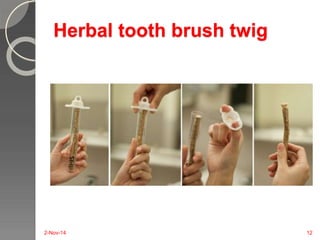
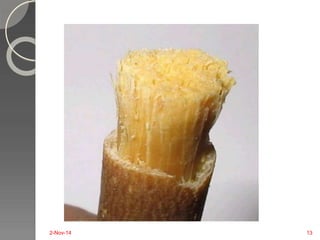
Herbal tooth brush twig 
2-Nov-14 12
2-Nov-14 13
Benefits of Brushing teeth 
 Freshens up the mouth 
 Removes bad odour from the 
mouth 
 Removes coating on teeth 
 Alleviates ‘Kapha’ 
 Increases desire for food 
 Makes on feel pleasant 
2-Nov-14 14
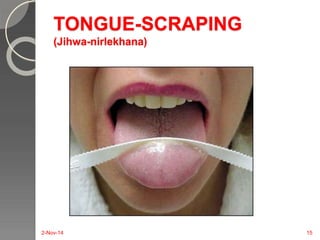
TONGUE-SCRAPING 
(Jihwa-nirlekhana) 
2-Nov-14 15
Benefits of tongue-scrapping: 
 Removes bad taste from mouth 
 Eliminates bad odour of mouth 
 Reduces swelling of tongue 
 Relieves stiffness of tongue 
 Enhances the sense of taste. 
 Thus helps maintain oral hygiene 
 Stimulates the taste buds. 
2-Nov-14 16
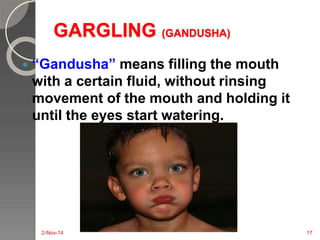
GARGLING (GANDUSHA) 
 “Gandusha” means filling the mouth 
with a certain fluid, without rinsing 
movement of the mouth and holding it 
until the eyes start watering. 
2-Nov-14 17
Fluids used for Gargling 
(Gandusha) 
 Fluids like Sesame oil, honey, milk, 
meat soup, rice gruel, herbal 
decoctions. 
 On daily basis Gargling is usually 
done with sesame oil, or meat 
soup. 
2-Nov-14 18
Benefits of Gargling (Gandusha) 
 Strengthens the mandible 
 Improves voice quality 
 Nourishes the face 
 Enhances taste-perception 
 Prevents drying of throat, chapping 
of lips and tooth-decay 
 Strengthens teeth & gums 
 Reduces hypersensitivity of teeth 
to sour taste or hard food 
substances 
2-Nov-14 19
MOUTH-WASH (Kawal) 
 Mouth wash (Kawal) is very similar 
to Gargling (Gandusha). 
 The only difference is that in this 
method the movement of rinsing 
the fluid in the mouth is done 
2-Nov-14 20
COLLYRIUM (Anjanam) 
 “EYE” is the most important among 
all the sense organs. 
 Hence “COLLYRIUM” is applied to 
the eyes to protect it from various 
eyes diseases. 
 It is useful to maintain the health of 
the eyes. 
2-Nov-14 21
Sauviranjana 
• Collyrium made 
from Antimony 
• To be applied 
daily for 
protection of eyes 
Rasnajanam 
• Collyrium made 
from Berberis 
aristata (Darvi) 
• To be apllied once 
in 5 or 8 nights 
for facilitating 
good lacrymation 
of eyes during the 
‘night’ 
2-Nov-14 22
BENEFITS OF COLLYRIUM 
(Collyrium) 
 It cleanses the eyes 
 Improvises Vision 
 Generates a shine and twinkle in 
the eye. 
 Protects and cures various eye 
diseases 
2-Nov-14 23
When not to apply collyrium 
 Exhaustion 
 Crying 
 After alcohol intake 
 Anger 
 Fear 
 Suppression of natural urges 
 Diseases of the head 
 Redness and pain in eyes 
 Swollen eye 
 Excessive watering of eyes 
2-Nov-14 24
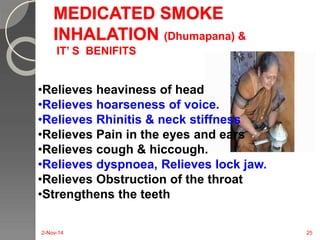
MEDICATED SMOKE 
INHALATION (Dhumapana) & 
IT’ S BENIFITS 
•Relieves heaviness of head 
•Relieves hoarseness of voice. 
•Relieves Rhinitis & neck stiffness 
•Relieves Pain in the eyes and ears 
•Relieves cough & hiccough. 
•Relieves dyspnoea, Relieves lock jaw. 
•Relieves Obstruction of the throat 
•Strengthens the teeth 
2-Nov-14 25
Purpose of Medicated 
Smoking? 
 Some part of the increased vitiated 
Kapha in the head region is 
instantly eliminated by inhalation of 
Medicated herbal smoke 
(Dhumapana) 
 Hence it is suggested following 
collyrium application. 
2-Nov-14 26
Time for inhalation of 
medicated smoke 
 After bathing 
 After eating 
 After tongue-scraping 
 After sneezing 
 After brushing teeth 
 After nasya (nasal instillation) 
 After applying collyrium 
 After sleep 
2-Nov-14 27
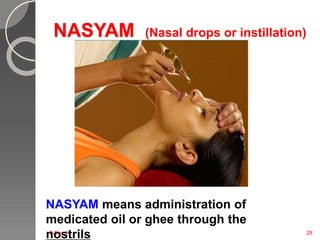
NASYAM (Nasal drops or instillation) 
NASYAM means administration of 
medicated oil or ghee through the 
nostrils 
2-Nov-14 28
What to use as Nasal 
drops? 
 A herbal medicated “Oil” specially 
indicated for Nasal instillation on a 
daily basis is – “ANU THAILAM” 
 Anu thailam is specially conducive 
to spreading into minute channels 
of the body. 
2-Nov-14 29
Signs of appropriate Nasal 
instillation 
 Lightness of head 
 Sound sleep and waking up in time 
 Cure of diseases 
 Pleasant mind 
 Clarity and proper functioning of all 
the sense organs 
2-Nov-14 30
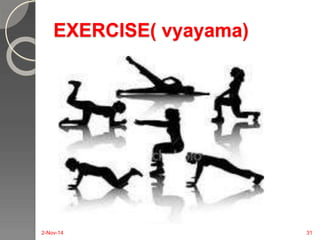
EXERCISE( vyayama) 
2-Nov-14 31
Signs of appropriate exercising : 
 Sweating 
 Increased respiration rate 
 Lightness of the body 
 Increased heart rate 
2-Nov-14 32
Benefits of exercise : 
 It nourishes the body 
 Gives good complexion 
 Maintains proportionate body parts by 
improving the musculature. 
 Enhances the digestive power 
 Prevents laziness 
 Lightness of the body 
 Detoxifies the body 
 Increases tolerance to exertion, heat or 
cold. 
2-Nov-14 33
Rules for Exercise according to 
Ayurveda : 
 Heavy exercise should be done in the 
Winter & Spring season. 
 Mild exercise should be done in all the 
remaining seasons. 
 Walking daily increases the life span, 
strength, intelligence 
 Walking improves digestion & health 
of “indriyas” or sense organs. 
2-Nov-14 34
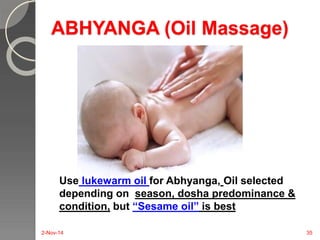
ABHYANGA (Oil Massage) 
Use lukewarm oil for Abhyanga, Oil selected 
depending on season, dosha predominance & 
condition, but “Sesame oil” is best 
2-Nov-14 35
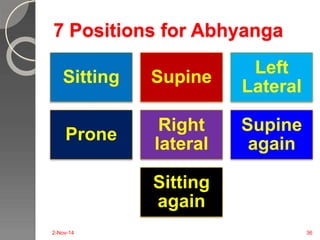
7 Positions for Abhyanga 
Sitting Supine 
Left 
Lateral 
Prone 
Right 
lateral 
Supine 
again 
Sitting 
again 
2-Nov-14 36
Benefits of Daily Abhyanga (oil 
massage) 
 Delays Ageing process 
 Relieves Fatigue & relaxes the body 
 Helps cure Vata diseases 
 Improves Vision 
 Improves skin complexion 
 Nourishes the body 
 Improves Sleep 
 Strengthens the body 
 Increases the Life span 
2-Nov-14 37
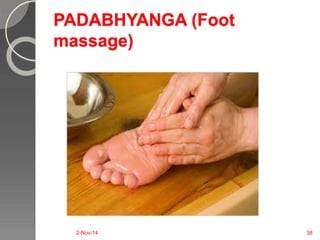
PADABHYANGA (Foot 
massage) 
2-Nov-14 38
Daily Foot-massage Benefits: 
 Reduces Dryness of body 
 Removes the stiffness or numbness in 
legs 
 Relaxes the feet 
 Gives strength & Stability to feet 
 Improves health of ‘eyes’ 
 Pacifies Vata 
 Prevents – Sciatica, Cracking of feet & 
Muscle stiffness in the legs 
2-Nov-14 39
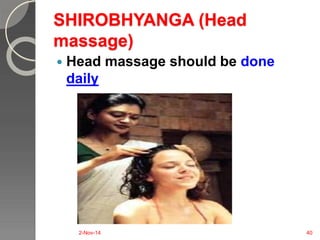
SHIROBHYANGA (Head 
massage) 
 Head massage should be done 
daily 
2-Nov-14 40
Benefits of Daily ‘Shiro-abhyanga’ 
(Head massage) 
 Prevents hair-fall 
 Prevents early graying of hair 
 Strengthens hair roots 
 Gives nourishment to all the sense 
organs like – eyes, ears, nose, 
tongue & skin 
 Gives good complexion to face 
 Good & sound sleep 
2-Nov-14 41
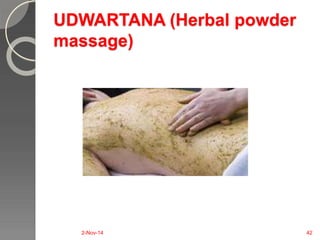
UDWARTANA (Herbal powder 
massage) 
2-Nov-14 42
Udwartana 
 “UDWARTANA” means – Massaging 
the body with fine powders (churnas) 
of various herbs of astringent taste. 
 It is mainly done after oil massage 
 Sometimes paste of herbal powders 
can also be used 
2-Nov-14 43
Benefits of “Udwartana” 
 Reduces excess “Kapha dosha” 
 Reduces excess “Body fat” 
 Strength & Stability of body 
 Clear & healthy complexion to skin 
 Reduces heaviness of body 
 Dilates blood vessels 
 Prevents rashes & itching 
2-Nov-14 44
Benefits of Daily bath 
•It is sacred 
•Helps live a long life 
•Improves strength of heart 
•Increases “Oja” 
•Relaxes the body 
•Removes excess Sweat, itching & 
Foul body odour 
•Removes drowsiness 
2-Nov-14 45
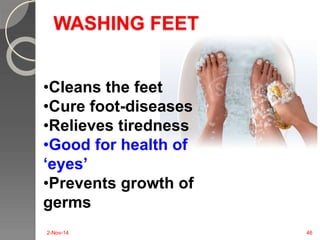
WASHING FEET 
•Cleans the feet 
•Cure foot-diseases 
•Relieves tiredness 
•Good for health of 
‘eyes’ 
•Prevents growth of 
germs 
2-Nov-14 46
Other daily regimes are : 
Wearing comfortable clothes depending 
on the climate – enhances beauty, 
pleases mind. 
2-Nov-14 47
 Wearing garlands made of ‘fragrant 
herbs & – e.g. Sandalwood, Saffron & 
fragrant flowers like jasmine – pleases 
mind. 
2-Nov-14 48
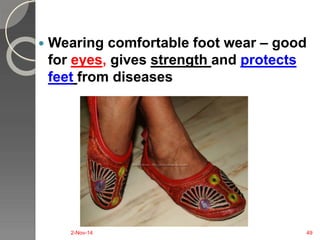
 Wearing comfortable foot wear – good 
for eyes, gives strength and protects 
feet from diseases 
2-Nov-14 49
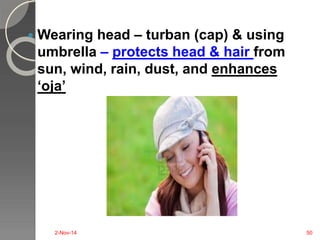
 Wearing head – turban (cap) & using 
umbrella – protects head & hair from 
sun, wind, rain, dust, and enhances 
‘oja’ 
2-Nov-14 50
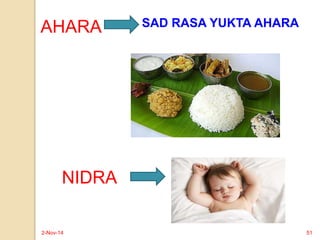
AHARA SAD RASA YUKTA AHARA 
NIDRA 
2-Nov-14 51
2-Nov-14 52
CONCLUSION; 
 Unhealthy life styles are the principal 
causes of modern day illnesses . 
 In recognizing the importance of years of 
life, 
 This wellbeing or wellness associated 
with social, mental, spiritual,& physical 
functioning. 
 It is possible only by these therapies. 
 So health management is free & 
enjoyable but disease management is 
costly & painful. 
 So every one should follow the 
2-Nov-14 53
THANK “U” 
2-Nov-14 54

ayurvedic therapies in daily life---dinacharya ppt

  • 1.
    AYURVEDIC THERAPIES IN DAILY REGIME(dinacharya) Dr.Rajimunnisa Begum P.G scholar ,k.c dept.& D.R SUNIL KUMAR, B.A.M,S 2-Nov-14 1
  • 2.
    AIMS OF AYURVEDA  Prevention of disease & maintenance of health  Curing the diseased “Prevention” is better than “cure” 2-Nov-14 2
  • 3.
    Importance of dailyhealth regimes in Ayurveda.  “Dinacharya” means the “appropriate daily regimes” which should be followed the Ayurveda way, for a physically, mentally and spiritually healthy life. 2-Nov-14 3
  • 4.
    Dinacharya  Rightfrom waking up in the morning till sleeping at night, all the daily routines have been given utmost importance in Ayurveda. 2-Nov-14 4
  • 5.
    AWAKENING FROM SLEEP  There is a well known proverb – “Early to bed, early to rise makes a person healthy, wealthy and wise. 2-Nov-14 5
  • 6.
    According to Ayurveda-  One who is desirous of a long, healthy life should wake up at the time of – “BRAHMA MUHURTA”  Brahma muhurta - means approximately 1to1/2 hour before sunrise.  Brahma = Knowledge. ‘Brahma muhurta’ is the best time for gaining knowledge 2-Nov-14 6
  • 7.
  • 8.
     Evacuate yourbowels  You can train yourself to do this at this time  If your digestion is normally sluggish drink a glass of warm water  Do not avoid answering the nature’s call  Do not strain too, if you do not have the urge.  After this wash your hands clean and splash some clean water on your face 2-Nov-14 8
  • 9.
  • 10.
    When to brushteeth?  Ayurveda mentions that teeth must be brushed –  In the morning  And also after eating food. 2-Nov-14 10
  • 11.
    What to usefor brushing ?  According to Ayurveda twigs of the following herbs can be used to brush teeth : ◦ Arka ◦ Vata (Banyan tree) ◦ Khadira ◦ Karanja ◦ Arjuna ◦ Nimba- is best among bitter herbs. ◦ In absence of twigs “powders” of herbs like Triphala, Trikatu & Trijatak can be used 2-Nov-14 11
  • 12.
    Herbal tooth brushtwig 2-Nov-14 12
  • 13.
  • 14.
    Benefits of Brushingteeth  Freshens up the mouth  Removes bad odour from the mouth  Removes coating on teeth  Alleviates ‘Kapha’  Increases desire for food  Makes on feel pleasant 2-Nov-14 14
  • 15.
  • 16.
    Benefits of tongue-scrapping:  Removes bad taste from mouth  Eliminates bad odour of mouth  Reduces swelling of tongue  Relieves stiffness of tongue  Enhances the sense of taste.  Thus helps maintain oral hygiene  Stimulates the taste buds. 2-Nov-14 16
  • 17.
    GARGLING (GANDUSHA) “Gandusha” means filling the mouth with a certain fluid, without rinsing movement of the mouth and holding it until the eyes start watering. 2-Nov-14 17
  • 18.
    Fluids used forGargling (Gandusha)  Fluids like Sesame oil, honey, milk, meat soup, rice gruel, herbal decoctions.  On daily basis Gargling is usually done with sesame oil, or meat soup. 2-Nov-14 18
  • 19.
    Benefits of Gargling(Gandusha)  Strengthens the mandible  Improves voice quality  Nourishes the face  Enhances taste-perception  Prevents drying of throat, chapping of lips and tooth-decay  Strengthens teeth & gums  Reduces hypersensitivity of teeth to sour taste or hard food substances 2-Nov-14 19
  • 20.
    MOUTH-WASH (Kawal) Mouth wash (Kawal) is very similar to Gargling (Gandusha).  The only difference is that in this method the movement of rinsing the fluid in the mouth is done 2-Nov-14 20
  • 21.
    COLLYRIUM (Anjanam) “EYE” is the most important among all the sense organs.  Hence “COLLYRIUM” is applied to the eyes to protect it from various eyes diseases.  It is useful to maintain the health of the eyes. 2-Nov-14 21
  • 22.
    Sauviranjana • Collyriummade from Antimony • To be applied daily for protection of eyes Rasnajanam • Collyrium made from Berberis aristata (Darvi) • To be apllied once in 5 or 8 nights for facilitating good lacrymation of eyes during the ‘night’ 2-Nov-14 22
  • 23.
    BENEFITS OF COLLYRIUM (Collyrium)  It cleanses the eyes  Improvises Vision  Generates a shine and twinkle in the eye.  Protects and cures various eye diseases 2-Nov-14 23
  • 24.
    When not toapply collyrium  Exhaustion  Crying  After alcohol intake  Anger  Fear  Suppression of natural urges  Diseases of the head  Redness and pain in eyes  Swollen eye  Excessive watering of eyes 2-Nov-14 24
  • 25.
    MEDICATED SMOKE INHALATION(Dhumapana) & IT’ S BENIFITS •Relieves heaviness of head •Relieves hoarseness of voice. •Relieves Rhinitis & neck stiffness •Relieves Pain in the eyes and ears •Relieves cough & hiccough. •Relieves dyspnoea, Relieves lock jaw. •Relieves Obstruction of the throat •Strengthens the teeth 2-Nov-14 25
  • 26.
    Purpose of Medicated Smoking?  Some part of the increased vitiated Kapha in the head region is instantly eliminated by inhalation of Medicated herbal smoke (Dhumapana)  Hence it is suggested following collyrium application. 2-Nov-14 26
  • 27.
    Time for inhalationof medicated smoke  After bathing  After eating  After tongue-scraping  After sneezing  After brushing teeth  After nasya (nasal instillation)  After applying collyrium  After sleep 2-Nov-14 27
  • 28.
    NASYAM (Nasal dropsor instillation) NASYAM means administration of medicated oil or ghee through the nostrils 2-Nov-14 28
  • 29.
    What to useas Nasal drops?  A herbal medicated “Oil” specially indicated for Nasal instillation on a daily basis is – “ANU THAILAM”  Anu thailam is specially conducive to spreading into minute channels of the body. 2-Nov-14 29
  • 30.
    Signs of appropriateNasal instillation  Lightness of head  Sound sleep and waking up in time  Cure of diseases  Pleasant mind  Clarity and proper functioning of all the sense organs 2-Nov-14 30
  • 31.
  • 32.
    Signs of appropriateexercising :  Sweating  Increased respiration rate  Lightness of the body  Increased heart rate 2-Nov-14 32
  • 33.
    Benefits of exercise:  It nourishes the body  Gives good complexion  Maintains proportionate body parts by improving the musculature.  Enhances the digestive power  Prevents laziness  Lightness of the body  Detoxifies the body  Increases tolerance to exertion, heat or cold. 2-Nov-14 33
  • 34.
    Rules for Exerciseaccording to Ayurveda :  Heavy exercise should be done in the Winter & Spring season.  Mild exercise should be done in all the remaining seasons.  Walking daily increases the life span, strength, intelligence  Walking improves digestion & health of “indriyas” or sense organs. 2-Nov-14 34
  • 35.
    ABHYANGA (Oil Massage) Use lukewarm oil for Abhyanga, Oil selected depending on season, dosha predominance & condition, but “Sesame oil” is best 2-Nov-14 35
  • 36.
    7 Positions forAbhyanga Sitting Supine Left Lateral Prone Right lateral Supine again Sitting again 2-Nov-14 36
  • 37.
    Benefits of DailyAbhyanga (oil massage)  Delays Ageing process  Relieves Fatigue & relaxes the body  Helps cure Vata diseases  Improves Vision  Improves skin complexion  Nourishes the body  Improves Sleep  Strengthens the body  Increases the Life span 2-Nov-14 37
  • 38.
  • 39.
    Daily Foot-massage Benefits:  Reduces Dryness of body  Removes the stiffness or numbness in legs  Relaxes the feet  Gives strength & Stability to feet  Improves health of ‘eyes’  Pacifies Vata  Prevents – Sciatica, Cracking of feet & Muscle stiffness in the legs 2-Nov-14 39
  • 40.
    SHIROBHYANGA (Head massage)  Head massage should be done daily 2-Nov-14 40
  • 41.
    Benefits of Daily‘Shiro-abhyanga’ (Head massage)  Prevents hair-fall  Prevents early graying of hair  Strengthens hair roots  Gives nourishment to all the sense organs like – eyes, ears, nose, tongue & skin  Gives good complexion to face  Good & sound sleep 2-Nov-14 41
  • 42.
    UDWARTANA (Herbal powder massage) 2-Nov-14 42
  • 43.
    Udwartana  “UDWARTANA”means – Massaging the body with fine powders (churnas) of various herbs of astringent taste.  It is mainly done after oil massage  Sometimes paste of herbal powders can also be used 2-Nov-14 43
  • 44.
    Benefits of “Udwartana”  Reduces excess “Kapha dosha”  Reduces excess “Body fat”  Strength & Stability of body  Clear & healthy complexion to skin  Reduces heaviness of body  Dilates blood vessels  Prevents rashes & itching 2-Nov-14 44
  • 45.
    Benefits of Dailybath •It is sacred •Helps live a long life •Improves strength of heart •Increases “Oja” •Relaxes the body •Removes excess Sweat, itching & Foul body odour •Removes drowsiness 2-Nov-14 45
  • 46.
    WASHING FEET •Cleansthe feet •Cure foot-diseases •Relieves tiredness •Good for health of ‘eyes’ •Prevents growth of germs 2-Nov-14 46
  • 47.
    Other daily regimesare : Wearing comfortable clothes depending on the climate – enhances beauty, pleases mind. 2-Nov-14 47
  • 48.
     Wearing garlandsmade of ‘fragrant herbs & – e.g. Sandalwood, Saffron & fragrant flowers like jasmine – pleases mind. 2-Nov-14 48
  • 49.
     Wearing comfortablefoot wear – good for eyes, gives strength and protects feet from diseases 2-Nov-14 49
  • 50.
     Wearing head– turban (cap) & using umbrella – protects head & hair from sun, wind, rain, dust, and enhances ‘oja’ 2-Nov-14 50
  • 51.
    AHARA SAD RASAYUKTA AHARA NIDRA 2-Nov-14 51
  • 52.
  • 53.
    CONCLUSION;  Unhealthylife styles are the principal causes of modern day illnesses .  In recognizing the importance of years of life,  This wellbeing or wellness associated with social, mental, spiritual,& physical functioning.  It is possible only by these therapies.  So health management is free & enjoyable but disease management is costly & painful.  So every one should follow the 2-Nov-14 53
  • 54.