Customer Case study Implementing Clarity – the need of an evangelistic approach or The PPM Preacher man’s verdict This presentation has 21 slides, 30 seconds per slide
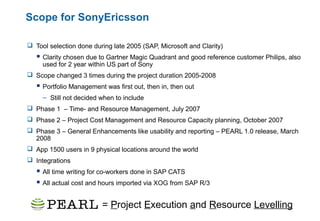
Scope for SonyEricsson Tool selection done during late 2005 (SAP, Microsoft and Clarity) ‏ Clarity chosen due to Gartner Magic Quadrant and good reference customer Philips, also used for 2 year within US part of Sony Scope changed 3 times during the project duration 2005-2008 Portfolio Management was first out, then in, then out Still not decided when to include Phase 1  – Time- and Resource Management, July 2007 Phase 2 – Project Cost Management and Resource Capacity planning, October 2007 Phase 3 – General Enhancements like usability and reporting – PEARL 1.0 release, March 2008 App 1500 users in 9 physical locations around the world Integrations All time writing for co-workers done in SAP CATS All actual cost and hours imported via XOG from SAP R/3 =  P roject  E xecution  a nd  R esource  Levelling
Planned scope for furnishing deal Tool selection done during late 2007 (MS Project Server, Planisware and Clarity) ‏ CA / CQC Solutions selected implementor during late 2007 Proof of concept run during Q1-08 Scope stated May-08 Phase 1  –Time reporting, Project Management, Resource Management, Service and Product management, Q1-09 Phase 2 – Demand and Portfolio planning, light weight Financials, Q2-09 Phase 3 – Financial planning and systems integrations, Q4-09 App 2000 users in 7 physical locations around the world All time writing will be done in Clarity
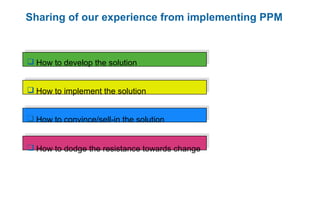
Sharing of our experience from implementing PPM How to develop the solution How to implement the solution How to convince/sell-in the solution How to dodge the resistance towards change
How to develop the solution Define and align processes first are key – develop tool secondly What will be measured in the future (KPI’s etc) ‏ Adopt an Agile working method with clear time boxes and one team sitting close together Focus on input, rather then output Reports are important but nothing compared to have input data in the system Start small and grow the scope Simplicity (out of the box approach)  Customize as little as possible due to the upgrading will hence have a large rate of failure Functional Clarity knowledge are key Translation of process into the ”claritanian” language, to see what is possible and durable How to develop the solution
H2 develop the solution (cont) ‏ Shorten the decision track Add an Operative Steering Committee with insight in the daily way you work and understanding of the impact of a decision The Executive Steering Group does not have the interest nor understanding of these questions How to develop the solution
Working the scope Define core  functionalities  and KPI's Build 1st Prototype Verify Prototype Any  Changes? Build Prototype Build Prototype Describe high-level core processes Describe sub- processes Re-define sub- processes Re-define sub- processes Re-define sub- processes Build Xnd Prototype Version 1  of solution, processes and  KPI's Process owner Solution Creation User/  Project group Yes Yes No How to develop the solution
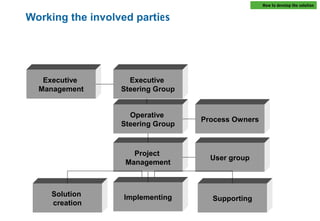
Working the involved part ies Executive  Steering Group Process Owners Operative  Steering Group Supporting Solution  creation User group Project  Management Implementing Executive  Management How to develop the solution
Decision Process Flow How to develop the solution
Expanding the scope – The onion model Core functionaltity – i.e Time Management Phase 2 – Project Management Phase 3 – Financial Management Phase 4 – Portfolio Management How to develop the solution Portfolio Management Financial Management Project Management Time Management
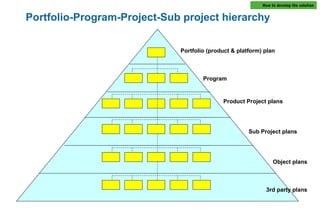
Portfolio-Program-Project-Sub project hierarchy How to develop the solution Portfolio (product & platform) plan Program Product Project plans Sub Project plans Object plans 3rd party plans
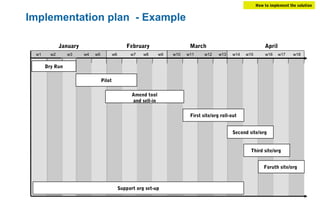
How to implement the solution First Dry run – Then pilot – Then implement full scale Need a finished product before being able to start the planning Seeing is believing Use the staggered approach – Big bangs are impossible Begin with the most beneficial or with the most reluctant part of the organisation  Depending on if you want an early buy-in or a chance to sharpen the arguments Start early in defining how to support the solution First, second and third level support are necessary but where is it best to be placed? Do you have a mature IT function for having the Application Management support in-house or do we outsource? Second line support best suited to have in-house How to implement the solution
Implementation plan  - Example January w1 w2 w5 w4 w6 w7 w9 w8 w10 w11 w12 w3 w15 w16 w14 w13 w18 w17 February March April Dry Run Pilot Amend tool and sell-in First site/org roll-out Second site/org  Third site/org  Foruth site/org  Support org set-up How to implement the solution
H2 implement the solution (cont.) ‏ Education of end users is best done by e-learning Class-room trainings are used for Subject Matter Experts and support personal E-learning packages are a very cheap and effective way of education Global deployment needs local deployment PM Each physical site needs one appointed person with the full responsibility to implement Someone with a local knowledge and understanding of gaps needed to be bridged How to implement the solution
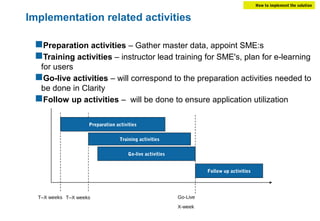
Implementation related activities Preparation activities  – Gather master data, appoint SME:s Training activities  – instructor lead training for SME's, plan for e-learning for users Go-live activities  – will correspond to the preparation activities needed to be done in Clarity  Follow up activities  –  will be done to ensure application utilization How to implement the solution Preparation activities Training activities Go-live activities Follow up activities T–X weeks T–X weeks Go-Live X-week
How to convince/sell-in the solutio n Change management is a cumbersome and tedious work but 80% of the effort in the project depends on its success Management attention and ownership is key to success Some decisions WILL make parts of the organization suffer Management need to stand on the podium, point ONE and only ONE direction Process owners must be appointed early in the project Project maturity within the organisation is key CMMI level 2 is preferred when implementing a PPM system but very seldom the case… Global, legal issues and cultural differences are cumbersome to reach a consensus around, especially in globally scattered organizations Involve all stakeholders heavily Identify and define the “what is in it for me” view early in the process Implementing a global process and a new tool is like pulling a piano upstairs without a lift The higher you come, the heavier it gets How to convince/sell-in the solution
How to dodge the resistance towards change… Executive Management will loose the informational advantage of the few Unless a restrictive user access model is adopted, all information will be available for the masses in real time Project Management will be feeling heavily exposed All they do and act upon will be visible to all in the organisation Line/Resource management will be more of a provider of resources than an influencer of the projects outcome Reducing their power to change Co-workers/time writers What’s in it for me? How to dodge the resistance towards change
… by using the “What’s in it for me?” Executive manager view Information at your fingertip in real time Early warning system allowing for quick corrective actions and abortion of programs/projects, hence saving money Project manager view Time schedules, resource planning and cost planning in one place Follow-up of actual hours and costs  Quick corrections and actions Line/Resource manager view One resource planning tool Follow-up of actual hours and project costs  Quick corrections and actions, closing and follow up. Possibility for global view of resources and projects  How to dodge the resistance towards change
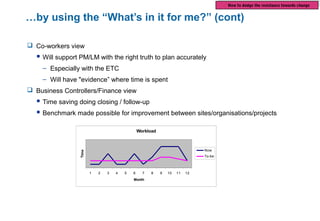
… by using the “What’s in it for me?” (cont) Co-workers view Will support PM/LM with the right truth to plan accurately Especially with the ETC Will have "evidence” where time is spent Business Controllers/Finance view Time saving doing closing / follow-up Benchmark made possible for improvement between sites/organisations/projects How to dodge the resistance towards change
The PPM Preacher man’s verdict  Unfortunately an unappreciated project to run, at least within the affected organisation The more the organisation realize the changes required, the more questioned it will be Management will be enthusiastic to start with but will start questioning why someone approved the change Must be obeyed by the Hofstadter's' law : things takes longer time than planned even if taken this law into consideration Heavy fighting the resistance towards changing the current way of working is the biggest threat to the project success
The PPM Preacher man’s verdict (cont.) The Portfolio view is the primary sell-in argument in order to convince management of the necessity of having the PPM tool/solution in place The portfolio view is the tip of the iceberg, the icing on the cake, once you have the others parts in place Steering group are not interested in the process discussions and business rule decisions needed to develop the solution Involve a reference group/take a hostage, empowered to really take the “ugly” decisions necessary PPM is not about implementing a tool, it is about changing the way you work and reaching a higher project maturity This must also be taught to Executive Management Change will be painful in the organisation and it doesn’t just involve ”the other guys”  -  It affects us all!

Sony Ericsson Case Study

  • 1.
    Customer Case studyImplementing Clarity – the need of an evangelistic approach or The PPM Preacher man’s verdict This presentation has 21 slides, 30 seconds per slide
  • 2.
    Scope for SonyEricssonTool selection done during late 2005 (SAP, Microsoft and Clarity) ‏ Clarity chosen due to Gartner Magic Quadrant and good reference customer Philips, also used for 2 year within US part of Sony Scope changed 3 times during the project duration 2005-2008 Portfolio Management was first out, then in, then out Still not decided when to include Phase 1 – Time- and Resource Management, July 2007 Phase 2 – Project Cost Management and Resource Capacity planning, October 2007 Phase 3 – General Enhancements like usability and reporting – PEARL 1.0 release, March 2008 App 1500 users in 9 physical locations around the world Integrations All time writing for co-workers done in SAP CATS All actual cost and hours imported via XOG from SAP R/3 = P roject E xecution a nd R esource Levelling
  • 3.
    Planned scope forfurnishing deal Tool selection done during late 2007 (MS Project Server, Planisware and Clarity) ‏ CA / CQC Solutions selected implementor during late 2007 Proof of concept run during Q1-08 Scope stated May-08 Phase 1 –Time reporting, Project Management, Resource Management, Service and Product management, Q1-09 Phase 2 – Demand and Portfolio planning, light weight Financials, Q2-09 Phase 3 – Financial planning and systems integrations, Q4-09 App 2000 users in 7 physical locations around the world All time writing will be done in Clarity
  • 4.
    Sharing of ourexperience from implementing PPM How to develop the solution How to implement the solution How to convince/sell-in the solution How to dodge the resistance towards change
  • 5.
    How to developthe solution Define and align processes first are key – develop tool secondly What will be measured in the future (KPI’s etc) ‏ Adopt an Agile working method with clear time boxes and one team sitting close together Focus on input, rather then output Reports are important but nothing compared to have input data in the system Start small and grow the scope Simplicity (out of the box approach) Customize as little as possible due to the upgrading will hence have a large rate of failure Functional Clarity knowledge are key Translation of process into the ”claritanian” language, to see what is possible and durable How to develop the solution
  • 6.
    H2 develop thesolution (cont) ‏ Shorten the decision track Add an Operative Steering Committee with insight in the daily way you work and understanding of the impact of a decision The Executive Steering Group does not have the interest nor understanding of these questions How to develop the solution
  • 7.
    Working the scopeDefine core functionalities and KPI's Build 1st Prototype Verify Prototype Any Changes? Build Prototype Build Prototype Describe high-level core processes Describe sub- processes Re-define sub- processes Re-define sub- processes Re-define sub- processes Build Xnd Prototype Version 1 of solution, processes and KPI's Process owner Solution Creation User/ Project group Yes Yes No How to develop the solution
  • 8.
    Working the involvedpart ies Executive Steering Group Process Owners Operative Steering Group Supporting Solution creation User group Project Management Implementing Executive Management How to develop the solution
  • 9.
    Decision Process FlowHow to develop the solution
  • 10.
    Expanding the scope– The onion model Core functionaltity – i.e Time Management Phase 2 – Project Management Phase 3 – Financial Management Phase 4 – Portfolio Management How to develop the solution Portfolio Management Financial Management Project Management Time Management
  • 11.
    Portfolio-Program-Project-Sub project hierarchyHow to develop the solution Portfolio (product & platform) plan Program Product Project plans Sub Project plans Object plans 3rd party plans
  • 12.
    How to implementthe solution First Dry run – Then pilot – Then implement full scale Need a finished product before being able to start the planning Seeing is believing Use the staggered approach – Big bangs are impossible Begin with the most beneficial or with the most reluctant part of the organisation Depending on if you want an early buy-in or a chance to sharpen the arguments Start early in defining how to support the solution First, second and third level support are necessary but where is it best to be placed? Do you have a mature IT function for having the Application Management support in-house or do we outsource? Second line support best suited to have in-house How to implement the solution
  • 13.
    Implementation plan - Example January w1 w2 w5 w4 w6 w7 w9 w8 w10 w11 w12 w3 w15 w16 w14 w13 w18 w17 February March April Dry Run Pilot Amend tool and sell-in First site/org roll-out Second site/org Third site/org Foruth site/org Support org set-up How to implement the solution
  • 14.
    H2 implement thesolution (cont.) ‏ Education of end users is best done by e-learning Class-room trainings are used for Subject Matter Experts and support personal E-learning packages are a very cheap and effective way of education Global deployment needs local deployment PM Each physical site needs one appointed person with the full responsibility to implement Someone with a local knowledge and understanding of gaps needed to be bridged How to implement the solution
  • 15.
    Implementation related activitiesPreparation activities – Gather master data, appoint SME:s Training activities – instructor lead training for SME's, plan for e-learning for users Go-live activities – will correspond to the preparation activities needed to be done in Clarity Follow up activities – will be done to ensure application utilization How to implement the solution Preparation activities Training activities Go-live activities Follow up activities T–X weeks T–X weeks Go-Live X-week
  • 16.
    How to convince/sell-inthe solutio n Change management is a cumbersome and tedious work but 80% of the effort in the project depends on its success Management attention and ownership is key to success Some decisions WILL make parts of the organization suffer Management need to stand on the podium, point ONE and only ONE direction Process owners must be appointed early in the project Project maturity within the organisation is key CMMI level 2 is preferred when implementing a PPM system but very seldom the case… Global, legal issues and cultural differences are cumbersome to reach a consensus around, especially in globally scattered organizations Involve all stakeholders heavily Identify and define the “what is in it for me” view early in the process Implementing a global process and a new tool is like pulling a piano upstairs without a lift The higher you come, the heavier it gets How to convince/sell-in the solution
  • 17.
    How to dodgethe resistance towards change… Executive Management will loose the informational advantage of the few Unless a restrictive user access model is adopted, all information will be available for the masses in real time Project Management will be feeling heavily exposed All they do and act upon will be visible to all in the organisation Line/Resource management will be more of a provider of resources than an influencer of the projects outcome Reducing their power to change Co-workers/time writers What’s in it for me? How to dodge the resistance towards change
  • 18.
    … by usingthe “What’s in it for me?” Executive manager view Information at your fingertip in real time Early warning system allowing for quick corrective actions and abortion of programs/projects, hence saving money Project manager view Time schedules, resource planning and cost planning in one place Follow-up of actual hours and costs Quick corrections and actions Line/Resource manager view One resource planning tool Follow-up of actual hours and project costs Quick corrections and actions, closing and follow up. Possibility for global view of resources and projects How to dodge the resistance towards change
  • 19.
    … by usingthe “What’s in it for me?” (cont) Co-workers view Will support PM/LM with the right truth to plan accurately Especially with the ETC Will have "evidence” where time is spent Business Controllers/Finance view Time saving doing closing / follow-up Benchmark made possible for improvement between sites/organisations/projects How to dodge the resistance towards change
  • 20.
    The PPM Preacherman’s verdict Unfortunately an unappreciated project to run, at least within the affected organisation The more the organisation realize the changes required, the more questioned it will be Management will be enthusiastic to start with but will start questioning why someone approved the change Must be obeyed by the Hofstadter's' law : things takes longer time than planned even if taken this law into consideration Heavy fighting the resistance towards changing the current way of working is the biggest threat to the project success
  • 21.
    The PPM Preacherman’s verdict (cont.) The Portfolio view is the primary sell-in argument in order to convince management of the necessity of having the PPM tool/solution in place The portfolio view is the tip of the iceberg, the icing on the cake, once you have the others parts in place Steering group are not interested in the process discussions and business rule decisions needed to develop the solution Involve a reference group/take a hostage, empowered to really take the “ugly” decisions necessary PPM is not about implementing a tool, it is about changing the way you work and reaching a higher project maturity This must also be taught to Executive Management Change will be painful in the organisation and it doesn’t just involve ”the other guys” - It affects us all!

Editor's Notes

  • #2 First speaker after Lunch – hour of tranquility Challange to guide you 2,5 year in 30 min Practical focus Questions – gladly but hopefully at the end
  • #3 Develop phones Global company 2 Years from idea to ready product Several hundred resources in project in several physical sites - Global organisation Phase 1 Time Mgmt = WBS Phase Cost = Project budget, forecasting and follow-up/actual costing
  • #4 Blue and yellow warehoues around the world Early in planning roll-out
  • #5 Watch for the color-coding in the right hand corner
  • #6 SCRUM working method proven working good for a configurable tool
  • #8 Process owner? – IT management for smaller organisations Core functionalities = Translation in Clarity terms Sub-processes = block of functions in clarity, connected to roles in real life
  • #9 Each level have their own supportive organisation/reference org. Depending on the size of the org.
  • #10 PDG = Operative Steering Group Important is the turn-around time for a decision and to have a way of escalating decisions.
  • #11 Scope change allways something to consider Most important is to scope in a way to give most ROI for the org.