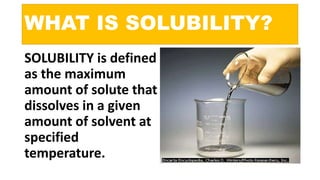
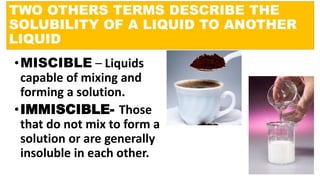
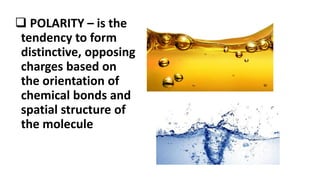
Solubility is defined as the maximum amount of solute that can dissolve in a given amount of solvent at a specified temperature. There are two components of solubility - soluble substances that dissolve in solvents and insoluble substances that do not dissolve. Liquids can be miscible, meaning they mix to form a solution, or immiscible, meaning they do not mix. Solubility depends on overcoming attractions between particles so that solute particles can disperse uniformly among solvent particles. Solubility generally decreases with increasing temperature for solutions of gases in liquids.