2 2/25/2020 Add a footer
Classifications
Main
Organic Inorganic
Municipal SolidWaste
(MSW)
Solid wastes:
Solid wastes are any discarded or abandoned materials. Solid wastes can be
solid, liquid, semi-solid or containerized gaseous material.
3 2/25/2020 Add a footer
Main
Organic Inorganic
Waste which decays
with time and grows
offensive odour and
gases which is
dangerous to health
is counted in organic
solid waste.
Eg: Food, Fruits,
Dead Organisms etc
Waste which is
congressional and
can't be observed
by soil is counted in
inorganic waste.
Eg: Broken Glass,
Metal, plastic etc.
4 2/25/2020 Add a footer
Municipal Solid
Waste
Bio Medical
Hazardous waste Industrial
Recyclables E-waste
5 2/25/2020 Add a footer
Hazardous waste
Hazardous waste consists of waste materials resulting from
items such as personal care products, detergents, batteries,
chemicals, pesticides, pharmaceuticals, oil household
maintenance items, blades, thermometers, electrical and
electronic equipment and so forth
Industrial waste
Industrial wastes contains material generated as a Bi-products
while various manufacturing process such as production of coke
during steel manufacturing, Formation of Cadmium during
making of iron, Production ofToluene etc.
6 2/25/2020 Add a footer
Bio Medical Waste
Recyclables
Bio Medical Wastes contains all type of wastes produced in
Hospitals and other health centres.
Eg: Chemical wastes, Sharp products, Discarded Medicines
Recyclables are collection of wastes which can be sold to recycle
companies directly or indirectly.
Eg: Steel/tin Cans,Waste/used papers, Empty boxes etc
7 2/25/2020 Add a footer
E-waste
E-waste contains used and outdated electronic equipments
which is no longer in use of user due to upgradation of
technology day by day.
Eg: Old PCs, Calculators,TVs, Printers, Lamps, Clocks
8 2/25/2020 Add a footer
Storage of MSW starts from trash bins placed at various
places from which waste is further transported to another
place. Collection of MSW is done by Corporations and
municipalities. Simple system which India follow in collecting
MSW is collecting MSW from trash bins by using trucks as
transportation.
In metro cities of India like this system almost works good
but in some under development cities this system isn't as
efficient as it should be because of lack of transportation and
manpower and also because of lack of awareness of people
in that particular area.
Disposals and treatments
Storage and
Collection
Solid waste management
9 2/25/2020 Add a footer
 Per capita generation, disposal and collection efficiency of MSW
for Indian state
10 2/25/2020 Add a footer
Disposals and
treatments
Aerobic composting
Incineration
Thermal treatment
techniques of MSWVermicomposting
Anaerobic digestion
Gasification
technology
RDF(Refuse Derived Fuel)
11 2/25/2020 Add a footer
Aerobic composting
In Aerobic composition the organic substances present in MSW are
converted into carbon based products by bacteria, this process is
also known as bacterial conversation.
The Carbon based products obtained are called composts.
Composts can be used as fertilizers.This process reduces the size of
MSW by 50-85%
12 2/25/2020 Add a footer
Vermicomposting
This process of disposal is very similar to aerobic composting.
But in this process earthworms are also included in the process
to boost up the reaction.
Why earthworms?
Because it can consume 5 times of organic matter compared
their body weight and compost it.
Currently Mumbai, Bangalore, Hyderabad and Faridabad
have vermicomposting plants.
13 2/25/2020 Add a footer
Anaerobic
digestion
Anaerobic digestion is method in which organic waste is buried into
pits under partially anaerobic condition. After it acts with
microorganisms under soil it releases methane and carbon dioxide.
The organic residue left is good for land it acts at fertilizers.This
process is much slower compared to other composting processes
Released Gases like methane can be used as direct fuel for power
generation thus it leads to energy recoveryThis method of disposal
is still in progress in India.
Fact:1 ton of organic MSW can produce 2-4 times methane
compared to it's original volume.
Incineration
Thermal treatment
techniques of MSW
Gasification technology
In this technique MSW is directly destroyed using heat energy.
Incineration is the process of complete
combustion of MSW it also leads to
energy recovery and destruction of toxic
wastes.This method is not eco friendly as
it produces Many toxic useless gases
which pollutes environment. Using this
method volume of MSW can be reduced
to 80-90%.Though this method isn't eco
friendly it can produce energy in very
high amount which is released during
combustion process.
This process is very similar to
incineration. But difference
comes in combustion process,
in gasification incineration
happens under presence of
oxygen. Main objective of
gasification technology is to
generate fuel gas which can be
stored and user later.This
process have efficiency of ~80%
15 2/25/2020 Add a footer
RDF(Refuse Derived Fuel)
RDF stands for refuse derived fuel. Main purpose of the
RDF method is to produce a good quality solid fuel from
MSW In RDF plant of Hyderabad 210 tons of MSW per day
produces the 6.6 MW of energy.This process is costlier and
not much efficient but for disposal purpose it is something
which is worth doing.
16 2/25/2020 Add a footer
32%
10%
7%
51%
Other (textile, glass, metal etc.)
Plastic
Paper
Biodegradable
COMPOSITION OF MSW IN INDIA
Source:Task Force onWaste to Energy, Planning Commission, 2014
17 2/25/2020 Add a footer
Effects of MSW on Environment
 Improper Management of MSW leads to Environmental
pollution.
 MSW leads to Long term pollution which is most dangerous
and hard to reduce/stop in environment.
 MSW produces following type of pollution,
Air Pollution Land Pollution Water Pollution
18 2/25/2020 Add a footer
Air Pollution
Disposal process of MSW contains many process like
incineration. During this processes burning of plastic, woods,
polymers etc. releases many green house gases along with
toxic gases and dangerous solid Bi-products. HarmfulGases
results into incensement in air pollution and it also hard to
reduce because of complexity of processes and lack of
technological advancement in most of cities.
19 2/25/2020 Add a footer
Land Pollution
 Mismanagement of storage of MSW results into land pollution.
It takes plastic more than 1000 years to decompose.
 In many cities of third world's nation we can observe major
MSW Storage issue due to which people starts to throw their
wastes in any corner of city or in a open ground which results
into dumping of debris after weeks because of unawareness of
people.
 This debris mostly contains plastic and Organic wastes. Organic
wastes produces very bad odour which pollutes the
atmosphere. And Plastic wastes results into degradation of
fertility of that particular land
20 2/25/2020
Water
Pollution
 The wastes which can't be recycled further after being
processed with various methods are dumped into ocean's.
 In India only 25-30% of collected MSW is disposed
properly.
 Plastic is highly dangerous for aquatic animals as it
destroys their ocean food chain.
 Aquatic creatures dies after consuming plastic
 Plastic debris blocks the way of many creatures like
penguins which travels different continents with change in
seasons which sometimes results into death of whole heard
21 2/25/2020 Add a footer
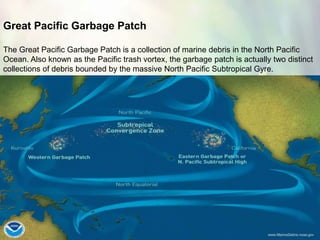
Great Pacific Garbage Patch
The Great Pacific Garbage Patch is a collection of marine debris in the North Pacific
Ocean. Also known as the Pacific trash vortex, the garbage patch is actually two distinct
collections of debris bounded by the massive North Pacific Subtropical Gyre.
22 2/25/2020 Add a footer
THANKYOU

Solid waste

  • 2.
    2 2/25/2020 Adda footer Classifications Main Organic Inorganic Municipal SolidWaste (MSW) Solid wastes: Solid wastes are any discarded or abandoned materials. Solid wastes can be solid, liquid, semi-solid or containerized gaseous material.
  • 3.
    3 2/25/2020 Adda footer Main Organic Inorganic Waste which decays with time and grows offensive odour and gases which is dangerous to health is counted in organic solid waste. Eg: Food, Fruits, Dead Organisms etc Waste which is congressional and can't be observed by soil is counted in inorganic waste. Eg: Broken Glass, Metal, plastic etc.
  • 4.
    4 2/25/2020 Adda footer Municipal Solid Waste Bio Medical Hazardous waste Industrial Recyclables E-waste
  • 5.
    5 2/25/2020 Adda footer Hazardous waste Hazardous waste consists of waste materials resulting from items such as personal care products, detergents, batteries, chemicals, pesticides, pharmaceuticals, oil household maintenance items, blades, thermometers, electrical and electronic equipment and so forth Industrial waste Industrial wastes contains material generated as a Bi-products while various manufacturing process such as production of coke during steel manufacturing, Formation of Cadmium during making of iron, Production ofToluene etc.
  • 6.
    6 2/25/2020 Adda footer Bio Medical Waste Recyclables Bio Medical Wastes contains all type of wastes produced in Hospitals and other health centres. Eg: Chemical wastes, Sharp products, Discarded Medicines Recyclables are collection of wastes which can be sold to recycle companies directly or indirectly. Eg: Steel/tin Cans,Waste/used papers, Empty boxes etc
  • 7.
    7 2/25/2020 Adda footer E-waste E-waste contains used and outdated electronic equipments which is no longer in use of user due to upgradation of technology day by day. Eg: Old PCs, Calculators,TVs, Printers, Lamps, Clocks
  • 8.
    8 2/25/2020 Adda footer Storage of MSW starts from trash bins placed at various places from which waste is further transported to another place. Collection of MSW is done by Corporations and municipalities. Simple system which India follow in collecting MSW is collecting MSW from trash bins by using trucks as transportation. In metro cities of India like this system almost works good but in some under development cities this system isn't as efficient as it should be because of lack of transportation and manpower and also because of lack of awareness of people in that particular area. Disposals and treatments Storage and Collection Solid waste management
  • 9.
    9 2/25/2020 Adda footer  Per capita generation, disposal and collection efficiency of MSW for Indian state
  • 10.
    10 2/25/2020 Adda footer Disposals and treatments Aerobic composting Incineration Thermal treatment techniques of MSWVermicomposting Anaerobic digestion Gasification technology RDF(Refuse Derived Fuel)
  • 11.
    11 2/25/2020 Adda footer Aerobic composting In Aerobic composition the organic substances present in MSW are converted into carbon based products by bacteria, this process is also known as bacterial conversation. The Carbon based products obtained are called composts. Composts can be used as fertilizers.This process reduces the size of MSW by 50-85%
  • 12.
    12 2/25/2020 Adda footer Vermicomposting This process of disposal is very similar to aerobic composting. But in this process earthworms are also included in the process to boost up the reaction. Why earthworms? Because it can consume 5 times of organic matter compared their body weight and compost it. Currently Mumbai, Bangalore, Hyderabad and Faridabad have vermicomposting plants.
  • 13.
    13 2/25/2020 Adda footer Anaerobic digestion Anaerobic digestion is method in which organic waste is buried into pits under partially anaerobic condition. After it acts with microorganisms under soil it releases methane and carbon dioxide. The organic residue left is good for land it acts at fertilizers.This process is much slower compared to other composting processes Released Gases like methane can be used as direct fuel for power generation thus it leads to energy recoveryThis method of disposal is still in progress in India. Fact:1 ton of organic MSW can produce 2-4 times methane compared to it's original volume.
  • 14.
    Incineration Thermal treatment techniques ofMSW Gasification technology In this technique MSW is directly destroyed using heat energy. Incineration is the process of complete combustion of MSW it also leads to energy recovery and destruction of toxic wastes.This method is not eco friendly as it produces Many toxic useless gases which pollutes environment. Using this method volume of MSW can be reduced to 80-90%.Though this method isn't eco friendly it can produce energy in very high amount which is released during combustion process. This process is very similar to incineration. But difference comes in combustion process, in gasification incineration happens under presence of oxygen. Main objective of gasification technology is to generate fuel gas which can be stored and user later.This process have efficiency of ~80%
  • 15.
    15 2/25/2020 Adda footer RDF(Refuse Derived Fuel) RDF stands for refuse derived fuel. Main purpose of the RDF method is to produce a good quality solid fuel from MSW In RDF plant of Hyderabad 210 tons of MSW per day produces the 6.6 MW of energy.This process is costlier and not much efficient but for disposal purpose it is something which is worth doing.
  • 16.
    16 2/25/2020 Adda footer 32% 10% 7% 51% Other (textile, glass, metal etc.) Plastic Paper Biodegradable COMPOSITION OF MSW IN INDIA Source:Task Force onWaste to Energy, Planning Commission, 2014
  • 17.
    17 2/25/2020 Adda footer Effects of MSW on Environment  Improper Management of MSW leads to Environmental pollution.  MSW leads to Long term pollution which is most dangerous and hard to reduce/stop in environment.  MSW produces following type of pollution, Air Pollution Land Pollution Water Pollution
  • 18.
    18 2/25/2020 Adda footer Air Pollution Disposal process of MSW contains many process like incineration. During this processes burning of plastic, woods, polymers etc. releases many green house gases along with toxic gases and dangerous solid Bi-products. HarmfulGases results into incensement in air pollution and it also hard to reduce because of complexity of processes and lack of technological advancement in most of cities.
  • 19.
    19 2/25/2020 Adda footer Land Pollution  Mismanagement of storage of MSW results into land pollution. It takes plastic more than 1000 years to decompose.  In many cities of third world's nation we can observe major MSW Storage issue due to which people starts to throw their wastes in any corner of city or in a open ground which results into dumping of debris after weeks because of unawareness of people.  This debris mostly contains plastic and Organic wastes. Organic wastes produces very bad odour which pollutes the atmosphere. And Plastic wastes results into degradation of fertility of that particular land
  • 20.
    20 2/25/2020 Water Pollution  Thewastes which can't be recycled further after being processed with various methods are dumped into ocean's.  In India only 25-30% of collected MSW is disposed properly.  Plastic is highly dangerous for aquatic animals as it destroys their ocean food chain.  Aquatic creatures dies after consuming plastic  Plastic debris blocks the way of many creatures like penguins which travels different continents with change in seasons which sometimes results into death of whole heard
  • 21.
    21 2/25/2020 Adda footer Great Pacific Garbage Patch The Great Pacific Garbage Patch is a collection of marine debris in the North Pacific Ocean. Also known as the Pacific trash vortex, the garbage patch is actually two distinct collections of debris bounded by the massive North Pacific Subtropical Gyre.
  • 22.
    22 2/25/2020 Adda footer THANKYOU