SOLID Software Development
Ken Burkhardt
What is SOLID?
Single Responsibility Principle
Open Closed Principle
Liskov Substitution Principle
Interface Segregation Principle
Dependency Inversion Principle
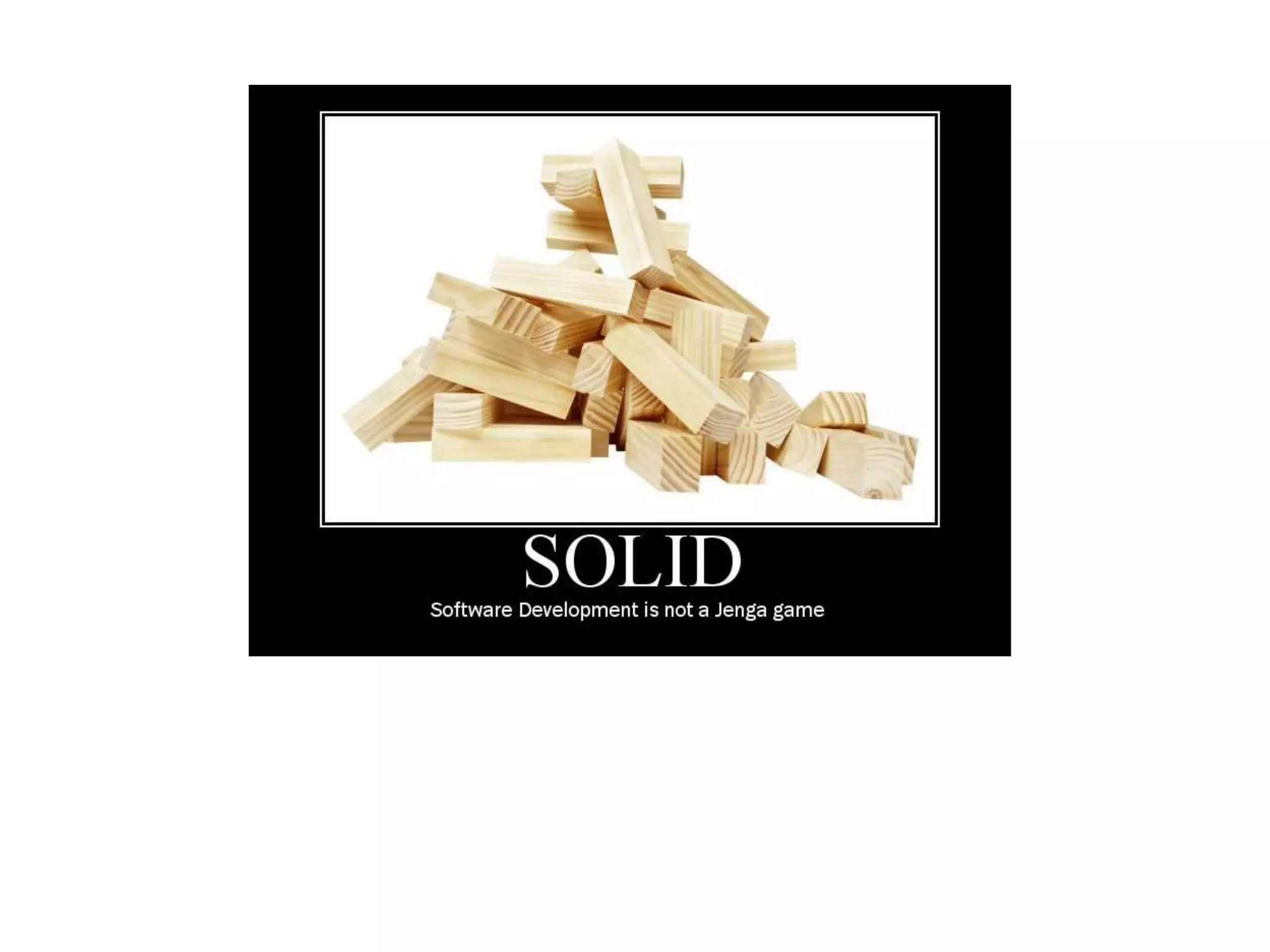
Why SOLID?
S.O.L.I.D. is a collection of best-
practice, object-oriented design
principles which can be applied to
your design, allowing you to
accomplish various desirable goals
such as loose-coupling, higher
maintainability
Single Responsibility Principle
THERE SHOULD NEVER BE MORE
THAN ONE REASON FOR A CLASS TO
CHANGE.
Demo - Superclass
Open Closed Principle
SOFTWARE ENTITIES SHOULD BE
OPEN FOR EXTENSION BUT CLOSED
FOR MODIFICATION
Demo – Add New Validator
Liskov Substitution Principle
You should be able to use any derived
class in place of a parent class and have
it behave in the same manner without
modification. It ensures that a derived
class does not affect the behavior of the
parent class, i.e. that a derived class
must be substitutable for its base class.
Interface Segregation Principle
CLIENTS SHOULD NOT BE FORCED TO
DEPEND UPON INTERFACES THAT
THEY DO NOT USE
Demo - Animals
Dependency Inversion Principle
A. HIGH LEVEL MODULES SHOULD NOT
DEPEND UPON LOW LEVEL MODULES.
BOTH SHOULD DEPEND UPON
ABSTRACTIONS
B. ABSTRACTIONS SHOULD NOT DEPEND
UPON DETAILS. DETAILS SHOULD DEPEND
UPON ABSTRACTIONS
Bad designs and poor code is not good
because it's hard to change. Bad designs are:
- Rigid (change affects too many parts of
the system)
- Fragile (every change breaks something
unexpected)
- Immobile (impossible to reuse)
Demo - Interfaces

SOLID Software Principles with C#