SOLID
HADI EHTERAMI
AUGUST 2020
The reason behind most unsuccessful
applications
 Putting more stress on classes by assigning more responsibilities to them. (A lot of
functionality not related to a class.)
 Forcing the classes to depend on each other. If classes are dependent on each
other (in other words tightly coupled), then a change in one will affect the other.
 Spreading duplicate code in the system/application.
Solution
 Choosing the correct architecture (in other words MVC, micro service ,3-tier,
Layered, MVP, MVVP and so on).
 Following Design Principles.
 Choosing correct Design Patterns to build the software based on its
specifications.
What is SOLID?
History
 The term SOLID is an acronym for five design principles intended to make
software designs more understandable, flexible and maintainable.
 The principles are a subset of many principles promoted by Robert C. Martin
 The SOLID acronym was first introduced by Michael Feathers.
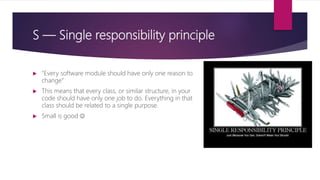
S — Single responsibility principle
 "Every software module should have only one reason to
change“
 This means that every class, or similar structure, in your
code should have only one job to do. Everything in that
class should be related to a single purpose.
 Small is good 
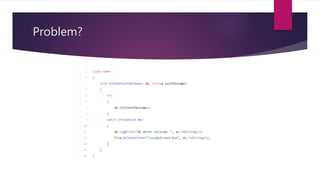
Problem?
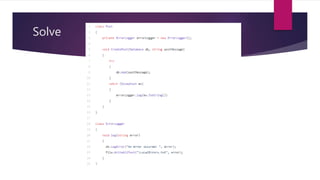
Solve
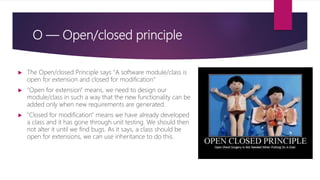
O — Open/closed principle
 The Open/closed Principle says "A software module/class is
open for extension and closed for modification“
 "Open for extension" means, we need to design our
module/class in such a way that the new functionality can be
added only when new requirements are generated.
 "Closed for modification" means we have already developed
a class and it has gone through unit testing. We should then
not alter it until we find bugs. As it says, a class should be
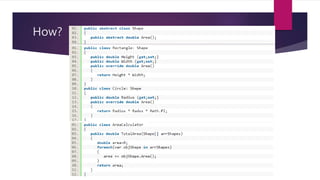
open for extensions, we can use inheritance to do this.
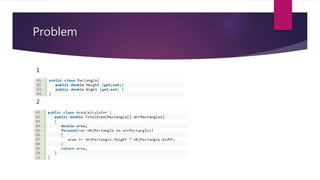
Problem
1
2
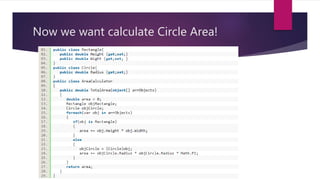
Now we want calculate Circle Area!
How?
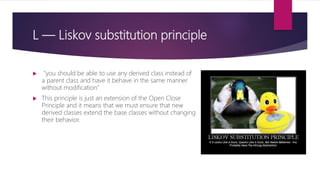
L — Liskov substitution principle
 "you should be able to use any derived class instead of
a parent class and have it behave in the same manner
without modification“
 This principle is just an extension of the Open Close
Principle and it means that we must ensure that new
derived classes extend the base classes without changing
their behavior.
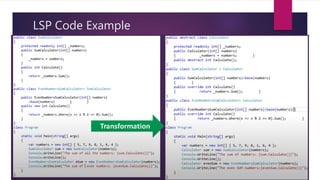
LSP Code Example
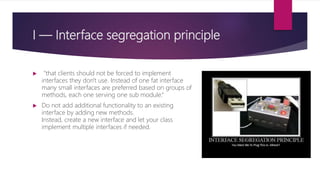
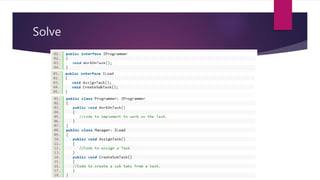
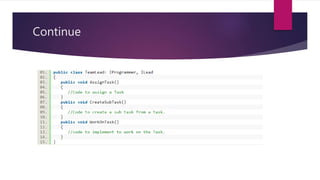
I — Interface segregation principle
 "that clients should not be forced to implement
interfaces they don't use. Instead of one fat interface
many small interfaces are preferred based on groups of
methods, each one serving one sub module.“
 Do not add additional functionality to an existing
interface by adding new methods.
Instead, create a new interface and let your class
implement multiple interfaces if needed.
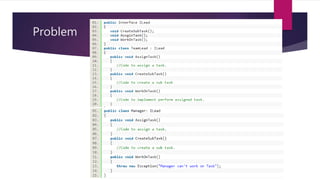
Problem
Solve
Continue
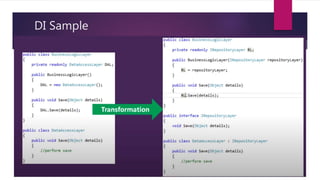
D: Dependency Inversion Principle
 The Dependency Inversion Principle (DIP) states that high-level
modules/classes should not depend on low-level modules/classes.
Both should depend upon abstractions
 Secondly, abstractions should not depend upon details. Details
should depend upon abstractions.
 is a way to decouple software modules.
 dependency inversion pattern, most often solved by using
dependency injection.
 Adapter Design Pattern use DIP
DI Sample
If don’t use SOLID Principles
 End up with strong coupling of the code with other modules
 End up with a code which is not testable
 End up with duplication of code
 Fix a bug with create another bug 
Following SOLID Principles …
 Achieve reduction in complicity of code
 Increase readability, extensibility and maintenance
 Reduce error and implement Reusability
 Achieve better testability
 Reduce tight coupling
Conclusion
 These are 5 essential principles used by professional software engineers all around the
globe, and if you are serious about creating ‘solid’ software, you should start applying
these principles today!

Solid

  • 1.
  • 2.
    The reason behindmost unsuccessful applications  Putting more stress on classes by assigning more responsibilities to them. (A lot of functionality not related to a class.)  Forcing the classes to depend on each other. If classes are dependent on each other (in other words tightly coupled), then a change in one will affect the other.  Spreading duplicate code in the system/application.
  • 3.
    Solution  Choosing thecorrect architecture (in other words MVC, micro service ,3-tier, Layered, MVP, MVVP and so on).  Following Design Principles.  Choosing correct Design Patterns to build the software based on its specifications.
  • 4.
  • 5.
    History  The termSOLID is an acronym for five design principles intended to make software designs more understandable, flexible and maintainable.  The principles are a subset of many principles promoted by Robert C. Martin  The SOLID acronym was first introduced by Michael Feathers.
  • 6.
    S — Singleresponsibility principle  "Every software module should have only one reason to change“  This means that every class, or similar structure, in your code should have only one job to do. Everything in that class should be related to a single purpose.  Small is good 
  • 7.
  • 8.
  • 9.
    O — Open/closedprinciple  The Open/closed Principle says "A software module/class is open for extension and closed for modification“  "Open for extension" means, we need to design our module/class in such a way that the new functionality can be added only when new requirements are generated.  "Closed for modification" means we have already developed a class and it has gone through unit testing. We should then not alter it until we find bugs. As it says, a class should be open for extensions, we can use inheritance to do this.
  • 10.
  • 11.
    Now we wantcalculate Circle Area!
  • 12.
  • 13.
    L — Liskovsubstitution principle  "you should be able to use any derived class instead of a parent class and have it behave in the same manner without modification“  This principle is just an extension of the Open Close Principle and it means that we must ensure that new derived classes extend the base classes without changing their behavior.
  • 14.
  • 15.
    I — Interfacesegregation principle  "that clients should not be forced to implement interfaces they don't use. Instead of one fat interface many small interfaces are preferred based on groups of methods, each one serving one sub module.“  Do not add additional functionality to an existing interface by adding new methods. Instead, create a new interface and let your class implement multiple interfaces if needed.
  • 16.
  • 17.
  • 18.
  • 19.
    D: Dependency InversionPrinciple  The Dependency Inversion Principle (DIP) states that high-level modules/classes should not depend on low-level modules/classes. Both should depend upon abstractions  Secondly, abstractions should not depend upon details. Details should depend upon abstractions.  is a way to decouple software modules.  dependency inversion pattern, most often solved by using dependency injection.  Adapter Design Pattern use DIP
  • 20.
  • 21.
    If don’t useSOLID Principles  End up with strong coupling of the code with other modules  End up with a code which is not testable  End up with duplication of code  Fix a bug with create another bug 
  • 22.
    Following SOLID Principles…  Achieve reduction in complicity of code  Increase readability, extensibility and maintenance  Reduce error and implement Reusability  Achieve better testability  Reduce tight coupling
  • 23.
    Conclusion  These are5 essential principles used by professional software engineers all around the globe, and if you are serious about creating ‘solid’ software, you should start applying these principles today!