SOLID
The Open/Closed Principle
Dependency Inversion
Paul Blundell
@Blundell_apps
www.blundellapps.com
Five basic principles of object-orientated programming.
“The principles when applied together intend to make it more likely that a
programmer will create a system that is easy to maintain and extend
over time”
S ?
O ?
L ?
I ?
D ?
SOLID
Five basic principles of object-orientated programming.
“The principles when applied together intend to make it more likely that a
programmer will create a system that is easy to maintain and extend
over time”
Single Responsibility Principle
Open / Closed Principle
Liskov’s Substitution
Interface Segregation
Dependency Inversion
SOLID
Five basic principles of object-orientated programming.
“The principles when applied together intend to make it more likely that a
programmer will create a system that is easy to maintain and extend
over time”
Single Responsibility Principle
Open / Closed Principle
Liskov’s Substitution
Interface Segregation
Dependency Inversion
SOLID
Open / Closed Principle
?
SOLID
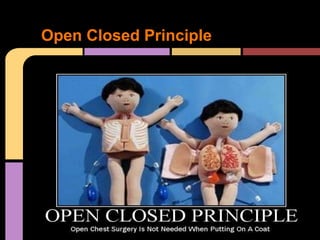
Open / Closed Principle
“Software entities (classes, modules,
methods etc) should be open for extension
but closed for modification”
That is such an entity can allow its behaviour
to be changed without altering its source
code.
SOLID
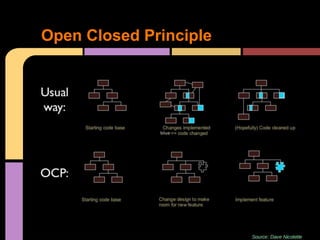
Open Closed Principle
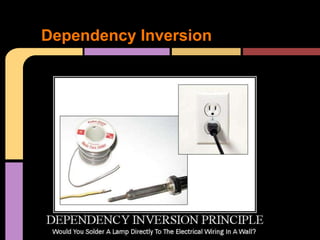
Dependency Inversion
The aim of the OCP kata is to use the Open
Closed Principle to design a maintainable
and extensible code base.
Think about:
- How to compose functionality out of existing
objects
- How to avoid reworking existing code
OCP Kata
Write the first failing test
Then write a factory that returns an object or
a composed object that makes the test
pass.
Rules:
- the factory should be limited to creating and
linking objects
- no conditionals allowed in the factory
OCP Kata
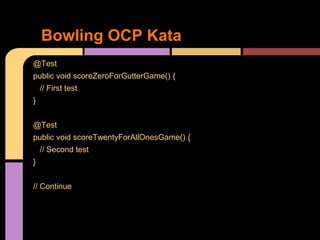
@Test
public void scoreZeroForGutterGame() {
// First test
}
@Test
public void scoreTwentyForAllOnesGame() {
// Second test
}
// Continue
Bowling OCP Kata
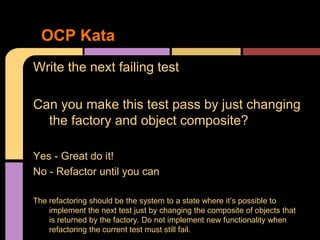
Write the next failing test
Can you make this test pass by just changing
the factory and object composite?
Yes - Great do it!
No - Refactor until you can
The refactoring should be the system to a state where it’s possible to
implement the next test just by changing the composite of objects that
is returned by the factory. Do not implement new functionality when
refactoring the current test must still fail.
OCP Kata
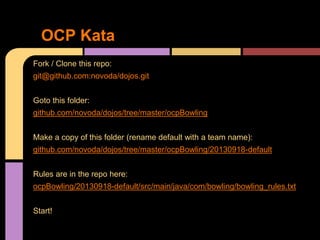
Fork / Clone this repo:
git@github.com:novoda/dojos.git
Goto this folder:
github.com/novoda/dojos/tree/master/ocpBowling
Make a copy of this folder (rename default with a team name):
github.com/novoda/dojos/tree/master/ocpBowling/20130918-default
Rules are in the repo here:
ocpBowling/20130918-default/src/main/java/com/bowling/bowling_rules.txt
Start!
OCP Kata
Matteo Vaccari
- invented the OCP Kata
- http://matteo.vaccari.name/blog/archives/293
David Nicolette
- created the OCP jigsaw diagram
Uncle Bob
- Creator of the original bowling Kata
- http://butunclebob.com/ArticleS.UncleBob.TheBowlingGameKata
Kevin Rutherford
- guided me in the art of Kata’s
- http://silkandspinach.net/
Jonas Gauffin
- for the meme
- http://blog.gauffin.org/2012/05/solid-principles-with-real-world-examples/#.UjWDy9K_s2k
Credits
Paul Blundell
@Blundell_apps
www.blundellapps.com

Open Closed Principle kata

  • 1.
    SOLID The Open/Closed Principle DependencyInversion Paul Blundell @Blundell_apps www.blundellapps.com
  • 2.
    Five basic principlesof object-orientated programming. “The principles when applied together intend to make it more likely that a programmer will create a system that is easy to maintain and extend over time” S ? O ? L ? I ? D ? SOLID
  • 3.
    Five basic principlesof object-orientated programming. “The principles when applied together intend to make it more likely that a programmer will create a system that is easy to maintain and extend over time” Single Responsibility Principle Open / Closed Principle Liskov’s Substitution Interface Segregation Dependency Inversion SOLID
  • 4.
    Five basic principlesof object-orientated programming. “The principles when applied together intend to make it more likely that a programmer will create a system that is easy to maintain and extend over time” Single Responsibility Principle Open / Closed Principle Liskov’s Substitution Interface Segregation Dependency Inversion SOLID
  • 5.
    Open / ClosedPrinciple ? SOLID
  • 6.
    Open / ClosedPrinciple “Software entities (classes, modules, methods etc) should be open for extension but closed for modification” That is such an entity can allow its behaviour to be changed without altering its source code. SOLID
  • 7.
  • 8.
  • 9.
  • 10.
    The aim ofthe OCP kata is to use the Open Closed Principle to design a maintainable and extensible code base. Think about: - How to compose functionality out of existing objects - How to avoid reworking existing code OCP Kata
  • 11.
    Write the firstfailing test Then write a factory that returns an object or a composed object that makes the test pass. Rules: - the factory should be limited to creating and linking objects - no conditionals allowed in the factory OCP Kata
  • 12.
    @Test public void scoreZeroForGutterGame(){ // First test } @Test public void scoreTwentyForAllOnesGame() { // Second test } // Continue Bowling OCP Kata
  • 13.
    Write the nextfailing test Can you make this test pass by just changing the factory and object composite? Yes - Great do it! No - Refactor until you can The refactoring should be the system to a state where it’s possible to implement the next test just by changing the composite of objects that is returned by the factory. Do not implement new functionality when refactoring the current test must still fail. OCP Kata
  • 14.
    Fork / Clonethis repo: git@github.com:novoda/dojos.git Goto this folder: github.com/novoda/dojos/tree/master/ocpBowling Make a copy of this folder (rename default with a team name): github.com/novoda/dojos/tree/master/ocpBowling/20130918-default Rules are in the repo here: ocpBowling/20130918-default/src/main/java/com/bowling/bowling_rules.txt Start! OCP Kata
  • 15.
    Matteo Vaccari - inventedthe OCP Kata - http://matteo.vaccari.name/blog/archives/293 David Nicolette - created the OCP jigsaw diagram Uncle Bob - Creator of the original bowling Kata - http://butunclebob.com/ArticleS.UncleBob.TheBowlingGameKata Kevin Rutherford - guided me in the art of Kata’s - http://silkandspinach.net/ Jonas Gauffin - for the meme - http://blog.gauffin.org/2012/05/solid-principles-with-real-world-examples/#.UjWDy9K_s2k Credits Paul Blundell @Blundell_apps www.blundellapps.com