SOLID Object Oriented Design
Craig Berntson
www.craigberntson.com
craig@craigberntson.com
Twitter: @craigber
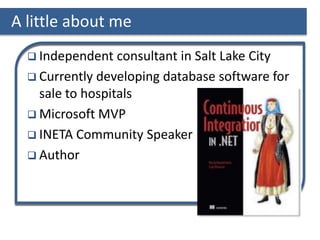
A little about me
 Independent consultant in Salt Lake City
 Currently developing database software for
sale to hospitals
 Microsoft MVP
 INETA Community Speaker
 Author
Today’s session
 Review basic OOP and smells
 SOLID principles
 Other agile/OOP principles
Basic OOP
 Polymorphism
 Encapsulation
 Inheritance
 Cohesion
 Coupling
Refactoring code smells
 Duplicate code
 Long method
 Large class
 Temporary field
 Switch statements
 Parallel inheritance hierarchies
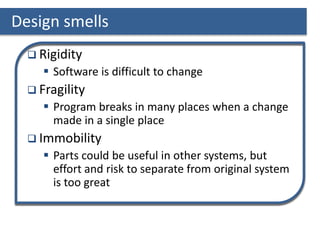
Design smells
 Rigidity
 Software is difficult to change
 Fragility
 Program breaks in many places when a change
made in a single place
 Immobility
 Parts could be useful in other systems, but
effort and risk to separate from original system
is too great
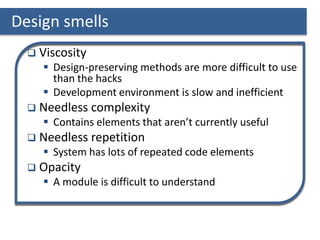
Design smells
 Viscosity
 Design-preserving methods are more difficult to use
than the hacks
 Development environment is slow and inefficient
 Needless complexity
 Contains elements that aren’t currently useful
 Needless repetition
 System has lots of repeated code elements
 Opacity
 A module is difficult to understand
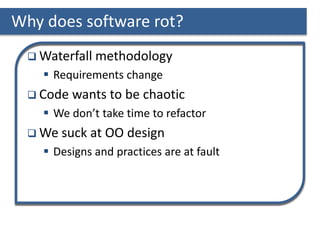
Why does software rot?
 Waterfall methodology
 Requirements change
 Code wants to be chaotic
 We don’t take time to refactor
 We suck at OO design
 Designs and practices are at fault
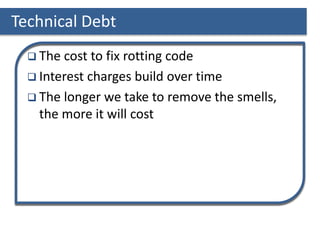
Technical Debt
 The cost to fix rotting code
 Interest charges build over time
 The longer we take to remove the smells,
the more it will cost
SOLID
 Single Responsibility Principle (SRP)
 Open-Closed Principle (OCP)
 Liskov Substitution Principle (LSP)
 Interface Segregation Principle (ISP)
 Dependency Inversion Principle (DIP)
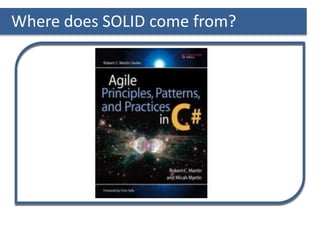
Where does SOLID come from?
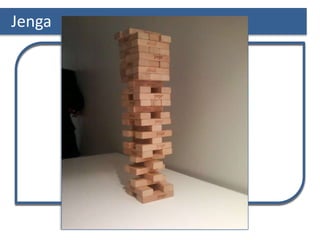
Jenga
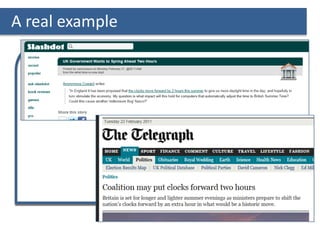
A real example
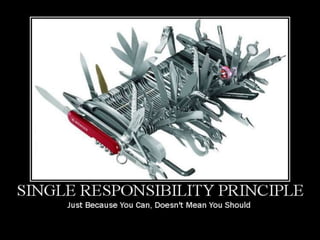
Single Responsibility Principle (SRP)
A class should have
only one reason to
change
Responsibility
 What a class does
 The more a class does, the more likely it will
change
 The more a class changes, the more likely
we will introduce bugs
Cohesion and Coupling
 Cohesion – How closely related are the
different responsibilities of a module
 Coupling – How much one module relies on
another
 Goal is low coupling and high cohesion
EXAMPLE CODE
Single Responsibility Principle
Demo
 Single Responsibility Principle
Open Closed principle (OCP)
Software entities (classes,
modules, functions, etc.)
should be open for
extension but closed for
modification
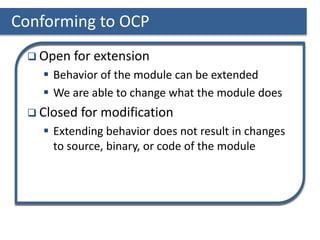
Conforming to OCP
 Open for extension
 Behavior of the module can be extended
 We are able to change what the module does
 Closed for modification
 Extending behavior does not result in changes
to source, binary, or code of the module
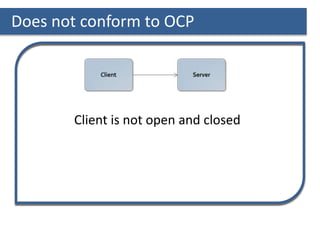
Does not conform to OCP
Client is not open and closed
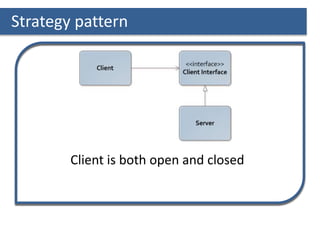
Strategy pattern
Client is both open and closed
Conforming to OCP
 Rely on abstractions
 Interfaces
 Abstract classes
EXAMPLE CODE
Open Closed Principle
Liskov Substitution Principle (LSP)
Subtypes must be
substitutable for
their base types
IS-A
 Basic OOP discusses inheritance with “IS-A”
 LSP says that “IS-A” refers to behavior
 Behavior is what software is really all about
Substitution
 Calling code should not know that one
module is different from its substitute
EXAMPLE CODE
Liskov Substitution Principle
Interface Segregation Principle (ISP)
Clients should not be
forced to depend on
methods they do not use
EXAMPLE CODE
Interface Segregation Principle
Dependency Inversion Principle (DIP)
High-level modules should not
depend on low-level modules. Both
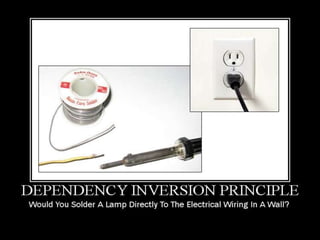
should depend on abstractions
Abstractions should not depend on
details. Details should depend upon
abstractions
EXAMPLE CODE
Dependency Inversion Principle
Other principles
 Keep It Simple Stupid (KISS)
 You Ain’t Gonna Need It (YAGNI)
 Don’t Repeat Yourself (DRY)
Today’s session
 Review basic OOP and smells
 Single Responsibility Principle (SRP)
 Open-Closed Principle (OCP)
 Liskov Substutution Principle (LSP)
 Interface Segregation Principle (ISP)
 Dependency Inversion Principle (DIP)
 Other agile/OOP principles
Questions?
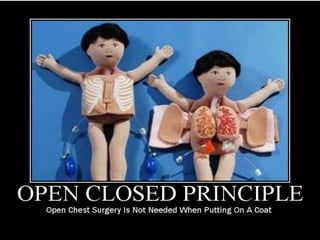
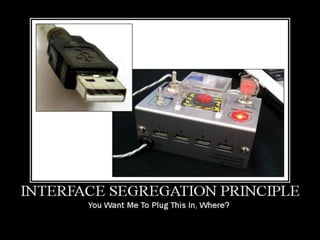
 Motivational posters courtesy of Derick
Bailey through the Creative Commons
License
 Contact me
 Email: craig@craigberntson.com
 Blog: www.craigberntson.com/blog
 Twitter: @craigber

Solid

  • 1.
    SOLID Object OrientedDesign Craig Berntson www.craigberntson.com craig@craigberntson.com Twitter: @craigber
  • 2.
    A little aboutme  Independent consultant in Salt Lake City  Currently developing database software for sale to hospitals  Microsoft MVP  INETA Community Speaker  Author
  • 3.
    Today’s session  Reviewbasic OOP and smells  SOLID principles  Other agile/OOP principles
  • 4.
    Basic OOP  Polymorphism Encapsulation  Inheritance  Cohesion  Coupling
  • 5.
    Refactoring code smells Duplicate code  Long method  Large class  Temporary field  Switch statements  Parallel inheritance hierarchies
  • 6.
    Design smells  Rigidity Software is difficult to change  Fragility  Program breaks in many places when a change made in a single place  Immobility  Parts could be useful in other systems, but effort and risk to separate from original system is too great
  • 7.
    Design smells  Viscosity Design-preserving methods are more difficult to use than the hacks  Development environment is slow and inefficient  Needless complexity  Contains elements that aren’t currently useful  Needless repetition  System has lots of repeated code elements  Opacity  A module is difficult to understand
  • 8.
    Why does softwarerot?  Waterfall methodology  Requirements change  Code wants to be chaotic  We don’t take time to refactor  We suck at OO design  Designs and practices are at fault
  • 9.
    Technical Debt  Thecost to fix rotting code  Interest charges build over time  The longer we take to remove the smells, the more it will cost
  • 10.
    SOLID  Single ResponsibilityPrinciple (SRP)  Open-Closed Principle (OCP)  Liskov Substitution Principle (LSP)  Interface Segregation Principle (ISP)  Dependency Inversion Principle (DIP)
  • 11.
    Where does SOLIDcome from?
  • 12.
  • 14.
  • 15.
    Single Responsibility Principle(SRP) A class should have only one reason to change
  • 17.
    Responsibility  What aclass does  The more a class does, the more likely it will change  The more a class changes, the more likely we will introduce bugs
  • 18.
    Cohesion and Coupling Cohesion – How closely related are the different responsibilities of a module  Coupling – How much one module relies on another  Goal is low coupling and high cohesion
  • 19.
  • 20.
  • 21.
    Open Closed principle(OCP) Software entities (classes, modules, functions, etc.) should be open for extension but closed for modification
  • 23.
    Conforming to OCP Open for extension  Behavior of the module can be extended  We are able to change what the module does  Closed for modification  Extending behavior does not result in changes to source, binary, or code of the module
  • 24.
    Does not conformto OCP Client is not open and closed
  • 25.
    Strategy pattern Client isboth open and closed
  • 26.
    Conforming to OCP Rely on abstractions  Interfaces  Abstract classes
  • 27.
  • 28.
    Liskov Substitution Principle(LSP) Subtypes must be substitutable for their base types
  • 30.
    IS-A  Basic OOPdiscusses inheritance with “IS-A”  LSP says that “IS-A” refers to behavior  Behavior is what software is really all about
  • 31.
    Substitution  Calling codeshould not know that one module is different from its substitute
  • 32.
  • 33.
    Interface Segregation Principle(ISP) Clients should not be forced to depend on methods they do not use
  • 35.
  • 36.
    Dependency Inversion Principle(DIP) High-level modules should not depend on low-level modules. Both should depend on abstractions Abstractions should not depend on details. Details should depend upon abstractions
  • 38.
  • 39.
    Other principles  KeepIt Simple Stupid (KISS)  You Ain’t Gonna Need It (YAGNI)  Don’t Repeat Yourself (DRY)
  • 40.
    Today’s session  Reviewbasic OOP and smells  Single Responsibility Principle (SRP)  Open-Closed Principle (OCP)  Liskov Substutution Principle (LSP)  Interface Segregation Principle (ISP)  Dependency Inversion Principle (DIP)  Other agile/OOP principles
  • 41.
    Questions?  Motivational posterscourtesy of Derick Bailey through the Creative Commons License  Contact me  Email: craig@craigberntson.com  Blog: www.craigberntson.com/blog  Twitter: @craigber