OO Design: S.O.L.I.D principles
Technical team
DNB 2015
Page 1Confidential
Presenters: Quang Nguyen, Lan Nguyen
Page 2Confidential
Outline
SOLID principles introduction
Purpose of use.
Definition, explanation, examples and benefits of
+ Single responsibility principle (SRP)
+ Open – close Principle (OCP)
+ Linkov's substitution principle (LSP)
+ Interface segregation principle (ISP)
+ Dependency inversion principle (DIP)
Conclusion
Q&A
Page 3Confidential
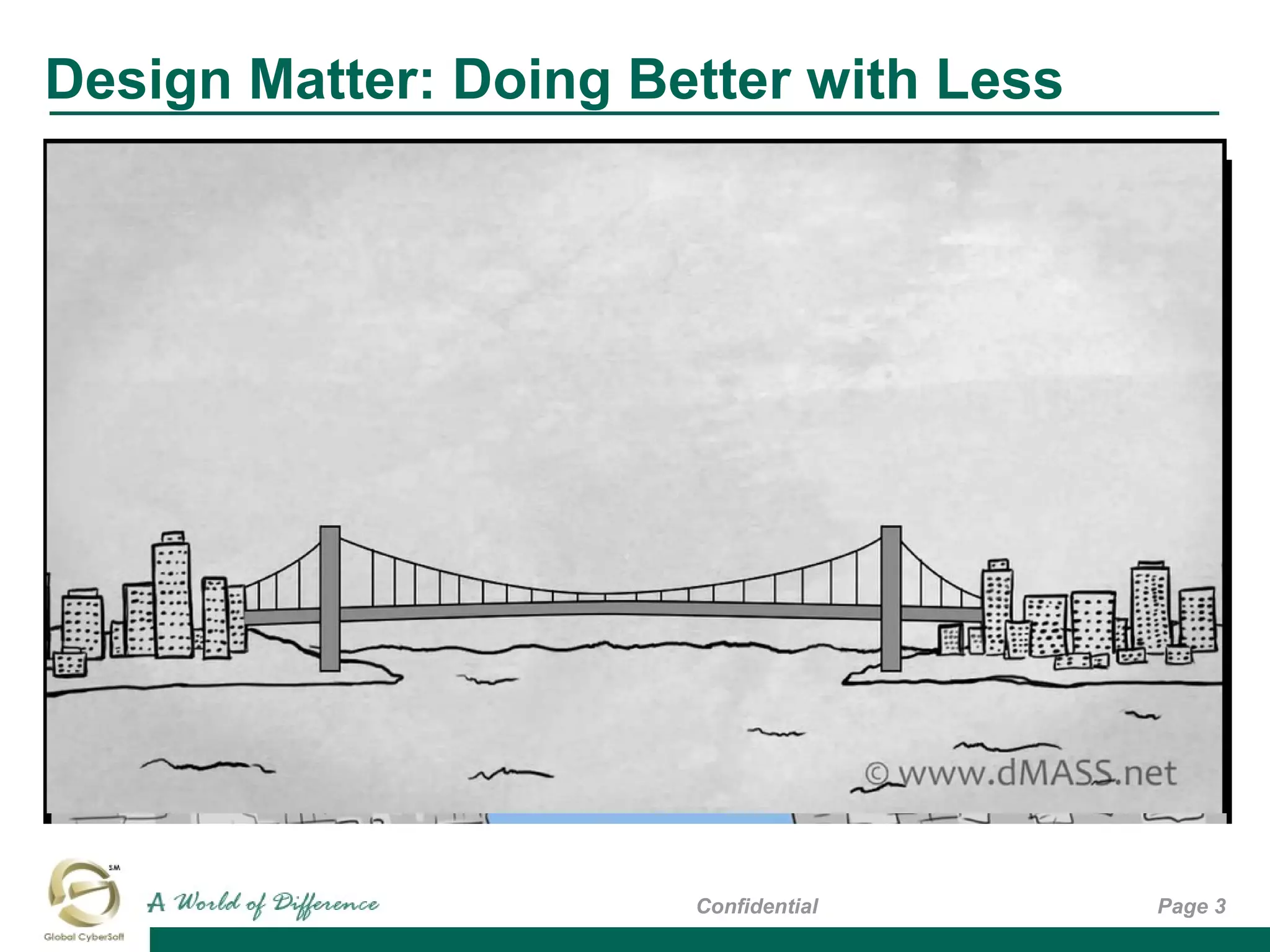
Design Matter: Doing Better with Less
Introduction
Page 4Confidential
S.O.L.I.D is an acronym for the first five object-oriented
design(OOD) principles by Robert C. Martin, popularly
known as Uncle Bob.
S – Single Responsibility principle
O – Open-closed principle
L – Liskov’s substitution principle
I – Interface segregation principle
D – Dependency Inversion principle
What are the issues that developers
always face to in software development
lifecycle?
Question
Requirements change
Page 6Confidential
Your requirements will always change (and grow) over
time
Your system need to evolve to handle the changes.
We should build a software which is smartly designed
enough to change.
.
What is “Smartly-designed Software” ?
Page 7Confidential
Handle the changes with minimal re-factor and effort.
Extendable
Reusable
Flexible
Customer and Developer satisfaction
Page 8Confidential
Customers are satisfied because the software:
+ Work well
+ Keeps working - always.
+ Can be changed, upgraded easily
+ Reuse to build other software.
+ Extendable, Flexible.
Help the developers:
+ Handle the changes easily.
+ Code better in any programming languages.
Page 9Confidential
PURPOSE OF USE
When combined together, these principles will help your
software:
 Become well and smartly-designed
 Easily handle the changes
 Make both customer and developer satisfied with their
work.
⇒Save money and time.
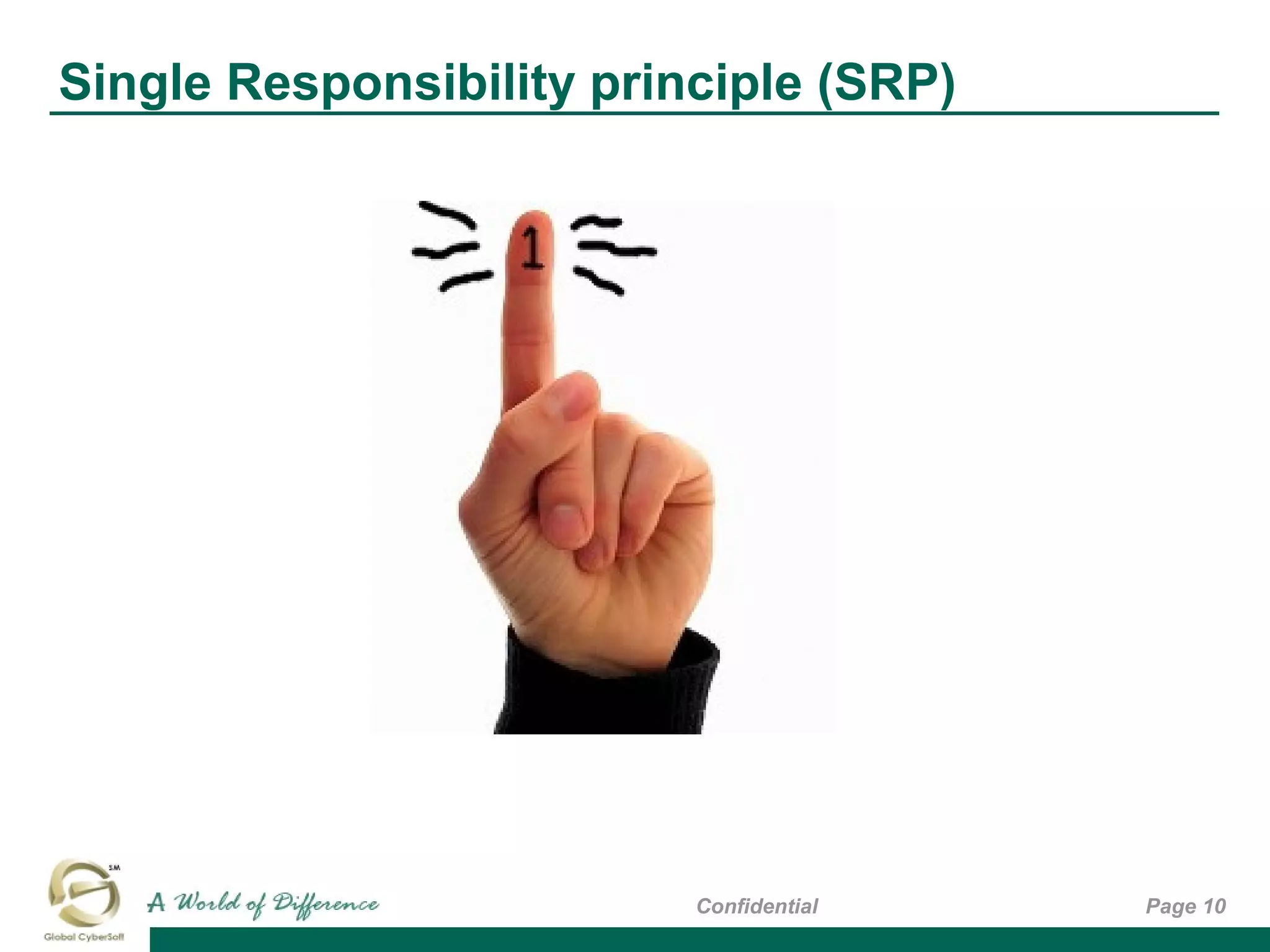
Single Responsibility principle (SRP)
Page 10Confidential
SRP - Definition
Page 11Confidential
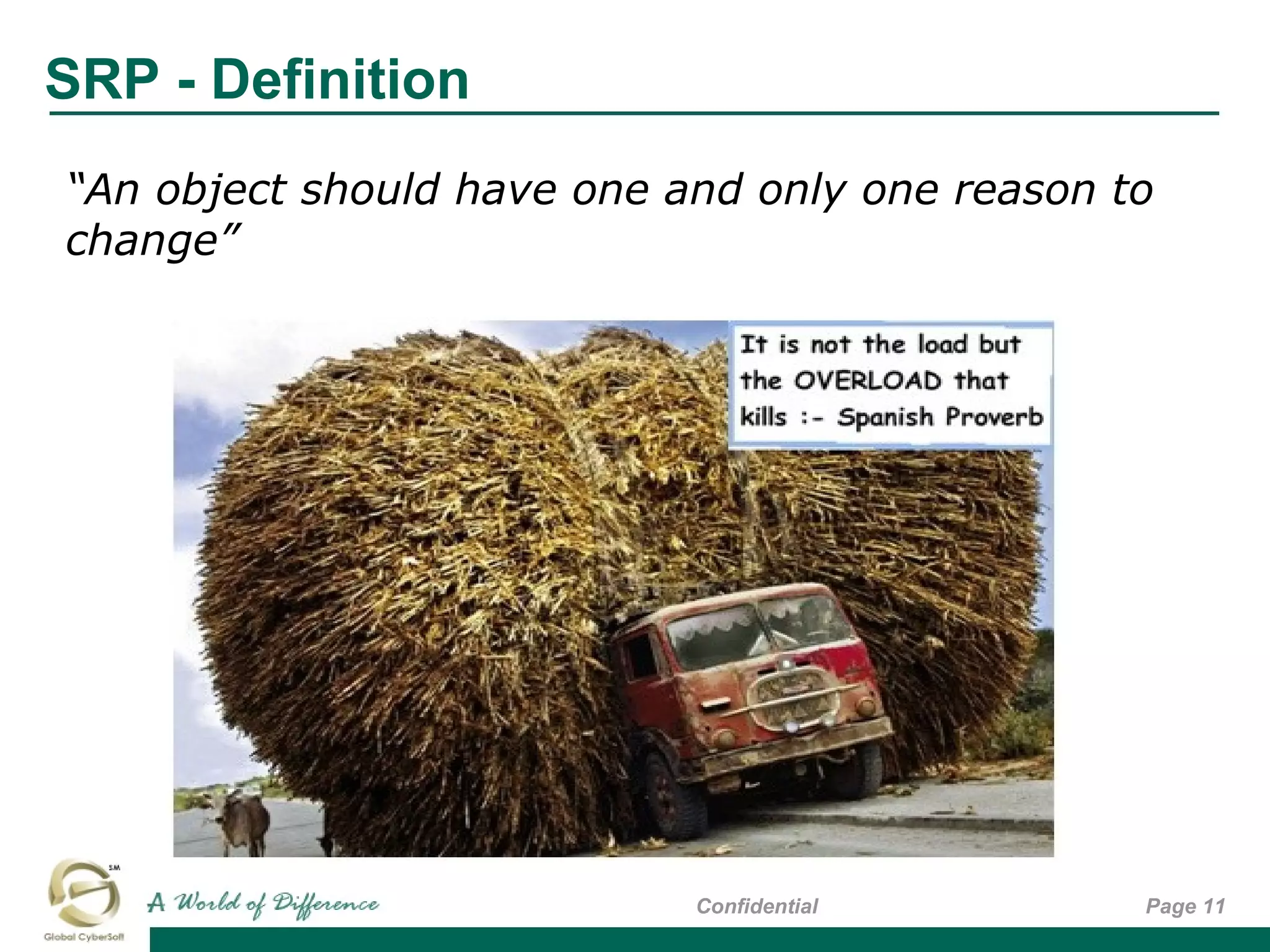
“An object should have one and only one reason to
change”
SRP - Explanation
Page 12Confidential
Responsibility is a family of functions that serves
one particular purpose.
If you have a class having more than one reason to
change
=> you should split the class into multiple classes
base on their responsibilities.
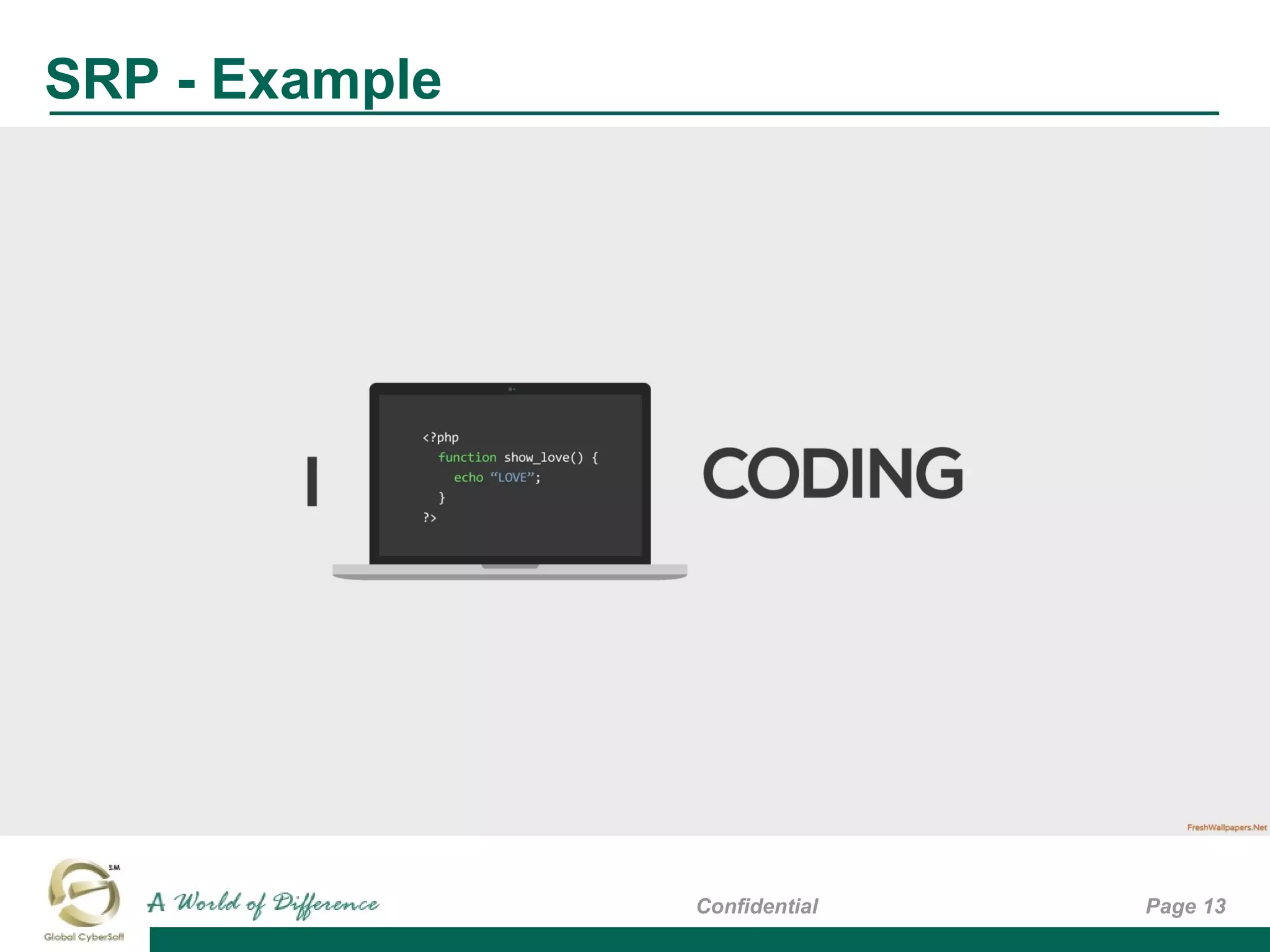
SRP - Example
Page 13Confidential
SRP – Why splitting is important ?
Page 14Confidential
- If classes have more than one responsibility ?
- Each responsibility is an axis of change.
+ Codes become complicated
+ One change effects another
- Big classes:
+ Difficult to change
+ Harder to read
+ Bugs
SRP – Benefit
Page 15Confidential
Increase the reusability of source code
Make your classes smaller, lesser complicated.
Restrict effects to other modules when we change
source codes.
Easier to read and write => less to write bugs.
Higher cohesion, lower coupling.
Smaller classes and smaller methods will give you
more flexibility
More classes != more complicated
Open – Close Principle (OCP)
Page 16Confidential
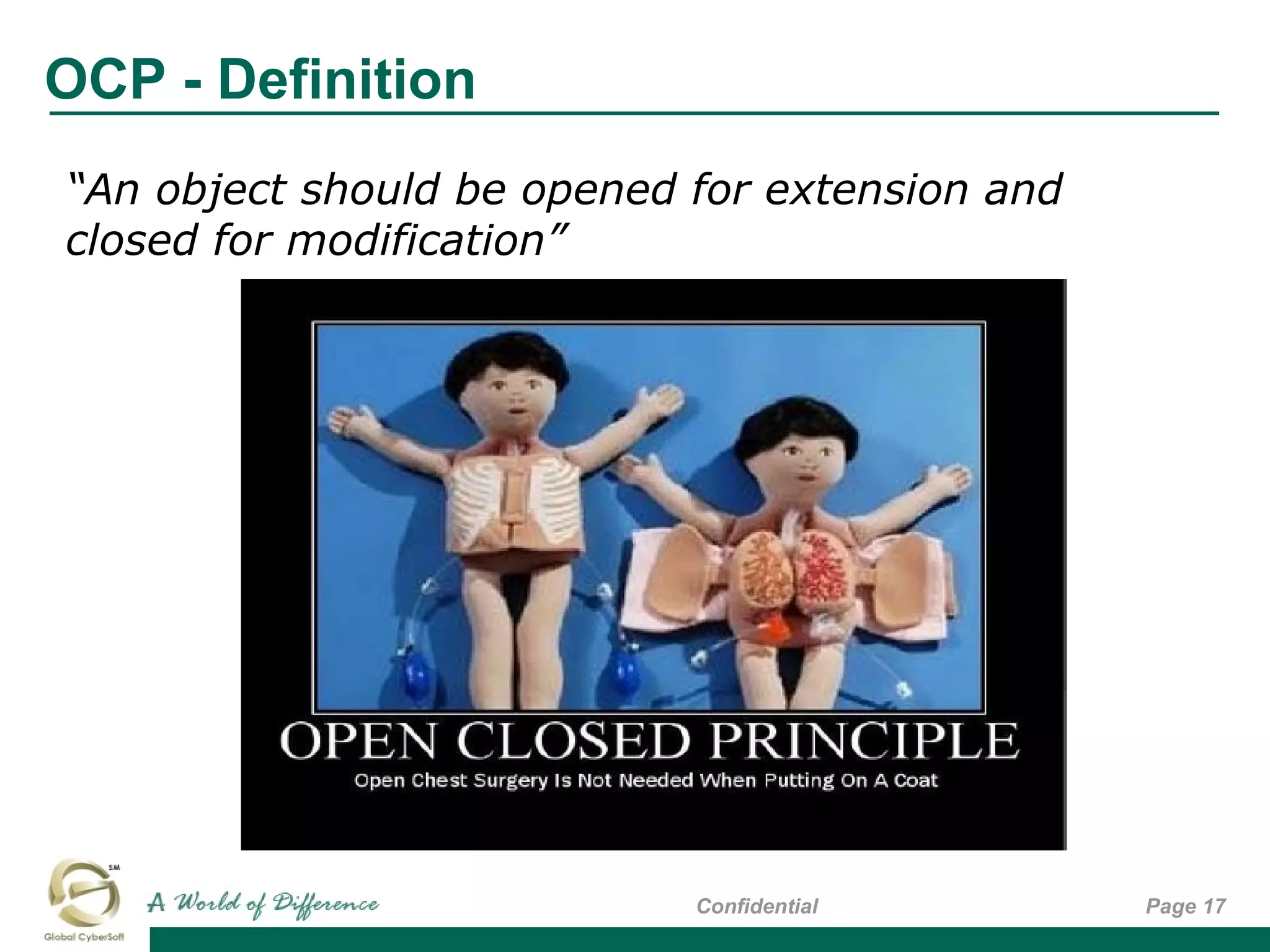
OCP - Definition
Page 17Confidential
“An object should be opened for extension and
closed for modification”
OCP - Explanation
Page 18Confidential
- You should extend a class without modifying it.
- if you read and understand all source code to find
what they are supposed to do and update.
⇒ so hard
⇒ cost time, effort
⇒ bugs
- But it’s easy to extend the source code to meet
the new requirements.
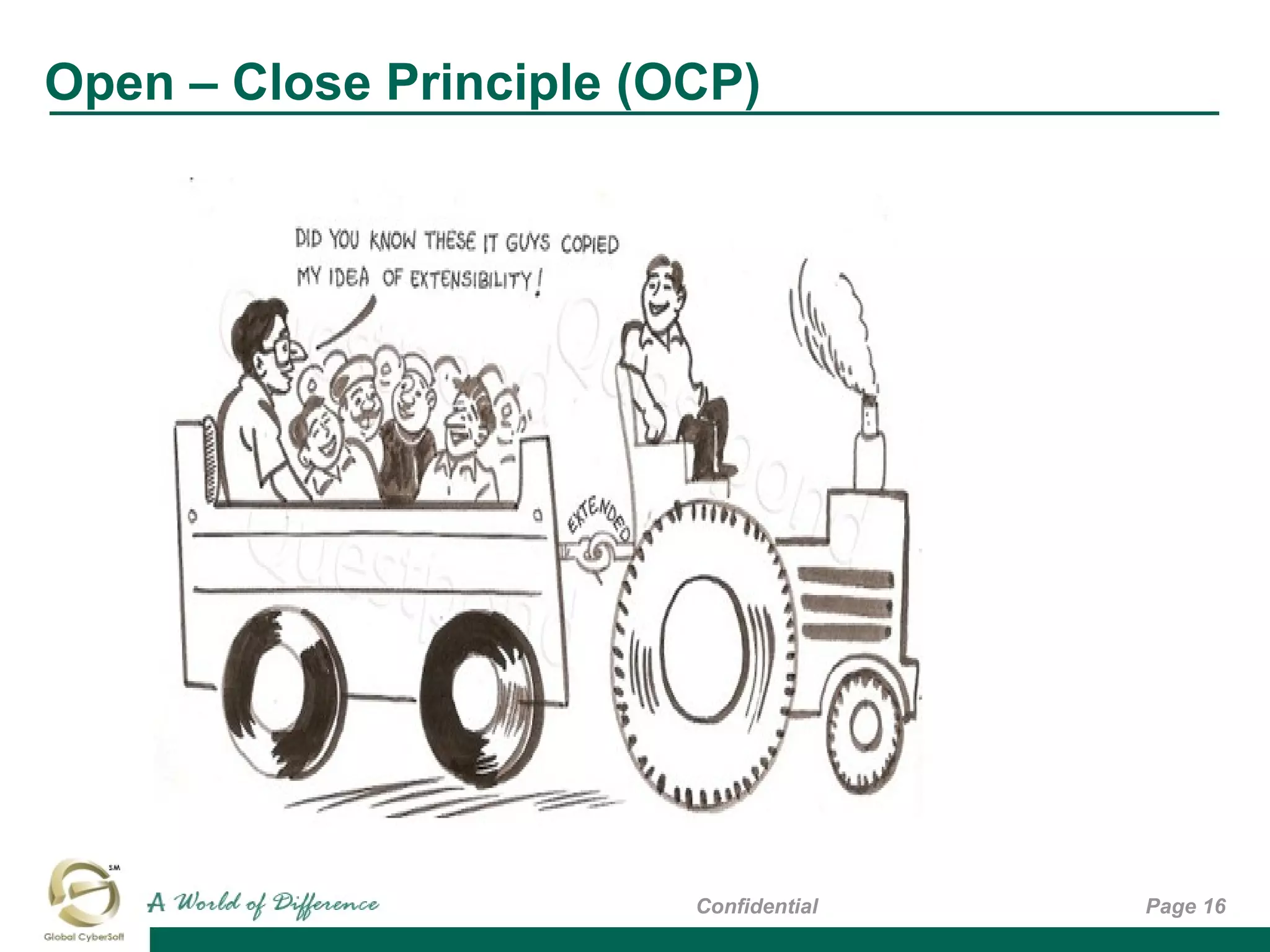
OCP - Example
Page 19Confidential
OCP – Benefit
Page 20Confidential
- Restrict effects to others because when you
change code.
- Not need to read all old source codes that already
worked well.
- Extend the existing libraries.
- Template Method Design Pattern
- Strategy Design Pattern.
Reference
Liskov's Substitution (LSP) - Definition
Page 22Confidential
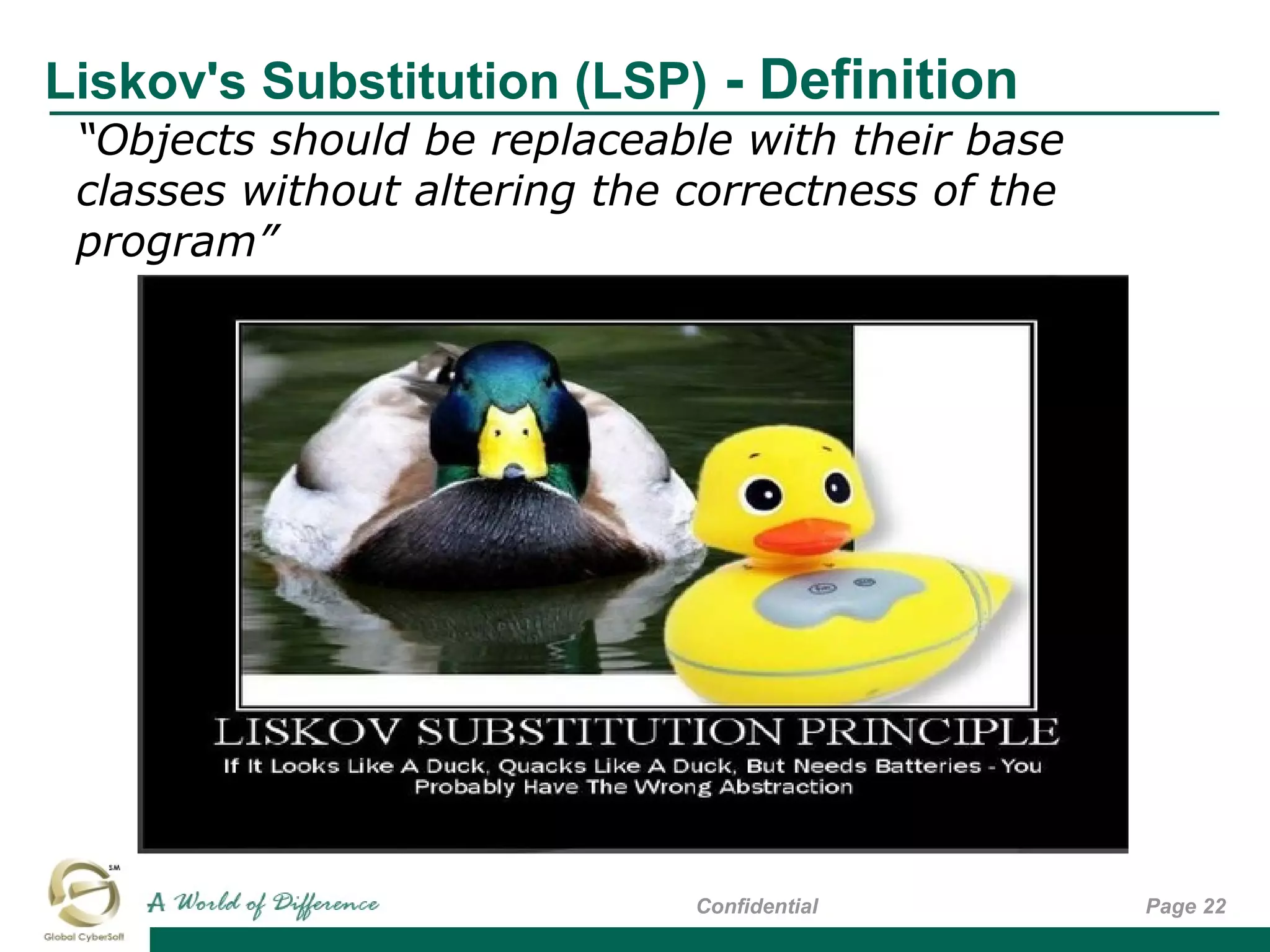
“Objects should be replaceable with their base
classes without altering the correctness of the
program”
LSP - Explanation
Page 23Confidential
+ Should always use a base class or interface
instead of the subclasses.
+ This works correctly with any subclasses of X.
⇒ Extends without replacing any base class's
functions
LSP - Example
Page 24Confidential
LSP – Benefit
Page 25Confidential
- This is an extension of OCP
⇒Wrong LSP => wrong OCP
⇒ Inherit all OCP's benefits.
- Preventing bugs caused by subclasses.
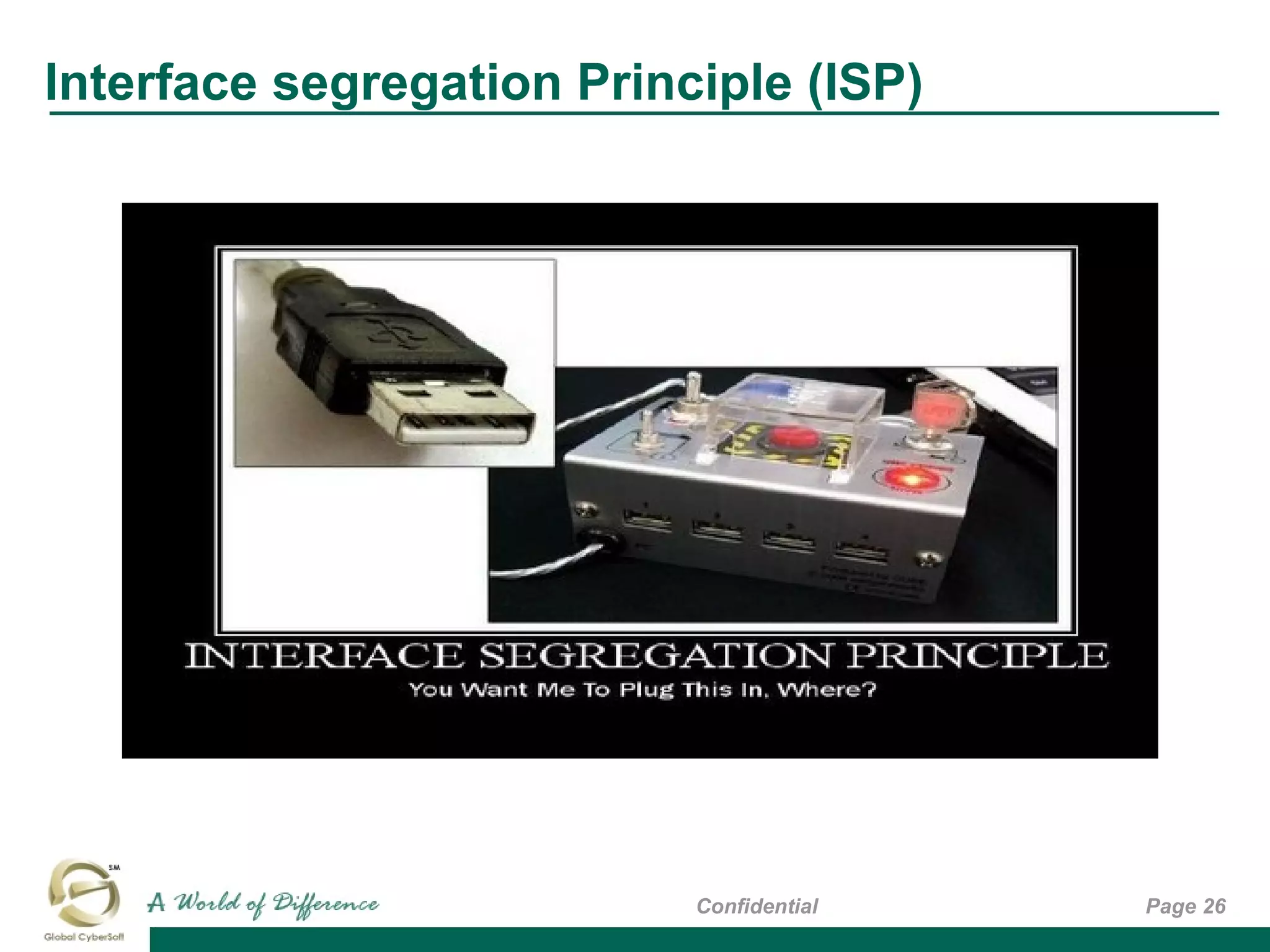
Interface segregation Principle (ISP)
Page 26Confidential
ISP - Definition
Page 27Confidential
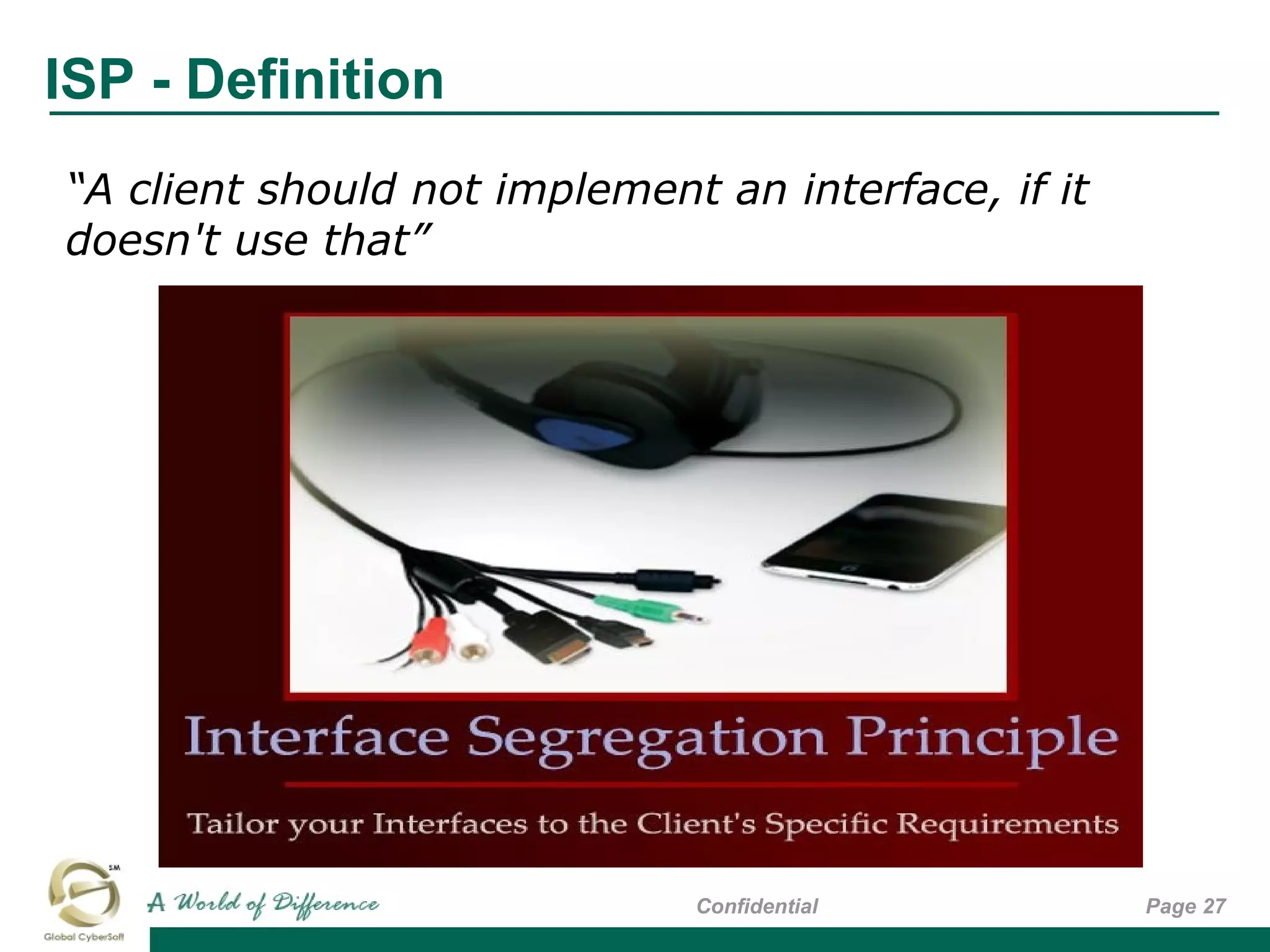
“A client should not implement an interface, if it
doesn't use that”
ISP - Explanation
Page 28Confidential
Clients should not be forced to implement interfaces
they don't use
=> Split a fat interface which has many methods
into many small interfaces.
ISP - Example
Page 29Confidential
ISP – Benefit
Page 30Confidential
- Smaller interface => more reusable
- Extendable
- Flexible
- Allows people to use only the parts of objects that
they need.
- High cohesion, low coupling
- Comply SRP.
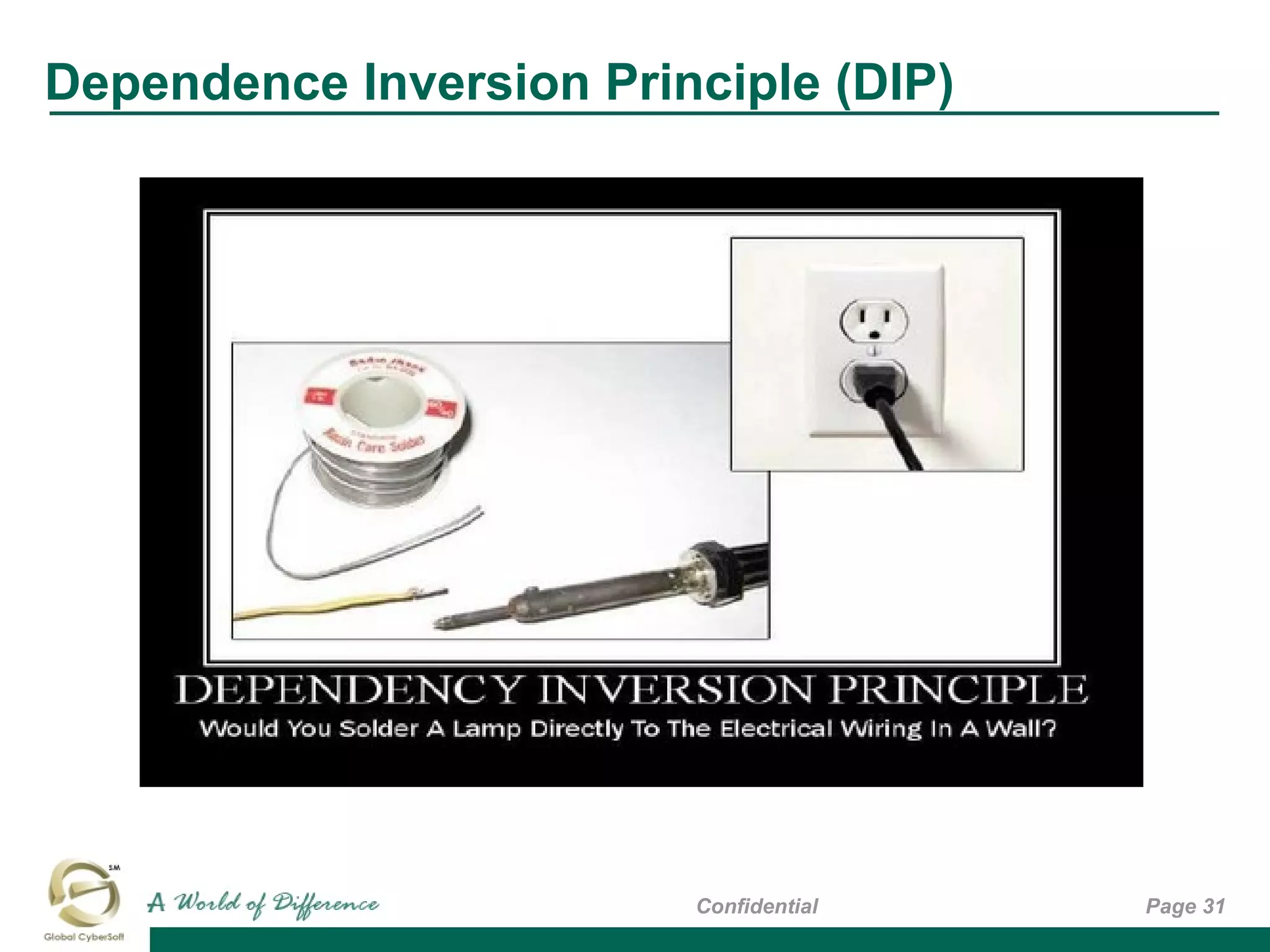
Dependence Inversion Principle (DIP)
Page 31Confidential
DIP - Definition
Page 32Confidential
“High level model should not depend on low level
module, both should depend on abstractions
Abstractions should not depend on details.
Details should depend on abstractions”
DIP - Explanation
Page 33Confidential
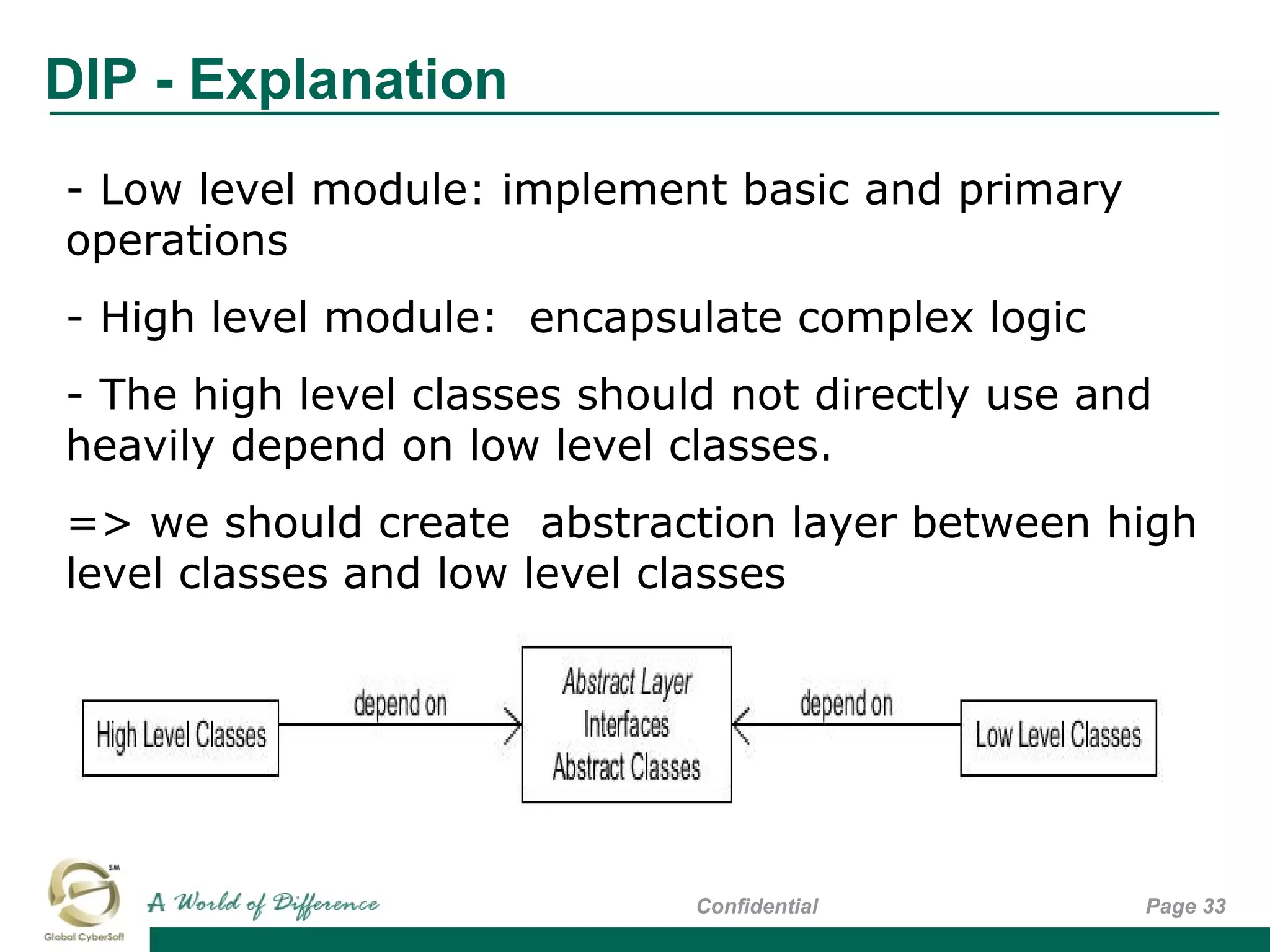
- Low level module: implement basic and primary
operations
- High level module: encapsulate complex logic
- The high level classes should not directly use and
heavily depend on low level classes.
=> we should create abstraction layer between high
level classes and low level classes
DIP - Example
Page 34Confidential
Demo - Explanation
Page 35Confidential
DIP - Explanation
Page 36Confidential
- Abstractions should not depend upon details
- Details should depend on abstractions
Page 37Confidential
- Spring frameworks' component
- Using Dependency Injection pattern
- Automatic class instantiation (from external files or
annotation)
- Entirely remove the low-level component dependencies
and achieve true DIP.
IoC Container & Dependency Injection
DIP – Benefit
Page 38Confidential
- Reusable
- Flexible
- More readable.
- Higher cohesion - lower coupling
- Remove dependencies between low and high level
modules.
- Violate DIP => Violate OCP or LSP.
- More classes != More complicated
Should we always apply DIP anywhere?
Question
Conclusion
Page 40Confidential
With S.O.L.I.D principles, our software:
 Easily handle the changes
 Become well and smartly-designed
 Make both customer and developer satisfied with their
work.
⇒Save money and time.
OOP vs OOD
Page 41Confidential
Object oriented design (OOD) = OOP + Design principles.
⇒The source code applied OOD will be:
+ Object oriented
+ Re-usable
+ Flexible: can be changed with minimal efforts.
+ Extendable: can be extended without changing existing
codes
Q&A
Page 42Confidential
References
Page 43Confidential
http://www.oodesign.com/
http://www.codeproject.com/Articles/703634/SOLID-
architecture-principles-using-simple-Csharp
https://scotch.io/bar-talk/s-o-l-i-d-the-first-five-principles-of-
object-oriented-design
Object oriented analysis and design book by Head First
Design pattern
Dependency Injection and IoC container in Spring Framework

SOLID principles-Present

  • 1.
    OO Design: S.O.L.I.Dprinciples Technical team DNB 2015 Page 1Confidential Presenters: Quang Nguyen, Lan Nguyen
  • 2.
    Page 2Confidential Outline SOLID principlesintroduction Purpose of use. Definition, explanation, examples and benefits of + Single responsibility principle (SRP) + Open – close Principle (OCP) + Linkov's substitution principle (LSP) + Interface segregation principle (ISP) + Dependency inversion principle (DIP) Conclusion Q&A
  • 3.
    Page 3Confidential Design Matter:Doing Better with Less
  • 4.
    Introduction Page 4Confidential S.O.L.I.D isan acronym for the first five object-oriented design(OOD) principles by Robert C. Martin, popularly known as Uncle Bob. S – Single Responsibility principle O – Open-closed principle L – Liskov’s substitution principle I – Interface segregation principle D – Dependency Inversion principle
  • 5.
    What are theissues that developers always face to in software development lifecycle? Question
  • 6.
    Requirements change Page 6Confidential Yourrequirements will always change (and grow) over time Your system need to evolve to handle the changes. We should build a software which is smartly designed enough to change. .
  • 7.
    What is “Smartly-designedSoftware” ? Page 7Confidential Handle the changes with minimal re-factor and effort. Extendable Reusable Flexible
  • 8.
    Customer and Developersatisfaction Page 8Confidential Customers are satisfied because the software: + Work well + Keeps working - always. + Can be changed, upgraded easily + Reuse to build other software. + Extendable, Flexible. Help the developers: + Handle the changes easily. + Code better in any programming languages.
  • 9.
    Page 9Confidential PURPOSE OFUSE When combined together, these principles will help your software:  Become well and smartly-designed  Easily handle the changes  Make both customer and developer satisfied with their work. ⇒Save money and time.
  • 10.
    Single Responsibility principle(SRP) Page 10Confidential
  • 11.
    SRP - Definition Page11Confidential “An object should have one and only one reason to change”
  • 12.
    SRP - Explanation Page12Confidential Responsibility is a family of functions that serves one particular purpose. If you have a class having more than one reason to change => you should split the class into multiple classes base on their responsibilities.
  • 13.
    SRP - Example Page13Confidential
  • 14.
    SRP – Whysplitting is important ? Page 14Confidential - If classes have more than one responsibility ? - Each responsibility is an axis of change. + Codes become complicated + One change effects another - Big classes: + Difficult to change + Harder to read + Bugs
  • 15.
    SRP – Benefit Page15Confidential Increase the reusability of source code Make your classes smaller, lesser complicated. Restrict effects to other modules when we change source codes. Easier to read and write => less to write bugs. Higher cohesion, lower coupling. Smaller classes and smaller methods will give you more flexibility More classes != more complicated
  • 16.
    Open – ClosePrinciple (OCP) Page 16Confidential
  • 17.
    OCP - Definition Page17Confidential “An object should be opened for extension and closed for modification”
  • 18.
    OCP - Explanation Page18Confidential - You should extend a class without modifying it. - if you read and understand all source code to find what they are supposed to do and update. ⇒ so hard ⇒ cost time, effort ⇒ bugs - But it’s easy to extend the source code to meet the new requirements.
  • 19.
    OCP - Example Page19Confidential
  • 20.
    OCP – Benefit Page20Confidential - Restrict effects to others because when you change code. - Not need to read all old source codes that already worked well. - Extend the existing libraries.
  • 21.
    - Template MethodDesign Pattern - Strategy Design Pattern. Reference
  • 22.
    Liskov's Substitution (LSP)- Definition Page 22Confidential “Objects should be replaceable with their base classes without altering the correctness of the program”
  • 23.
    LSP - Explanation Page23Confidential + Should always use a base class or interface instead of the subclasses. + This works correctly with any subclasses of X. ⇒ Extends without replacing any base class's functions
  • 24.
    LSP - Example Page24Confidential
  • 25.
    LSP – Benefit Page25Confidential - This is an extension of OCP ⇒Wrong LSP => wrong OCP ⇒ Inherit all OCP's benefits. - Preventing bugs caused by subclasses.
  • 26.
    Interface segregation Principle(ISP) Page 26Confidential
  • 27.
    ISP - Definition Page27Confidential “A client should not implement an interface, if it doesn't use that”
  • 28.
    ISP - Explanation Page28Confidential Clients should not be forced to implement interfaces they don't use => Split a fat interface which has many methods into many small interfaces.
  • 29.
    ISP - Example Page29Confidential
  • 30.
    ISP – Benefit Page30Confidential - Smaller interface => more reusable - Extendable - Flexible - Allows people to use only the parts of objects that they need. - High cohesion, low coupling - Comply SRP.
  • 31.
    Dependence Inversion Principle(DIP) Page 31Confidential
  • 32.
    DIP - Definition Page32Confidential “High level model should not depend on low level module, both should depend on abstractions Abstractions should not depend on details. Details should depend on abstractions”
  • 33.
    DIP - Explanation Page33Confidential - Low level module: implement basic and primary operations - High level module: encapsulate complex logic - The high level classes should not directly use and heavily depend on low level classes. => we should create abstraction layer between high level classes and low level classes
  • 34.
    DIP - Example Page34Confidential
  • 35.
  • 36.
    DIP - Explanation Page36Confidential - Abstractions should not depend upon details - Details should depend on abstractions
  • 37.
    Page 37Confidential - Springframeworks' component - Using Dependency Injection pattern - Automatic class instantiation (from external files or annotation) - Entirely remove the low-level component dependencies and achieve true DIP. IoC Container & Dependency Injection
  • 38.
    DIP – Benefit Page38Confidential - Reusable - Flexible - More readable. - Higher cohesion - lower coupling - Remove dependencies between low and high level modules. - Violate DIP => Violate OCP or LSP. - More classes != More complicated
  • 39.
    Should we alwaysapply DIP anywhere? Question
  • 40.
    Conclusion Page 40Confidential With S.O.L.I.Dprinciples, our software:  Easily handle the changes  Become well and smartly-designed  Make both customer and developer satisfied with their work. ⇒Save money and time.
  • 41.
    OOP vs OOD Page41Confidential Object oriented design (OOD) = OOP + Design principles. ⇒The source code applied OOD will be: + Object oriented + Re-usable + Flexible: can be changed with minimal efforts. + Extendable: can be extended without changing existing codes
  • 42.
  • 43.