Department of Water and Power
City of Los Angeles

California State Lands Commission
Owens Lake Demonstration Project

Yamen Nanne
Solar Energy Development
June 2nd, 2010
Presentation Outline
 LADWP Renewables Overview

 Project Background & Drivers
 Project Development Review & Status
 Solar Technologies Assessment
 Wind Tunnel Testing
 Geotechnical affects on foundations

 Revised Solar Demonstration Project Structure
 Feedback & Recommendations on Next Steps

2
Los Angeles Department of Water Power (LADWP) Env / Energy Policies


LADWP & Green LA Greenhouse Gas (GHG) Reduction Goals:
o
o

Deliver coal-free energy to customers by 2020.

o



Reduce GHG emissions to 20% below 1990 levels by 2012 and to 35% below 1990 levels by 2030.

Compliance with other GHG reduction legislation such as AB32, SB1368, etc.

Renewable Portfolio Standard (RPS):
o



Energy sold to LADWP customers include 20% renewable resource by 2010 and 35% by 2020.

Integrated Resource Plan:
o

LADWP plans to assure adequate resources to meet customer energy needs reliably and economically.


o

Incorporates strategies to meet GHG, RPS goals, and integration requirements.

Energy Cost Adjustment Factor (ECAF)
o

The ECAF authorizes the LADWP to recover their costs due to the fluctuating costs of renewable sources of
power, fuel/natural gas, and escalating costs of third party provided purchased power.

3
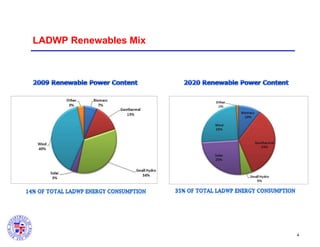
LADWP Renewables Mix

4
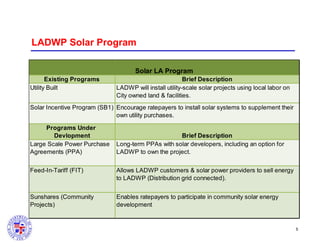
LADWP Solar Program
Solar LA Program
Existing Programs
Utility Built

Brief Description
LADWP will install utility-scale solar projects using local labor on
City owned land & facilities.

Solar Incentive Program (SB1) Encourage ratepayers to install solar systems to supplement their
own utility purchases.
Programs Under
Devlopment
Large Scale Power Purchase
Agreements (PPA)

Brief Description
Long-term PPAs with solar developers, including an option for
LADWP to own the project.

Feed-In-Tariff (FIT)

Allows LADWP customers & solar power providers to sell energy
to LADWP (Distribution grid connected).

Sunshares (Community
Projects)

Enables ratepayers to participate in community solar energy
development

5
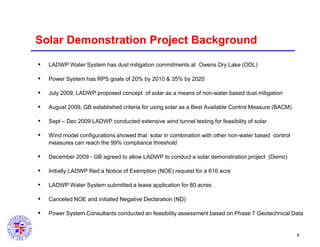
Solar Demonstration Project Background


LADWP Water System has dust mitigation commitments at Owens Dry Lake (ODL)



Power System has RPS goals of 20% by 2010 & 35% by 2020



July 2009, LADWP proposed concept of solar as a means of non-water based dust mitigation



August 2009, GB established criteria for using solar as a Best Available Control Measure (BACM)



Sept – Dec 2009 LADWP conducted extensive wind tunnel testing for feasibility of solar



Wind model configurations showed that solar in combination with other non-water based control
measures can reach the 99% compliance threshold



December 2009 - GB agreed to allow LADWP to conduct a solar demonstration project (Demo)



Initially LADWP filed a Notice of Exemption (NOE) request for a 616 acre



LADWP Water System submitted a lease application for 80 acres



Canceled NOE and initiated Negative Declaration (ND)



Power System Consultants conducted an feasibility assessment based on Phase 7 Geotechnical Data

6
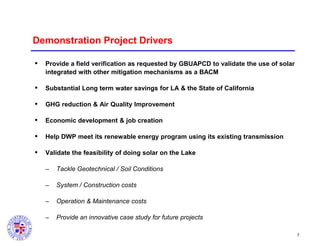
Demonstration Project Drivers


Provide a field verification as requested by GBUAPCD to validate the use of solar
integrated with other mitigation mechanisms as a BACM



Substantial Long term water savings for LA & the State of California



GHG reduction & Air Quality Improvement



Economic development & job creation



Help DWP meet its renewable energy program using its existing transmission



Validate the feasibility of doing solar on the Lake
–

Tackle Geotechnical / Soil Conditions

–

System / Construction costs

–

Operation & Maintenance costs

–

Provide an innovative case study for future projects
7
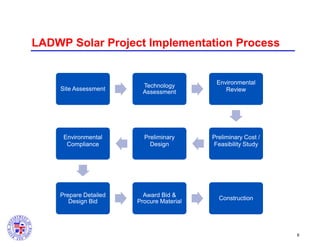
LADWP Solar Project Implementation Process

Site Assessment

Technology
Assessment

Environmental
Review

Environmental
Compliance

Preliminary
Design

Preliminary Cost /
Feasibility Study

Prepare Detailed
Design Bid

Award Bid &
Procure Material

Construction

8
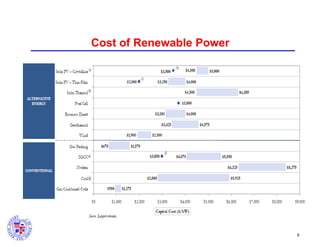
Cost of Renewable Power

9
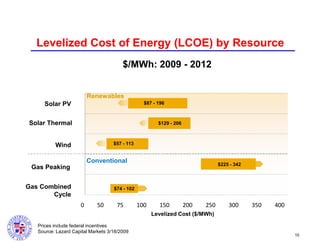
Levelized Cost of Energy (LCOE) by Resource
$/MWh: 2009 - 2012
Renewables
$87 - 196

Solar PV
Solar Thermal

$129 - 206

$57 - 113

Wind

Conventional

$225 - 342

Gas Peaking
Gas Combined
Cycle

0
0

50

$74 - 102

75

100

150

200

250

300

350

400

Levelized Cost ($/MWh)
Prices include federal incentives
Source: Lazard Capital Markets 3/18/2009

10
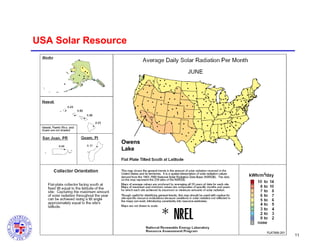
USA Solar Resource

Owens
Lake

11
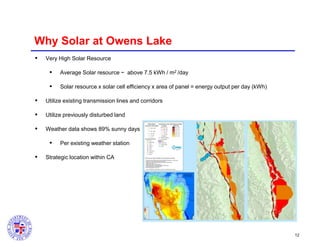
Why Solar at Owens Lake


Very High Solar Resource



Average Solar resource ~ above 7.5 kWh / m2 /day



Solar resource x solar cell efficiency x area of panel = energy output per day (kWh)



Utilize existing transmission lines and corridors



Utilize previously disturbed land



Weather data shows 89% sunny days




Per existing weather station

Strategic location within CA

12
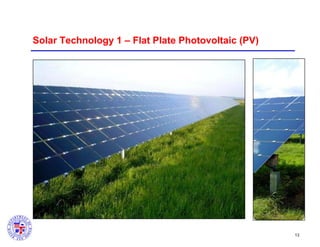
Solar Technology 1 – Flat Plate Photovoltaic (PV)

13
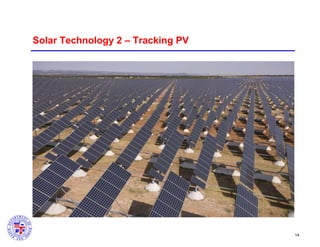
Solar Technology 2 – Tracking PV

14
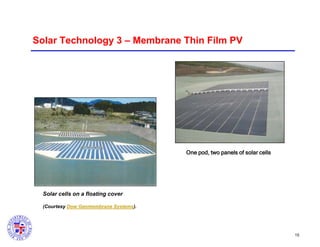
Solar Technology 3 – Membrane Thin Film PV

One pod, two panels of solar cells

Solar cells on a floating cover
(Courtesy Dow Geomembrane Systems).

15
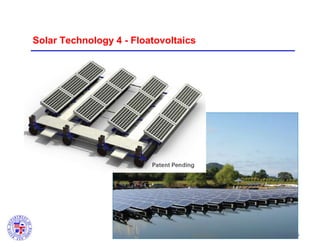
Solar Technology 4 - Floatovoltaics

16
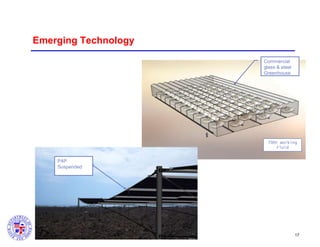
Emerging Technology
Commercial
glass & steel
Greenhouse

700F Working
Fluid

P4P
Suspended

17
Preferred Technology – Standard PV


Proven Commercially Technology



Minimal water use



Lowest cost & maintenance



Modular constructability



LADWP had existing RFP for Design & Procurement



Fixed panels most likely to provide most optimal ground coverage

18
Wind Tunnel Testing Project Team

19
GBUAPCD - Wind Reduction Criterion
 Historically, Best Available Control Measures (BACM) required to achieve
99 percent reduction in dust emissions on the Owens playa (SIP, Chapter 8,
Attachment B, Item 3(c)iii).

 For solar, measure of success defined by the District as complete
sheltering of 99 percent or more of the area within the solar panel array.
Previous Control measures required 75% coverage to achieve 99% sheltering

 The design wind speed defined by District is 22.4 m/s (50 mph) at 10 m
above ground. Complete sheltering occurs when the wind speed at 0.254 m
above ground is 4.5 m/s or less.

 Complete sheltering occurs when the wind speed at a height of 0.254 m (10
inches) above ground is reduced to 20 percent or less of the wind speed at
10 m.

20
1 MW PV Block


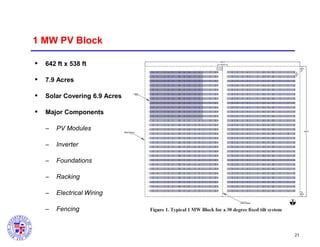
642 ft x 538 ft



7.9 Acres



Solar Covering 6.9 Acres



Major Components
–

PV Modules

–

Inverter

–

Foundations

–

Racking

–

Electrical Wiring

–

Fencing

21
Wind Tunnel Test Configuration Summary
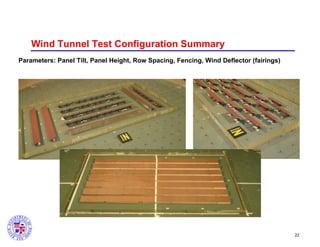
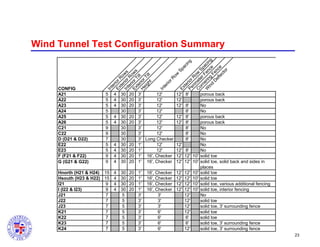
Parameters: Panel Tilt, Panel Height, Row Spacing, Fencing, Wind Deflector (fairings)

22
5
5
5
5
5
5
9
9
7
5
5
9
9

In
te
rio
rR
ow
Sp
Ex
ac
te
in
rio
g
Pe r
R
rim o
C et w
or er S
n
F p
W erin en acin
in g ce g
d
D Fen
ef
le ce
ct
or

CONFIG
A21
A22
A23
A24
A25
A26
C21
C22
D (D21 & D22)
E22
E23
F (F21 & F22)
G (G21 & G22)

In
te
r
Ex ior
te Ro
In rior ws
te R
r
o
Ex ior ws
Ti
te
lt
H rior
ei
gh Tilt
t

Wind Tunnel Test Configuration Summary

4 30 20 3'
12'
4 30 20 3'
12'
4 30 20 3'
12'
30
3'
12'
4 30 20 3'
12'
4 30 20 3'
12'
30
3'
12'
30
3'
12'
30
3' Long Checker
4 30 20 1'
12'
4 30 20 1'
12'
4 30 20 1' 16', Checker

Hnorth (H21 & H24) 15 4 30 20 1'
Hsouth (H23 & H22) 15 4 30 20 1'
I21
9 4 30 20 1'
I (I22 & I23)
9 4 30 20 1'
J21
7
5
3'
J22
7
5
3'
J23
7
5
3'
K21
7
5
3'
K22
7
5
3'
K23
7
5
3'
K24
7
5
3'

16', Checker
16', Checker
16', Checker
16', Checker
3'
3'
3'
6'
6'
6'
6'

12' 8'
porous back
12'
porous back
12' 8'
No
8'
No
12' 8'
porous back
12' 8'
porous back
8'
No
8'
No
8'
No
12'
No
12' 8'
No
12' 12' 10' solid toe
12' 12' 10' solid toe, solid back and sides in
places
12' 12' 10' solid toe
12' 12' 10' solid toe, various additional fencing
12' 12' 10' solid toe, interior fencing
12'
No
12'
solid toe
12'
solid toe, 3' surrounding fence
12'
solid toe
6'
solid toe
6'
solid toe, 3' surrounding fence
12'
solid toe, 3' surrounding fence
23
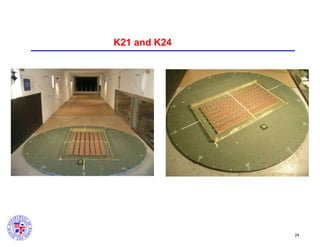
K21 and K24

24
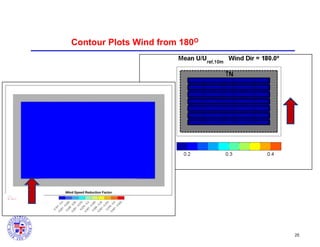
Contour Plots Wind from 180O

WWWW
DWrWctWoW

25
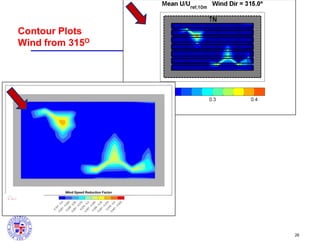
Contour Plots
Wind from 315O

WWWW
DWrWctWoW

26
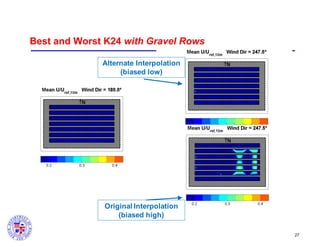
Best and Worst K24 with Gravel Rows
Alternate Interpolation
(biased low)

Original Interpolation
(biased high)
27
Lease Application Background
•

LADWP Submitted a Lease Application Feb 24, 2010

•

80 Acres of Land for a Solar

•

Within Area T1A-4 of Phase 7

•

Solar augmented w/ gravel

•

Solar within earthen berms

•

Emerging technologies

•

On March 22nd responded w/ a letter to LADWP requesting further details on the
specifics of what the demo project will entail

•

Since then:

•

Continued economic and geotechnical analysis of best solutions to implement
for the Demo

28
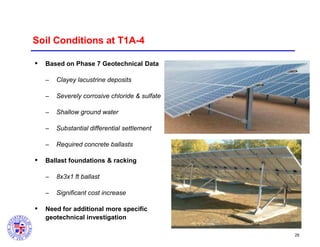
Soil Conditions at T1A-4


Based on Phase 7 Geotechnical Data
–
–

Severely corrosive chloride & sulfate

–

Shallow ground water

–

Substantial differential settlement

–



Clayey lacustrine deposits
Required concrete ballasts

Ballast foundations & racking
–
–



8x3x1 ft ballast
Significant cost increase

Need for additional more specific
geotechnical investigation
29
Scope of Geotechnical Study


Submit GeoTech Permit



Investigate 20 acres on T37-1



Investigate 20 acres on Area 1 of Phase 8



Foundation design
–

Bearing capacity of soil

–

Experimental foundations
•



Subgrade Preparation
–



Piles, Hemispherical, Rect / Square

Blending in material (lime, cement)

Loading scenarios
–

Axial, lateral, & combined

–

Using a backhoe & spring scale

30
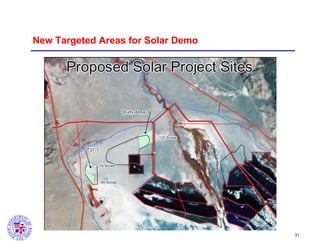
New Targeted Areas for Solar Demo

31
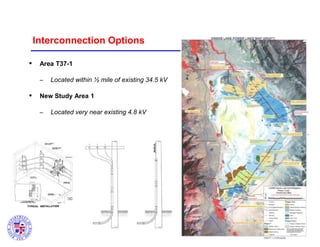
Interconnection Options


Area T37-1
–



Located within ½ mile of existing 34.5 kV

New Study Area 1
–

Located very near existing 4.8 kV

32
Revised Demo Structure


Obtain GeoTech Permit



Conduct GeoTechnical Study



Amend Lease application pending Geotech Analysis
–

Create flexibility

–

Phase I
•
•

–

½ MW of Solar PV w/ Gravel
3 – 5 acres depending on technology

Phase II
•



Other / emerging technologies

More engagement w/ External Stakeholders

33
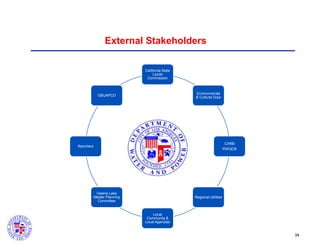
External Stakeholders
California State
Lands
Commission

Environmental
& Cultural Grps

GBUAPCD

CARB
RWQCB

Ranchers

Owens Lake
Master Planning
Committee

Regional Utilities

Local
Community &
Local Agencies

34
Remaining Milestones


June 9th Owens Lake Master Planning Committee Presentation



GeoTech Permit



GeoTechnical Investigation



Revise Lease / Project Description



Draft Neg Dec Completed



Board approval of final CEQA document



Engineer & procure system



Construction



COD : Target of July 1st, 2011 but no later than Oct 1st, 2011
–



Wind season is October – June, however Demo can be validated if significant wind events occur

Monitoring & Validation Period

35
Feedback & Recommendations

36

Solar PV on Dry Lakebed Soil

  • 1.
    Department of Waterand Power City of Los Angeles California State Lands Commission Owens Lake Demonstration Project Yamen Nanne Solar Energy Development June 2nd, 2010
  • 2.
    Presentation Outline  LADWPRenewables Overview  Project Background & Drivers  Project Development Review & Status  Solar Technologies Assessment  Wind Tunnel Testing  Geotechnical affects on foundations  Revised Solar Demonstration Project Structure  Feedback & Recommendations on Next Steps 2
  • 3.
    Los Angeles Departmentof Water Power (LADWP) Env / Energy Policies  LADWP & Green LA Greenhouse Gas (GHG) Reduction Goals: o o Deliver coal-free energy to customers by 2020. o  Reduce GHG emissions to 20% below 1990 levels by 2012 and to 35% below 1990 levels by 2030. Compliance with other GHG reduction legislation such as AB32, SB1368, etc. Renewable Portfolio Standard (RPS): o  Energy sold to LADWP customers include 20% renewable resource by 2010 and 35% by 2020. Integrated Resource Plan: o LADWP plans to assure adequate resources to meet customer energy needs reliably and economically.  o Incorporates strategies to meet GHG, RPS goals, and integration requirements. Energy Cost Adjustment Factor (ECAF) o The ECAF authorizes the LADWP to recover their costs due to the fluctuating costs of renewable sources of power, fuel/natural gas, and escalating costs of third party provided purchased power. 3
  • 4.
  • 5.
    LADWP Solar Program SolarLA Program Existing Programs Utility Built Brief Description LADWP will install utility-scale solar projects using local labor on City owned land & facilities. Solar Incentive Program (SB1) Encourage ratepayers to install solar systems to supplement their own utility purchases. Programs Under Devlopment Large Scale Power Purchase Agreements (PPA) Brief Description Long-term PPAs with solar developers, including an option for LADWP to own the project. Feed-In-Tariff (FIT) Allows LADWP customers & solar power providers to sell energy to LADWP (Distribution grid connected). Sunshares (Community Projects) Enables ratepayers to participate in community solar energy development 5
  • 6.
    Solar Demonstration ProjectBackground  LADWP Water System has dust mitigation commitments at Owens Dry Lake (ODL)  Power System has RPS goals of 20% by 2010 & 35% by 2020  July 2009, LADWP proposed concept of solar as a means of non-water based dust mitigation  August 2009, GB established criteria for using solar as a Best Available Control Measure (BACM)  Sept – Dec 2009 LADWP conducted extensive wind tunnel testing for feasibility of solar  Wind model configurations showed that solar in combination with other non-water based control measures can reach the 99% compliance threshold  December 2009 - GB agreed to allow LADWP to conduct a solar demonstration project (Demo)  Initially LADWP filed a Notice of Exemption (NOE) request for a 616 acre  LADWP Water System submitted a lease application for 80 acres  Canceled NOE and initiated Negative Declaration (ND)  Power System Consultants conducted an feasibility assessment based on Phase 7 Geotechnical Data 6
  • 7.
    Demonstration Project Drivers  Providea field verification as requested by GBUAPCD to validate the use of solar integrated with other mitigation mechanisms as a BACM  Substantial Long term water savings for LA & the State of California  GHG reduction & Air Quality Improvement  Economic development & job creation  Help DWP meet its renewable energy program using its existing transmission  Validate the feasibility of doing solar on the Lake – Tackle Geotechnical / Soil Conditions – System / Construction costs – Operation & Maintenance costs – Provide an innovative case study for future projects 7
  • 8.
    LADWP Solar ProjectImplementation Process Site Assessment Technology Assessment Environmental Review Environmental Compliance Preliminary Design Preliminary Cost / Feasibility Study Prepare Detailed Design Bid Award Bid & Procure Material Construction 8
  • 9.
  • 10.
    Levelized Cost ofEnergy (LCOE) by Resource $/MWh: 2009 - 2012 Renewables $87 - 196 Solar PV Solar Thermal $129 - 206 $57 - 113 Wind Conventional $225 - 342 Gas Peaking Gas Combined Cycle 0 0 50 $74 - 102 75 100 150 200 250 300 350 400 Levelized Cost ($/MWh) Prices include federal incentives Source: Lazard Capital Markets 3/18/2009 10
  • 11.
  • 12.
    Why Solar atOwens Lake  Very High Solar Resource  Average Solar resource ~ above 7.5 kWh / m2 /day  Solar resource x solar cell efficiency x area of panel = energy output per day (kWh)  Utilize existing transmission lines and corridors  Utilize previously disturbed land  Weather data shows 89% sunny days   Per existing weather station Strategic location within CA 12
  • 13.
    Solar Technology 1– Flat Plate Photovoltaic (PV) 13
  • 14.
    Solar Technology 2– Tracking PV 14
  • 15.
    Solar Technology 3– Membrane Thin Film PV One pod, two panels of solar cells Solar cells on a floating cover (Courtesy Dow Geomembrane Systems). 15
  • 16.
    Solar Technology 4- Floatovoltaics 16
  • 17.
    Emerging Technology Commercial glass &steel Greenhouse 700F Working Fluid P4P Suspended 17
  • 18.
    Preferred Technology –Standard PV  Proven Commercially Technology  Minimal water use  Lowest cost & maintenance  Modular constructability  LADWP had existing RFP for Design & Procurement  Fixed panels most likely to provide most optimal ground coverage 18
  • 19.
    Wind Tunnel TestingProject Team 19
  • 20.
    GBUAPCD - WindReduction Criterion  Historically, Best Available Control Measures (BACM) required to achieve 99 percent reduction in dust emissions on the Owens playa (SIP, Chapter 8, Attachment B, Item 3(c)iii).  For solar, measure of success defined by the District as complete sheltering of 99 percent or more of the area within the solar panel array. Previous Control measures required 75% coverage to achieve 99% sheltering  The design wind speed defined by District is 22.4 m/s (50 mph) at 10 m above ground. Complete sheltering occurs when the wind speed at 0.254 m above ground is 4.5 m/s or less.  Complete sheltering occurs when the wind speed at a height of 0.254 m (10 inches) above ground is reduced to 20 percent or less of the wind speed at 10 m. 20
  • 21.
    1 MW PVBlock  642 ft x 538 ft  7.9 Acres  Solar Covering 6.9 Acres  Major Components – PV Modules – Inverter – Foundations – Racking – Electrical Wiring – Fencing 21
  • 22.
    Wind Tunnel TestConfiguration Summary Parameters: Panel Tilt, Panel Height, Row Spacing, Fencing, Wind Deflector (fairings) 22
  • 23.
    5 5 5 5 5 5 9 9 7 5 5 9 9 In te rio rR ow Sp Ex ac te in rio g Pe r R rim o Cet w or er S n F p W erin en acin in g ce g d D Fen ef le ce ct or CONFIG A21 A22 A23 A24 A25 A26 C21 C22 D (D21 & D22) E22 E23 F (F21 & F22) G (G21 & G22) In te r Ex ior te Ro In rior ws te R r o Ex ior ws Ti te lt H rior ei gh Tilt t Wind Tunnel Test Configuration Summary 4 30 20 3' 12' 4 30 20 3' 12' 4 30 20 3' 12' 30 3' 12' 4 30 20 3' 12' 4 30 20 3' 12' 30 3' 12' 30 3' 12' 30 3' Long Checker 4 30 20 1' 12' 4 30 20 1' 12' 4 30 20 1' 16', Checker 4 30 20 1' 16', Checker Hnorth (H21 & H24) 15 4 30 20 1' Hsouth (H23 & H22) 15 4 30 20 1' I21 9 4 30 20 1' I (I22 & I23) 9 4 30 20 1' J21 7 5 3' J22 7 5 3' J23 7 5 3' K21 7 5 3' K22 7 5 3' K23 7 5 3' K24 7 5 3' 16', Checker 16', Checker 16', Checker 16', Checker 3' 3' 3' 6' 6' 6' 6' 12' 8' porous back 12' porous back 12' 8' No 8' No 12' 8' porous back 12' 8' porous back 8' No 8' No 8' No 12' No 12' 8' No 12' 12' 10' solid toe 12' 12' 10' solid toe, solid back and sides in places 12' 12' 10' solid toe 12' 12' 10' solid toe 12' 12' 10' solid toe, various additional fencing 12' 12' 10' solid toe, interior fencing 12' No 12' solid toe 12' solid toe, 3' surrounding fence 12' solid toe 6' solid toe 6' solid toe, 3' surrounding fence 12' solid toe, 3' surrounding fence 23
  • 24.
  • 25.
    Contour Plots Windfrom 180O WWWW DWrWctWoW 25
  • 26.
    Contour Plots Wind from315O WWWW DWrWctWoW 26
  • 27.
    Best and WorstK24 with Gravel Rows Alternate Interpolation (biased low) Original Interpolation (biased high) 27
  • 28.
    Lease Application Background • LADWPSubmitted a Lease Application Feb 24, 2010 • 80 Acres of Land for a Solar • Within Area T1A-4 of Phase 7 • Solar augmented w/ gravel • Solar within earthen berms • Emerging technologies • On March 22nd responded w/ a letter to LADWP requesting further details on the specifics of what the demo project will entail • Since then: • Continued economic and geotechnical analysis of best solutions to implement for the Demo 28
  • 29.
    Soil Conditions atT1A-4  Based on Phase 7 Geotechnical Data – – Severely corrosive chloride & sulfate – Shallow ground water – Substantial differential settlement –  Clayey lacustrine deposits Required concrete ballasts Ballast foundations & racking – –  8x3x1 ft ballast Significant cost increase Need for additional more specific geotechnical investigation 29
  • 30.
    Scope of GeotechnicalStudy  Submit GeoTech Permit  Investigate 20 acres on T37-1  Investigate 20 acres on Area 1 of Phase 8  Foundation design – Bearing capacity of soil – Experimental foundations •  Subgrade Preparation –  Piles, Hemispherical, Rect / Square Blending in material (lime, cement) Loading scenarios – Axial, lateral, & combined – Using a backhoe & spring scale 30
  • 31.
    New Targeted Areasfor Solar Demo 31
  • 32.
    Interconnection Options  Area T37-1 –  Locatedwithin ½ mile of existing 34.5 kV New Study Area 1 – Located very near existing 4.8 kV 32
  • 33.
    Revised Demo Structure  ObtainGeoTech Permit  Conduct GeoTechnical Study  Amend Lease application pending Geotech Analysis – Create flexibility – Phase I • • – ½ MW of Solar PV w/ Gravel 3 – 5 acres depending on technology Phase II •  Other / emerging technologies More engagement w/ External Stakeholders 33
  • 34.
    External Stakeholders California State Lands Commission Environmental &Cultural Grps GBUAPCD CARB RWQCB Ranchers Owens Lake Master Planning Committee Regional Utilities Local Community & Local Agencies 34
  • 35.
    Remaining Milestones  June 9thOwens Lake Master Planning Committee Presentation  GeoTech Permit  GeoTechnical Investigation  Revise Lease / Project Description  Draft Neg Dec Completed  Board approval of final CEQA document  Engineer & procure system  Construction  COD : Target of July 1st, 2011 but no later than Oct 1st, 2011 –  Wind season is October – June, however Demo can be validated if significant wind events occur Monitoring & Validation Period 35
  • 36.

Editor's Notes

  • #4 AB32 directs Air Resources Board (ARB) to develop a statewide comprehensive plan to reduce GHG emissions to 80% below 1990 levels by 2050.SB1368 requires new or upgraded electric generation facilities and contracts to be at least as clean as a combined cycle.
  • #7  Water System has dust mitigation commitments at Owens Dry Lake (ODL) that are regulated by the Great Basin Unified Air Pollution Control District (GB) In August 2009, GB established criteria for using solar as a dust mitigation – solar equipment must reduce surface level wind speed by 80% of a 50 mph wind from any direction, over 99% of the areaLADWP studied and tested about 30 different solar photovoltaic configurations to mitigate dust, including various solar array orientations, tilts, heights and spacing, and using different fencing and gravel placement. See example of a configuration on the next slide.Wind model configurations showed that solar in combination can reached 98% compliance. A 99% compliance threshold, as required by GB, was not attained. Preliminary engineering & economic assessments showed that the most complex design that reach the 98% compliance, if implemented in the field, would be very expensive according to Black & Vetch (B&V), and will inherently have higher maintenance costs.December 2009 - GB agreed to allow LADWP to move forward on a solar demonstration project (Demo) on a conditional basis that we provide them the authority as a monitoring agency during the Demonstration validation period
  • #10 While capital costs for a number of Alternative Energy generation technologies (e.g., solar PV, solar thermal) are currently inexcess of conventional generation technologies (e.g., gas, coal, nuclear), declining costs for many Alternative Energygeneration technologies, coupled with rising long-term construction and fuel costs for conventional generation technologies,are working to close formerly wide gaps in electricity costs. IGCC - Integrated gasification combined cycle
  • #11 Certain Alternative Energy generation technologies are becoming increasingly cost-competitive with conventional generationtechnologies under some scenarios, before factoring in environmental and other externalities (e.g., RECs, potential carbonemission costs, transmission and back-up generation/system reliability costs) as well as construction and fuel costs dynamicsaffecting conventional generation technologies
  • #33 Most Economic is overheadAlternate is to put on sub-surface