SOLAR POWERED SHIP
AN INITIATIVE…..
SOLAR POWER:- Solar energy is radiant light and heat from the Sun that is harnessed using a range of
ever-evolving technologies such as photovoltaic cells and battery arrangement.
It is an important source of renewable energy and its technologies are broadly characterized as
either passive solar or active solar. Active solar depending on how they capture and distribute solar
energy or convert it into electricity. Active solar techniques include the use of photovoltaic
systems, concentrated solar power and solar water heating to harness the energy.
NEED OF SOLAR SHIP:-
INSTALLATION OF SOLAR PANEL ONBOARD FOR COST EFFICIENCY:
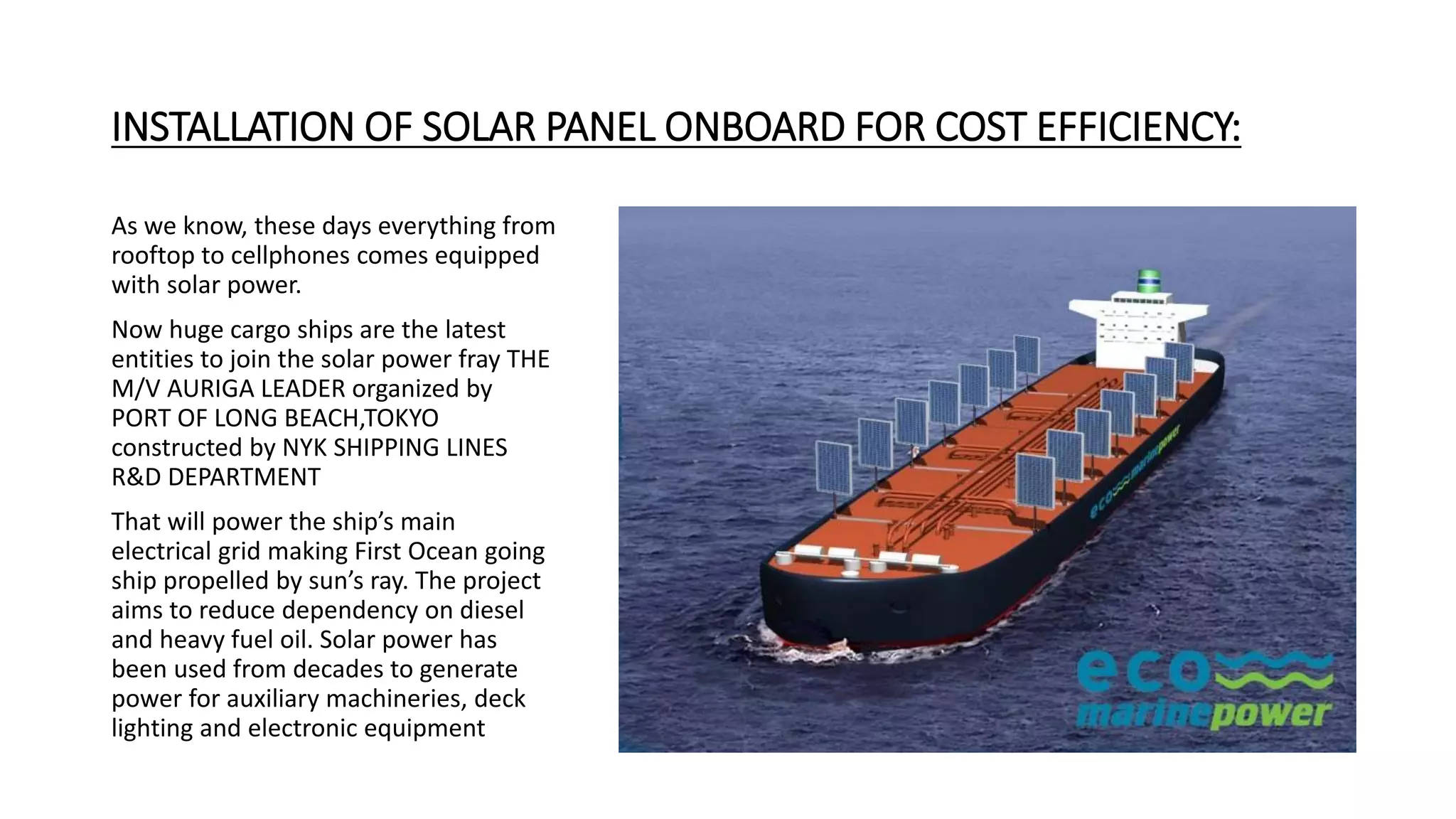
As we know, these days everything from
rooftop to cellphones comes equipped
with solar power.
Now huge cargo ships are the latest
entities to join the solar power fray THE
M/V AURIGA LEADER organized by
PORT OF LONG BEACH,TOKYO
constructed by NYK SHIPPING LINES
R&D DEPARTMENT
That will power the ship’s main
electrical grid making First Ocean going
ship propelled by sun’s ray. The project
aims to reduce dependency on diesel
and heavy fuel oil. Solar power has
been used from decades to generate
power for auxiliary machineries, deck
lighting and electronic equipment
THE M/V AURIGA LEADER (NYK SHIPPING LINES R&D DEPARTMENT)
AURIGA LEADER’S SPECIFICATION:
• Auriga Leader, a RoRo Ship, is
the world’s first partially
propelled cargo carrier ship
fitted with over 300 solar arrays
that generate around 10 percent
of its required operating power.
• The solar powered ship
measures almost 200 meters
lengthwise with a width of
slightly over 32 meters
• With a depth of over 34 meters,
the Auriga Leader has a DWT of
almost 19,000 tonnes and a GRT
of around 60,000 tonnes.
• . The vessel’s owners, the
Nippon Yusen and the Nippon
Oil companies have invested
almost US $ 2 million in order to
ensure the successful working of
the Auriga Leader RoRo Ship.
POWER PRODUCED BY AURIGA LEADER:
• M/V AURIGA LEADER consist
300 panels is helping to power
the ship’s thruster, hydraulics
and steering gears that provides
sufficient energy to run
machineries. It produces
400kwatt energy to run auxiliary
and electronic equipment like.
• POWER CONSUME BY:-
1. ENGINE ROOM EQIPMENT
2. BRIDGE EQIPMENT
3. GALLEY & ACCOMODATION
EQUIPMENT
POWER CONSUME BY EQUPMENTS:-
ENGINE ROOM
• 1. Auxiliary sea water pumps
• 2. Diesel oil transfer pump
• 3. Lube oil transfer
• 4. Bilge pump
• 5. alarm ( co2, dead man and fire)
• 6. blowers and air circulating fans
• 7. Air conditioner condenser pumps
• 8. Fridge pump
• 9. Fire and general service pump
• 10. Fresh water generator ejector pump
BRIDGE ROOM
1. Radar
2. Magnetic compass
3. ARPA:-AUTOMATIC RADAR PLOTTING AID
4. Speed and distance log device
5. Echo sounder
6. ICDS:-ELECTRONIC CHART DISPLAY
INFORMATION
7. Rudder angle indicator
8. Voyage data recorder
9. GPS recorder
10. Navigational lights
11. Ship whistle
• Etc.
CIRUIT DESIGN AND INSTALLATION
CIRDUIT DESIGN INSTALLATION OF SOLAR SET
COST & MAINTENANCE OF PHOTOVOLTIC CELLS
• COSTY OF SOLAR PANELS:-
Currently solar cells for a very wide range of prices, with most marine
grade panels priced from around £200 to well over £500 per 100 watts.
It depends upon the quality of solar plates is been order by respected
marine company.
• MAINTENACE OF SOALR PANELS ON BOARD:-
Solar panels generally require very little maintenance since there are
no moving parts. A few times a year, the panels should be inspected for
any dirt or debris that may collect on them.
Advantages and Benefits of Solar Power on Ships:-
• Clean source of power particularly useful when a ship is in port or near
populated areas.
• Can be used as source of power for emergency lighting which will outlast
traditional back-up systems.
• The use of special lightweight & flexible solar panels allows for more solar
to be installed on ships e.g. on awnings, angled surfaces, areas where
access is needed.
• The solution meets Classification Society requirements and the basic
configuration has received acceptance from ClassNK.
• When combined with efficient marine LED lights the effective output of
the system can be increased by a factor of x5 or more.
• Suitable for retrofitting to existing ships or for inclusion into new
shipbuilding projects.
FUTURE ASPECTS AND INITIATIVES:-
Indian Naval Ship Sarvekshak has
undertaken an innovative project for
provision of electricity onboard using
solar energy. The ship has installed 18
light weight flexible panels of 300 W
each, which are 100% marine
compatible. This power source can be
used at sea as well as in harbor. This
green initiative of the Indian Navy saves
approximately 89.1 kg of carbon
emission per day when compared with a
diesel generator. The estimated savings
in a service life of 15 years is expected to
be about Rupees One Crore.
ANOTHER EFFORT SHOWEN BY “CUSET” STUDENTS AND ITS
R&D DEPARTMENT :
1. They constructed ferry named “ADITYA”
powered by 50 solar panels.which
produces 40KW power & attain speed
upto 7 knot.
2. The operational cost of the boat, Aditya,
is Rs 163 per day against a diesel boat’s
Rs 7,000 says Shaji Nair, director of
Kerala’s water transport department.
3. Two electric motors and a lithium battery
is used in the boat. The boat is 20 meter
long and seven meter wide. It can travel
at a speed of 14km per hour. The
construction of the Rs 1.50-crore boat
took nearly two years. The boat has a
seating capacity of 75.
CONCLUISON:-
• Since it has been decades that human race is depend on oil
based fuels (nonrenewable source) for transportation because of
its availability, but now not only resources are reducing, pollution
is also increases due to over consumption.
• It is a time when human has to use its intellectual idea to
implement technology that can use renewable sources like
sunray, wind power and thermal energy to run the system to
maintain cost efficiency and environment stability.
REFERENCES:-
• www.marines.com
• www.marineinsight.com
• MARINE AUXILLIARY MACHINE : McGEORGE
• www.nyk.com
• http://www.nyk.com/english/release/1414/ne_110525.html
• http://www.ecomarinepower.com/en/aquarius-marine-solar-power

Solar powered ship .....by dwivedi

  • 1.
    SOLAR POWERED SHIP ANINITIATIVE…..
  • 2.
    SOLAR POWER:- Solarenergy is radiant light and heat from the Sun that is harnessed using a range of ever-evolving technologies such as photovoltaic cells and battery arrangement. It is an important source of renewable energy and its technologies are broadly characterized as either passive solar or active solar. Active solar depending on how they capture and distribute solar energy or convert it into electricity. Active solar techniques include the use of photovoltaic systems, concentrated solar power and solar water heating to harness the energy.
  • 3.
  • 4.
    INSTALLATION OF SOLARPANEL ONBOARD FOR COST EFFICIENCY: As we know, these days everything from rooftop to cellphones comes equipped with solar power. Now huge cargo ships are the latest entities to join the solar power fray THE M/V AURIGA LEADER organized by PORT OF LONG BEACH,TOKYO constructed by NYK SHIPPING LINES R&D DEPARTMENT That will power the ship’s main electrical grid making First Ocean going ship propelled by sun’s ray. The project aims to reduce dependency on diesel and heavy fuel oil. Solar power has been used from decades to generate power for auxiliary machineries, deck lighting and electronic equipment
  • 5.
    THE M/V AURIGALEADER (NYK SHIPPING LINES R&D DEPARTMENT)
  • 6.
    AURIGA LEADER’S SPECIFICATION: •Auriga Leader, a RoRo Ship, is the world’s first partially propelled cargo carrier ship fitted with over 300 solar arrays that generate around 10 percent of its required operating power. • The solar powered ship measures almost 200 meters lengthwise with a width of slightly over 32 meters • With a depth of over 34 meters, the Auriga Leader has a DWT of almost 19,000 tonnes and a GRT of around 60,000 tonnes. • . The vessel’s owners, the Nippon Yusen and the Nippon Oil companies have invested almost US $ 2 million in order to ensure the successful working of the Auriga Leader RoRo Ship.
  • 7.
    POWER PRODUCED BYAURIGA LEADER: • M/V AURIGA LEADER consist 300 panels is helping to power the ship’s thruster, hydraulics and steering gears that provides sufficient energy to run machineries. It produces 400kwatt energy to run auxiliary and electronic equipment like. • POWER CONSUME BY:- 1. ENGINE ROOM EQIPMENT 2. BRIDGE EQIPMENT 3. GALLEY & ACCOMODATION EQUIPMENT
  • 8.
    POWER CONSUME BYEQUPMENTS:- ENGINE ROOM • 1. Auxiliary sea water pumps • 2. Diesel oil transfer pump • 3. Lube oil transfer • 4. Bilge pump • 5. alarm ( co2, dead man and fire) • 6. blowers and air circulating fans • 7. Air conditioner condenser pumps • 8. Fridge pump • 9. Fire and general service pump • 10. Fresh water generator ejector pump BRIDGE ROOM 1. Radar 2. Magnetic compass 3. ARPA:-AUTOMATIC RADAR PLOTTING AID 4. Speed and distance log device 5. Echo sounder 6. ICDS:-ELECTRONIC CHART DISPLAY INFORMATION 7. Rudder angle indicator 8. Voyage data recorder 9. GPS recorder 10. Navigational lights 11. Ship whistle • Etc.
  • 9.
    CIRUIT DESIGN ANDINSTALLATION CIRDUIT DESIGN INSTALLATION OF SOLAR SET
  • 10.
    COST & MAINTENANCEOF PHOTOVOLTIC CELLS • COSTY OF SOLAR PANELS:- Currently solar cells for a very wide range of prices, with most marine grade panels priced from around £200 to well over £500 per 100 watts. It depends upon the quality of solar plates is been order by respected marine company. • MAINTENACE OF SOALR PANELS ON BOARD:- Solar panels generally require very little maintenance since there are no moving parts. A few times a year, the panels should be inspected for any dirt or debris that may collect on them.
  • 11.
    Advantages and Benefitsof Solar Power on Ships:- • Clean source of power particularly useful when a ship is in port or near populated areas. • Can be used as source of power for emergency lighting which will outlast traditional back-up systems. • The use of special lightweight & flexible solar panels allows for more solar to be installed on ships e.g. on awnings, angled surfaces, areas where access is needed. • The solution meets Classification Society requirements and the basic configuration has received acceptance from ClassNK. • When combined with efficient marine LED lights the effective output of the system can be increased by a factor of x5 or more. • Suitable for retrofitting to existing ships or for inclusion into new shipbuilding projects.
  • 12.
    FUTURE ASPECTS ANDINITIATIVES:- Indian Naval Ship Sarvekshak has undertaken an innovative project for provision of electricity onboard using solar energy. The ship has installed 18 light weight flexible panels of 300 W each, which are 100% marine compatible. This power source can be used at sea as well as in harbor. This green initiative of the Indian Navy saves approximately 89.1 kg of carbon emission per day when compared with a diesel generator. The estimated savings in a service life of 15 years is expected to be about Rupees One Crore.
  • 13.
    ANOTHER EFFORT SHOWENBY “CUSET” STUDENTS AND ITS R&D DEPARTMENT : 1. They constructed ferry named “ADITYA” powered by 50 solar panels.which produces 40KW power & attain speed upto 7 knot. 2. The operational cost of the boat, Aditya, is Rs 163 per day against a diesel boat’s Rs 7,000 says Shaji Nair, director of Kerala’s water transport department. 3. Two electric motors and a lithium battery is used in the boat. The boat is 20 meter long and seven meter wide. It can travel at a speed of 14km per hour. The construction of the Rs 1.50-crore boat took nearly two years. The boat has a seating capacity of 75.
  • 14.
    CONCLUISON:- • Since ithas been decades that human race is depend on oil based fuels (nonrenewable source) for transportation because of its availability, but now not only resources are reducing, pollution is also increases due to over consumption. • It is a time when human has to use its intellectual idea to implement technology that can use renewable sources like sunray, wind power and thermal energy to run the system to maintain cost efficiency and environment stability.
  • 15.
    REFERENCES:- • www.marines.com • www.marineinsight.com •MARINE AUXILLIARY MACHINE : McGEORGE • www.nyk.com • http://www.nyk.com/english/release/1414/ne_110525.html • http://www.ecomarinepower.com/en/aquarius-marine-solar-power