Solar energy harnessed portable
water purifier
By
Murali Krishna T 4MC14EE022
Naveen A M 4MC14EE023
Rajiva Sharma C N 4MC14EE028
Bhargavarama P 4MC14EE008
Under the guidance of
Mrs Mohanalakshmi J
Assistant professor
Dept. of EE MCE Hassan
1
OUTLINE
PART 1: Background of the proposed work
 Introduction
 Review of the earlier work
 Objective
PART 2: Methodology and implementation
 Block diagram of the system
 Methodology
 Charge controller and motor controller
 Results obtained
2
Introduction
 Water is one of the most important substance on earth.
 Scarcity of water and quality of water have long been a concern for many
people in the world.
 Population is increasing on an exponential scale which leads to a greater
need for water reserves.
3
Water Crisis – Global
Scenario
1.1 Billion
People face
water Scarcity
80% of illnesses are
Linked to poor
water and sanitation
conditions
1.8 Million People
die from
diarrheal diseases
2MT of Human
waste is deposited in
water courses
everyday
Less than 1% of fresh
water on earth is
accessible
4,100 children die
every day from water
borne diseases
4
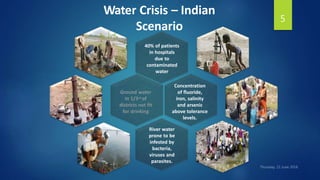
Water Crisis – Indian
Scenario
River water
prone to be
infested by
bacteria,
viruses and
parasites.
40% of patients
in hospitals
due to
contaminated
water
Ground water
in 1/3rd of
districts not fit
for drinking
Concentration
of fluoride,
iron, salinity
and arsenic
above tolerance
levels.
5
Review of the earlier work
 It has become a recent concern and idea to use solar panels as an energy source for
cleaning water in developing countries[1].
 The existing water purification systems use UV and RO filters which require electricity
and are powered by utility power supply.
 Reverse osmosis is capable of removing up to 99 percent of 65 different contaminants
including lead, fluoride, chlorine, dissolved salts, and much more[3].
 Johnathan, Coleman, Jared, Compere, Marc, Fennesy, Kyle students of Embry riddle
Aeronautical University have developed a portable solar water purifier system for public
use during disaster recovery. This system can purify water at the rate of 2-3gpm and
capable of catering the demands of 750-1000 people in a day.
 An U. S based company called AID-GEAR has developed a portable, battery powered
water purifier called Oasis-3. The Oasis-3 water purification system is designed to
rapidly provide clean, safe drinking water anywhere in the world.
6
Objective
 To design a dependable way to purify water in locations that are off the
grid and don't have constant sources of clean water.
 The design also needs to be able to built on a low budget because most
of the region where there is no potable water available are basically poor
areas.
 The main objective of the proposed work is to design and construct a solar
power water purification unit independent of utility supply.
7
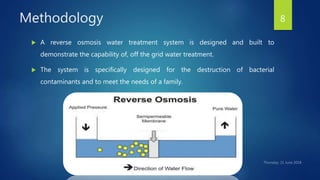
Methodology
 A reverse osmosis water treatment system is designed and built to
demonstrate the capability of, off the grid water treatment.
 The system is specifically designed for the destruction of bacterial
contaminants and to meet the needs of a family.
8
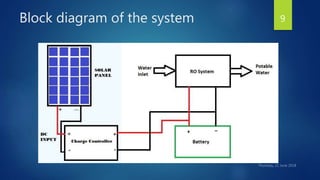
Block diagram of the system 9
 Only sunlight is required to power the purification system. Two 50w solar panels
are used to collect energy from sunlight and charge a 24V battery.
 The stored electricity is used to power the R.O system having 24v dc motor.
 The R.O treatment disrupts the bacteria , contaminants and produces a source of
potable water.
10
Components
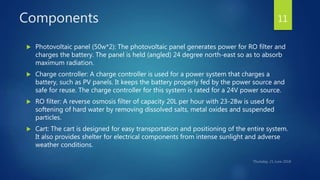
 Photovoltaic panel (50w*2): The photovoltaic panel generates power for RO filter and
charges the battery. The panel is held (angled) 24 degree north-east so as to absorb
maximum radiation.
 Charge controller: A charge controller is used for a power system that charges a
battery, such as PV panels. It keeps the battery properly fed by the power source and
safe for reuse. The charge controller for this system is rated for a 24V power source.
 RO filter: A reverse osmosis filter of capacity 20L per hour with 23-28w is used for
softening of hard water by removing dissolved salts, metal oxides and suspended
particles.
 Cart: The cart is designed for easy transportation and positioning of the entire system.
It also provides shelter for electrical components from intense sunlight and adverse
weather conditions.
11
Reverse osmosis system
 The components of R.O system is bought separately and then assembled.
 R.O system components are;
1. Pre bowl filter: Removes the suspended particles in the inlet water.
2. Sediment filter: Reduce solid particle transported by the fluid.
3. carbon filter : Removes contaminants and impurities using chemical absorption.
4. R.O filter : It has R.O membrane with capillaries of .0001 microns that removes
dissolved impurities and covert hard water into soft one.
5. DC diaphragm motor: A 24v,0.9A dc motor to pump a fluid with pressure for reverse
osmosis process.
12
Charge controller
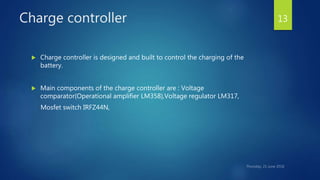
 Charge controller is designed and built to control the charging of the
battery.
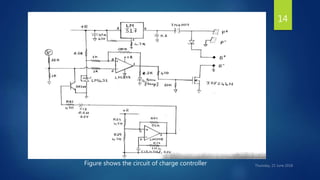
 Main components of the charge controller are : Voltage
comparator(Operational amplifier LM358),Voltage regulator LM317,
Mosfet switch IRFZ44N,
13
Figure shows the circuit of charge controller
14
Working
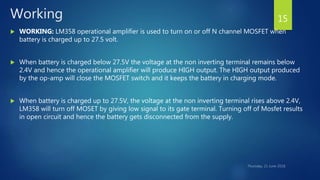
 WORKING: LM358 operational amplifier is used to turn on or off N channel MOSFET when
battery is charged up to 27.5 volt.
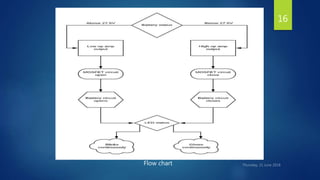
 When battery is charged below 27.5V the voltage at the non inverting terminal remains below
2.4V and hence the operational amplifier will produce HIGH output. The HIGH output produced
by the op-amp will close the MOSFET switch and it keeps the battery in charging mode.
 When battery is charged up to 27.5V, the voltage at the non inverting terminal rises above 2.4V,
LM358 will turn off MOSET by giving low signal to its gate terminal. Turning off of Mosfet results
in open circuit and hence the battery gets disconnected from the supply.
15
Flow chart
16
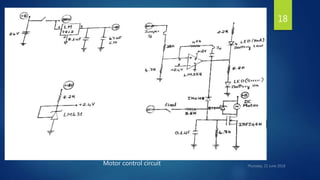
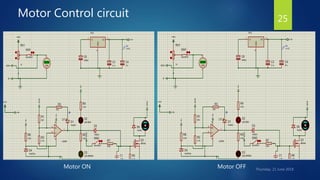
Motor control circuit
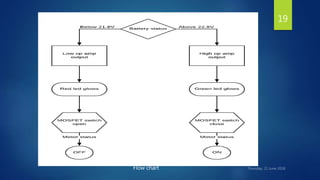
 A battery monitoring & motor control circuit is designed to continuously monitor the battery
conditions and turn off the motor if battery voltage reduce below 21.8V. LEDs are provided to
indicate motor running and battery charge status.
 When battery is charged below 21.8V the voltage at the non inverting terminal remains below
2.4V and hence the operational amplifier will produce LOW output. The LOW output produced
by the op-amp will open the MOSFET switch and resulting in turning OFF of the motor.
 When charge on the battery increases above 22.8V , the voltage at the non inverting terminal
appears above 2.4V, LM358 will close MOSET by giving HIGH signal to its gate terminal. . The
closing action of the Mosfet switch energises the motor and will continuously run until the float
switch gets opened or charge on the battery reduces below 21.8V.
17
Motor control circuit
18
Flow chart
19
Cart
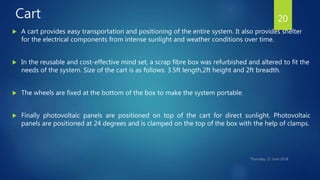
 A cart provides easy transportation and positioning of the entire system. It also provides shelter
for the electrical components from intense sunlight and weather conditions over time.
 In the reusable and cost-effective mind set, a scrap fibre box was refurbished and altered to fit the
needs of the system. Size of the cart is as follows: 3.5ft length,2ft height and 2ft breadth.
 The wheels are fixed at the bottom of the box to make the system portable.
 Finally photovoltaic panels are positioned on top of the cart for direct sunlight. Photovoltaic
panels are positioned at 24 degrees and is clamped on the top of the box with the help of clamps.
20
Results and discussions
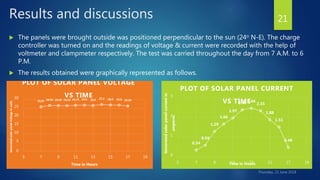
 The panels were brought outside was positioned perpendicular to the sun (24o N-E). The charge
controller was turned on and the readings of voltage & current were recorded with the help of
voltmeter and clampmeter respectively. The test was carried throughout the day from 7 A.M. to 6
P.M.
 The results obtained were graphically represented as follows.
21
25.87 26.62 26.55 26.52 26.73 26.8 26.6 27.2 26.9 26.8 26.35
0
5
10
15
20
25
30
5 7 9 11 13 15 17 19
GeneratedsolarpanelVoltageinvolts
Time in Hours
PLOT OF SOLAR PANEL VOLTAGE
VS TIME
0.34
0.59
1.29
1.66
1.97
2.38 2.46
2.33
1.88
1.51
0.48
0
1
2
3
5 7 9 11 13 15 17 19
Generatedsolarpanelcurrentin
amperes
Time in Hours
PLOT OF SOLAR PANEL CURRENT
VS TIME
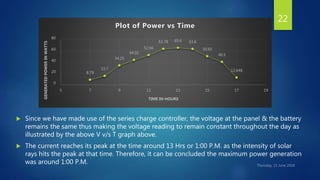
 Since we have made use of the series charge controller, the voltage at the panel & the battery
remains the same thus making the voltage reading to remain constant throughout the day as
illustrated by the above V v/s T graph above.
 The current reaches its peak at the time around 13 Hrs or 1:00 P.M. as the intensity of solar
rays hits the peak at that time. Therefore, it can be concluded the maximum power generation
was around 1:00 P.M.
22
8.79
15.7
34.25
44.02
52.66
63.78 65.6 63.6
50.65
40.5
12.648
0
20
40
60
80
5 7 9 11 13 15 17 19
GENERATEDPOWERINWATTS
TIME IN HOURS
Plot of Power vs Time
Simulation results
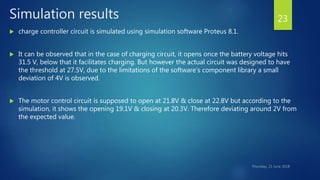
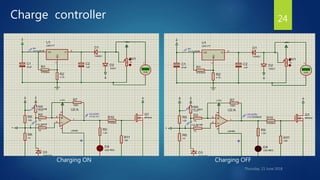
 charge controller circuit is simulated using simulation software Proteus 8.1.
 It can be observed that in the case of charging circuit, it opens once the battery voltage hits
31.5 V, below that it facilitates charging. But however the actual circuit was designed to have
the threshold at 27.5V, due to the limitations of the software’s component library a small
deviation of 4V is observed.
 The motor control circuit is supposed to open at 21.8V & close at 22.8V but according to the
simulation, it shows the opening 19.1V & closing at 20.3V. Therefore deviating around 2V from
the expected value.
23
24
Charging ON Charging OFF
Charge controller
25
Motor ON Motor OFF
Motor Control circuit
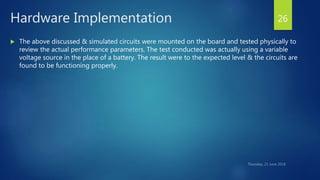
Hardware Implementation
 The above discussed & simulated circuits were mounted on the board and tested physically to
review the actual performance parameters. The test conducted was actually using a variable
voltage source in the place of a battery. The result were to the expected level & the circuits are
found to be functioning properly.
26
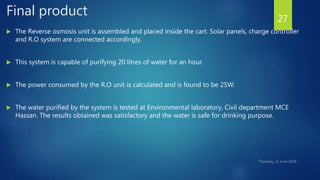
Final product
 The Reverse osmosis unit is assembled and placed inside the cart. Solar panels, charge controller
and R.O system are connected accordingly.
 This system is capable of purifying 20 litres of water for an hour.
 The power consumed by the R.O unit is calculated and is found to be 25W.
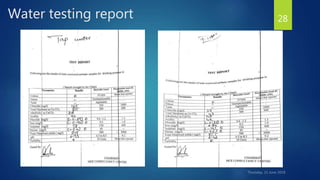
 The water purified by the system is tested at Environmental laboratory, Civil department MCE
Hassan. The results obtained was satisfactory and the water is safe for drinking purpose.
27
Water testing report 28
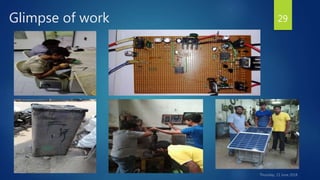
Glimpse of work 29
References
[1] Jolapara, Kamlesh. "Energize Your Home with Solar Power.“ Futureenergyblog.com.
WordPress, 16 Sept. 2014. Web. Sept. 2014.
[2] Honsberg, Christiana, and Stuart Bowden. "Efficiency and Solar Cell Cost."
PV Education. N.p., Mar. 2013. Web. Apr. 2014.
[3] Warsinger, David M.; Tow, Emily W.; Nayar, Kishor G.; Maswadeh, Laith A.; Lienhard V,
John H. (2016). "Energy efficiency of batch and semi-batch (CCRO) reverse osmosis
desalination". Water Research. pp. 272–282.
[4] Yung Wong, Shavin Pinto, Yan Tang, Marc Compere “Community Development through a
Sustainable Micro-Business Selling Clean Water”, Global Humanitarian Technology
Conference IEEE 2014.
30
Thank You
31

Solar powered portable water Purifier

  • 1.
    Solar energy harnessedportable water purifier By Murali Krishna T 4MC14EE022 Naveen A M 4MC14EE023 Rajiva Sharma C N 4MC14EE028 Bhargavarama P 4MC14EE008 Under the guidance of Mrs Mohanalakshmi J Assistant professor Dept. of EE MCE Hassan 1
  • 2.
    OUTLINE PART 1: Backgroundof the proposed work  Introduction  Review of the earlier work  Objective PART 2: Methodology and implementation  Block diagram of the system  Methodology  Charge controller and motor controller  Results obtained 2
  • 3.
    Introduction  Water isone of the most important substance on earth.  Scarcity of water and quality of water have long been a concern for many people in the world.  Population is increasing on an exponential scale which leads to a greater need for water reserves. 3
  • 4.
    Water Crisis –Global Scenario 1.1 Billion People face water Scarcity 80% of illnesses are Linked to poor water and sanitation conditions 1.8 Million People die from diarrheal diseases 2MT of Human waste is deposited in water courses everyday Less than 1% of fresh water on earth is accessible 4,100 children die every day from water borne diseases 4
  • 5.
    Water Crisis –Indian Scenario River water prone to be infested by bacteria, viruses and parasites. 40% of patients in hospitals due to contaminated water Ground water in 1/3rd of districts not fit for drinking Concentration of fluoride, iron, salinity and arsenic above tolerance levels. 5
  • 6.
    Review of theearlier work  It has become a recent concern and idea to use solar panels as an energy source for cleaning water in developing countries[1].  The existing water purification systems use UV and RO filters which require electricity and are powered by utility power supply.  Reverse osmosis is capable of removing up to 99 percent of 65 different contaminants including lead, fluoride, chlorine, dissolved salts, and much more[3].  Johnathan, Coleman, Jared, Compere, Marc, Fennesy, Kyle students of Embry riddle Aeronautical University have developed a portable solar water purifier system for public use during disaster recovery. This system can purify water at the rate of 2-3gpm and capable of catering the demands of 750-1000 people in a day.  An U. S based company called AID-GEAR has developed a portable, battery powered water purifier called Oasis-3. The Oasis-3 water purification system is designed to rapidly provide clean, safe drinking water anywhere in the world. 6
  • 7.
    Objective  To designa dependable way to purify water in locations that are off the grid and don't have constant sources of clean water.  The design also needs to be able to built on a low budget because most of the region where there is no potable water available are basically poor areas.  The main objective of the proposed work is to design and construct a solar power water purification unit independent of utility supply. 7
  • 8.
    Methodology  A reverseosmosis water treatment system is designed and built to demonstrate the capability of, off the grid water treatment.  The system is specifically designed for the destruction of bacterial contaminants and to meet the needs of a family. 8
  • 9.
    Block diagram ofthe system 9
  • 10.
     Only sunlightis required to power the purification system. Two 50w solar panels are used to collect energy from sunlight and charge a 24V battery.  The stored electricity is used to power the R.O system having 24v dc motor.  The R.O treatment disrupts the bacteria , contaminants and produces a source of potable water. 10
  • 11.
    Components  Photovoltaic panel(50w*2): The photovoltaic panel generates power for RO filter and charges the battery. The panel is held (angled) 24 degree north-east so as to absorb maximum radiation.  Charge controller: A charge controller is used for a power system that charges a battery, such as PV panels. It keeps the battery properly fed by the power source and safe for reuse. The charge controller for this system is rated for a 24V power source.  RO filter: A reverse osmosis filter of capacity 20L per hour with 23-28w is used for softening of hard water by removing dissolved salts, metal oxides and suspended particles.  Cart: The cart is designed for easy transportation and positioning of the entire system. It also provides shelter for electrical components from intense sunlight and adverse weather conditions. 11
  • 12.
    Reverse osmosis system The components of R.O system is bought separately and then assembled.  R.O system components are; 1. Pre bowl filter: Removes the suspended particles in the inlet water. 2. Sediment filter: Reduce solid particle transported by the fluid. 3. carbon filter : Removes contaminants and impurities using chemical absorption. 4. R.O filter : It has R.O membrane with capillaries of .0001 microns that removes dissolved impurities and covert hard water into soft one. 5. DC diaphragm motor: A 24v,0.9A dc motor to pump a fluid with pressure for reverse osmosis process. 12
  • 13.
    Charge controller  Chargecontroller is designed and built to control the charging of the battery.  Main components of the charge controller are : Voltage comparator(Operational amplifier LM358),Voltage regulator LM317, Mosfet switch IRFZ44N, 13
  • 14.
    Figure shows thecircuit of charge controller 14
  • 15.
    Working  WORKING: LM358operational amplifier is used to turn on or off N channel MOSFET when battery is charged up to 27.5 volt.  When battery is charged below 27.5V the voltage at the non inverting terminal remains below 2.4V and hence the operational amplifier will produce HIGH output. The HIGH output produced by the op-amp will close the MOSFET switch and it keeps the battery in charging mode.  When battery is charged up to 27.5V, the voltage at the non inverting terminal rises above 2.4V, LM358 will turn off MOSET by giving low signal to its gate terminal. Turning off of Mosfet results in open circuit and hence the battery gets disconnected from the supply. 15
  • 16.
  • 17.
    Motor control circuit A battery monitoring & motor control circuit is designed to continuously monitor the battery conditions and turn off the motor if battery voltage reduce below 21.8V. LEDs are provided to indicate motor running and battery charge status.  When battery is charged below 21.8V the voltage at the non inverting terminal remains below 2.4V and hence the operational amplifier will produce LOW output. The LOW output produced by the op-amp will open the MOSFET switch and resulting in turning OFF of the motor.  When charge on the battery increases above 22.8V , the voltage at the non inverting terminal appears above 2.4V, LM358 will close MOSET by giving HIGH signal to its gate terminal. . The closing action of the Mosfet switch energises the motor and will continuously run until the float switch gets opened or charge on the battery reduces below 21.8V. 17
  • 18.
  • 19.
  • 20.
    Cart  A cartprovides easy transportation and positioning of the entire system. It also provides shelter for the electrical components from intense sunlight and weather conditions over time.  In the reusable and cost-effective mind set, a scrap fibre box was refurbished and altered to fit the needs of the system. Size of the cart is as follows: 3.5ft length,2ft height and 2ft breadth.  The wheels are fixed at the bottom of the box to make the system portable.  Finally photovoltaic panels are positioned on top of the cart for direct sunlight. Photovoltaic panels are positioned at 24 degrees and is clamped on the top of the box with the help of clamps. 20
  • 21.
    Results and discussions The panels were brought outside was positioned perpendicular to the sun (24o N-E). The charge controller was turned on and the readings of voltage & current were recorded with the help of voltmeter and clampmeter respectively. The test was carried throughout the day from 7 A.M. to 6 P.M.  The results obtained were graphically represented as follows. 21 25.87 26.62 26.55 26.52 26.73 26.8 26.6 27.2 26.9 26.8 26.35 0 5 10 15 20 25 30 5 7 9 11 13 15 17 19 GeneratedsolarpanelVoltageinvolts Time in Hours PLOT OF SOLAR PANEL VOLTAGE VS TIME 0.34 0.59 1.29 1.66 1.97 2.38 2.46 2.33 1.88 1.51 0.48 0 1 2 3 5 7 9 11 13 15 17 19 Generatedsolarpanelcurrentin amperes Time in Hours PLOT OF SOLAR PANEL CURRENT VS TIME
  • 22.
     Since wehave made use of the series charge controller, the voltage at the panel & the battery remains the same thus making the voltage reading to remain constant throughout the day as illustrated by the above V v/s T graph above.  The current reaches its peak at the time around 13 Hrs or 1:00 P.M. as the intensity of solar rays hits the peak at that time. Therefore, it can be concluded the maximum power generation was around 1:00 P.M. 22 8.79 15.7 34.25 44.02 52.66 63.78 65.6 63.6 50.65 40.5 12.648 0 20 40 60 80 5 7 9 11 13 15 17 19 GENERATEDPOWERINWATTS TIME IN HOURS Plot of Power vs Time
  • 23.
    Simulation results  chargecontroller circuit is simulated using simulation software Proteus 8.1.  It can be observed that in the case of charging circuit, it opens once the battery voltage hits 31.5 V, below that it facilitates charging. But however the actual circuit was designed to have the threshold at 27.5V, due to the limitations of the software’s component library a small deviation of 4V is observed.  The motor control circuit is supposed to open at 21.8V & close at 22.8V but according to the simulation, it shows the opening 19.1V & closing at 20.3V. Therefore deviating around 2V from the expected value. 23
  • 24.
    24 Charging ON ChargingOFF Charge controller
  • 25.
    25 Motor ON MotorOFF Motor Control circuit
  • 26.
    Hardware Implementation  Theabove discussed & simulated circuits were mounted on the board and tested physically to review the actual performance parameters. The test conducted was actually using a variable voltage source in the place of a battery. The result were to the expected level & the circuits are found to be functioning properly. 26
  • 27.
    Final product  TheReverse osmosis unit is assembled and placed inside the cart. Solar panels, charge controller and R.O system are connected accordingly.  This system is capable of purifying 20 litres of water for an hour.  The power consumed by the R.O unit is calculated and is found to be 25W.  The water purified by the system is tested at Environmental laboratory, Civil department MCE Hassan. The results obtained was satisfactory and the water is safe for drinking purpose. 27
  • 28.
  • 29.
  • 30.
    References [1] Jolapara, Kamlesh."Energize Your Home with Solar Power.“ Futureenergyblog.com. WordPress, 16 Sept. 2014. Web. Sept. 2014. [2] Honsberg, Christiana, and Stuart Bowden. "Efficiency and Solar Cell Cost." PV Education. N.p., Mar. 2013. Web. Apr. 2014. [3] Warsinger, David M.; Tow, Emily W.; Nayar, Kishor G.; Maswadeh, Laith A.; Lienhard V, John H. (2016). "Energy efficiency of batch and semi-batch (CCRO) reverse osmosis desalination". Water Research. pp. 272–282. [4] Yung Wong, Shavin Pinto, Yan Tang, Marc Compere “Community Development through a Sustainable Micro-Business Selling Clean Water”, Global Humanitarian Technology Conference IEEE 2014. 30
  • 31.

Editor's Notes