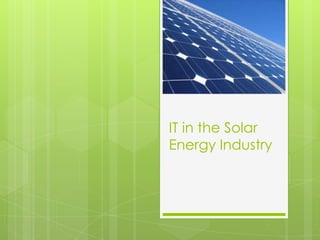
IT in the Solar
Energy Industry
History
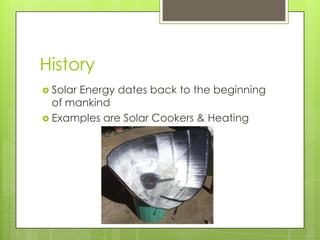
 SolarEnergy dates back to the beginning
  of mankind
 Examples are Solar Cookers & Heating
History
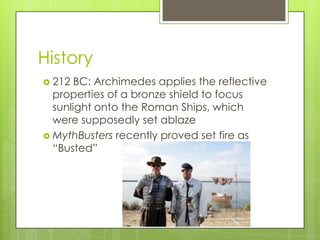
 212  BC: Archimedes applies the reflective
  properties of a bronze shield to focus
  sunlight onto the Roman Ships, which
  were supposedly set ablaze
 MythBusters recently proved set fire as
  “Busted”
History
 1515: Da Vinci developed a solar collector,
  but was never completed
 1767: De Saussure of Switzerland built the
  world’s first solar collector
 The solar collector was later used in British
  expeditions in South Africa
History
 1839:   Edmond Becquerrel of France
  discovered the photovoltaic effect
 1891: Clarence Kemp of Baltimore patented
  the first solar water heater
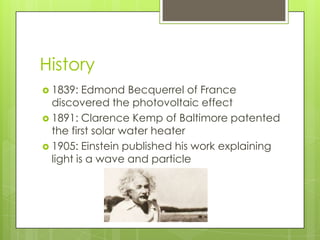
 1905: Einstein published his work explaining
  light is a wave and particle
History
 1908: William Baily of Carnegie Steel
  created the first solar thermal collector
 1941: Earliest known silicon solar cell
  invented by Russell Ohl, but only had 1%
  conversion efficency
History
 1954: Daryl Chaplin, Calvin Fuller and
  Gerald Pearson of Bell Laboratories
  developed the silicon photovoltaic (PV)
  cell with six percent conversion efficiency
 Captured free electrons and converted
  to electrical current
 1955: Bell technology used in telephone
  carrier system in Americus, GA
History
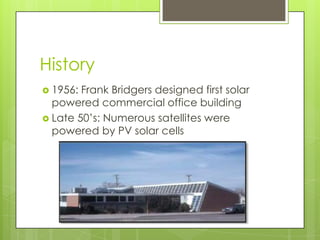
 1956: Frank Bridgers designed first solar
  powered commercial office building
 Late 50’s: Numerous satellites were
  powered by PV solar cells
Late 1970’s
 Late  70’s: NASA Lewis Research Center
  installs 83 PV cell systems across the world
 Included was Papago Indian Reservation
  in Arizona which was first village
  complexly run by solar energy
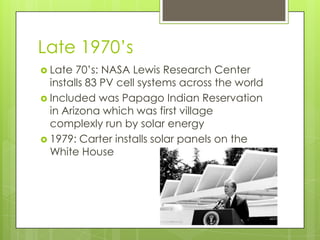
 1979: Carter installs solar panels on the
  White House
History
 1983: ARCO Solar develops first solar field in
  central California & Solar Design Associates
  develops another field in Hudson River Valley
 1986: 150 MW field place in Kramer Junction, CA
  which utilized the application of mirrors and
  turbines
 1986: Reagan removed White House PV cells
History
 1990’s: Decreasing costs in energy
 1994: NREL new cells using gallium
  arsenide and gallium indium phosphide,
  increasing conversion efficiencies to 30%
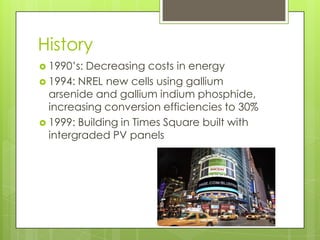
 1999: Building in Times Square built with
  intergraded PV panels
IT History
 ITwas not a factor in Solar Energy until
  large applications of panels were used
 Data of power consumption helped
  optimize usage of battery/solar energy
 This made sure there was no interruption in
  power consumption
Commercial
Applications
of IT and Solar
Energy
Energy Infrastructure Evolution
 Paradigm/Infrastructure    Shift
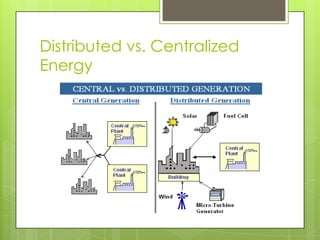
    Centralized Energy Systems
    Distributed (Decentralized) Energy Systems
Centralized Energy Systems
   Located close to resources
   Flocated close to resources
   Economiucs of Scale
       1960s begin to see decline
       No longer competitvely cheap/reliable
       Unable to effectively serve “remote customers
   Environmental Issues
       Polution/Ozone depletion – Global Warming
       Burning off Fossil Fuels
         Coal
         High CO2 emissions
Distributed Energy Systems
   Highly Decentralized/Localized
       Mass produced plants
         Smaller
         Site-Specific
       Modular architecture
           Multiple generators, stores, distribution paths

   Integration of Clean/Renewable Energy
    Sources
       Winds, Solar & Geothermic
Distributed vs. Centralized
Energy
Implications on IT
 The   Smart Grid to Improve
    Reliability
    Flexibility
    Efficiency
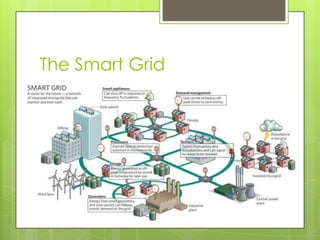
What is the Smart Grid
   Computer-based automation, control,
    management and monitoring of energy systems

   Applications
            Supply/Demand forecasting of energy needs
            Dynamic energy resource allocation
            Virtual power plants, remote control of energy
             distribution assets
            Consumer-side power management


   Information Technology is the innovation driver
The Smart Grid
The Role of Renewables and
the Smart Grid
 Renewables   will supply an increasing
  portion of our overall energy demands
 Modular infrastructure mediated by Smart
  Grid technology will ease integration
     SG/IT to manage these resources
     Supplement existing energy generation
      clusters
 "Plug   and play"
Solar/Photovoltaic Energy and
the Smart Grid
   Increased adoption and development of PV
    technology
     Enabled by SG infrastructure
     Allow "on-site" photovoltaics to use existing
       land/structures
     Distribution close to where being consumed
   Virtual controllers
     Innovative sun-tracking capabilities on
       panels
     Realizing greater efficiency
Solar/Photovoltaic Energy and
the Smart Grid
   Positive Business Implications
     Increased cost competitiveness
     Growing supporting ecosystem
   New Business Opportunities/Business Model
    Innovation
       Solar Panel Development
           IT Component/supporting tech
       Solar Panel Integration
           Installation using localized usage data
           Architect large/small-scale implementation strategies
       Solar Energy Management
           Software development - intellegent energy management
           End-to-end customer service, personalized reporting
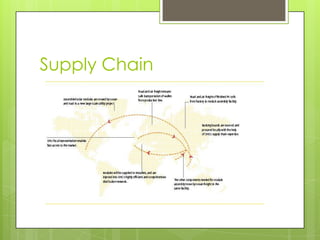
Supply Chain
 Silicon suppliers- Asia
 Cell manufacturers -Asia
 Module manufacturers -Asia and Europe
 Distributors or systems integrators Asia and
  Europe
Supply Chain
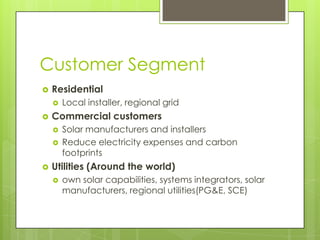
Customer Segment
   Residential
       Local installer, regional grid
   Commercial customers
       Solar manufacturers and installers
       Reduce electricity expenses and carbon
        footprints
   Utilities (Around the world)
       own solar capabilities, systems integrators, solar
        manufacturers, regional utilities(PG&E, SCE)
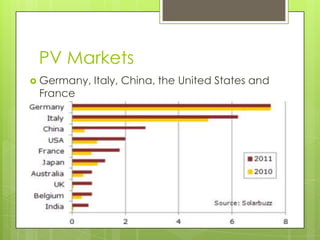
PV Markets
 Germany,   Italy, China, the United States and
 France
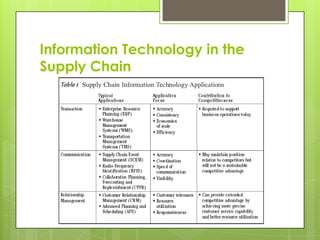
Information Technology in the
Supply Chain
   Transaction category: order management,
    warehouse management, transportation
    management, and accounting
   Communication category: exchange
    information between firm locations, global
    sites and supply chain partners
   Relationship category: manage the strategic
    and tactical relationships between firms and
    their customers
Information Technology in the
Supply Chain
Domestic
Applications
of IT and Solar
Energy
Domestic IT Advantages
 Advantage    of this processing power is by
  optimizing power output.
 Inverters fuse panel monitoring systems to
  boost performance and domestic
  application.
 Sophisticated algorithms to maximize
  power outputs.
Performance is Boosted By:
   Power mismatch causes current variance
    between panels on string (3-5%)
   Partial shading caused by leaves, fixture
    shadows, leaves, and weather over multiple
    panels (Causes damage and reduces power
    by 5-25%)
   Under voltage caused by short strings(IV
    Curve reduced 15% caused by short strings
    and high temperatures)
   Suboptimal Maximum Power Point Tracking (3-
    10% power losses)
Suboptimal Points
 Solar   panels all have problems .

 Theseproblems produce variances in
 voltage.

 Since the panels must be strung together
 the challenges rise out of optimizing the
 string current.
IT systems in the solar industry
 Utilize advance calculus
 real-time information
 Create a transfer for theoretical maximum
  points over dynamic energy production.
 This allows for domestic solar panel
  systems to become up to 25% more
  efficient.
IT Forward
Looking
Applications in
Solar Industry
Future Trends
 Increase Conversion Efficiency


 Control System


 Centralized to Decentralized
Increase Conversion
         Solar        Efficiency
         Maps
                          Solar maps provide l solar
                          resource information on grid
                          cells.
Computational             Computers model and
  Simulation
                          predict solar energy levels.
                          What’s more, a solar
                          simulator is a device that
                          provides illumination
       Monitoring         approximating
      Manufacturing       natural sunlight.
                          IT helps to monitor the
                          defects and improve the
                          quality of the solar panels.
Control System
 Data   tracking& reporting: IT can help to
  track the power generated individually
  from each module and report the data.
 WiFi Tagging: Wireless solar-powered tags
  can be installed on solar system to relay
  system data not only to users but also to
  local utility suppliers.
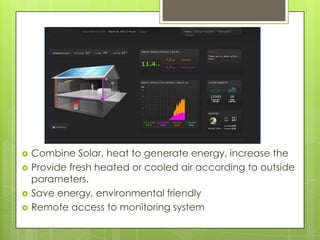
 Intelligent Management System
   Combine Solar, heat to generate energy, increase the
   Provide fresh heated or cooled air according to outside
    parameters.
   Save energy, environmental friendly
   Remote access to monitoring system
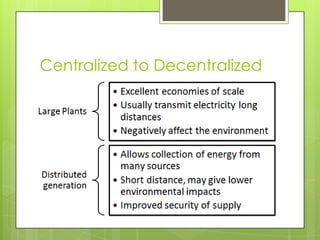
Centralized to Decentralized
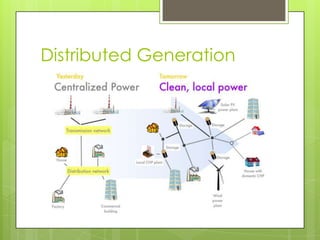
Distributed Generation
Questions

Solar Panels

  • 1.
    IT in theSolar Energy Industry
  • 2.
    History  SolarEnergy datesback to the beginning of mankind  Examples are Solar Cookers & Heating
  • 3.
    History  212 BC: Archimedes applies the reflective properties of a bronze shield to focus sunlight onto the Roman Ships, which were supposedly set ablaze  MythBusters recently proved set fire as “Busted”
  • 4.
    History  1515: DaVinci developed a solar collector, but was never completed  1767: De Saussure of Switzerland built the world’s first solar collector  The solar collector was later used in British expeditions in South Africa
  • 5.
    History  1839: Edmond Becquerrel of France discovered the photovoltaic effect  1891: Clarence Kemp of Baltimore patented the first solar water heater  1905: Einstein published his work explaining light is a wave and particle
  • 6.
    History  1908: WilliamBaily of Carnegie Steel created the first solar thermal collector  1941: Earliest known silicon solar cell invented by Russell Ohl, but only had 1% conversion efficency
  • 7.
    History  1954: DarylChaplin, Calvin Fuller and Gerald Pearson of Bell Laboratories developed the silicon photovoltaic (PV) cell with six percent conversion efficiency  Captured free electrons and converted to electrical current  1955: Bell technology used in telephone carrier system in Americus, GA
  • 8.
    History  1956: FrankBridgers designed first solar powered commercial office building  Late 50’s: Numerous satellites were powered by PV solar cells
  • 9.
    Late 1970’s  Late 70’s: NASA Lewis Research Center installs 83 PV cell systems across the world  Included was Papago Indian Reservation in Arizona which was first village complexly run by solar energy  1979: Carter installs solar panels on the White House
  • 10.
    History  1983: ARCOSolar develops first solar field in central California & Solar Design Associates develops another field in Hudson River Valley  1986: 150 MW field place in Kramer Junction, CA which utilized the application of mirrors and turbines  1986: Reagan removed White House PV cells
  • 11.
    History  1990’s: Decreasingcosts in energy  1994: NREL new cells using gallium arsenide and gallium indium phosphide, increasing conversion efficiencies to 30%  1999: Building in Times Square built with intergraded PV panels
  • 12.
    IT History  ITwasnot a factor in Solar Energy until large applications of panels were used  Data of power consumption helped optimize usage of battery/solar energy  This made sure there was no interruption in power consumption
  • 13.
  • 14.
    Energy Infrastructure Evolution Paradigm/Infrastructure Shift  Centralized Energy Systems  Distributed (Decentralized) Energy Systems
  • 15.
    Centralized Energy Systems  Located close to resources  Flocated close to resources  Economiucs of Scale  1960s begin to see decline  No longer competitvely cheap/reliable  Unable to effectively serve “remote customers  Environmental Issues  Polution/Ozone depletion – Global Warming  Burning off Fossil Fuels  Coal  High CO2 emissions
  • 16.
    Distributed Energy Systems  Highly Decentralized/Localized  Mass produced plants  Smaller  Site-Specific  Modular architecture  Multiple generators, stores, distribution paths  Integration of Clean/Renewable Energy Sources  Winds, Solar & Geothermic
  • 17.
  • 18.
    Implications on IT The Smart Grid to Improve  Reliability  Flexibility  Efficiency
  • 19.
    What is theSmart Grid  Computer-based automation, control, management and monitoring of energy systems  Applications  Supply/Demand forecasting of energy needs  Dynamic energy resource allocation  Virtual power plants, remote control of energy distribution assets  Consumer-side power management  Information Technology is the innovation driver
  • 20.
  • 21.
    The Role ofRenewables and the Smart Grid  Renewables will supply an increasing portion of our overall energy demands  Modular infrastructure mediated by Smart Grid technology will ease integration  SG/IT to manage these resources  Supplement existing energy generation clusters  "Plug and play"
  • 22.
    Solar/Photovoltaic Energy and theSmart Grid  Increased adoption and development of PV technology  Enabled by SG infrastructure  Allow "on-site" photovoltaics to use existing land/structures  Distribution close to where being consumed  Virtual controllers  Innovative sun-tracking capabilities on panels  Realizing greater efficiency
  • 23.
    Solar/Photovoltaic Energy and theSmart Grid  Positive Business Implications  Increased cost competitiveness  Growing supporting ecosystem  New Business Opportunities/Business Model Innovation  Solar Panel Development  IT Component/supporting tech  Solar Panel Integration  Installation using localized usage data  Architect large/small-scale implementation strategies  Solar Energy Management  Software development - intellegent energy management  End-to-end customer service, personalized reporting
  • 24.
    Supply Chain  Siliconsuppliers- Asia  Cell manufacturers -Asia  Module manufacturers -Asia and Europe  Distributors or systems integrators Asia and Europe
  • 25.
  • 26.
    Customer Segment  Residential  Local installer, regional grid  Commercial customers  Solar manufacturers and installers  Reduce electricity expenses and carbon footprints  Utilities (Around the world)  own solar capabilities, systems integrators, solar manufacturers, regional utilities(PG&E, SCE)
  • 27.
    PV Markets  Germany, Italy, China, the United States and France
  • 28.
    Information Technology inthe Supply Chain  Transaction category: order management, warehouse management, transportation management, and accounting  Communication category: exchange information between firm locations, global sites and supply chain partners  Relationship category: manage the strategic and tactical relationships between firms and their customers
  • 29.
    Information Technology inthe Supply Chain
  • 30.
  • 31.
    Domestic IT Advantages Advantage of this processing power is by optimizing power output.  Inverters fuse panel monitoring systems to boost performance and domestic application.  Sophisticated algorithms to maximize power outputs.
  • 32.
    Performance is BoostedBy:  Power mismatch causes current variance between panels on string (3-5%)  Partial shading caused by leaves, fixture shadows, leaves, and weather over multiple panels (Causes damage and reduces power by 5-25%)  Under voltage caused by short strings(IV Curve reduced 15% caused by short strings and high temperatures)  Suboptimal Maximum Power Point Tracking (3- 10% power losses)
  • 33.
    Suboptimal Points  Solar panels all have problems .  Theseproblems produce variances in voltage.  Since the panels must be strung together the challenges rise out of optimizing the string current.
  • 34.
    IT systems inthe solar industry  Utilize advance calculus  real-time information  Create a transfer for theoretical maximum points over dynamic energy production.  This allows for domestic solar panel systems to become up to 25% more efficient.
  • 35.
  • 36.
    Future Trends IncreaseConversion Efficiency Control System Centralized to Decentralized
  • 37.
    Increase Conversion Solar Efficiency Maps Solar maps provide l solar resource information on grid cells. Computational Computers model and Simulation predict solar energy levels. What’s more, a solar simulator is a device that provides illumination Monitoring approximating Manufacturing natural sunlight. IT helps to monitor the defects and improve the quality of the solar panels.
  • 38.
    Control System  Data tracking& reporting: IT can help to track the power generated individually from each module and report the data.  WiFi Tagging: Wireless solar-powered tags can be installed on solar system to relay system data not only to users but also to local utility suppliers.  Intelligent Management System
  • 39.
    Combine Solar, heat to generate energy, increase the  Provide fresh heated or cooled air according to outside parameters.  Save energy, environmental friendly  Remote access to monitoring system
  • 40.
  • 41.
  • 42.