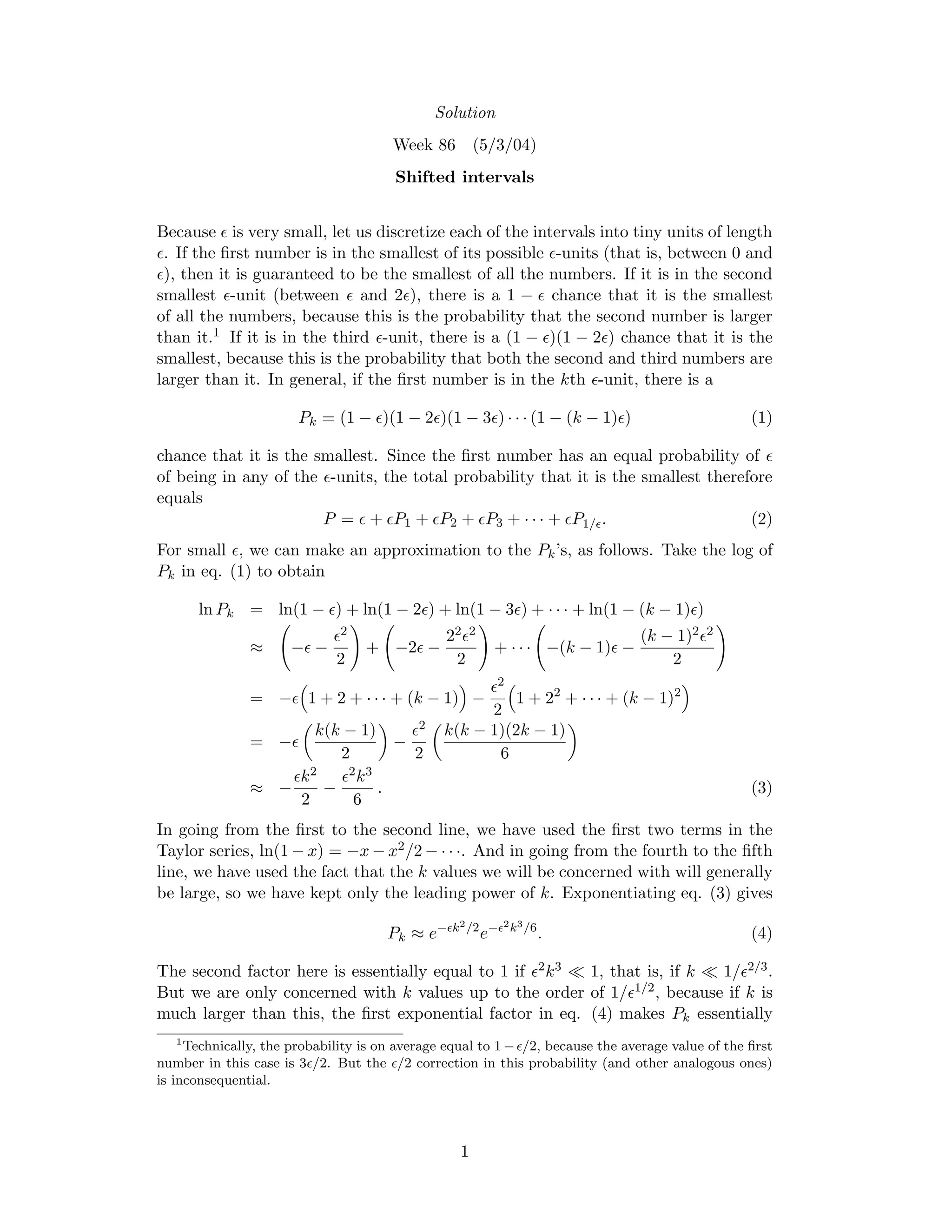
Solution
Week 86 (5/3/04)
Shifted intervals
Because is very small, let us discretize each of the intervals into tiny units of length
. If the first number is in the smallest of its possible -units (that is, between 0 and
), then it is guaranteed to be the smallest of all the numbers. If it is in the second
smallest -unit (between and 2 ), there is a 1 − chance that it is the smallest
of all the numbers, because this is the probability that the second number is larger
than it.1 If it is in the third -unit, there is a (1 − )(1 − 2 ) chance that it is the
smallest, because this is the probability that both the second and third numbers are
larger than it. In general, if the first number is in the kth -unit, there is a
Pk = (1 − )(1 − 2 )(1 − 3 ) · · · (1 − (k − 1) ) (1)
chance that it is the smallest. Since the first number has an equal probability of
of being in any of the -units, the total probability that it is the smallest therefore
equals
P = + P1 + P2 + P3 + · · · + P1/ . (2)
For small , we can make an approximation to the Pk’s, as follows. Take the log of
Pk in eq. (1) to obtain
ln Pk = ln(1 − ) + ln(1 − 2 ) + ln(1 − 3 ) + · · · + ln(1 − (k − 1) )
≈ − −
2
2
+ −2 −
22 2
2
+ · · · −(k − 1) −
(k − 1)2 2
2
= − 1 + 2 + · · · + (k − 1) −
2
2
1 + 22
+ · · · + (k − 1)2
= −
k(k − 1)
2
−
2
2
k(k − 1)(2k − 1)
6
≈ −
k2
2
−
2k3
6
. (3)
In going from the first to the second line, we have used the first two terms in the
Taylor series, ln(1 − x) = −x − x2/2 − · · ·. And in going from the fourth to the fifth
line, we have used the fact that the k values we will be concerned with will generally
be large, so we have kept only the leading power of k. Exponentiating eq. (3) gives
Pk ≈ e− k2/2
e− 2k3/6
. (4)
The second factor here is essentially equal to 1 if 2k3 1, that is, if k 1/ 2/3.
But we are only concerned with k values up to the order of 1/ 1/2, because if k is
much larger than this, the first exponential factor in eq. (4) makes Pk essentially
1
Technically, the probability is on average equal to 1− /2, because the average value of the first
number in this case is 3 /2. But the /2 correction in this probability (and other analogous ones)
is inconsequential.
1
equal to zero. Since 1/ 1/2 1/ 2/3, we see that whenever Pk is not essentially
zero, we can set the second exponential factor equal to 1. So we have
Pk ≈ e− k2/2
. (5)
Eq. (2) then becomes
P ≈ 1 + e− /2
+ e−22 /2
+ e−32 /2
+ · · · + e−(1/ )2 /2
. (6)
Since is small, we may approximate this sum by an integral. And since the terms
eventually become negligibly small, we can let the integral run to infinity. We then
have
P ≈
∞
0
e−( /2)x2
dx. (7)
Using the general result, ∞
−∞ e−y2/b dy =
√
πb, we have
P ≈
2
2π
=
π
2
≡
π
2N
. (8)
Note that the Pk in eq. (5) is negligibly small if k 1
√
≡
√
N. Therefore, most
of the terms in the sum in eq. (6) are negligible. The fraction of the terms that
contribute goes like
√
N/N = 1/
√
N.
Remark: Eq. (8) shows that P scales like 1/
√
N. If we consider the different setup
where all the N intervals range from 0 to 1, instead of being successively shifted by , then
the probability that the first number is the smallest is simply 1/N, because the smallest
number is equally likely to be in any of the N identical intervals. It makes sense that the
above 1/
√
N result for the shifted intervals is larger than the 1/N result for the non-shifted
intervals.
If you want to derive the “non-shifted” 1/N result by doing an integral, observe that
if the first number equals x, then there is a (1 − x)N−1
chance that all the other N − 1
numbers are larger than x. Therefore,
P =
1
0
(1 − x)N−1
dx =
1
N
. (9)
2

Sol86

  • 1.
    Solution Week 86 (5/3/04) Shiftedintervals Because is very small, let us discretize each of the intervals into tiny units of length . If the first number is in the smallest of its possible -units (that is, between 0 and ), then it is guaranteed to be the smallest of all the numbers. If it is in the second smallest -unit (between and 2 ), there is a 1 − chance that it is the smallest of all the numbers, because this is the probability that the second number is larger than it.1 If it is in the third -unit, there is a (1 − )(1 − 2 ) chance that it is the smallest, because this is the probability that both the second and third numbers are larger than it. In general, if the first number is in the kth -unit, there is a Pk = (1 − )(1 − 2 )(1 − 3 ) · · · (1 − (k − 1) ) (1) chance that it is the smallest. Since the first number has an equal probability of of being in any of the -units, the total probability that it is the smallest therefore equals P = + P1 + P2 + P3 + · · · + P1/ . (2) For small , we can make an approximation to the Pk’s, as follows. Take the log of Pk in eq. (1) to obtain ln Pk = ln(1 − ) + ln(1 − 2 ) + ln(1 − 3 ) + · · · + ln(1 − (k − 1) ) ≈ − − 2 2 + −2 − 22 2 2 + · · · −(k − 1) − (k − 1)2 2 2 = − 1 + 2 + · · · + (k − 1) − 2 2 1 + 22 + · · · + (k − 1)2 = − k(k − 1) 2 − 2 2 k(k − 1)(2k − 1) 6 ≈ − k2 2 − 2k3 6 . (3) In going from the first to the second line, we have used the first two terms in the Taylor series, ln(1 − x) = −x − x2/2 − · · ·. And in going from the fourth to the fifth line, we have used the fact that the k values we will be concerned with will generally be large, so we have kept only the leading power of k. Exponentiating eq. (3) gives Pk ≈ e− k2/2 e− 2k3/6 . (4) The second factor here is essentially equal to 1 if 2k3 1, that is, if k 1/ 2/3. But we are only concerned with k values up to the order of 1/ 1/2, because if k is much larger than this, the first exponential factor in eq. (4) makes Pk essentially 1 Technically, the probability is on average equal to 1− /2, because the average value of the first number in this case is 3 /2. But the /2 correction in this probability (and other analogous ones) is inconsequential. 1
  • 2.
    equal to zero.Since 1/ 1/2 1/ 2/3, we see that whenever Pk is not essentially zero, we can set the second exponential factor equal to 1. So we have Pk ≈ e− k2/2 . (5) Eq. (2) then becomes P ≈ 1 + e− /2 + e−22 /2 + e−32 /2 + · · · + e−(1/ )2 /2 . (6) Since is small, we may approximate this sum by an integral. And since the terms eventually become negligibly small, we can let the integral run to infinity. We then have P ≈ ∞ 0 e−( /2)x2 dx. (7) Using the general result, ∞ −∞ e−y2/b dy = √ πb, we have P ≈ 2 2π = π 2 ≡ π 2N . (8) Note that the Pk in eq. (5) is negligibly small if k 1 √ ≡ √ N. Therefore, most of the terms in the sum in eq. (6) are negligible. The fraction of the terms that contribute goes like √ N/N = 1/ √ N. Remark: Eq. (8) shows that P scales like 1/ √ N. If we consider the different setup where all the N intervals range from 0 to 1, instead of being successively shifted by , then the probability that the first number is the smallest is simply 1/N, because the smallest number is equally likely to be in any of the N identical intervals. It makes sense that the above 1/ √ N result for the shifted intervals is larger than the 1/N result for the non-shifted intervals. If you want to derive the “non-shifted” 1/N result by doing an integral, observe that if the first number equals x, then there is a (1 − x)N−1 chance that all the other N − 1 numbers are larger than x. Therefore, P = 1 0 (1 − x)N−1 dx = 1 N . (9) 2