Solution
Week 72 (1/26/04)
Find the foci
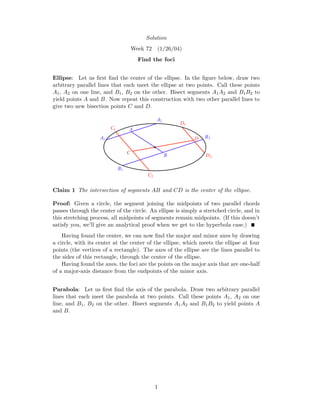
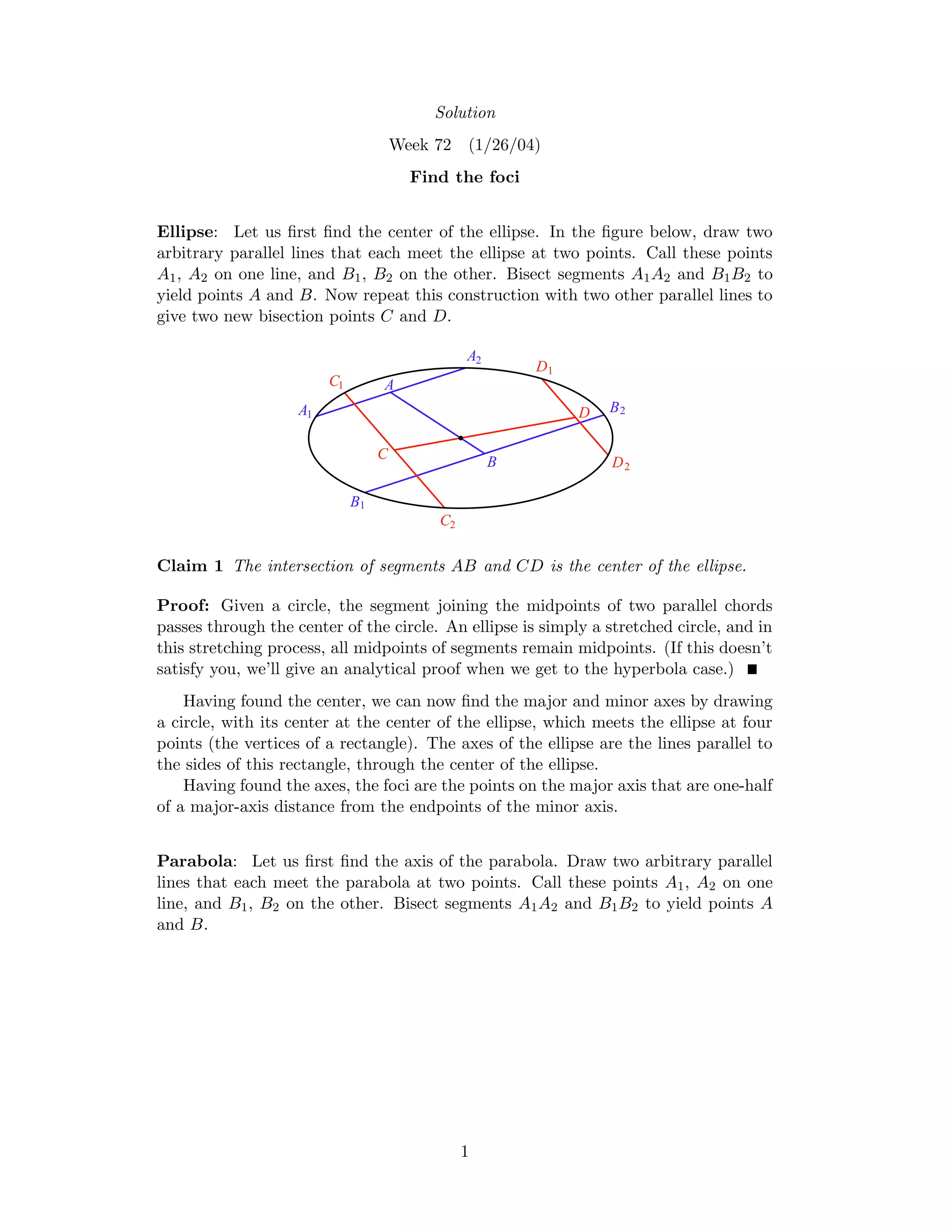
Ellipse: Let us first find the center of the ellipse. In the figure below, draw two
arbitrary parallel lines that each meet the ellipse at two points. Call these points
A1, A2 on one line, and B1, B2 on the other. Bisect segments A1A2 and B1B2 to
yield points A and B. Now repeat this construction with two other parallel lines to
give two new bisection points C and D.
A
A
C
B
D1
C1
C2
D1
D2
A2
B1
B2
Claim 1 The intersection of segments AB and CD is the center of the ellipse.
Proof: Given a circle, the segment joining the midpoints of two parallel chords
passes through the center of the circle. An ellipse is simply a stretched circle, and in
this stretching process, all midpoints of segments remain midpoints. (If this doesn’t
satisfy you, we’ll give an analytical proof when we get to the hyperbola case.)
Having found the center, we can now find the major and minor axes by drawing
a circle, with its center at the center of the ellipse, which meets the ellipse at four
points (the vertices of a rectangle). The axes of the ellipse are the lines parallel to
the sides of this rectangle, through the center of the ellipse.
Having found the axes, the foci are the points on the major axis that are one-half
of a major-axis distance from the endpoints of the minor axis.
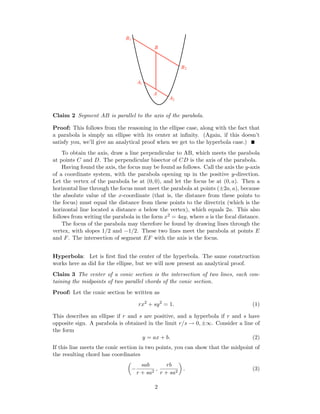
Parabola: Let us first find the axis of the parabola. Draw two arbitrary parallel
lines that each meet the parabola at two points. Call these points A1, A2 on one
line, and B1, B2 on the other. Bisect segments A1A2 and B1B2 to yield points A
and B.
1
A
A
B
1
A2
B1
B2
Claim 2 Segment AB is parallel to the axis of the parabola.
Proof: This follows from the reasoning in the ellipse case, along with the fact that
a parabola is simply an ellipse with its center at infinity. (Again, if this doesn’t
satisfy you, we’ll give an analytical proof when we get to the hyperbola case.)
To obtain the axis, draw a line perpendicular to AB, which meets the parabola
at points C and D. The perpendicular bisector of CD is the axis of the parabola.
Having found the axis, the focus may be found as follows. Call the axis the y-axis
of a coordinate system, with the parabola opening up in the positive y-direction.
Let the vertex of the parabola be at (0, 0), and let the focus be at (0, a). Then a
horizontal line through the focus must meet the parabola at points (±2a, a), because
the absolute value of the x-coordinate (that is, the distance from these points to
the focus) must equal the distance from these points to the directrix (which is the
horizontal line located a distance a below the vertex), which equals 2a. This also
follows from writing the parabola in the form x2 = 4ay, where a is the focal distance.
The focus of the parabola may therefore be found by drawing lines through the
vertex, with slopes 1/2 and −1/2. These two lines meet the parabola at points E
and F. The intersection of segment EF with the axis is the focus.
Hyperbola: Let is first find the center of the hyperbola. The same construction
works here as did for the ellipse, but we will now present an analytical proof.
Claim 3 The center of a conic section is the intersection of two lines, each con-
taining the midpoints of two parallel chords of the conic section.
Proof: Let the conic section be written as
rx2
+ sy2
= 1. (1)
This describes an ellipse if r and s are positive, and a hyperbola if r and s have
opposite sign. A parabola is obtained in the limit r/s → 0, ±∞. Consider a line of
the form
y = ax + b. (2)
If this line meets the conic section in two points, you can show that the midpoint of
the resulting chord has coordinates
−
sab
r + sa2
,
rb
r + sa2
. (3)
2
Note that when solving the quadratic equation for the intersection of the line and
the conic section, we can ignore the discriminant in the quadratic formula, because
we are concerned only with the midpoint between the intersections. This simplifies
things greatly.
The slope of the line joining this point to the center of the conic section (which
is the origin) equals −r/(sa). This is independent of the constant b, so another
parallel chord (that is, another chord with the same a but a different b) will also
have its midpoint lying on this same line through the origin.
Having found the center, we can now find the axes by drawing a circle, with its
center at the center of the hyperbola, which meets the hyperbola at four points (the
vertices of a rectangle). The axes of the hyperbola are the lines parallel to the sides
of this rectangle, through the center of the hyperbola.
Let us now, for convenience, assume that the hyperbola is written in the form
x2
m2
−
y2
n2
= 1. (4)
Then the focal length is well known to be c =
√
m2 + n2. We have already found
m, which is the distance from the center to an intersection of the major axis with
the hyperbola. So we simply need to find n, which may be found by noting that
the point (
√
2m, n) is on the hyperbola. We may therefore construct the foci as
follows. Knowing the length m, we can construct the length
√
2m, and then the
point (
√
2m, 0). We can then draw a vertical line to obtain the point (
√
2m, n).
Then we can draw a horizontal line to obtain the point (m, n). This yields the
diagonal distance
√
m2 + n2. The foci are the points (±
√
m2 + n2, 0).
3

Sol72

  • 1.
    Solution Week 72 (1/26/04) Findthe foci Ellipse: Let us first find the center of the ellipse. In the figure below, draw two arbitrary parallel lines that each meet the ellipse at two points. Call these points A1, A2 on one line, and B1, B2 on the other. Bisect segments A1A2 and B1B2 to yield points A and B. Now repeat this construction with two other parallel lines to give two new bisection points C and D. A A C B D1 C1 C2 D1 D2 A2 B1 B2 Claim 1 The intersection of segments AB and CD is the center of the ellipse. Proof: Given a circle, the segment joining the midpoints of two parallel chords passes through the center of the circle. An ellipse is simply a stretched circle, and in this stretching process, all midpoints of segments remain midpoints. (If this doesn’t satisfy you, we’ll give an analytical proof when we get to the hyperbola case.) Having found the center, we can now find the major and minor axes by drawing a circle, with its center at the center of the ellipse, which meets the ellipse at four points (the vertices of a rectangle). The axes of the ellipse are the lines parallel to the sides of this rectangle, through the center of the ellipse. Having found the axes, the foci are the points on the major axis that are one-half of a major-axis distance from the endpoints of the minor axis. Parabola: Let us first find the axis of the parabola. Draw two arbitrary parallel lines that each meet the parabola at two points. Call these points A1, A2 on one line, and B1, B2 on the other. Bisect segments A1A2 and B1B2 to yield points A and B. 1
  • 2.
    A A B 1 A2 B1 B2 Claim 2 SegmentAB is parallel to the axis of the parabola. Proof: This follows from the reasoning in the ellipse case, along with the fact that a parabola is simply an ellipse with its center at infinity. (Again, if this doesn’t satisfy you, we’ll give an analytical proof when we get to the hyperbola case.) To obtain the axis, draw a line perpendicular to AB, which meets the parabola at points C and D. The perpendicular bisector of CD is the axis of the parabola. Having found the axis, the focus may be found as follows. Call the axis the y-axis of a coordinate system, with the parabola opening up in the positive y-direction. Let the vertex of the parabola be at (0, 0), and let the focus be at (0, a). Then a horizontal line through the focus must meet the parabola at points (±2a, a), because the absolute value of the x-coordinate (that is, the distance from these points to the focus) must equal the distance from these points to the directrix (which is the horizontal line located a distance a below the vertex), which equals 2a. This also follows from writing the parabola in the form x2 = 4ay, where a is the focal distance. The focus of the parabola may therefore be found by drawing lines through the vertex, with slopes 1/2 and −1/2. These two lines meet the parabola at points E and F. The intersection of segment EF with the axis is the focus. Hyperbola: Let is first find the center of the hyperbola. The same construction works here as did for the ellipse, but we will now present an analytical proof. Claim 3 The center of a conic section is the intersection of two lines, each con- taining the midpoints of two parallel chords of the conic section. Proof: Let the conic section be written as rx2 + sy2 = 1. (1) This describes an ellipse if r and s are positive, and a hyperbola if r and s have opposite sign. A parabola is obtained in the limit r/s → 0, ±∞. Consider a line of the form y = ax + b. (2) If this line meets the conic section in two points, you can show that the midpoint of the resulting chord has coordinates − sab r + sa2 , rb r + sa2 . (3) 2
  • 3.
    Note that whensolving the quadratic equation for the intersection of the line and the conic section, we can ignore the discriminant in the quadratic formula, because we are concerned only with the midpoint between the intersections. This simplifies things greatly. The slope of the line joining this point to the center of the conic section (which is the origin) equals −r/(sa). This is independent of the constant b, so another parallel chord (that is, another chord with the same a but a different b) will also have its midpoint lying on this same line through the origin. Having found the center, we can now find the axes by drawing a circle, with its center at the center of the hyperbola, which meets the hyperbola at four points (the vertices of a rectangle). The axes of the hyperbola are the lines parallel to the sides of this rectangle, through the center of the hyperbola. Let us now, for convenience, assume that the hyperbola is written in the form x2 m2 − y2 n2 = 1. (4) Then the focal length is well known to be c = √ m2 + n2. We have already found m, which is the distance from the center to an intersection of the major axis with the hyperbola. So we simply need to find n, which may be found by noting that the point ( √ 2m, n) is on the hyperbola. We may therefore construct the foci as follows. Knowing the length m, we can construct the length √ 2m, and then the point ( √ 2m, 0). We can then draw a vertical line to obtain the point ( √ 2m, n). Then we can draw a horizontal line to obtain the point (m, n). This yields the diagonal distance √ m2 + n2. The foci are the points (± √ m2 + n2, 0). 3