Solution
Week 14 (12/16/02)
Find the angles
Although this problem seems simple at first glance, angle chasing won’t provide the
answer. Something a bit more sneaky is required. At the risk of going overboard,
we’ll give four solutions. You can check that all of the solutions rely on the equality
of the two given 50◦ angles, and on the fact that 2(80◦) + 20◦ = 180◦.
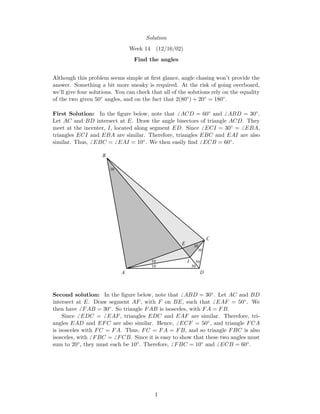
First Solution: In the figure below, note that ACD = 60◦ and ABD = 30◦.
Let AC and BD intersect at E. Draw the angle bisectors of triangle ACD. They
meet at the incenter, I, located along segment ED. Since ECI = 30◦ = EBA,
triangles ECI and EBA are similar. Therefore, triangles EBC and EAI are also
similar. Thus, EBC = EAI = 10◦. We then easily find ECB = 60◦.
50
30
5010
30
10
30
A
I
E
B
D
C
Second solution: In the figure below, note that ABD = 30◦. Let AC and BD
intersect at E. Draw segment AF, with F on BE, such that EAF = 50◦. We
then have FAB = 30◦. So triangle FAB is isosceles, with FA = FB.
Since EDC = EAF, triangles EDC and EAF are similar. Therefore, tri-
angles EAD and EFC are also similar. Hence, ECF = 50◦, and triangle FCA
is isosceles with FC = FA. Thus, FC = FA = FB, and so triangle FBC is also
isosceles, with FBC = FCB. Since it is easy to show that these two angles must
sum to 20◦, they must each be 10◦. Therefore, FBC = 10◦ and ECB = 60◦.
1
50
50
30
50
30
A
E
F
B
D
C
Third Solution: In the figure below, note that ACD = 60◦. Reflect triangle
ABC across AB to yield triangle ABG. Note that D, A, and G are collinear. From
the law of sines in triangle DBC, we have
sin 50◦
BC
=
sin(60◦ + α)
BD
. (1)
From the law of sines in triangle DBG, we have
sin 50◦
BG
=
sin α
BD
. (2)
But BC = BG, so we have sin(60◦ + α) = sin α. Therefore, 60◦ + α and α must be
supplementary angles, which gives α = 60◦. We then easily obtain DBC = 10◦.
50508080
60
50
AG
B
D
C
α
α
2
Fourth Solution: We now present the brute-force method using the law of sines,
just to show that it can be done.
In the figure below, let AC and BD intersect at E. Let the length of AB be 1
unit. Then the law of sines in triangle AED gives
a =
sin 50◦
sin 110◦
, and d =
sin 20◦
sin 110◦
. (3)
The law of sines in triangles AEB and DEC then gives
b =
sin 80◦
sin 30◦
sin 50◦
sin 110◦
, and c =
sin 50◦
sin 60◦
sin 20◦
sin 110◦
. (4)
The law of sines in triangle BEC finally gives
sin 80◦ sin 50◦
sin 30◦ sin 110◦
sin α =
sin 50◦ sin 20◦
sin 60◦ sin 110◦
sin β. (5)
Substituting 70◦ − α for β yields (after some algebra)
tan α =
sin 60◦ sin 80◦ sin 70◦
sin 60◦ sin 80◦ cos 70◦ + sin 30◦ sin 20◦
. (6)
Using sin 20◦ = 2 sin 10◦ cos 10◦ = 2 sin 10◦ sin 80◦, along with sin 30◦ = 1/2, gives
tan α =
sin 60◦ sin 70◦
sin 60◦ cos 70◦ + sin 10◦
. (7)
Finally, expanding sin 10◦ = sin(70◦ − 60◦) gives the result
tan α = tan 60◦
. (8)
Hence α = 60◦, and so β = 10◦.
a
b
c
d
1
α
β
50
110
80
50
20
60
30
A
E
B
D
C
3

Sol14

  • 1.
    Solution Week 14 (12/16/02) Findthe angles Although this problem seems simple at first glance, angle chasing won’t provide the answer. Something a bit more sneaky is required. At the risk of going overboard, we’ll give four solutions. You can check that all of the solutions rely on the equality of the two given 50◦ angles, and on the fact that 2(80◦) + 20◦ = 180◦. First Solution: In the figure below, note that ACD = 60◦ and ABD = 30◦. Let AC and BD intersect at E. Draw the angle bisectors of triangle ACD. They meet at the incenter, I, located along segment ED. Since ECI = 30◦ = EBA, triangles ECI and EBA are similar. Therefore, triangles EBC and EAI are also similar. Thus, EBC = EAI = 10◦. We then easily find ECB = 60◦. 50 30 5010 30 10 30 A I E B D C Second solution: In the figure below, note that ABD = 30◦. Let AC and BD intersect at E. Draw segment AF, with F on BE, such that EAF = 50◦. We then have FAB = 30◦. So triangle FAB is isosceles, with FA = FB. Since EDC = EAF, triangles EDC and EAF are similar. Therefore, tri- angles EAD and EFC are also similar. Hence, ECF = 50◦, and triangle FCA is isosceles with FC = FA. Thus, FC = FA = FB, and so triangle FBC is also isosceles, with FBC = FCB. Since it is easy to show that these two angles must sum to 20◦, they must each be 10◦. Therefore, FBC = 10◦ and ECB = 60◦. 1
  • 2.
    50 50 30 50 30 A E F B D C Third Solution: Inthe figure below, note that ACD = 60◦. Reflect triangle ABC across AB to yield triangle ABG. Note that D, A, and G are collinear. From the law of sines in triangle DBC, we have sin 50◦ BC = sin(60◦ + α) BD . (1) From the law of sines in triangle DBG, we have sin 50◦ BG = sin α BD . (2) But BC = BG, so we have sin(60◦ + α) = sin α. Therefore, 60◦ + α and α must be supplementary angles, which gives α = 60◦. We then easily obtain DBC = 10◦. 50508080 60 50 AG B D C α α 2
  • 3.
    Fourth Solution: Wenow present the brute-force method using the law of sines, just to show that it can be done. In the figure below, let AC and BD intersect at E. Let the length of AB be 1 unit. Then the law of sines in triangle AED gives a = sin 50◦ sin 110◦ , and d = sin 20◦ sin 110◦ . (3) The law of sines in triangles AEB and DEC then gives b = sin 80◦ sin 30◦ sin 50◦ sin 110◦ , and c = sin 50◦ sin 60◦ sin 20◦ sin 110◦ . (4) The law of sines in triangle BEC finally gives sin 80◦ sin 50◦ sin 30◦ sin 110◦ sin α = sin 50◦ sin 20◦ sin 60◦ sin 110◦ sin β. (5) Substituting 70◦ − α for β yields (after some algebra) tan α = sin 60◦ sin 80◦ sin 70◦ sin 60◦ sin 80◦ cos 70◦ + sin 30◦ sin 20◦ . (6) Using sin 20◦ = 2 sin 10◦ cos 10◦ = 2 sin 10◦ sin 80◦, along with sin 30◦ = 1/2, gives tan α = sin 60◦ sin 70◦ sin 60◦ cos 70◦ + sin 10◦ . (7) Finally, expanding sin 10◦ = sin(70◦ − 60◦) gives the result tan α = tan 60◦ . (8) Hence α = 60◦, and so β = 10◦. a b c d 1 α β 50 110 80 50 20 60 30 A E B D C 3