Introduction to Soils
Kitty O’Neil, Ph.D.
Cornell Cooperative Extension, NNY
Northern NY Field Crops Team
Introduction to Soils
• At end of today’s discussion, you should…
– Understand why soil is important
– Explain to someone what soil is made of
– Explain to someone how soil was/is formed
– Understand that soils are highly variable in
space and time

Northern NY Field Crops Team
Introduction to Soils
• Importance of soil
– Soil functions

• Definition of soil
• Components of soil
– Mineral, organic matter, air, water

• Soil formation, weathering
– Parent materials
– Soil formation processes
– Soil differs from parent material

• Soils vary in space and in time
Northern NY Field Crops Team
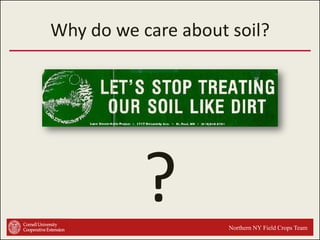
Why do we care about soil?

?
Northern NY Field Crops Team
Why do we care about soil?
• Soil resources were and are a central
factor in shaping human history and
development.
• Survival of humans and animals is
dependent on light, water, air and soil.
• Good, productive soil is a basic human
need.
– Grow our food, clean our water, clean our air
Northern NY Field Crops Team
Why do we care about soil?
“All civilization is basically dependent upon
natural resources. All natural resources …are
soil or derivatives of soil. Farms, ranges,
crops and livestock, forests, irrigation water,
and even water power resolve themselves
into questions of soil. Soil is therefore the
basic natural resource.”
- Aldo Leopold, Erosion and Prosperity, 1921
Northern NY Field Crops Team
Why do we care about soil?
• “Man—despite his artistic pretensions,
his sophistication, and his many
accomplishments—owes his existence to
a six-inch layer of topsoil and the fact
that it rains.”
- Author unknown

Northern NY Field Crops Team
What does soil DO?
OK, so soil is important.
Why? What does soil actually DO?

?
Northern NY Field Crops Team
What does soil DO?
1. Soil serves as a natural medium for the
growth of plants,
2. regulates and purifies water,
3. recycles organic wastes and nutrients,
4. provides habitat for soil organisms, and
5. serves as physical support for building and
construction.

= Soil functions
Northern NY Field Crops Team
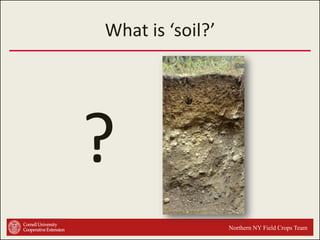
What is ‘soil?’

?
Northern NY Field Crops Team
What is ‘soil?’
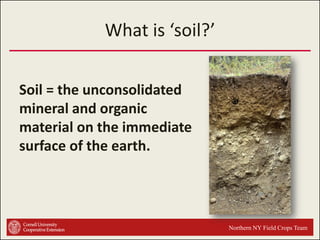
Soil = the unconsolidated
mineral and organic
material on the immediate
surface of the earth.

Northern NY Field Crops Team
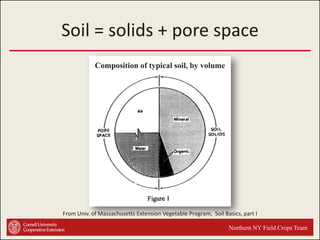
Soil = solids + pore space
Composition of typical soil, by volume

From Univ. of Massachusetts Extension Vegetable Program, Soil Basics, part I
Northern NY Field Crops Team
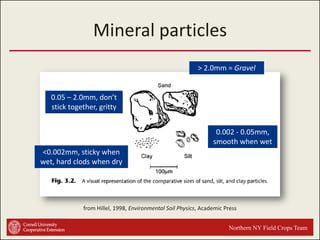
Mineral particles
> 2.0mm = Gravel

0.05 – 2.0mm, don’t
stick together, gritty
0.002 - 0.05mm,
smooth when wet
<0.002mm, sticky when
wet, hard clods when dry

from Hillel, 1998, Environmental Soil Physics, Academic Press
Northern NY Field Crops Team
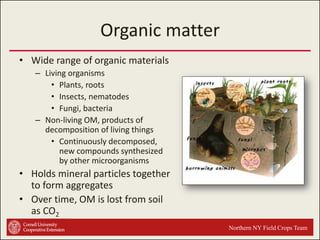
Organic matter
• Wide range of organic materials
– Living organisms
• Plants, roots
• Insects, nematodes
• Fungi, bacteria
– Non-living OM, products of
decomposition of living things
• Continuously decomposed,
new compounds synthesized
by other microorganisms

• Holds mineral particles together
to form aggregates
• Over time, OM is lost from soil
as CO2
Northern NY Field Crops Team
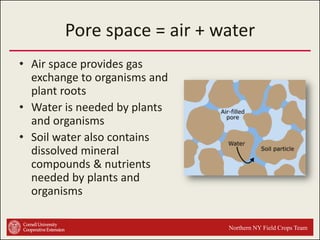
Pore space = air + water
• Air space provides gas
exchange to organisms and
plant roots
• Water is needed by plants
and organisms
• Soil water also contains
dissolved mineral
compounds & nutrients
needed by plants and
organisms
Northern NY Field Crops Team
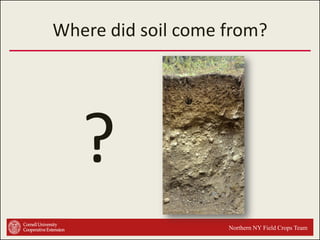
Where did soil come from?

?
Northern NY Field Crops Team
Where did soil come from?
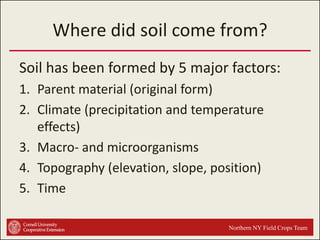
Soil has been formed by 5 major factors:
1. Parent material (original form)
2. Climate (precipitation and temperature
effects)
3. Macro- and microorganisms
4. Topography (elevation, slope, position)
5. Time
Northern NY Field Crops Team
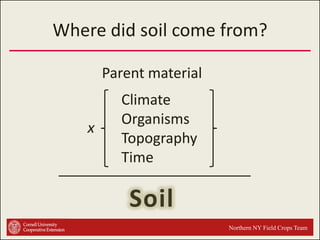
Where did soil come from?
Parent material
x

Climate
Organisms
Topography
Time

Soil
Northern NY Field Crops Team
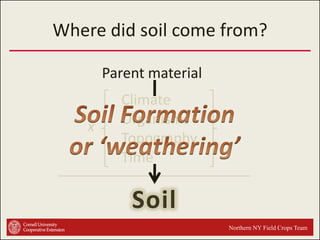
Where did soil come from?
Parent material
x

Climate
Organisms
Topography
Time

Soil
Northern NY Field Crops Team
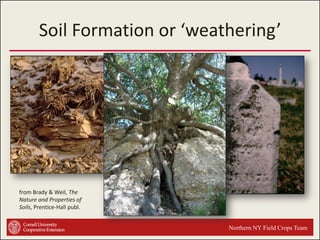
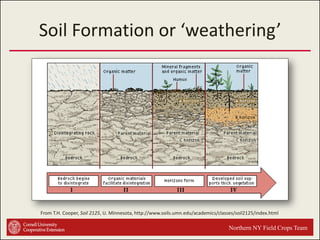
Soil Formation or ‘weathering’

from Brady & Weil, The
Nature and Properties of
Soils, Prentice-Hall publ.
Northern NY Field Crops Team
Soil Formation or ‘weathering’

From T.H. Cooper, Soil 2125, U. Minnesota, http://www.soils.umn.edu/academics/classes/soil2125/index.html

Northern NY Field Crops Team
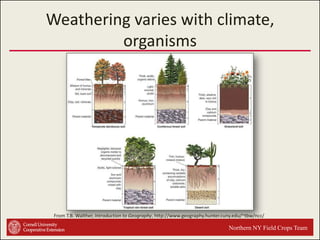
Weathering varies with climate,
organisms

From T.B. Walther, Introduction to Geography, http://www.geography.hunter.cuny.edu/~tbw/ncc/

Northern NY Field Crops Team
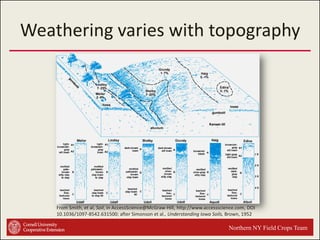
Weathering varies with topography

From Smith, et al, Soil, in AccessScience@McGraw-Hill, http://www.accessscience.com, DOI
10.1036/1097-8542.631500; after Simonson et al., Understanding Iowa Soils, Brown, 1952

Northern NY Field Crops Team
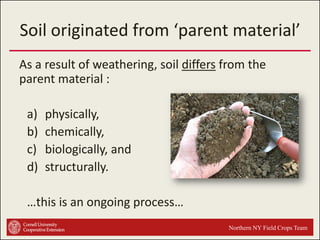
Soil originated from ‘parent material’
As a result of weathering, soil differs from the
parent material :
a)
b)
c)
d)

physically,
chemically,
biologically, and
structurally.

…this is an ongoing process…
Northern NY Field Crops Team
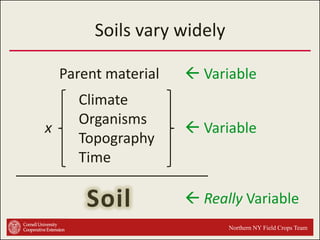
Soils vary widely
Parent material

x

 Variable

Climate
Organisms
Topography
Time

 Variable

Soil

 Really Variable
Northern NY Field Crops Team
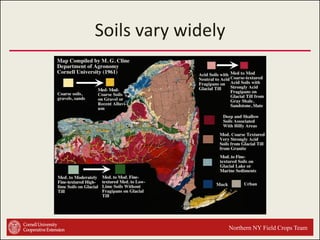
Soils vary widely

Northern NY Field Crops Team
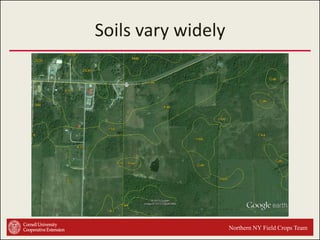
Soils vary widely

Northern NY Field Crops Team
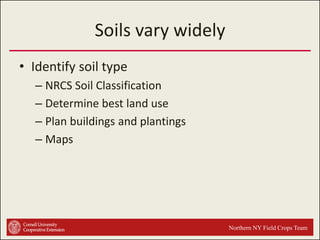
Soils vary widely
• Identify soil type
– NRCS Soil Classification
– Determine best land use
– Plan buildings and plantings
– Maps

Northern NY Field Crops Team
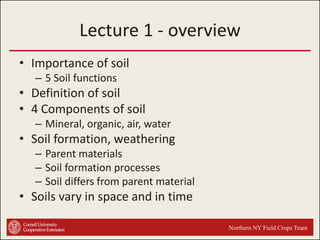
Lecture 1 - overview
• Importance of soil
– 5 Soil functions

• Definition of soil
• 4 Components of soil
– Mineral, organic, air, water

• Soil formation, weathering
– Parent materials
– Soil formation processes
– Soil differs from parent material

• Soils vary in space and in time
Northern NY Field Crops Team
Questions?

Northern NY Field Crops Team

Soils 101 intro

  • 1.
    Introduction to Soils KittyO’Neil, Ph.D. Cornell Cooperative Extension, NNY Northern NY Field Crops Team
  • 2.
    Introduction to Soils •At end of today’s discussion, you should… – Understand why soil is important – Explain to someone what soil is made of – Explain to someone how soil was/is formed – Understand that soils are highly variable in space and time Northern NY Field Crops Team
  • 3.
    Introduction to Soils •Importance of soil – Soil functions • Definition of soil • Components of soil – Mineral, organic matter, air, water • Soil formation, weathering – Parent materials – Soil formation processes – Soil differs from parent material • Soils vary in space and in time Northern NY Field Crops Team
  • 4.
    Why do wecare about soil? ? Northern NY Field Crops Team
  • 5.
    Why do wecare about soil? • Soil resources were and are a central factor in shaping human history and development. • Survival of humans and animals is dependent on light, water, air and soil. • Good, productive soil is a basic human need. – Grow our food, clean our water, clean our air Northern NY Field Crops Team
  • 6.
    Why do wecare about soil? “All civilization is basically dependent upon natural resources. All natural resources …are soil or derivatives of soil. Farms, ranges, crops and livestock, forests, irrigation water, and even water power resolve themselves into questions of soil. Soil is therefore the basic natural resource.” - Aldo Leopold, Erosion and Prosperity, 1921 Northern NY Field Crops Team
  • 7.
    Why do wecare about soil? • “Man—despite his artistic pretensions, his sophistication, and his many accomplishments—owes his existence to a six-inch layer of topsoil and the fact that it rains.” - Author unknown Northern NY Field Crops Team
  • 8.
    What does soilDO? OK, so soil is important. Why? What does soil actually DO? ? Northern NY Field Crops Team
  • 9.
    What does soilDO? 1. Soil serves as a natural medium for the growth of plants, 2. regulates and purifies water, 3. recycles organic wastes and nutrients, 4. provides habitat for soil organisms, and 5. serves as physical support for building and construction. = Soil functions Northern NY Field Crops Team
  • 10.
    What is ‘soil?’ ? NorthernNY Field Crops Team
  • 11.
    What is ‘soil?’ Soil= the unconsolidated mineral and organic material on the immediate surface of the earth. Northern NY Field Crops Team
  • 12.
    Soil = solids+ pore space Composition of typical soil, by volume From Univ. of Massachusetts Extension Vegetable Program, Soil Basics, part I Northern NY Field Crops Team
  • 13.
    Mineral particles > 2.0mm= Gravel 0.05 – 2.0mm, don’t stick together, gritty 0.002 - 0.05mm, smooth when wet <0.002mm, sticky when wet, hard clods when dry from Hillel, 1998, Environmental Soil Physics, Academic Press Northern NY Field Crops Team
  • 14.
    Organic matter • Widerange of organic materials – Living organisms • Plants, roots • Insects, nematodes • Fungi, bacteria – Non-living OM, products of decomposition of living things • Continuously decomposed, new compounds synthesized by other microorganisms • Holds mineral particles together to form aggregates • Over time, OM is lost from soil as CO2 Northern NY Field Crops Team
  • 15.
    Pore space =air + water • Air space provides gas exchange to organisms and plant roots • Water is needed by plants and organisms • Soil water also contains dissolved mineral compounds & nutrients needed by plants and organisms Northern NY Field Crops Team
  • 16.
    Where did soilcome from? ? Northern NY Field Crops Team
  • 17.
    Where did soilcome from? Soil has been formed by 5 major factors: 1. Parent material (original form) 2. Climate (precipitation and temperature effects) 3. Macro- and microorganisms 4. Topography (elevation, slope, position) 5. Time Northern NY Field Crops Team
  • 18.
    Where did soilcome from? Parent material x Climate Organisms Topography Time Soil Northern NY Field Crops Team
  • 19.
    Where did soilcome from? Parent material x Climate Organisms Topography Time Soil Northern NY Field Crops Team
  • 20.
    Soil Formation or‘weathering’ from Brady & Weil, The Nature and Properties of Soils, Prentice-Hall publ. Northern NY Field Crops Team
  • 21.
    Soil Formation or‘weathering’ From T.H. Cooper, Soil 2125, U. Minnesota, http://www.soils.umn.edu/academics/classes/soil2125/index.html Northern NY Field Crops Team
  • 22.
    Weathering varies withclimate, organisms From T.B. Walther, Introduction to Geography, http://www.geography.hunter.cuny.edu/~tbw/ncc/ Northern NY Field Crops Team
  • 23.
    Weathering varies withtopography From Smith, et al, Soil, in AccessScience@McGraw-Hill, http://www.accessscience.com, DOI 10.1036/1097-8542.631500; after Simonson et al., Understanding Iowa Soils, Brown, 1952 Northern NY Field Crops Team
  • 24.
    Soil originated from‘parent material’ As a result of weathering, soil differs from the parent material : a) b) c) d) physically, chemically, biologically, and structurally. …this is an ongoing process… Northern NY Field Crops Team
  • 25.
    Soils vary widely Parentmaterial x  Variable Climate Organisms Topography Time  Variable Soil  Really Variable Northern NY Field Crops Team
  • 26.
    Soils vary widely NorthernNY Field Crops Team
  • 27.
    Soils vary widely NorthernNY Field Crops Team
  • 28.
    Soils vary widely •Identify soil type – NRCS Soil Classification – Determine best land use – Plan buildings and plantings – Maps Northern NY Field Crops Team
  • 29.
    Lecture 1 -overview • Importance of soil – 5 Soil functions • Definition of soil • 4 Components of soil – Mineral, organic, air, water • Soil formation, weathering – Parent materials – Soil formation processes – Soil differs from parent material • Soils vary in space and in time Northern NY Field Crops Team
  • 30.