Presented by Seminar Guide
Chaitanya Anpat Prof. Pritesh Patil
TE – IT
Monday, October 24, 20161
Copy Protection
Agenda
• Introduction
• Brief idea about protection methods
• Code confusion
• Debuggers
• Code confusion techniques
• conclusion
Introduction
• Copy protection is effort to prevent cracking
• Cracking-modification to binary files to
remove protection
reverse engineering
• Discovering technical principles of
device,object,system,software.
• It often involves disassembling exe code to
get machine code and bypass software
security.
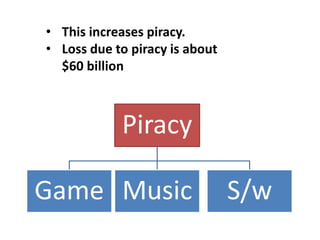
Piracy
Game Music S/w
• This increases piracy.
• Loss due to piracy is about
$60 billion
.
.
Method of protection
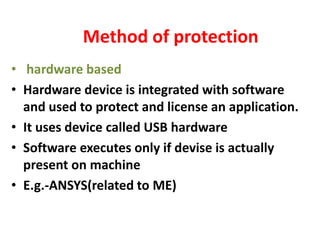
• hardware based
• Hardware device is integrated with software
and used to protect and license an application.
• It uses device called USB hardware
• Software executes only if devise is actually
present on machine
• E.g.-ANSYS(related to ME)
• Serial key generation
• enter serial key
• Serial key compare
• If match installation complete
Encryptions
• Encoding applications in such a way that only
authorized users can use it
• It doesn’t prevent hacking
• Used to prevent data at rest like files and
data at transits like data transfer via
networks
Debug-Blocker
• In Armadillo, we find another feature called
Debug- Blocker.
• Armadillo creates 2 processes, referred to
them as father ( or parent ) and child. The
father process acts as a debugger, trying to
protect the child from other debuggers.
Code confusion/obfuscation
• Process of confusing
• Transforms source code such that it is
difficult for human to grasp and debugger to
disassemble accurately
• confused code should be functionally
equivalent to users perspective.
• introduce code confusing techniques so as
make code difficult to debug and which
prevent s/w to be reversed.
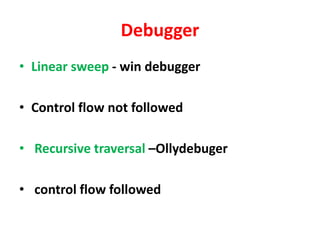
Debugger
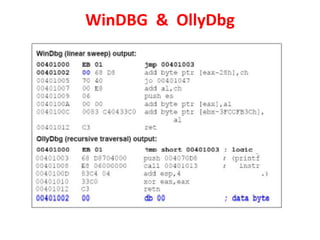
• Linear sweep - win debugger
• Control flow not followed
• Recursive traversal –Ollydebuger
• control flow followed
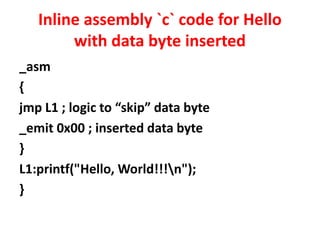
Inline assembly `c` code for Hello
with data byte inserted
_asm
{
jmp L1 ; logic to “skip” data byte
_emit 0x00 ; inserted data byte
}
L1:printf("Hello, World!!!n");
}
WinDBG & OllyDbg
.
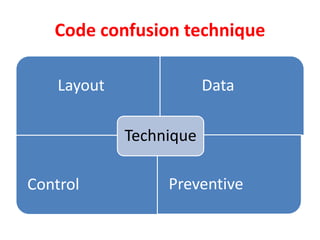
Code confusion technique
Layout Data
Control Preventive
Technique
Layout technique
• Layout obfuscations modify the layout
structure of the program by two basic
methods: renaming identifiers and removing
debugging information
• They make the program code less informative
to a reverse engineer.
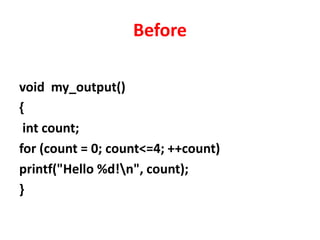
Before
void my_output()
{
int count;
for (count = 0; count<=4; ++count)
printf("Hello %d!n", count);
}
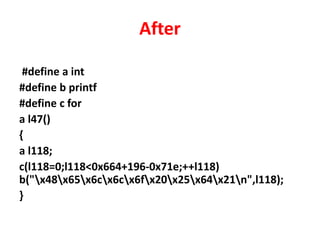
• Tools used this technique are SD Obfuscator
CXX obfuscator.
• They will automatically output confused code
whose functionality remains same after
obfuscation.
After
#define a int
#define b printf
#define c for
a l47()
{
a l118;
c(l118=0;l118<0x664+196-0x71e;++l118)
b("x48x65x6cx6cx6fx20x25x64x21n",l118);
}
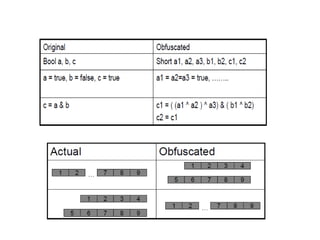
Data code confusion technique
• It changes the program’s use of data or data
structures.
• The storage of data can be obfuscated by
replacing current data definitions with those
which do not make sense for their intended
use. For example, a loop iteration variable
can be replaced with another variable type
besides an integer.
Control flow code confusion
• It changes the flow of the program
executing code in parallel
• insert new functions
• mislead the disassembler while
executing concurrently
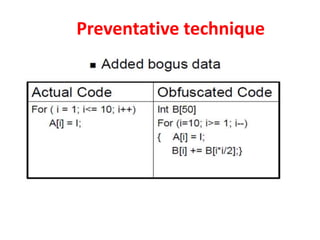
Preventative technique
Conclusion
Prevention*cracking
.

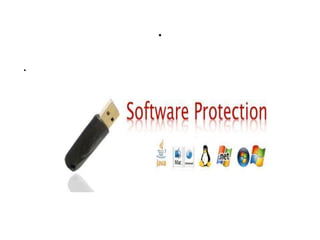
Software Protection Techniques

  • 1.
    Presented by SeminarGuide Chaitanya Anpat Prof. Pritesh Patil TE – IT Monday, October 24, 20161 Copy Protection
  • 2.
    Agenda • Introduction • Briefidea about protection methods • Code confusion • Debuggers • Code confusion techniques • conclusion
  • 3.
    Introduction • Copy protectionis effort to prevent cracking • Cracking-modification to binary files to remove protection reverse engineering • Discovering technical principles of device,object,system,software. • It often involves disassembling exe code to get machine code and bypass software security.
  • 4.
    Piracy Game Music S/w •This increases piracy. • Loss due to piracy is about $60 billion
  • 5.
  • 6.
    Method of protection •hardware based • Hardware device is integrated with software and used to protect and license an application. • It uses device called USB hardware • Software executes only if devise is actually present on machine • E.g.-ANSYS(related to ME)
  • 7.
    • Serial keygeneration • enter serial key • Serial key compare • If match installation complete
  • 8.
    Encryptions • Encoding applicationsin such a way that only authorized users can use it • It doesn’t prevent hacking • Used to prevent data at rest like files and data at transits like data transfer via networks
  • 9.
    Debug-Blocker • In Armadillo,we find another feature called Debug- Blocker. • Armadillo creates 2 processes, referred to them as father ( or parent ) and child. The father process acts as a debugger, trying to protect the child from other debuggers.
  • 10.
    Code confusion/obfuscation • Processof confusing • Transforms source code such that it is difficult for human to grasp and debugger to disassemble accurately • confused code should be functionally equivalent to users perspective. • introduce code confusing techniques so as make code difficult to debug and which prevent s/w to be reversed.
  • 11.
    Debugger • Linear sweep- win debugger • Control flow not followed • Recursive traversal –Ollydebuger • control flow followed
  • 12.
    Inline assembly `c`code for Hello with data byte inserted _asm { jmp L1 ; logic to “skip” data byte _emit 0x00 ; inserted data byte } L1:printf("Hello, World!!!n"); }
  • 13.
  • 14.
    Code confusion technique LayoutData Control Preventive Technique
  • 15.
    Layout technique • Layoutobfuscations modify the layout structure of the program by two basic methods: renaming identifiers and removing debugging information • They make the program code less informative to a reverse engineer.
  • 16.
    Before void my_output() { int count; for(count = 0; count<=4; ++count) printf("Hello %d!n", count); }
  • 17.
    • Tools usedthis technique are SD Obfuscator CXX obfuscator. • They will automatically output confused code whose functionality remains same after obfuscation.
  • 18.
    After #define a int #defineb printf #define c for a l47() { a l118; c(l118=0;l118<0x664+196-0x71e;++l118) b("x48x65x6cx6cx6fx20x25x64x21n",l118); }
  • 19.
    Data code confusiontechnique • It changes the program’s use of data or data structures. • The storage of data can be obfuscated by replacing current data definitions with those which do not make sense for their intended use. For example, a loop iteration variable can be replaced with another variable type besides an integer.
  • 21.
    Control flow codeconfusion • It changes the flow of the program executing code in parallel • insert new functions • mislead the disassembler while executing concurrently
  • 22.
  • 23.
  • 24.