Software Development
       Lifecycle

“You’ve got to be very careful if you don’t know where
   you’re going, because you might not get there.”

                     Yogi Berra


                                                         1
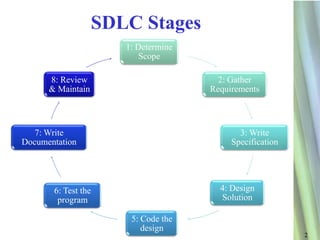
SDLC Stages
                      1: Determine
                          Scope

      8: Review                        2: Gather
      & Maintain                     Requirements


   7: Write                                 3: Write
Documentation                             Specification


       6: Test the                     4: Design
        program                        Solution

                       5: Code the
                          design
                                                          2
1: Determine the Scope
Also called the Problem Domain
Describe the boundaries of the problem
Identify what is and what is not covered
Include those who are affected (stakeholders)
and describe how they are affected.
 what functions is the product supposed to have
  i.e. how the interface should be, what should the
  product do, how will the user use the product.
                                                      3
2: Gathering Requirements


                            4
2: Gathering Requirements
A common failure of IT projects worldwide
The Functional Requirements must be
known
 What is wanted by those who are affected
Gathering techniques:
   Existing Documentation
   Observation
   Interview
   Questionnaires
                                             5
3: Write Specification
A categorised list of elements required to
start designing a solution, inc:
   Inputs
   Outputs
   Processing
   Storage
   User interface
   Constraints

                                             6
4: Design Solution
Using design tools, inc
   Forms design
   Flowcharts
   Structure diagrams
   DFDs and ERDs
   UML diagrams
   Class schemas


                              7
5: Code the design
Designs are converted into program code
Language will have been selected
depending on program function
Teams of programmers may work on
different modules or classes
Teams must adopt similar working
practices and understand how their modules
fit into larger solution
                                             8
6: Test the program
Testing is a critical part of the quality
assurance process,
2 common methods for module testing are:
 Black Box - doesn’t care about how the
  program was written, only if it does what it’s
  supposed to do.
 White Box – examines performance of code.
  Ensures code generates correct results
White box starts after Black box and takes
longer.
                                                   9
6: Test the program
A thorough test plan should include:
 All possible outcomes (check flowcharts
  logical pathways e.g. Loops & True/False)
 Sufficient test data which checks Normal,
  Extreme and Erroneous data.
 Trace table inc; Date, Test, Expected result,
  Actual Result, Corrective action and
 Screen captures
Debugging tools include:
 Breakpoint & Trace (run program line-by line),
 Watches (changes to variable contents)
                                                   10
7: Write Documentation
Three types of documentation
Internal (inside code)
 Meaningful variable names,
 Tidy layout & good comments (why not how)
Technical (for maintenance)
 Requirements specification, Design diagrams,
  Test strategy, fully commented code,
  Troubleshooting guide.
User (step-by step instructions)
 Text files (e.g. Readme.txt), PDF files,
  Sceencasts and animations.                     11
8: Review & Maintain
Reviewing
 Looking at the solution and comparing it with
  the original requirements
 Have they been met? and How well is the
  solution working?
Maintenance
 Keeping the solution working
 Expanding the scope of the program to add
  extra features and functionality
 Over 80% of the lifecycle can be maintenance
                                                  12

Software development lifecycle

  • 1.
    Software Development Lifecycle “You’ve got to be very careful if you don’t know where you’re going, because you might not get there.” Yogi Berra 1
  • 2.
    SDLC Stages 1: Determine Scope 8: Review 2: Gather & Maintain Requirements 7: Write 3: Write Documentation Specification 6: Test the 4: Design program Solution 5: Code the design 2
  • 3.
    1: Determine theScope Also called the Problem Domain Describe the boundaries of the problem Identify what is and what is not covered Include those who are affected (stakeholders) and describe how they are affected.  what functions is the product supposed to have i.e. how the interface should be, what should the product do, how will the user use the product. 3
  • 4.
  • 5.
    2: Gathering Requirements Acommon failure of IT projects worldwide The Functional Requirements must be known  What is wanted by those who are affected Gathering techniques:  Existing Documentation  Observation  Interview  Questionnaires 5
  • 6.
    3: Write Specification Acategorised list of elements required to start designing a solution, inc:  Inputs  Outputs  Processing  Storage  User interface  Constraints 6
  • 7.
    4: Design Solution Usingdesign tools, inc  Forms design  Flowcharts  Structure diagrams  DFDs and ERDs  UML diagrams  Class schemas 7
  • 8.
    5: Code thedesign Designs are converted into program code Language will have been selected depending on program function Teams of programmers may work on different modules or classes Teams must adopt similar working practices and understand how their modules fit into larger solution 8
  • 9.
    6: Test theprogram Testing is a critical part of the quality assurance process, 2 common methods for module testing are:  Black Box - doesn’t care about how the program was written, only if it does what it’s supposed to do.  White Box – examines performance of code. Ensures code generates correct results White box starts after Black box and takes longer. 9
  • 10.
    6: Test theprogram A thorough test plan should include:  All possible outcomes (check flowcharts logical pathways e.g. Loops & True/False)  Sufficient test data which checks Normal, Extreme and Erroneous data.  Trace table inc; Date, Test, Expected result, Actual Result, Corrective action and  Screen captures Debugging tools include:  Breakpoint & Trace (run program line-by line),  Watches (changes to variable contents) 10
  • 11.
    7: Write Documentation Threetypes of documentation Internal (inside code)  Meaningful variable names,  Tidy layout & good comments (why not how) Technical (for maintenance)  Requirements specification, Design diagrams, Test strategy, fully commented code, Troubleshooting guide. User (step-by step instructions)  Text files (e.g. Readme.txt), PDF files, Sceencasts and animations. 11
  • 12.
    8: Review &Maintain Reviewing  Looking at the solution and comparing it with the original requirements  Have they been met? and How well is the solution working? Maintenance  Keeping the solution working  Expanding the scope of the program to add extra features and functionality  Over 80% of the lifecycle can be maintenance 12