






SOFT SKILLS SERIES
Employability Skills that will set you up for Career Success
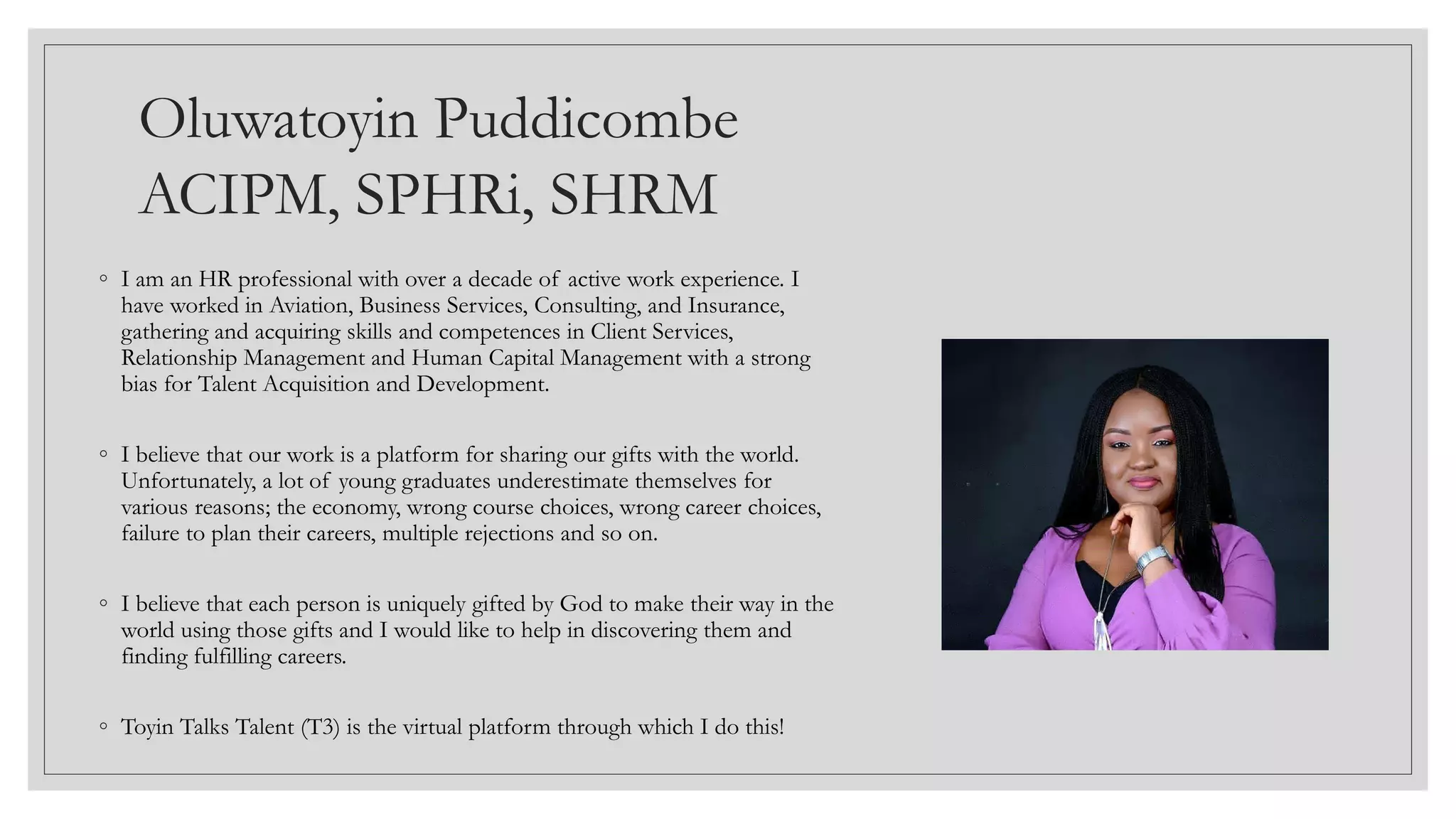
Oluwatoyin Puddicombe
Toyin Talks Talent
Oluwatoyin Puddicombe
ACIPM, SPHRi, SHRM
◦ I am an HR professional with over a decade of active work experience. I
have worked in Aviation, Business Services, Consulting, and Insurance,
gathering and acquiring skills and competences in Client Services,
Relationship Management and Human Capital Management with a strong
bias for Talent Acquisition and Development.
◦ I believe that our work is a platform for sharing our gifts with the world.
Unfortunately, a lot of young graduates underestimate themselves for
various reasons; the economy, wrong course choices, wrong career choices,
failure to plan their careers, multiple rejections and so on.
◦ I believe that each person is uniquely gifted by God to make their way in the
world using those gifts and I would like to help in discovering them and
finding fulfilling careers.
◦ Toyin Talks Talent (T3) is the virtual platform through which I do this!
Series Outline
Lesson 1.
Interpersonal Skills
Lesson 2.
Problem Solving
Lesson 3.
Listening Skills
Lesson 4.
Public Speaking
Lesson 5.
Business Etiquette
Learning Outcomes
At the end of the session, you should be able to:
1. Describe what Soft Skills are
2. Identify where you may not have displayed it.
3. Explain the problem-solving technique you
can apply immediately.
4. Recognise the barriers you have, to listening
actively.
5. Commit to changing ONE thing; either to
STOP something or to START something.
Housekeeping
◦ 4-week Soft Skills Series
Support
Please note your questions
and ask after the session
There is a time limit, so kindly
re-join the session after the time
out
We are all here to learn, so let’s
participate and have fun!
DEFINING SOFT SKILLS
Soft skills are a combination of skills that enable people to navigate their environment,
work well with others, perform well, and achieve their goals with complementing hard
skills.
The Collins English Dictionary defines the term "soft skills" as "desirable qualities for
certain forms of employment that do not depend on acquired knowledge: they include
common sense, the ability to deal with people, and a positive flexible attitude."
In Deloitte’s 2016 Global Human Capital Trends
Report, 92% of respondents rated soft skills as a
critical priority.
A recent study in the UK
determined that “Soft Skills” are
worth £88bn ($186bn CDN) to
the UK economy. A business
group, including, believe it or not,
McDonalds is doing a three-
month study on how government
can introduce policies that will
help employees and employers
develop soft skills.
Whitehead 2020
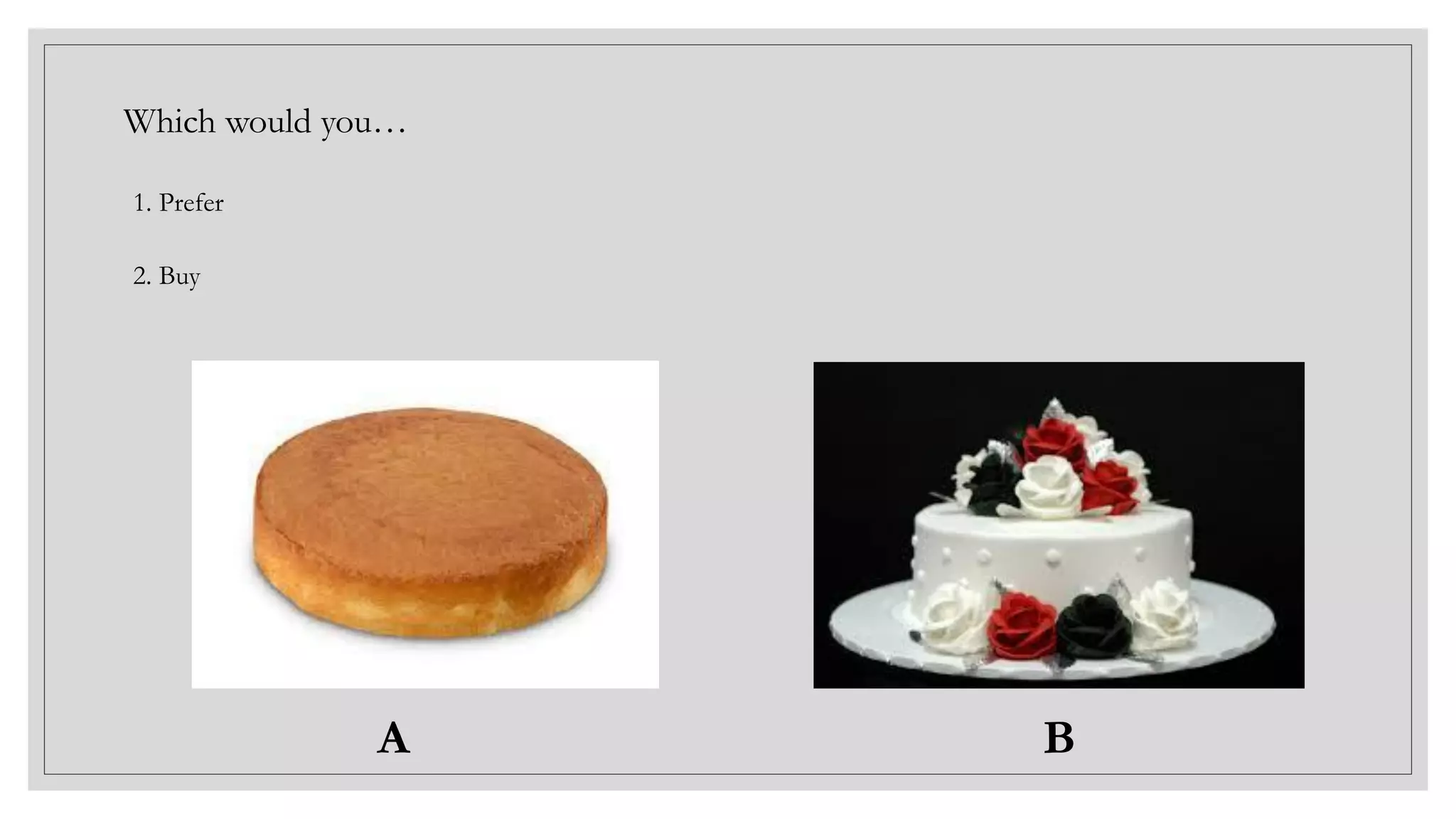
A B
Which would you…
1. Prefer
2. Buy
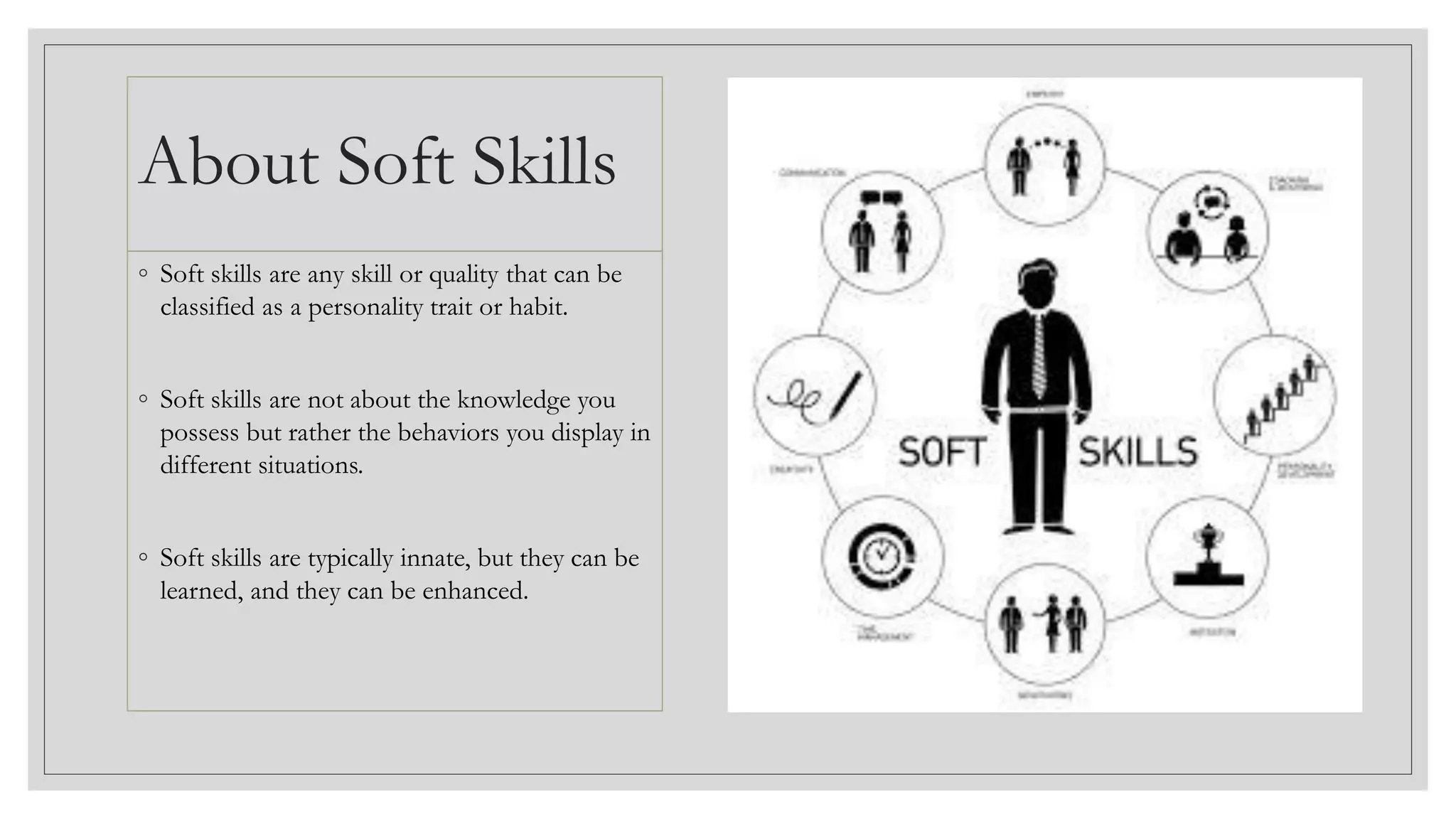
About Soft Skills
◦ Soft skills are any skill or quality that can be
classified as a personality trait or habit.
◦ Soft skills are not about the knowledge you
possess but rather the behaviors you display in
different situations.
◦ Soft skills are typically innate, but they can be
learned, and they can be enhanced.
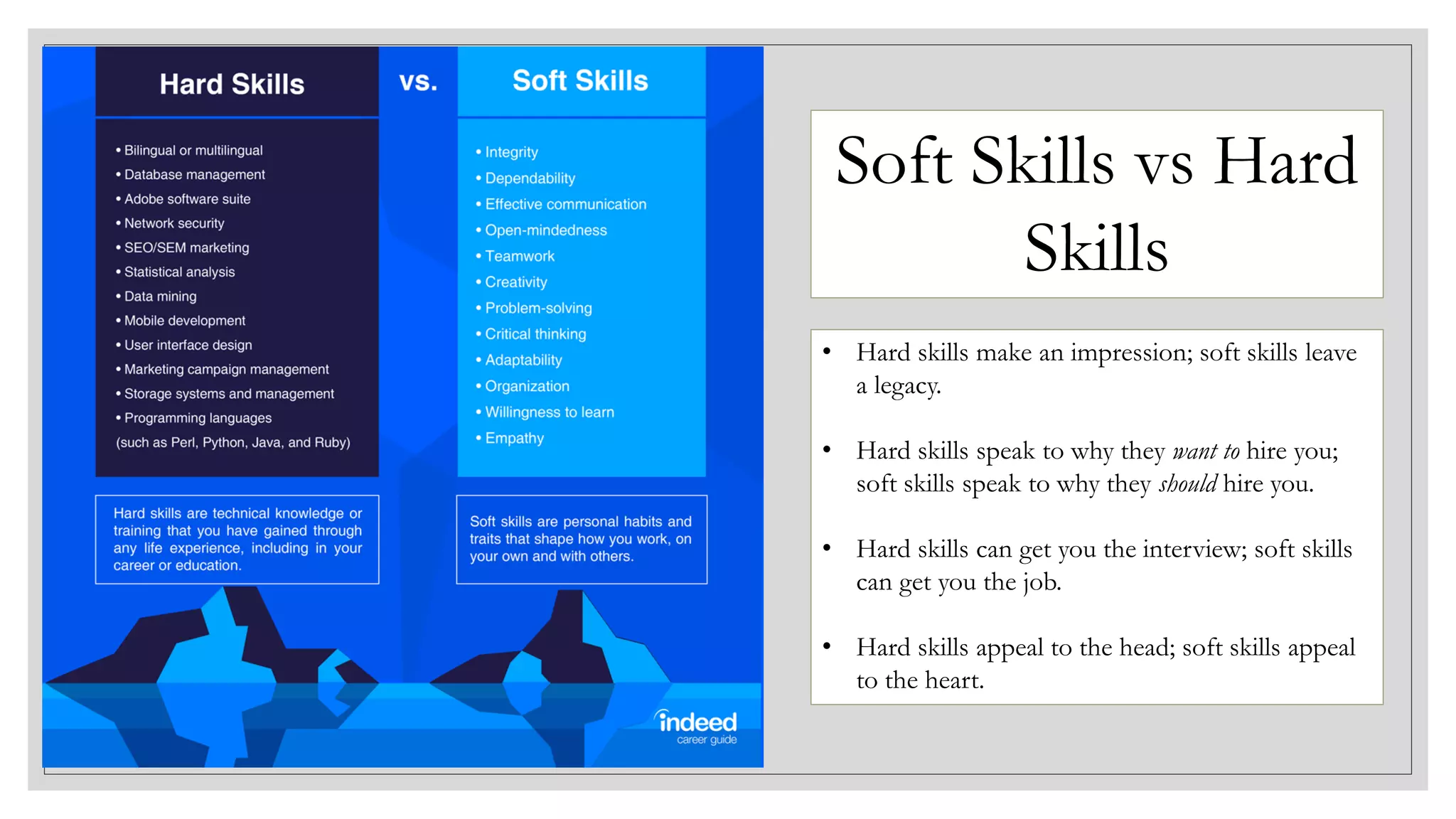
Soft Skills vs Hard
Skills
• Hard skills make an impression; soft skills leave
a legacy.
• Hard skills speak to why they want to hire you;
soft skills speak to why they should hire you.
• Hard skills can get you the interview; soft skills
can get you the job.
• Hard skills appeal to the head; soft skills appeal
to the heart.
Why are Soft
Skills
Important?
• Human interactions cannot
always be defined empirically.
• That two people were
exposed to the same scenarios
with the same factors does
not mean they will react in the
same way.
• Soft skills are the answers to
those indefinable
“somethings” that are deal
breakers in certain business
situations.
Laying the right
Foundation
CHARACTER
• Values
• Experiences
• Personality
• Habits
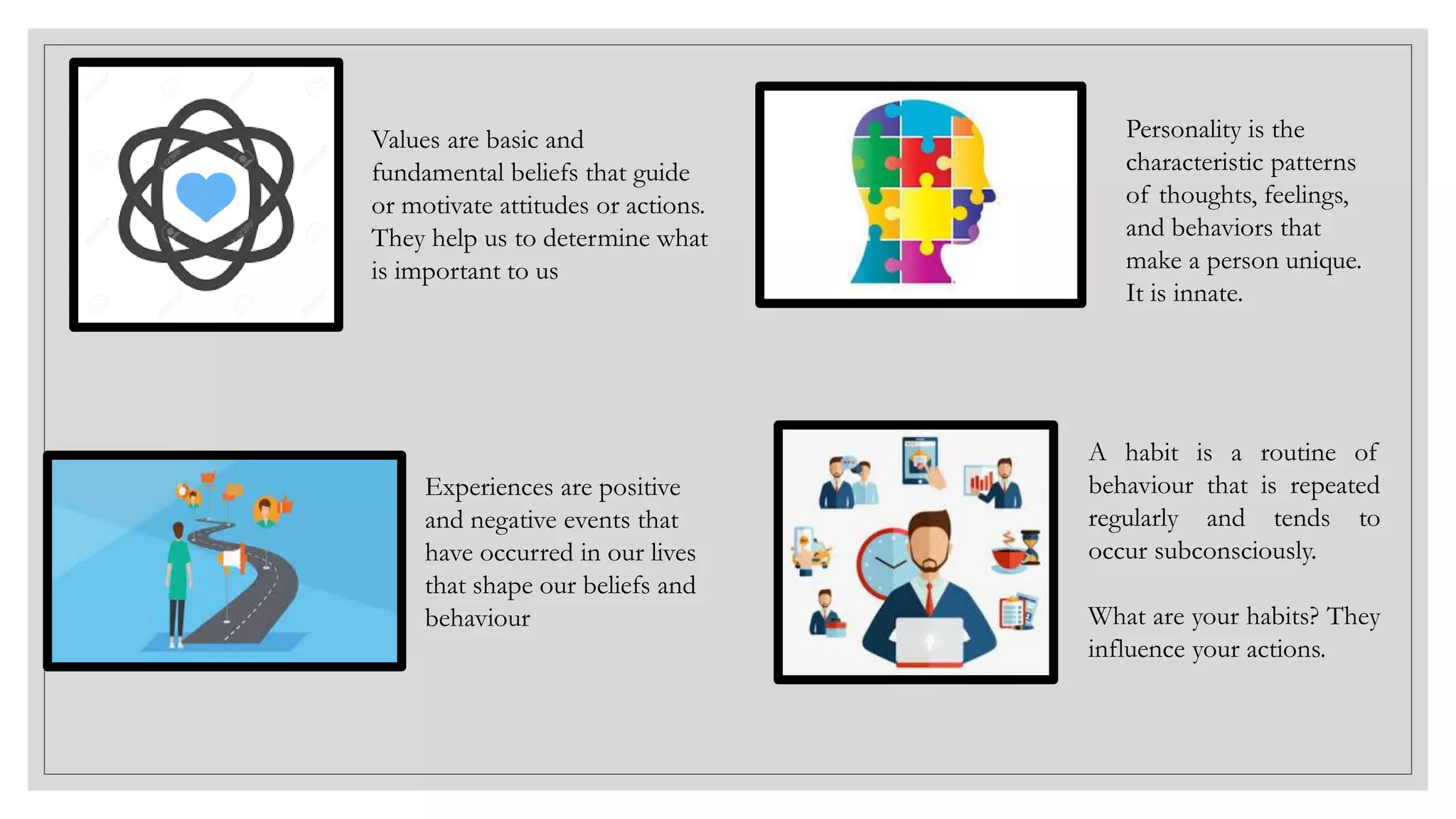
A habit is a routine of
behaviour that is repeated
regularly and tends to
occur subconsciously.
What are your habits? They
influence your actions.
Experiences are positive
and negative events that
have occurred in our lives
that shape our beliefs and
behaviour
Personality is the
characteristic patterns
of thoughts, feelings,
and behaviors that
make a person unique.
It is innate.
Values are basic and
fundamental beliefs that guide
or motivate attitudes or actions.
They help us to determine what
is important to us
SOFT SKILLS FOR
CAREER EXCELLENCE
Some soft skills that prove invaluable in life and career
Problem
Solving
The ability to handle
difficult or unexpected
situations in the
workplace as well as
complex business
challenges.
Effective Problem
Solving
• Problem solving requires some other key
skills to be effective:
• Creativity (thinking differently)
• Critical Thinking (asking many ‘whys’)
• Active Listening (attentive listening)
• Research (gathering information)
• Teamwork (asking for and giving help)
• Emotional Intelligence (self-management)
• Decision Making (what action to take)
• Risk Assessment and Management
(What could go wrong and what to do about
it)
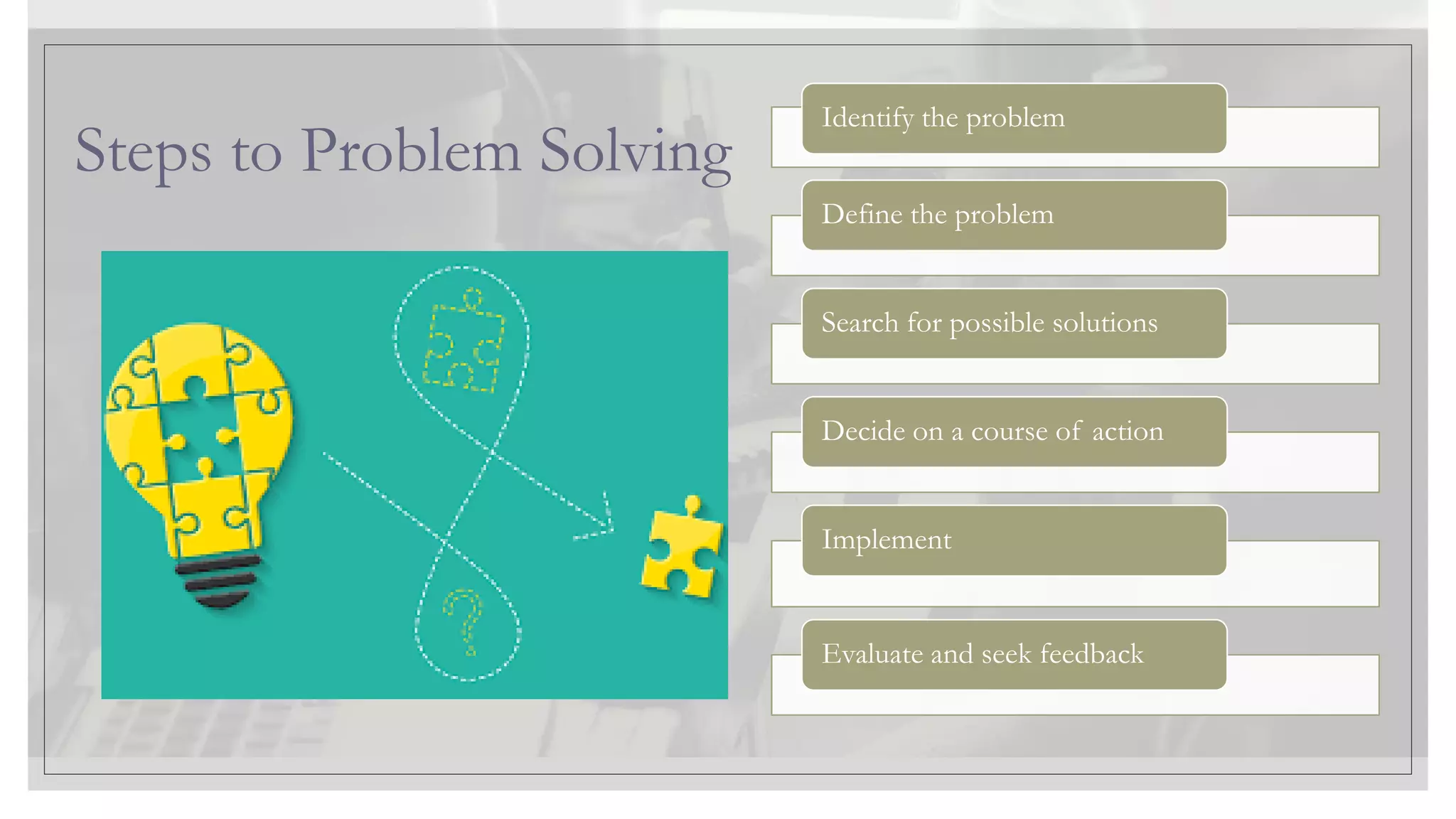
Steps to Problem Solving
Identify the problem
Define the problem
Search for possible solutions
Decide on a course of action
Implement
Evaluate and seek feedback
Case Study
◦ Lekan is the Head of a Sales business unit and has 7 people reporting to him. He has worked in the company
for almost 10 years. Feedback from his Line Manager is usually good, and his team members have only good
things to say about him.
◦ Over the past year, however, output from Lekan’s team has been low, yet he is constantly complaining of
being overwhelmed and needing more staff. When asked why, he usually responds that there is a lot to do.
◦ When asked if his team members were pulling their weight, he says that everyone is doing their best. His
appraisals of them show that he thinks they are working well.
◦ What are the likely reasons for this problem?
You have biases and they can affect your perspectives.
You can be so focused on small, easy to solve problems that you
overlook that that there might be one causative bigger problem at
the root. Solve that, and it can take care of all the little ones.
Consider the following:
Is the problem real or perceived?
Is this problem really an opportunity?
Does the problem need solving?
Clearly articulate your goals. What would the solution look like
and what is the desired impact
Identify what the possible barriers are.
Information is critical to problem solving. You need to gather as
much relevant information as possible.
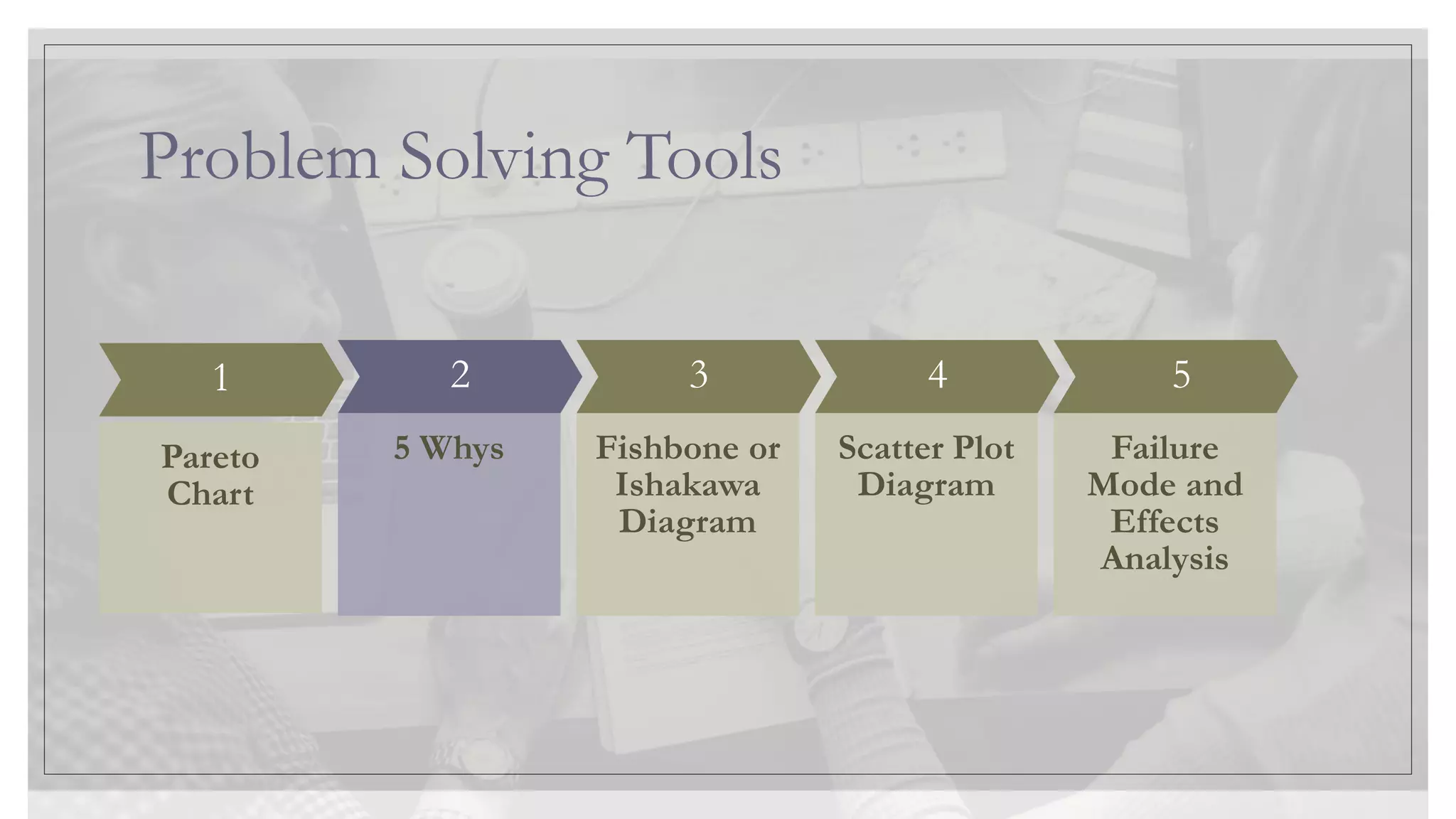
Problem Solving Tools
1
Pareto
Chart
2
5 Whys
3
Fishbone or
Ishakawa
Diagram
4
Scatter Plot
Diagram
5
Failure
Mode and
Effects
Analysis
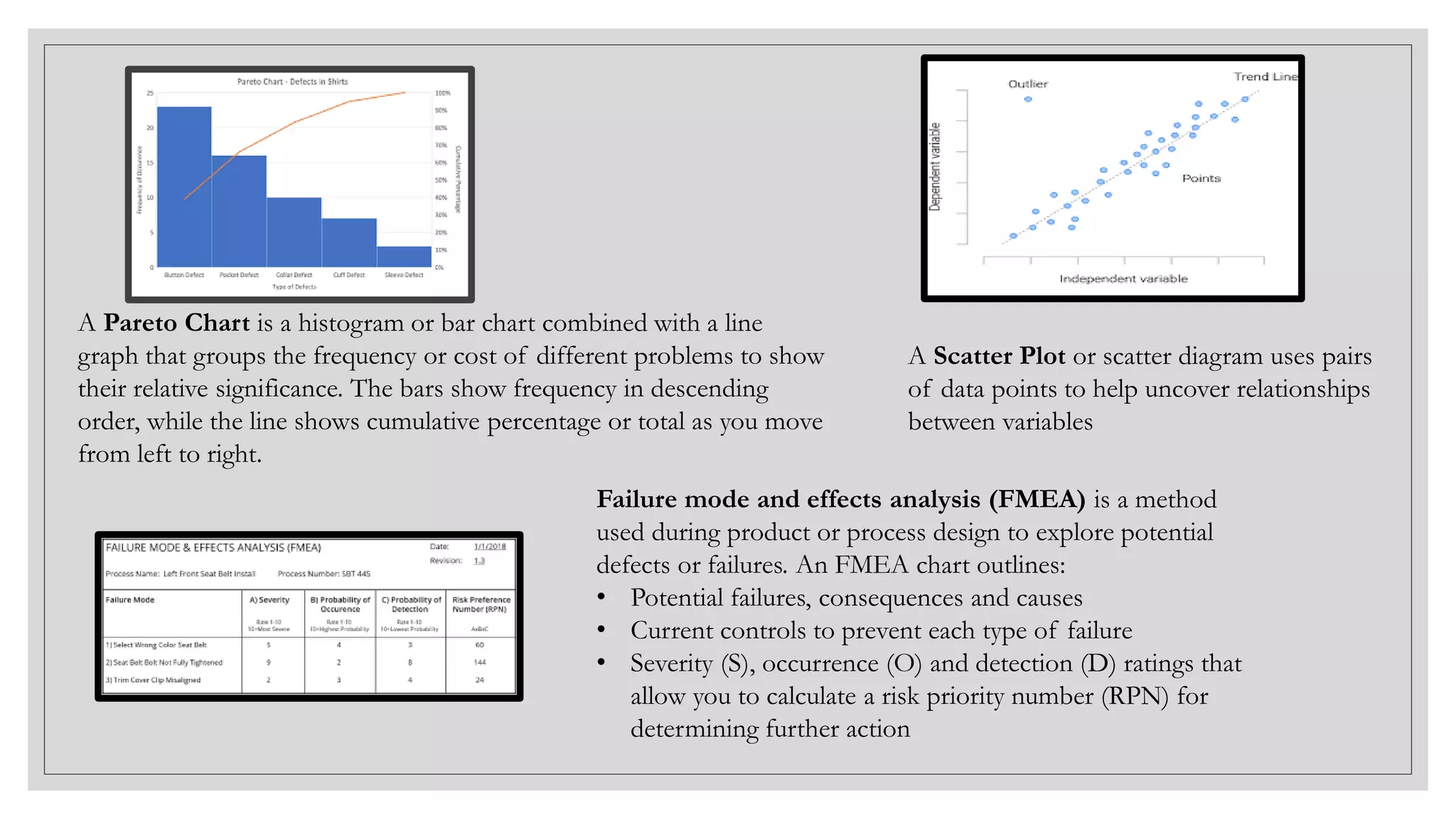
A Pareto Chart is a histogram or bar chart combined with a line
graph that groups the frequency or cost of different problems to show
their relative significance. The bars show frequency in descending
order, while the line shows cumulative percentage or total as you move
from left to right.
A Scatter Plot or scatter diagram uses pairs
of data points to help uncover relationships
between variables
Failure mode and effects analysis (FMEA) is a method
used during product or process design to explore potential
defects or failures. An FMEA chart outlines:
• Potential failures, consequences and causes
• Current controls to prevent each type of failure
• Severity (S), occurrence (O) and detection (D) ratings that
allow you to calculate a risk priority number (RPN) for
determining further action
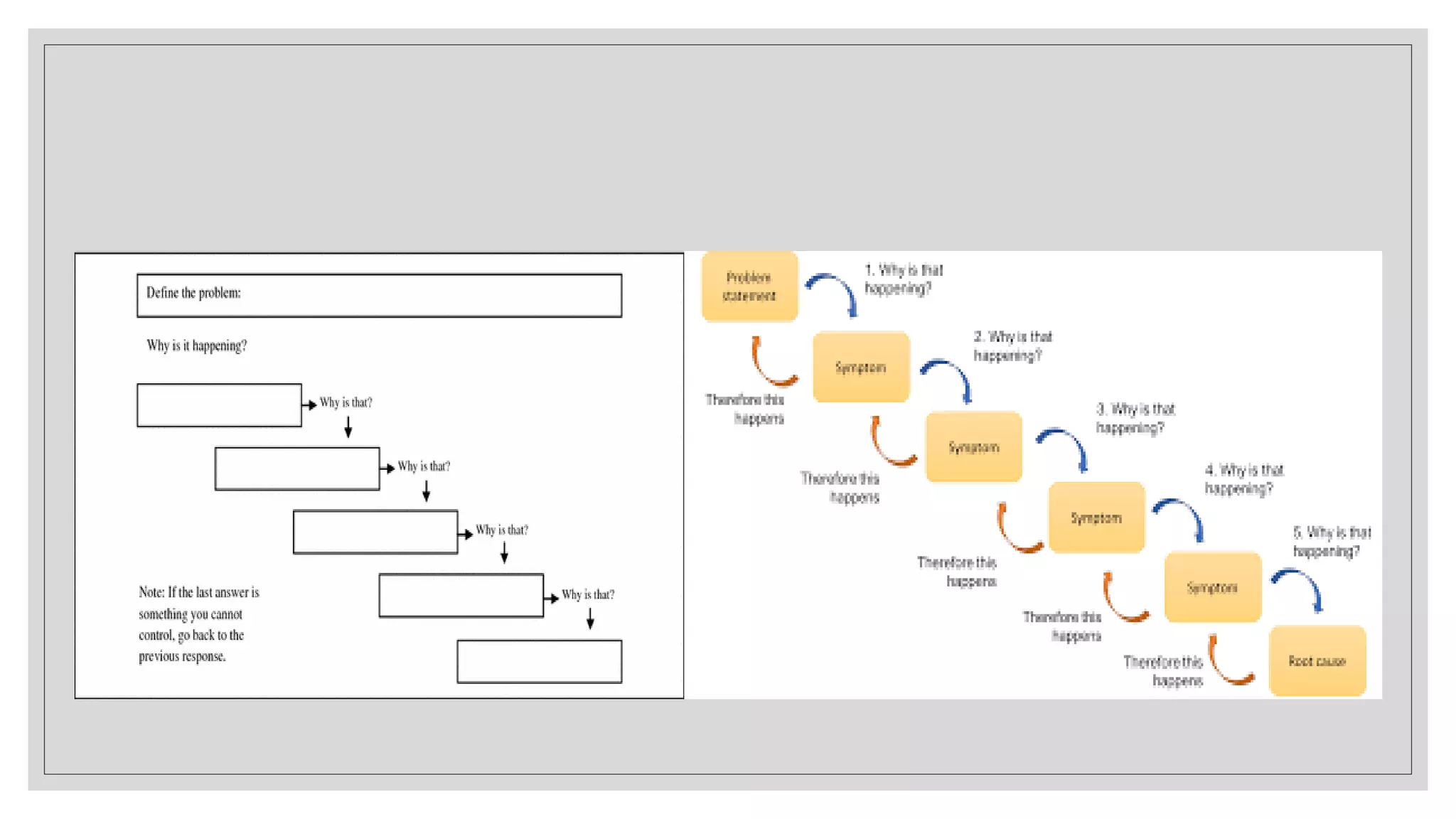
5 Whys
◦ The 5 Whys is a method that uses a series of questions to drill down into
successive layers of a problem.
◦ The basic idea is that each time you ask why, the answer becomes the basis of the
next why.
◦ It is a simple tool useful for problems where you do not need advanced statistics
◦ It may not be the best tool for complex problems.
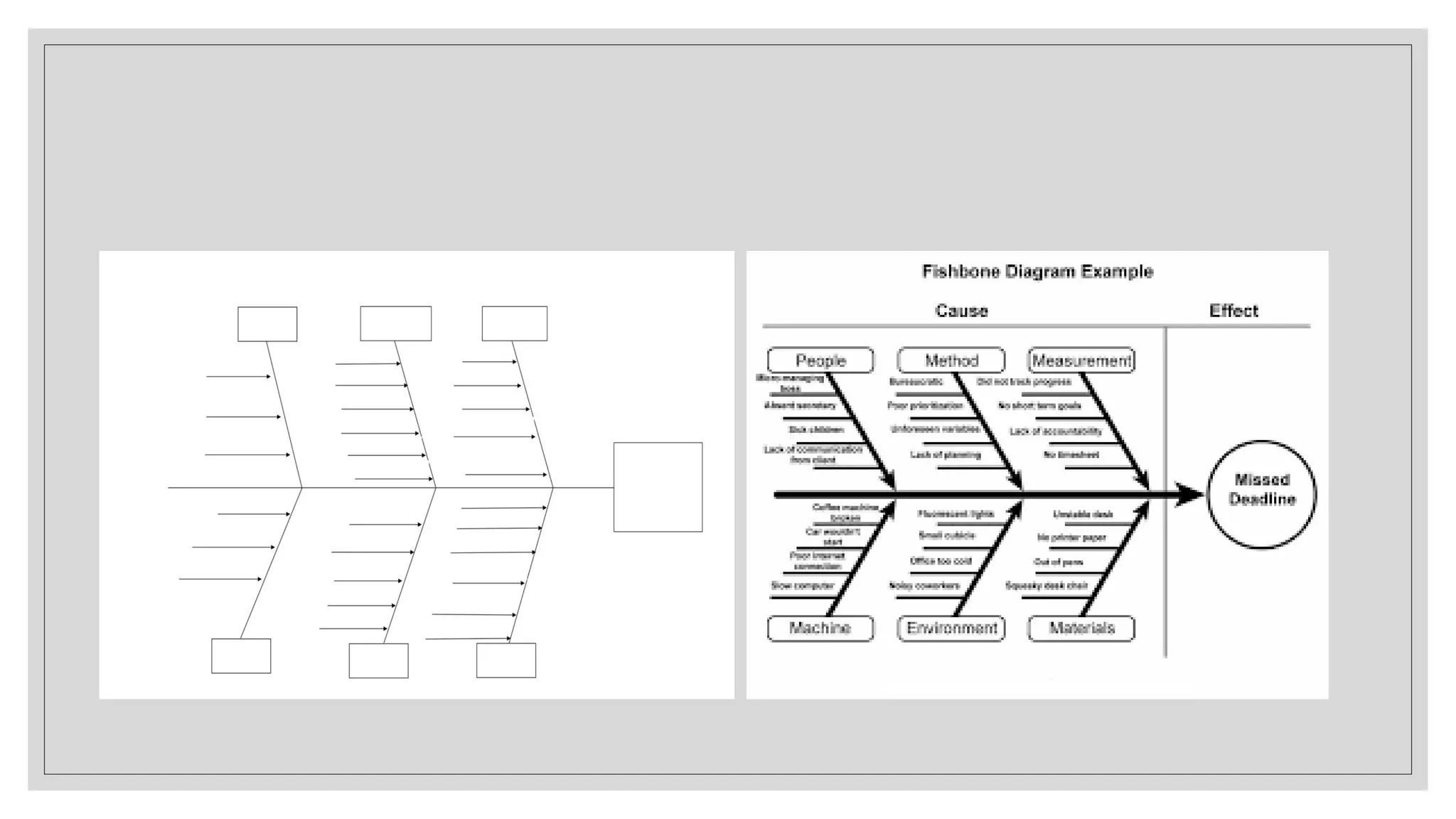
Fishbone or Ishakawa Diagram
◦ A fishbone diagram sorts possible causes into various categories that
branch off from the original problem.
◦ Also called a cause-and-effect or Ishakawa diagram, a fishbone
diagram may have multiple sub-causes branching off each identified
category.
PROBLEM SOLVING
MINDSET
ATTITUDE - the most important tool
◦ The right attitude is important when
approaching problems
◦ Having the tools and techniques are good, but
useless if the individual is not willing to tackle
the problem, or always passes it on to someone
else.
◦ Sometimes, the only problem-solving tool you
need is the willingness to try and to not give up.
◦ Understand that the same strategy you used to
sole one problem might not work in another
scenario.
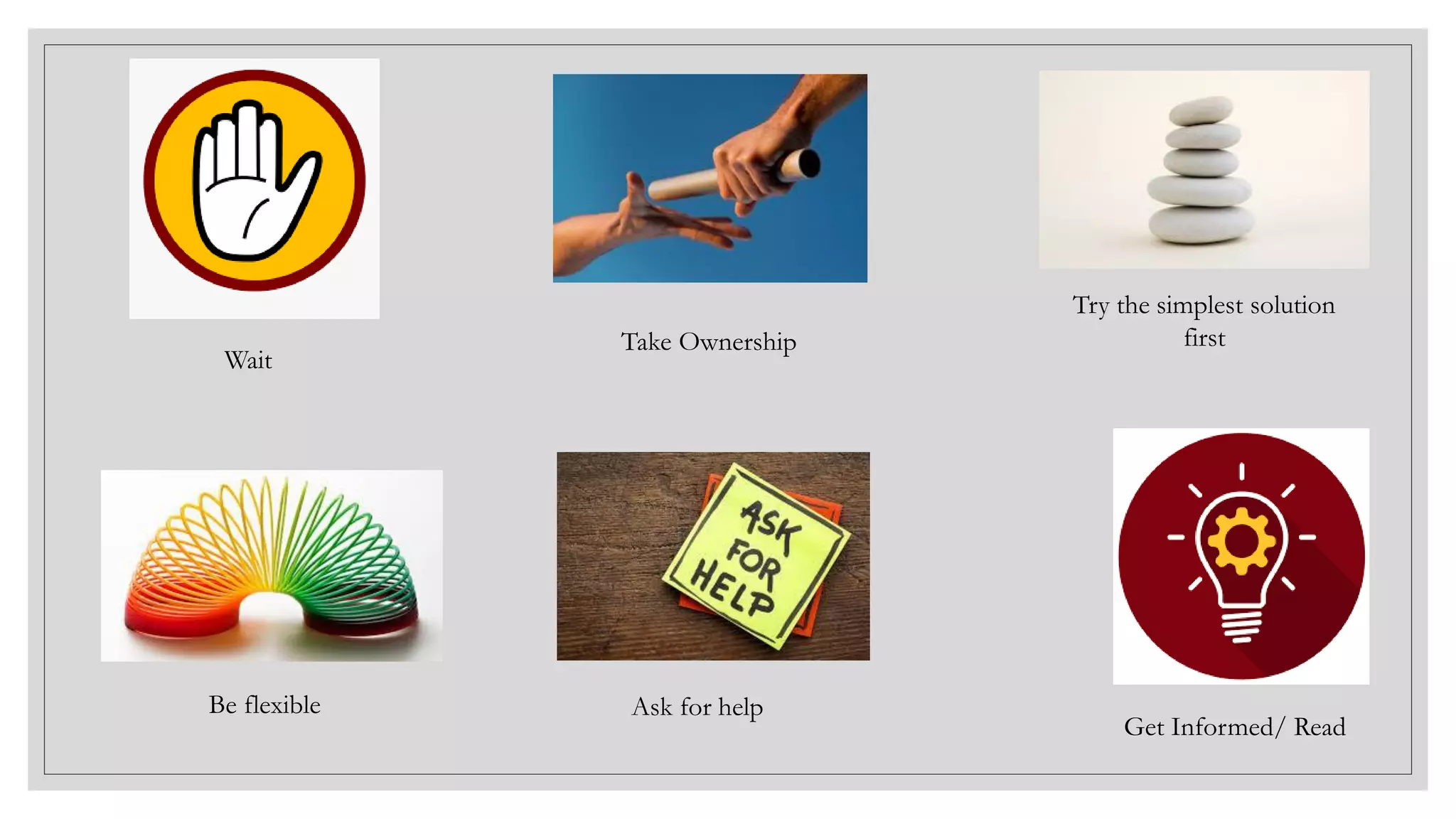
Wait
Take Ownership
Ask for help
Get Informed/ Read
Be flexible
Try the simplest solution
first
LISTENING SKILLS
Listening
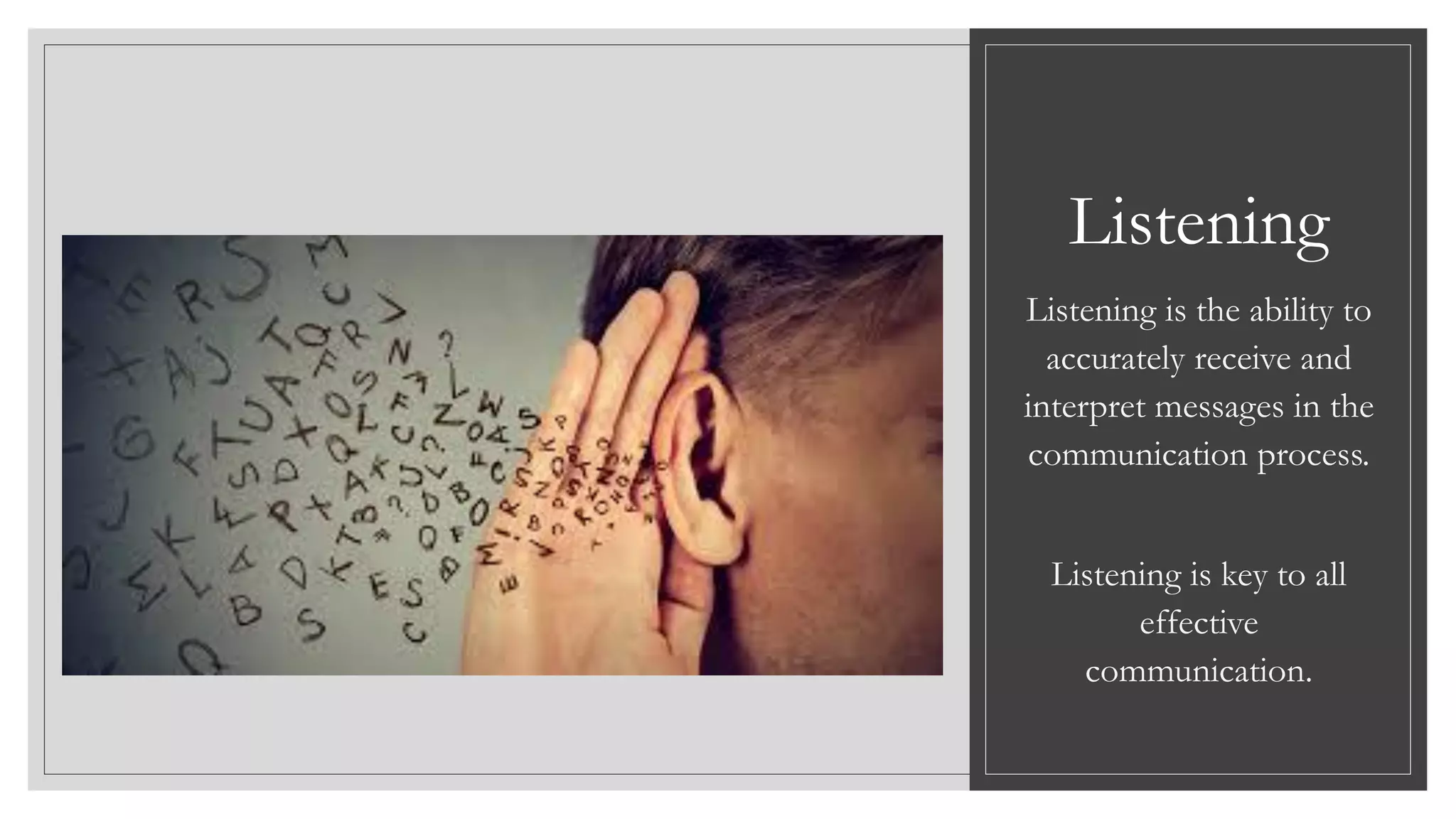
Listening is the ability to
accurately receive and
interpret messages in the
communication process.
Listening is key to all
effective
communication.
Active Listening
• Active listening refers to a pattern of
listening that keeps you engaged with your
conversation partner in a positive way.
• It is the process of listening attentively while
someone else speaks, paraphrasing and
reflecting back what is said, and withholding
judgment and advice.
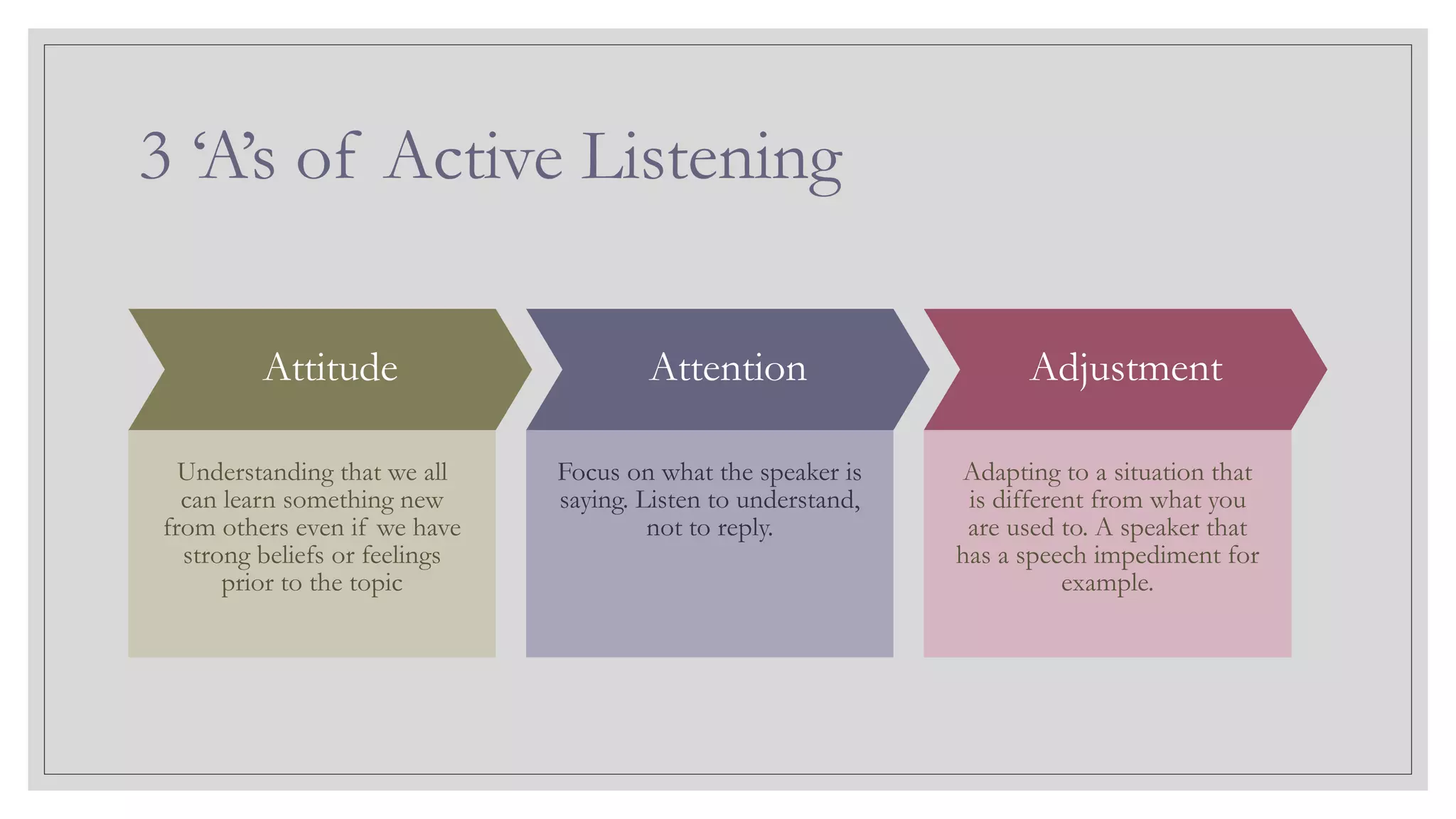
3 ‘A’s of Active Listening
Attitude
Understanding that we all
can learn something new
from others even if we have
strong beliefs or feelings
prior to the topic
Attention
Focus on what the speaker is
saying. Listen to understand,
not to reply.
Adjustment
Adapting to a situation that
is different from what you
are used to. A speaker that
has a speech impediment for
example.
Why is active listening
important in the
workplace?
• It helps you build connections.
• It helps you build trust.
• It helps you identify and solve problems.
• It helps you increase your knowledge and
understanding of various topics.
• It helps you avoid missing critical information.
Active Listening
Techniques
• Verbal Techniques
• Non-verbal Techniques
VERBAL ACTIVE
LISTENING SKILLS
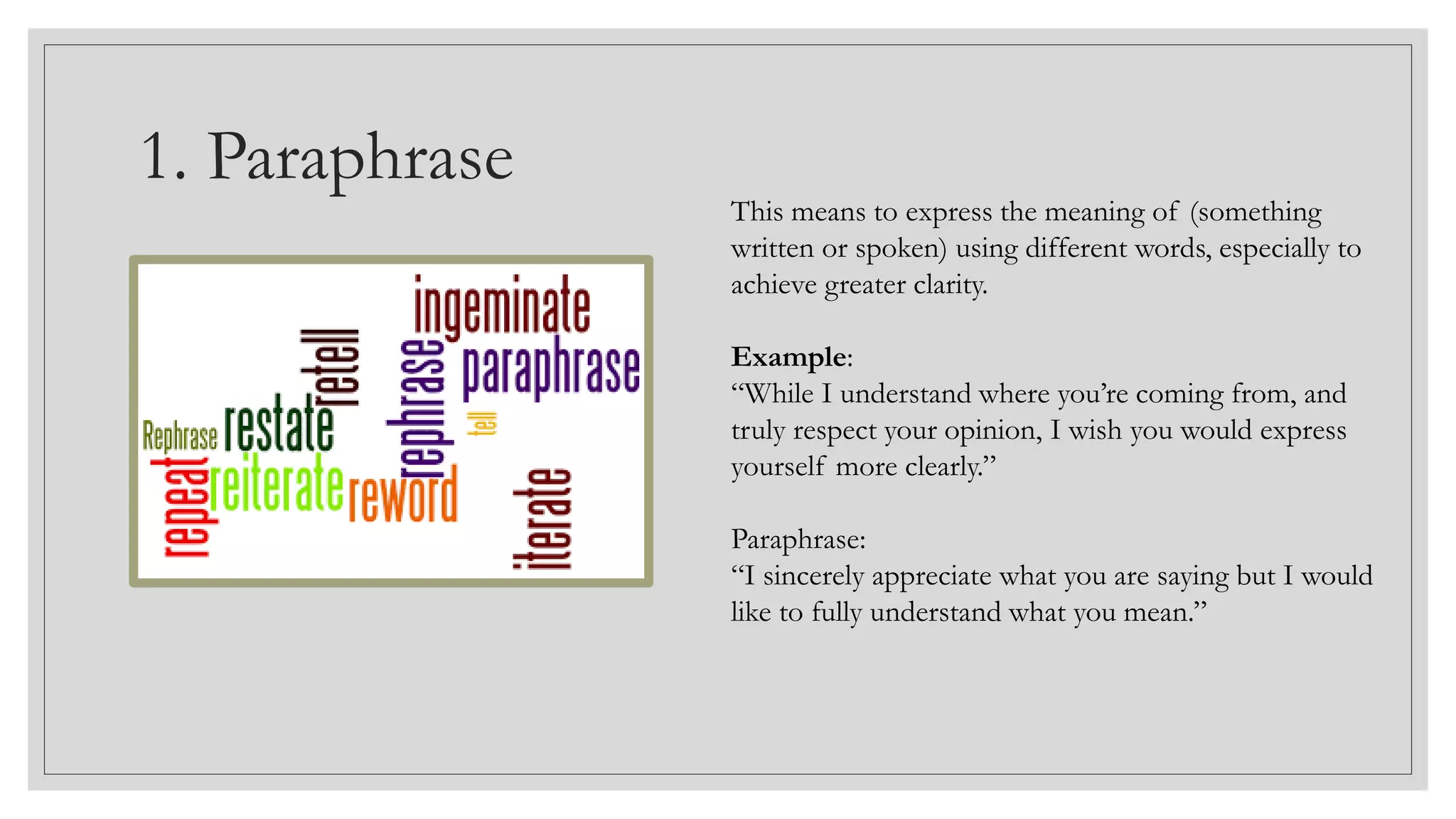
1. Paraphrase
This means to express the meaning of (something
written or spoken) using different words, especially to
achieve greater clarity.
Example:
“While I understand where you’re coming from, and
truly respect your opinion, I wish you would express
yourself more clearly.”
Paraphrase:
“I sincerely appreciate what you are saying but I would
like to fully understand what you mean.”
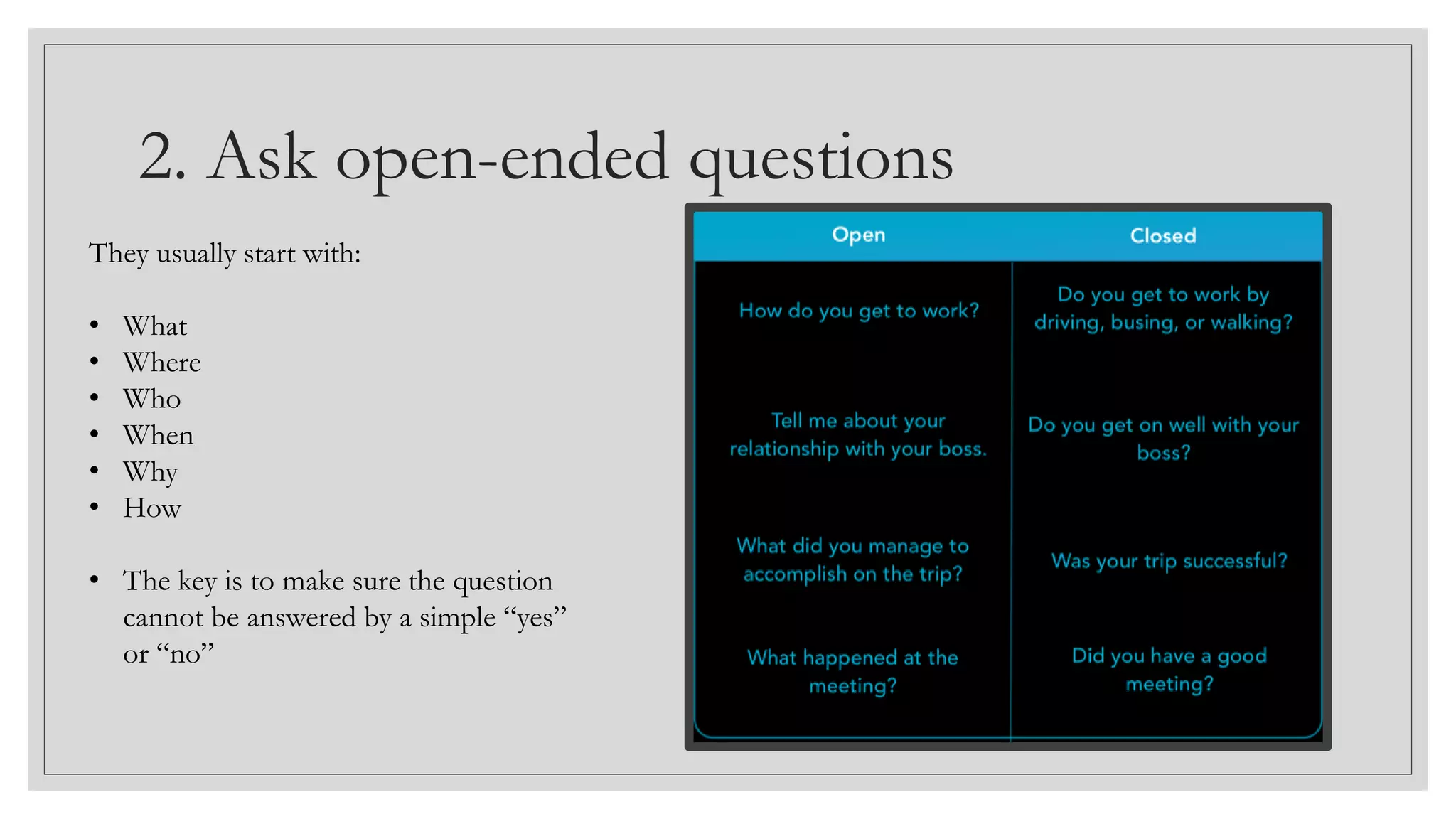
2. Ask open-ended questions
They usually start with:
• What
• Where
• Who
• When
• Why
• How
• The key is to make sure the question
cannot be answered by a simple “yes”
or “no”
3. Ask specific probing questions
◦ You can use the phrase “Tell me….” to invite
more information on a subject
◦ Components of a probing questions are:
◦ Prompting
◦ Seeking further information
◦ Re-focusing
◦ Re-direction
◦ Critical Awareness
4. Use short verbal affirmations
◦ Short, positive statements helps the speaker feel
more comfortable
◦ They show you are engaged and able to process
the information they are providing.
◦ Small verbal affirmations help you continue the
conversation without interrupting the speaker or
disrupting their flow.
◦ Example: “I understand.” “I see.” “Yes, that
makes sense.” “I agree.”
5. Display empathy.
◦ Make sure the speaker understands you’re able
to recognize their emotions and share their
feelings.
◦ By showing compassion, rather than just feeling
it, you connect with the speaker and begin
establishing a sense of mutual trust.
◦ Example: “I’m so sorry you’re dealing with this
problem. Let’s think of some ways I can help.”
6. Share similar experiences
◦ Discussing comparable situations shows the
speaker you have successfully interpreted their
message
◦ It can also assist in building relationships.
◦ If the speaker has shared a problem, providing
input from how you solved similar challenges is
valuable to others.
◦ Example: “I also sent many applications before
I got my first interview invite; but after I got the
job I wanted, I forgot about how stressful the
job search was.”
7. Recall previously shared information
◦ Try to remember key concepts, ideas or other
critical points the speaker has shared with you in
the past.
◦ This demonstrates you are not only listening to
what they are saying currently, but you care
enough to retain information and recall specific
details.
◦ Example: “Last week you mentioned inviting
Kunle to help with this account, and I think
that’s a great idea.”
Non-Verbal
Active Listening
Skills
• Nodding
• Smiling
• Avoid distracting movements
• Maintain eye contact
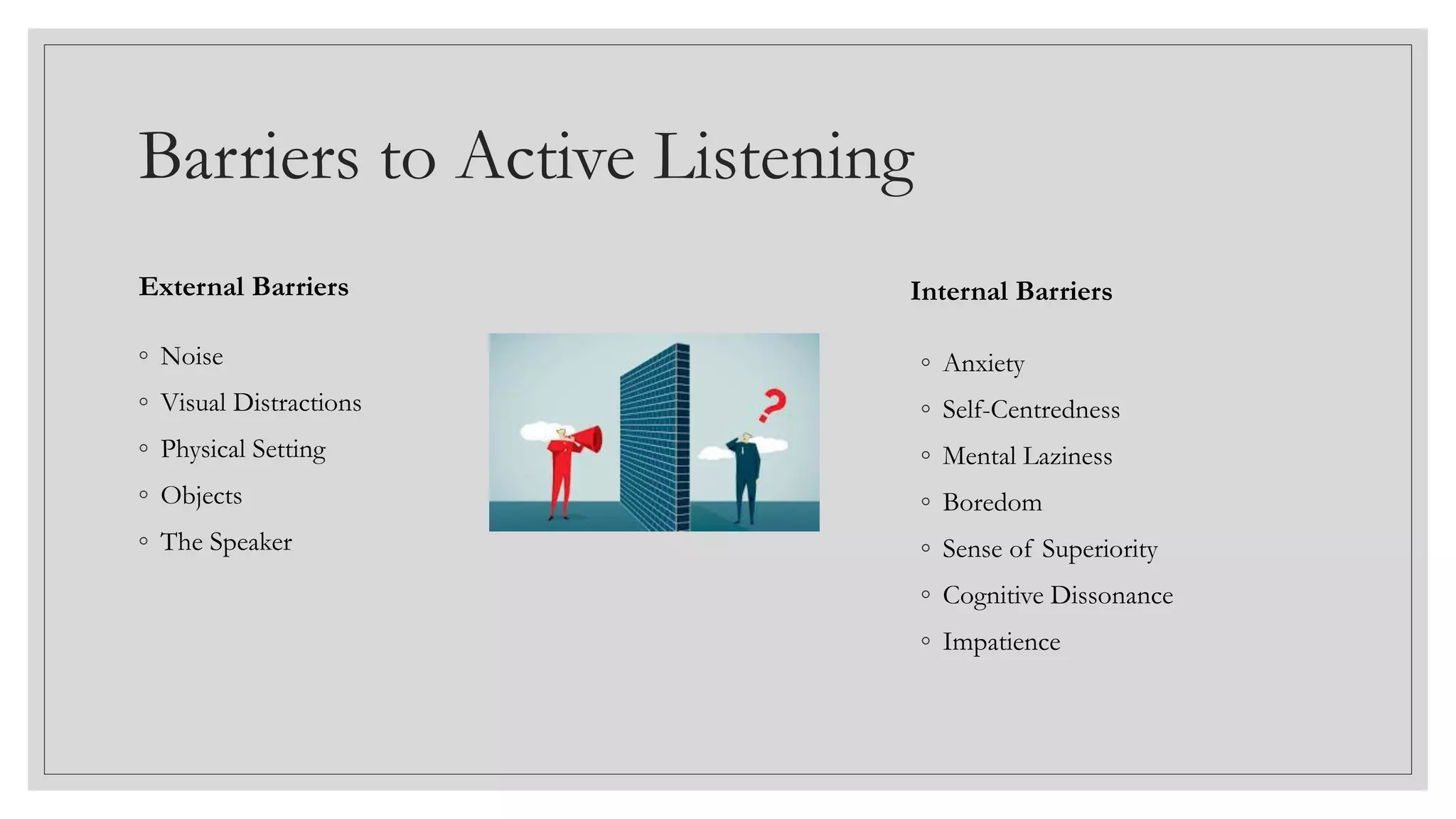
Barriers to Active Listening
External Barriers
◦ Noise
◦ Visual Distractions
◦ Physical Setting
◦ Objects
◦ The Speaker
Internal Barriers
◦ Anxiety
◦ Self-Centredness
◦ Mental Laziness
◦ Boredom
◦ Sense of Superiority
◦ Cognitive Dissonance
◦ Impatience
Connect with me and Let’s
Talk!
◦ Twitter - @toyintalktalent, @toyinpuddy
◦ Instagram - @toyintalkstalent
◦ Facebook Group – Toyin Talks Talent (T3)Network
◦ Telegram – T3 Network (Soft Skills Support for 4 weeks)
◦ LinkedIn – Oluwatoyin Puddicombe
◦ YouTube – Oluwatoyin Puddicombe
THANK YOU!
Any Questions?

Soft skills series Problem Solving and Listening Skills

  • 1.
    SOFT SKILLS SERIES EmployabilitySkills that will set you up for Career Success Oluwatoyin Puddicombe Toyin Talks Talent
  • 2.
    Oluwatoyin Puddicombe ACIPM, SPHRi,SHRM ◦ I am an HR professional with over a decade of active work experience. I have worked in Aviation, Business Services, Consulting, and Insurance, gathering and acquiring skills and competences in Client Services, Relationship Management and Human Capital Management with a strong bias for Talent Acquisition and Development. ◦ I believe that our work is a platform for sharing our gifts with the world. Unfortunately, a lot of young graduates underestimate themselves for various reasons; the economy, wrong course choices, wrong career choices, failure to plan their careers, multiple rejections and so on. ◦ I believe that each person is uniquely gifted by God to make their way in the world using those gifts and I would like to help in discovering them and finding fulfilling careers. ◦ Toyin Talks Talent (T3) is the virtual platform through which I do this!
  • 3.
    Series Outline Lesson 1. InterpersonalSkills Lesson 2. Problem Solving Lesson 3. Listening Skills Lesson 4. Public Speaking Lesson 5. Business Etiquette
  • 4.
    Learning Outcomes At theend of the session, you should be able to: 1. Describe what Soft Skills are 2. Identify where you may not have displayed it. 3. Explain the problem-solving technique you can apply immediately. 4. Recognise the barriers you have, to listening actively. 5. Commit to changing ONE thing; either to STOP something or to START something.
  • 5.
    Housekeeping ◦ 4-week SoftSkills Series Support Please note your questions and ask after the session There is a time limit, so kindly re-join the session after the time out We are all here to learn, so let’s participate and have fun!
  • 6.
    DEFINING SOFT SKILLS Softskills are a combination of skills that enable people to navigate their environment, work well with others, perform well, and achieve their goals with complementing hard skills. The Collins English Dictionary defines the term "soft skills" as "desirable qualities for certain forms of employment that do not depend on acquired knowledge: they include common sense, the ability to deal with people, and a positive flexible attitude."
  • 7.
    In Deloitte’s 2016Global Human Capital Trends Report, 92% of respondents rated soft skills as a critical priority. A recent study in the UK determined that “Soft Skills” are worth £88bn ($186bn CDN) to the UK economy. A business group, including, believe it or not, McDonalds is doing a three- month study on how government can introduce policies that will help employees and employers develop soft skills. Whitehead 2020
  • 8.
    A B Which wouldyou… 1. Prefer 2. Buy
  • 9.
    About Soft Skills ◦Soft skills are any skill or quality that can be classified as a personality trait or habit. ◦ Soft skills are not about the knowledge you possess but rather the behaviors you display in different situations. ◦ Soft skills are typically innate, but they can be learned, and they can be enhanced.
  • 10.
    Soft Skills vsHard Skills • Hard skills make an impression; soft skills leave a legacy. • Hard skills speak to why they want to hire you; soft skills speak to why they should hire you. • Hard skills can get you the interview; soft skills can get you the job. • Hard skills appeal to the head; soft skills appeal to the heart.
  • 11.
    Why are Soft Skills Important? •Human interactions cannot always be defined empirically. • That two people were exposed to the same scenarios with the same factors does not mean they will react in the same way. • Soft skills are the answers to those indefinable “somethings” that are deal breakers in certain business situations.
  • 12.
    Laying the right Foundation CHARACTER •Values • Experiences • Personality • Habits
  • 13.
    A habit isa routine of behaviour that is repeated regularly and tends to occur subconsciously. What are your habits? They influence your actions. Experiences are positive and negative events that have occurred in our lives that shape our beliefs and behaviour Personality is the characteristic patterns of thoughts, feelings, and behaviors that make a person unique. It is innate. Values are basic and fundamental beliefs that guide or motivate attitudes or actions. They help us to determine what is important to us
  • 14.
    SOFT SKILLS FOR CAREEREXCELLENCE Some soft skills that prove invaluable in life and career
  • 15.
    Problem Solving The ability tohandle difficult or unexpected situations in the workplace as well as complex business challenges.
  • 16.
    Effective Problem Solving • Problemsolving requires some other key skills to be effective: • Creativity (thinking differently) • Critical Thinking (asking many ‘whys’) • Active Listening (attentive listening) • Research (gathering information) • Teamwork (asking for and giving help) • Emotional Intelligence (self-management) • Decision Making (what action to take) • Risk Assessment and Management (What could go wrong and what to do about it)
  • 17.
    Steps to ProblemSolving Identify the problem Define the problem Search for possible solutions Decide on a course of action Implement Evaluate and seek feedback
  • 18.
    Case Study ◦ Lekanis the Head of a Sales business unit and has 7 people reporting to him. He has worked in the company for almost 10 years. Feedback from his Line Manager is usually good, and his team members have only good things to say about him. ◦ Over the past year, however, output from Lekan’s team has been low, yet he is constantly complaining of being overwhelmed and needing more staff. When asked why, he usually responds that there is a lot to do. ◦ When asked if his team members were pulling their weight, he says that everyone is doing their best. His appraisals of them show that he thinks they are working well. ◦ What are the likely reasons for this problem?
  • 19.
    You have biasesand they can affect your perspectives. You can be so focused on small, easy to solve problems that you overlook that that there might be one causative bigger problem at the root. Solve that, and it can take care of all the little ones. Consider the following: Is the problem real or perceived? Is this problem really an opportunity? Does the problem need solving? Clearly articulate your goals. What would the solution look like and what is the desired impact Identify what the possible barriers are. Information is critical to problem solving. You need to gather as much relevant information as possible.
  • 20.
    Problem Solving Tools 1 Pareto Chart 2 5Whys 3 Fishbone or Ishakawa Diagram 4 Scatter Plot Diagram 5 Failure Mode and Effects Analysis
  • 21.
    A Pareto Chartis a histogram or bar chart combined with a line graph that groups the frequency or cost of different problems to show their relative significance. The bars show frequency in descending order, while the line shows cumulative percentage or total as you move from left to right. A Scatter Plot or scatter diagram uses pairs of data points to help uncover relationships between variables Failure mode and effects analysis (FMEA) is a method used during product or process design to explore potential defects or failures. An FMEA chart outlines: • Potential failures, consequences and causes • Current controls to prevent each type of failure • Severity (S), occurrence (O) and detection (D) ratings that allow you to calculate a risk priority number (RPN) for determining further action
  • 22.
    5 Whys ◦ The5 Whys is a method that uses a series of questions to drill down into successive layers of a problem. ◦ The basic idea is that each time you ask why, the answer becomes the basis of the next why. ◦ It is a simple tool useful for problems where you do not need advanced statistics ◦ It may not be the best tool for complex problems.
  • 24.
    Fishbone or IshakawaDiagram ◦ A fishbone diagram sorts possible causes into various categories that branch off from the original problem. ◦ Also called a cause-and-effect or Ishakawa diagram, a fishbone diagram may have multiple sub-causes branching off each identified category.
  • 26.
  • 27.
    ATTITUDE - themost important tool ◦ The right attitude is important when approaching problems ◦ Having the tools and techniques are good, but useless if the individual is not willing to tackle the problem, or always passes it on to someone else. ◦ Sometimes, the only problem-solving tool you need is the willingness to try and to not give up. ◦ Understand that the same strategy you used to sole one problem might not work in another scenario.
  • 28.
    Wait Take Ownership Ask forhelp Get Informed/ Read Be flexible Try the simplest solution first
  • 29.
  • 30.
    Listening Listening is theability to accurately receive and interpret messages in the communication process. Listening is key to all effective communication.
  • 31.
    Active Listening • Activelistening refers to a pattern of listening that keeps you engaged with your conversation partner in a positive way. • It is the process of listening attentively while someone else speaks, paraphrasing and reflecting back what is said, and withholding judgment and advice.
  • 32.
    3 ‘A’s ofActive Listening Attitude Understanding that we all can learn something new from others even if we have strong beliefs or feelings prior to the topic Attention Focus on what the speaker is saying. Listen to understand, not to reply. Adjustment Adapting to a situation that is different from what you are used to. A speaker that has a speech impediment for example.
  • 33.
    Why is activelistening important in the workplace? • It helps you build connections. • It helps you build trust. • It helps you identify and solve problems. • It helps you increase your knowledge and understanding of various topics. • It helps you avoid missing critical information.
  • 34.
    Active Listening Techniques • VerbalTechniques • Non-verbal Techniques
  • 35.
  • 36.
    1. Paraphrase This meansto express the meaning of (something written or spoken) using different words, especially to achieve greater clarity. Example: “While I understand where you’re coming from, and truly respect your opinion, I wish you would express yourself more clearly.” Paraphrase: “I sincerely appreciate what you are saying but I would like to fully understand what you mean.”
  • 37.
    2. Ask open-endedquestions They usually start with: • What • Where • Who • When • Why • How • The key is to make sure the question cannot be answered by a simple “yes” or “no”
  • 38.
    3. Ask specificprobing questions ◦ You can use the phrase “Tell me….” to invite more information on a subject ◦ Components of a probing questions are: ◦ Prompting ◦ Seeking further information ◦ Re-focusing ◦ Re-direction ◦ Critical Awareness
  • 39.
    4. Use shortverbal affirmations ◦ Short, positive statements helps the speaker feel more comfortable ◦ They show you are engaged and able to process the information they are providing. ◦ Small verbal affirmations help you continue the conversation without interrupting the speaker or disrupting their flow. ◦ Example: “I understand.” “I see.” “Yes, that makes sense.” “I agree.”
  • 40.
    5. Display empathy. ◦Make sure the speaker understands you’re able to recognize their emotions and share their feelings. ◦ By showing compassion, rather than just feeling it, you connect with the speaker and begin establishing a sense of mutual trust. ◦ Example: “I’m so sorry you’re dealing with this problem. Let’s think of some ways I can help.”
  • 41.
    6. Share similarexperiences ◦ Discussing comparable situations shows the speaker you have successfully interpreted their message ◦ It can also assist in building relationships. ◦ If the speaker has shared a problem, providing input from how you solved similar challenges is valuable to others. ◦ Example: “I also sent many applications before I got my first interview invite; but after I got the job I wanted, I forgot about how stressful the job search was.”
  • 42.
    7. Recall previouslyshared information ◦ Try to remember key concepts, ideas or other critical points the speaker has shared with you in the past. ◦ This demonstrates you are not only listening to what they are saying currently, but you care enough to retain information and recall specific details. ◦ Example: “Last week you mentioned inviting Kunle to help with this account, and I think that’s a great idea.”
  • 43.
    Non-Verbal Active Listening Skills • Nodding •Smiling • Avoid distracting movements • Maintain eye contact
  • 44.
    Barriers to ActiveListening External Barriers ◦ Noise ◦ Visual Distractions ◦ Physical Setting ◦ Objects ◦ The Speaker Internal Barriers ◦ Anxiety ◦ Self-Centredness ◦ Mental Laziness ◦ Boredom ◦ Sense of Superiority ◦ Cognitive Dissonance ◦ Impatience
  • 45.
    Connect with meand Let’s Talk! ◦ Twitter - @toyintalktalent, @toyinpuddy ◦ Instagram - @toyintalkstalent ◦ Facebook Group – Toyin Talks Talent (T3)Network ◦ Telegram – T3 Network (Soft Skills Support for 4 weeks) ◦ LinkedIn – Oluwatoyin Puddicombe ◦ YouTube – Oluwatoyin Puddicombe
  • 46.