REASONS YOUR JOB
APPLICATION MAY NOT
PROGRESS TO THE NEXT
PHASE
Oluwatoyin Puddicombe
#ToyinTalksTalent
 I am an HR professional with over a decade of active work
experience. I have worked in Aviation, Business Services,
Consulting, and Insurance, gathering and acquiring skills and
competences in Client Services, Relationship Management,
Business Development and Human Capital Management
with a strong bias for Talent Acquisition and Development.
 I believe that our work is a platform for sharing our gifts with
the world. Unfortunately, a lot of young graduates
underestimate themselves for various reasons; the economy,
wrong course choices, wrong career choices, failure to plan
their careers, multiple rejections and so on.
 I believe that each person is uniquely gifted by God to make
their way in the world using those gifts and I would like to help
in discovering them and finding fulfilling careers.
 This is the reason for Toyin Talks Talent.
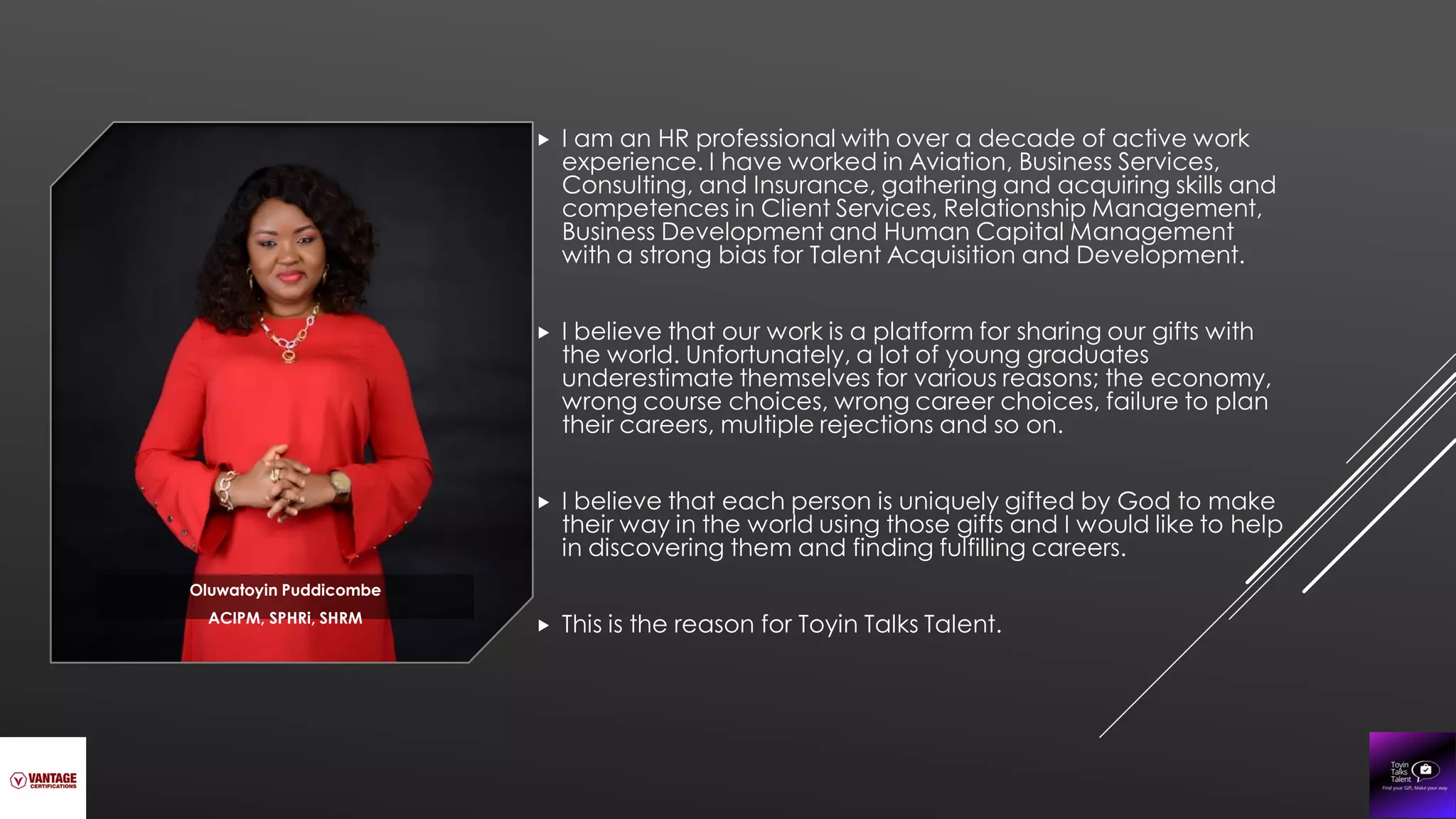
Oluwatoyin Puddicombe
ACIPM, SPHRi, SHRM
LEARNING OUTCOMES
At the end of the session, you should be able to:
 Describe how the world of work has changed and how it affect
the application and interview processes
 Identify mistakes candidates make that affect the progress of
their job applications
 Learn what employers consider before they choose the ideal
candidate
HOUSEKEEPING
Please note your
questions and ask
after the session or
type in the chat box
If you are not asking or
responding to a question,
please keep your
microphone muted
We are all here to
learn, so let’s
participate and have
fun!
TABLE OF CONTENT
 Overview of how the world of work has changed
 Missteps at the Application Phase
 Missteps at the Interview Phase
 What employers consider before selecting the ideal candidate
 Putting your best foot forward
HOW THE WORLD OF WORK HAS
CHANGED
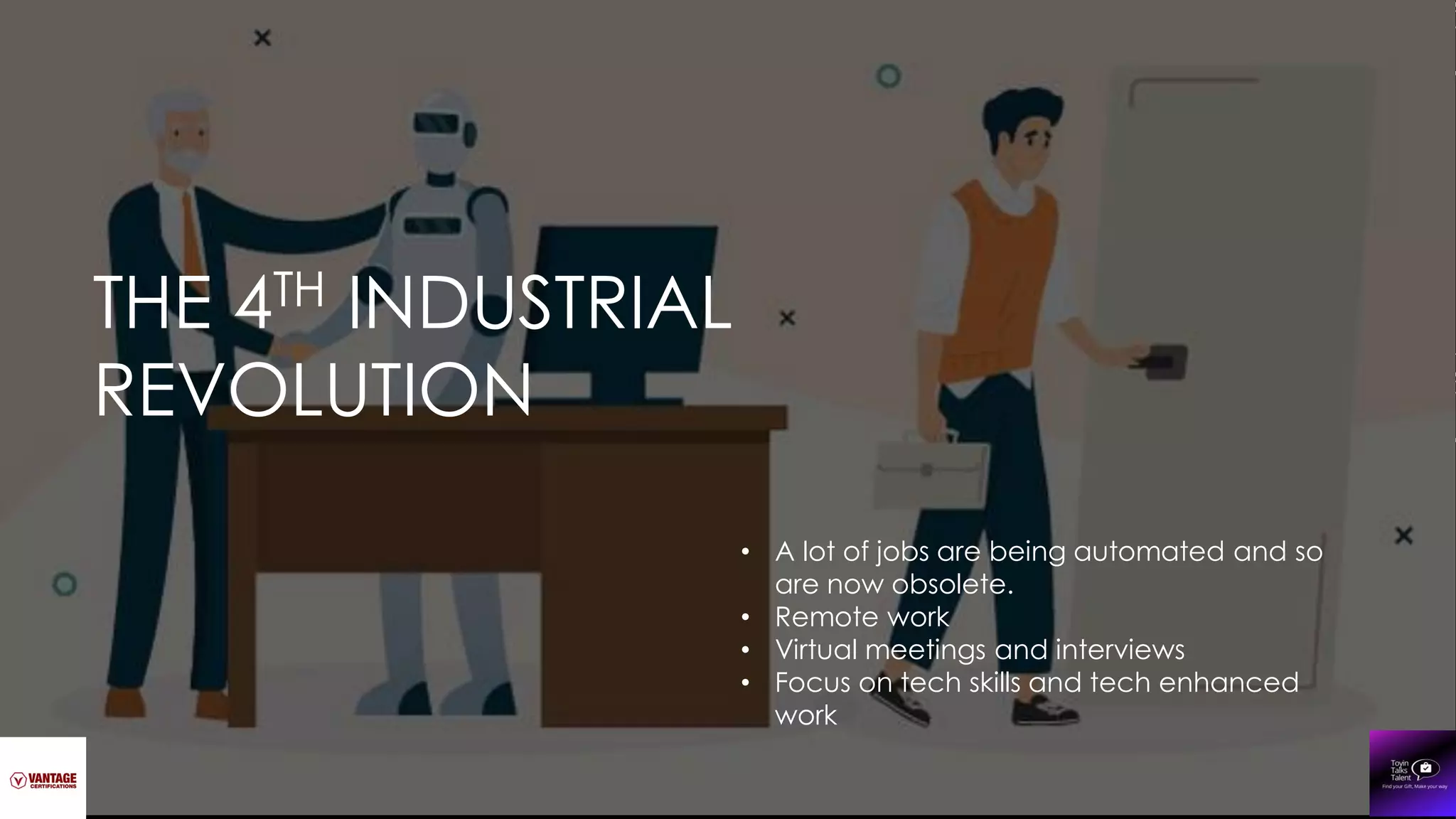
THE 4TH INDUSTRIAL
REVOLUTION
• A lot of jobs are being automated and so
are now obsolete.
• Remote work
• Virtual meetings and interviews
• Focus on tech skills and tech enhanced
work
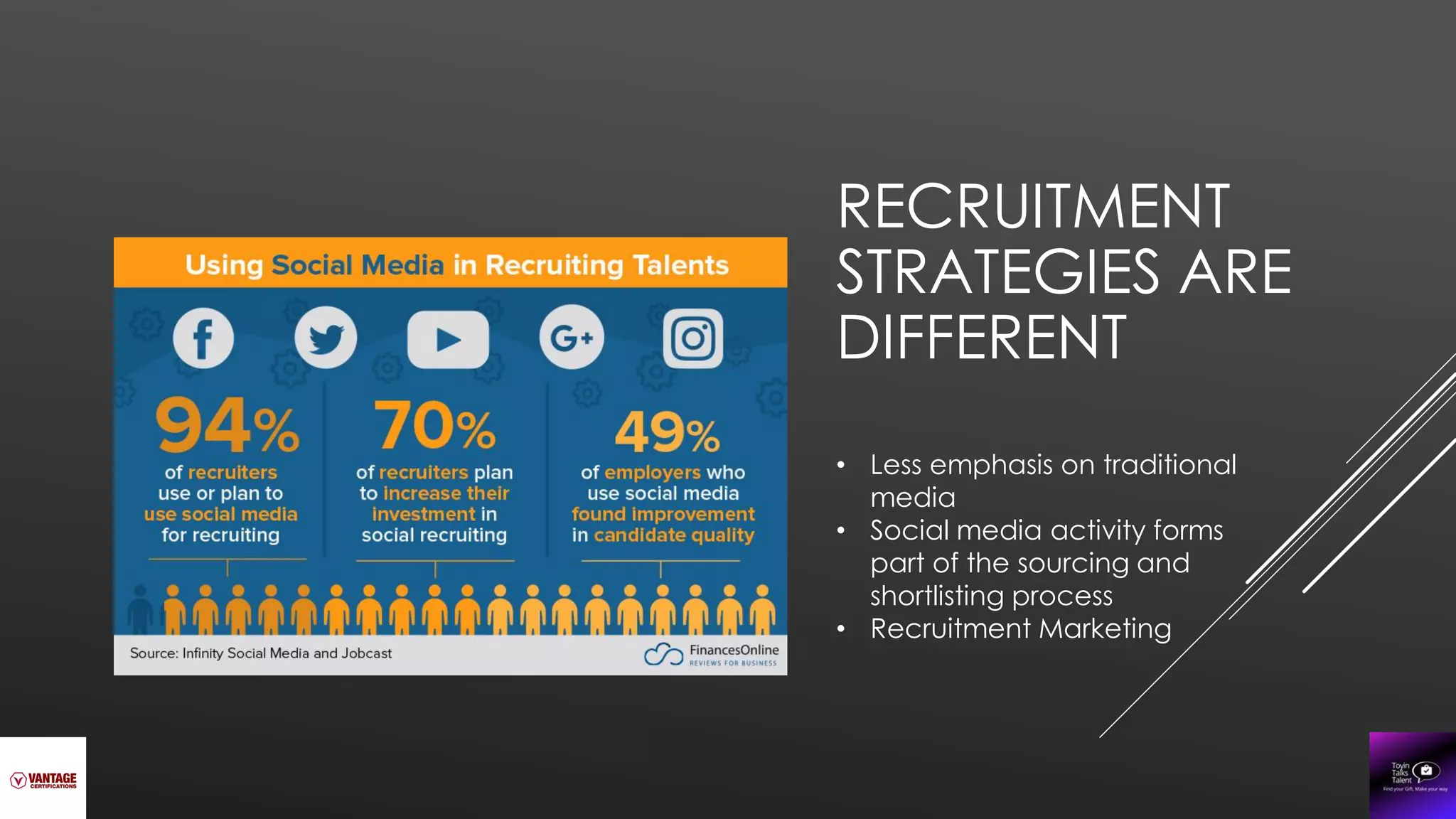
RECRUITMENT
STRATEGIES ARE
DIFFERENT
• Less emphasis on traditional
media
• Social media activity forms
part of the sourcing and
shortlisting process
• Recruitment Marketing
YOUR ONLINE PRESENCE IS
YOUR NEW CV
• How are you demonstrating your
KSA’s on social media?
• What started prior to COVID-19 has
been ramped up in the era of social
distancing and increased number of
digital options.
AREA OF
EXPERTISE
 What are you known for?
 What are your strengths?
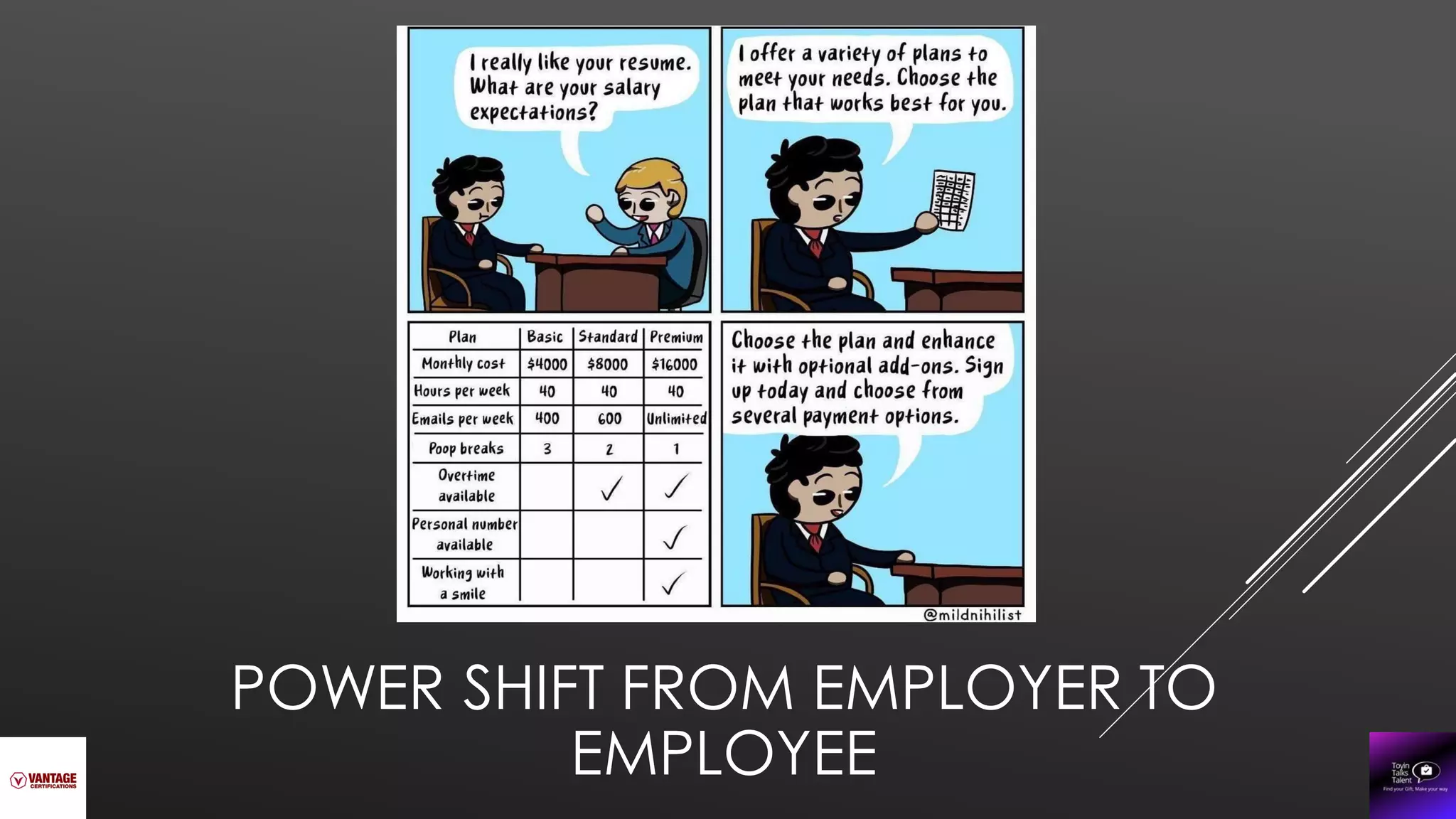
POWER SHIFT FROM EMPLOYER TO
EMPLOYEE
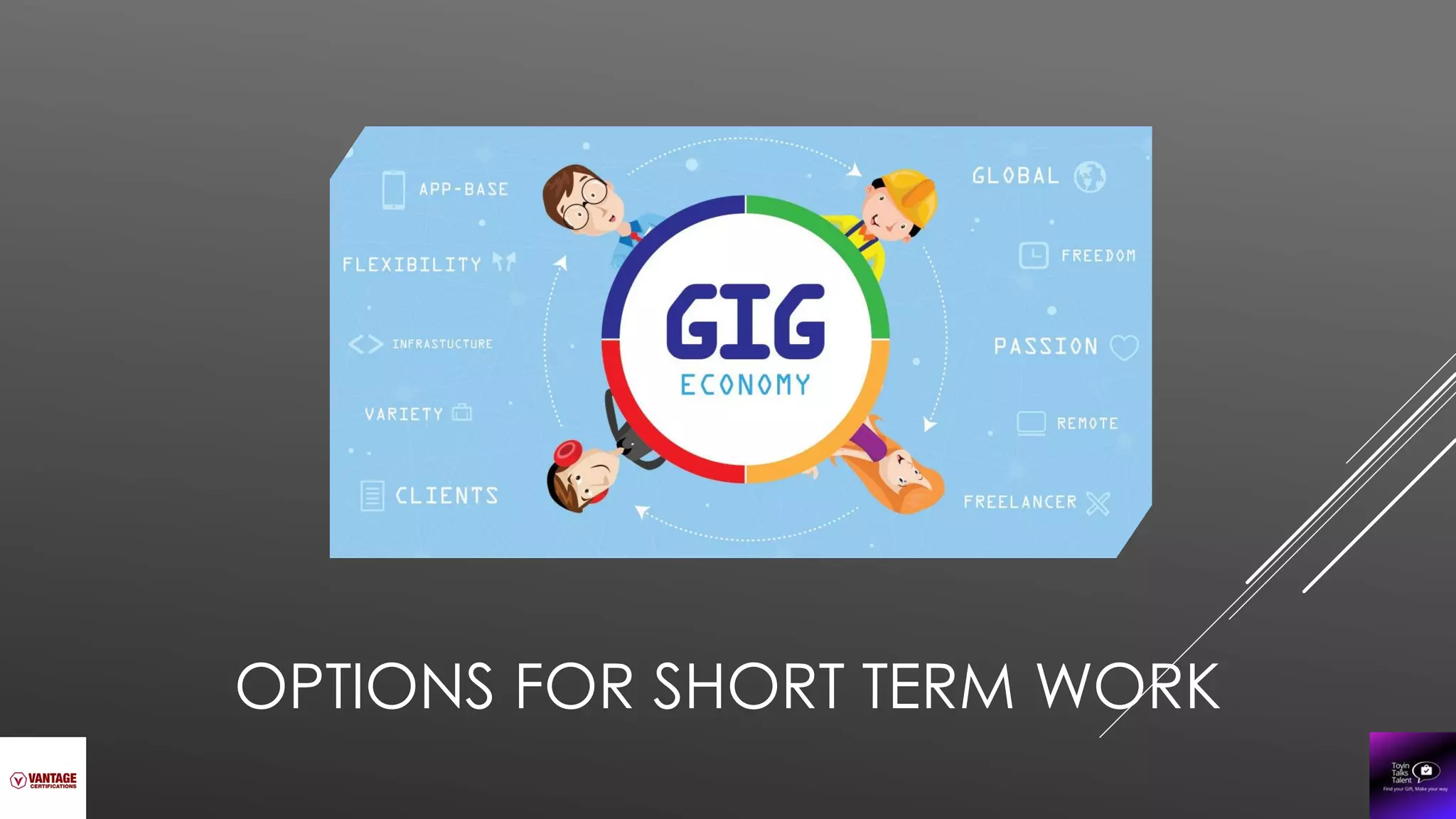
OPTIONS FOR SHORT TERM WORK
EVERYONE IS A SALESMAN
• The “war for talent” creates a scenario where the
employer is the customer, and YOU are the
product.
• The Salesman mindset is one that connects your
value proposition to the employer’s needs.
THE EFFECT ON
“GLOCALIZATION”
• The term means putting a local flair on
international practices and making them
relevant to your environment.
• Since the playing field is now online, your
competences are being compared to
those of your contemporaries all over the
world.
• This is pointing to an international
standardization
THE CURRENCY CALLED
KNOWLEDGE
• Almost everything you need to learn is
on the internet.
• The more you know and can do, the
better positioned you are for choice
jobs.
• An offshoot of this though is that you
have fewer excuses.
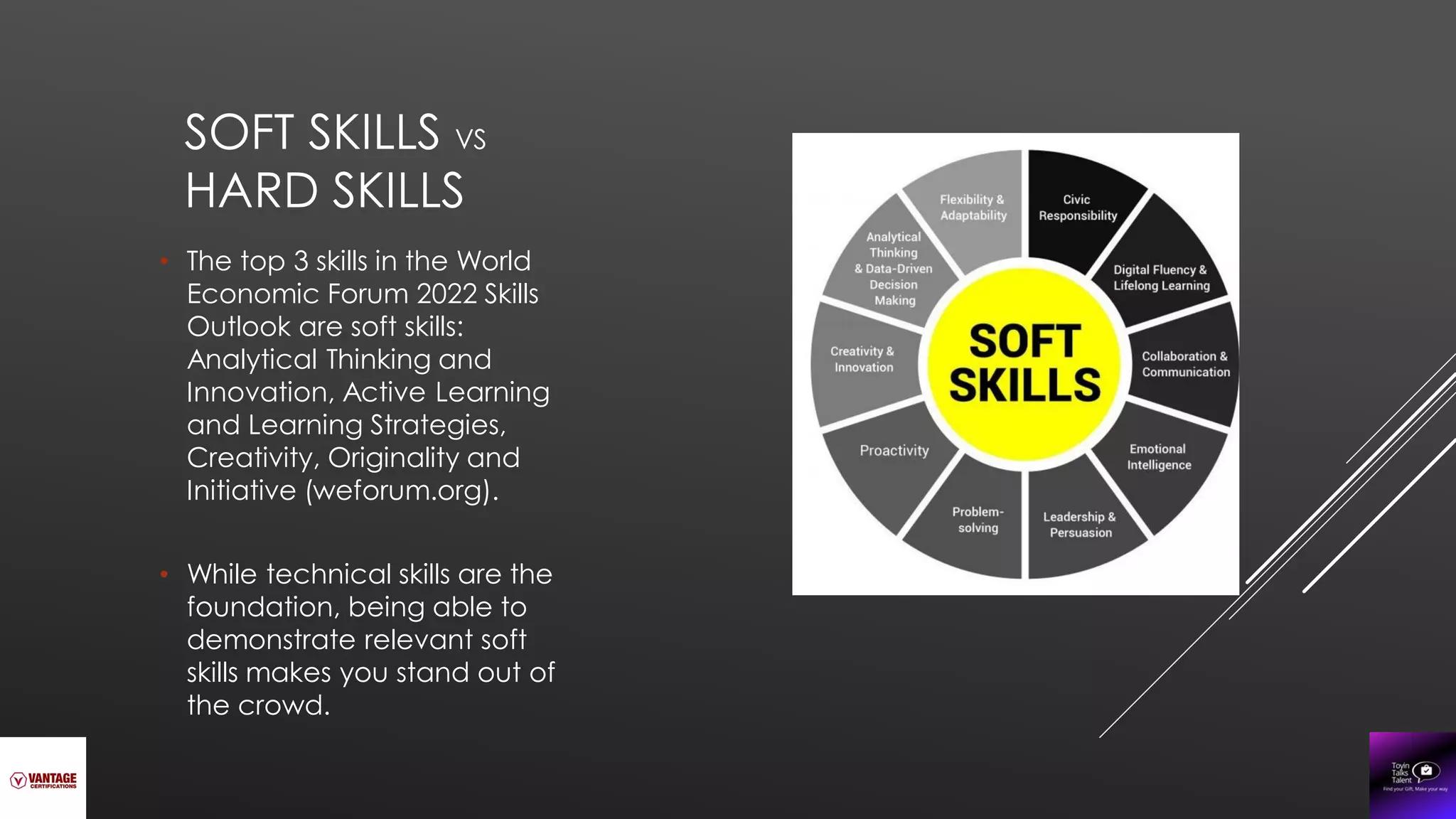
SOFT SKILLS VS
HARD SKILLS
• The top 3 skills in the World
Economic Forum 2022 Skills
Outlook are soft skills:
Analytical Thinking and
Innovation, Active Learning
and Learning Strategies,
Creativity, Originality and
Initiative (weforum.org).
• While technical skills are the
foundation, being able to
demonstrate relevant soft
skills makes you stand out of
the crowd.
THE APPLICATION PHASE
Why your application could get rejected
NOT BEING QUALIFIED FOR THE JOB
 You don’t have the required skills for the job or the skills you do
have are not contemporary.
 Remember tech is the new oil!
 Digital skills are now in high demand with ads for roles like Digital
Marketing Manager, Social Media Manager, Full Stack Developer
becoming more common.
 Do not “try your luck”.
NOT FOLLOWING APPLICATION
GUIDELINES
 Some job ads specify things like
 Email subject matter
 Number of times you are permitted to apply
 Closing dates
 Applying through a link supplied
 Documentation to be included in the application
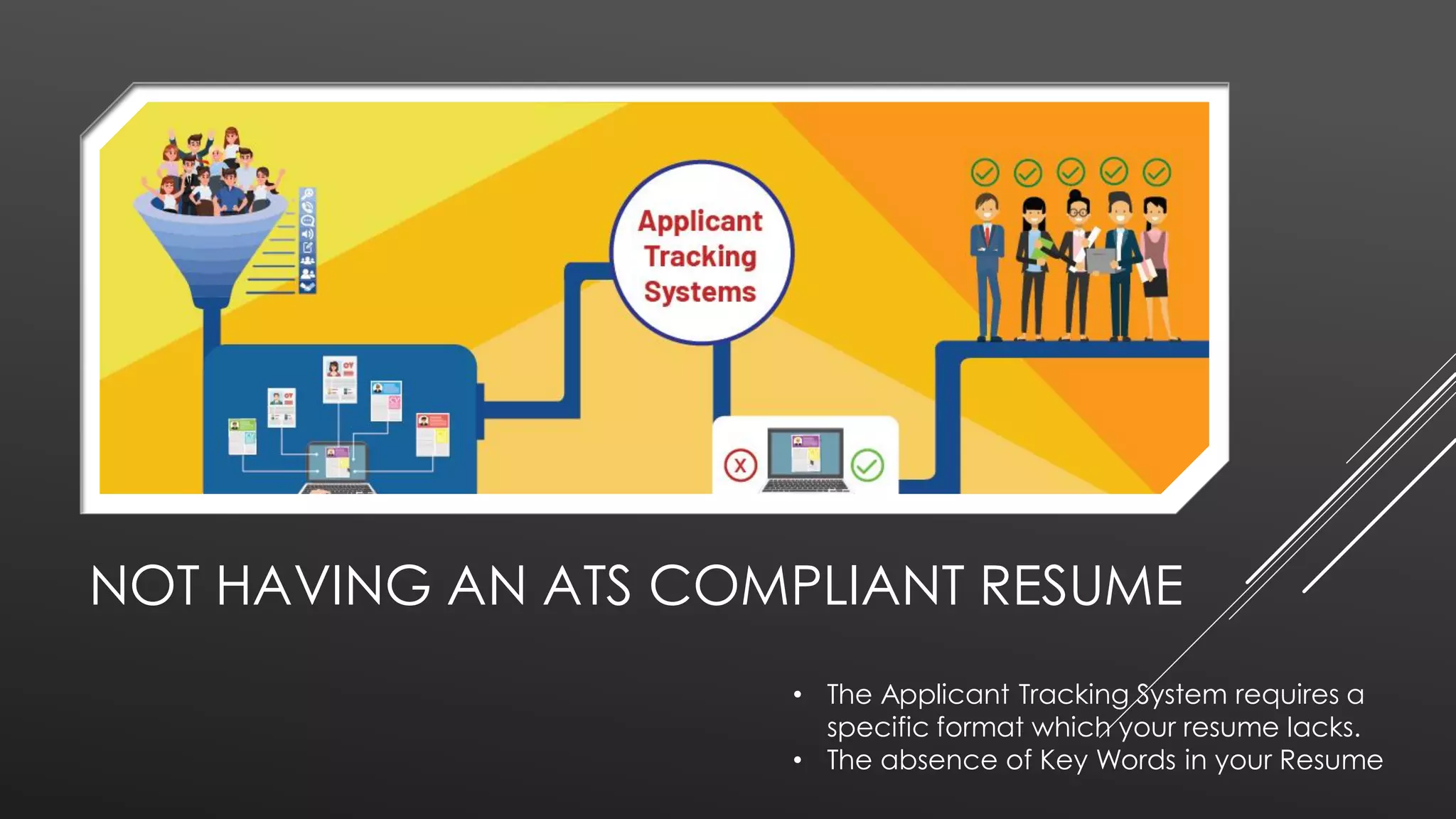
NOT HAVING AN ATS COMPLIANT RESUME
• The Applicant Tracking System requires a
specific format which your resume lacks.
• The absence of Key Words in your Resume
NOT HAVING AN ISSUE-FREE RESUME
 Problems with formatting and inconsistencies in front, spacing etc.
 Spelling and grammatical errors
 Cliches in career summaries and core skills
 Including irrelevant information
 Not prioritizing relevant information
 Not aligning experiences with expectations for the role
 Putting most recent work experience last.
 Lying about any information on your resume
 Exaggerating your abilities
NOT HAVING AN ISSUE-FREE RESUME
 Including irrelevant or obsolete skills
 Not including contemporary skills
 Not including responsibilities in each role in your work history
 Speaking passively rather than actively about performance in past roles
 Leaving out achievements or not making the SMART
 Including unnecessary graphics and colours
 Leaving out vital contact information
 Having an unprofessional sounding email address e.g.,
slimshady@hotmail.com
NOT SELLING YOURSELF ON
YOUR RESUME
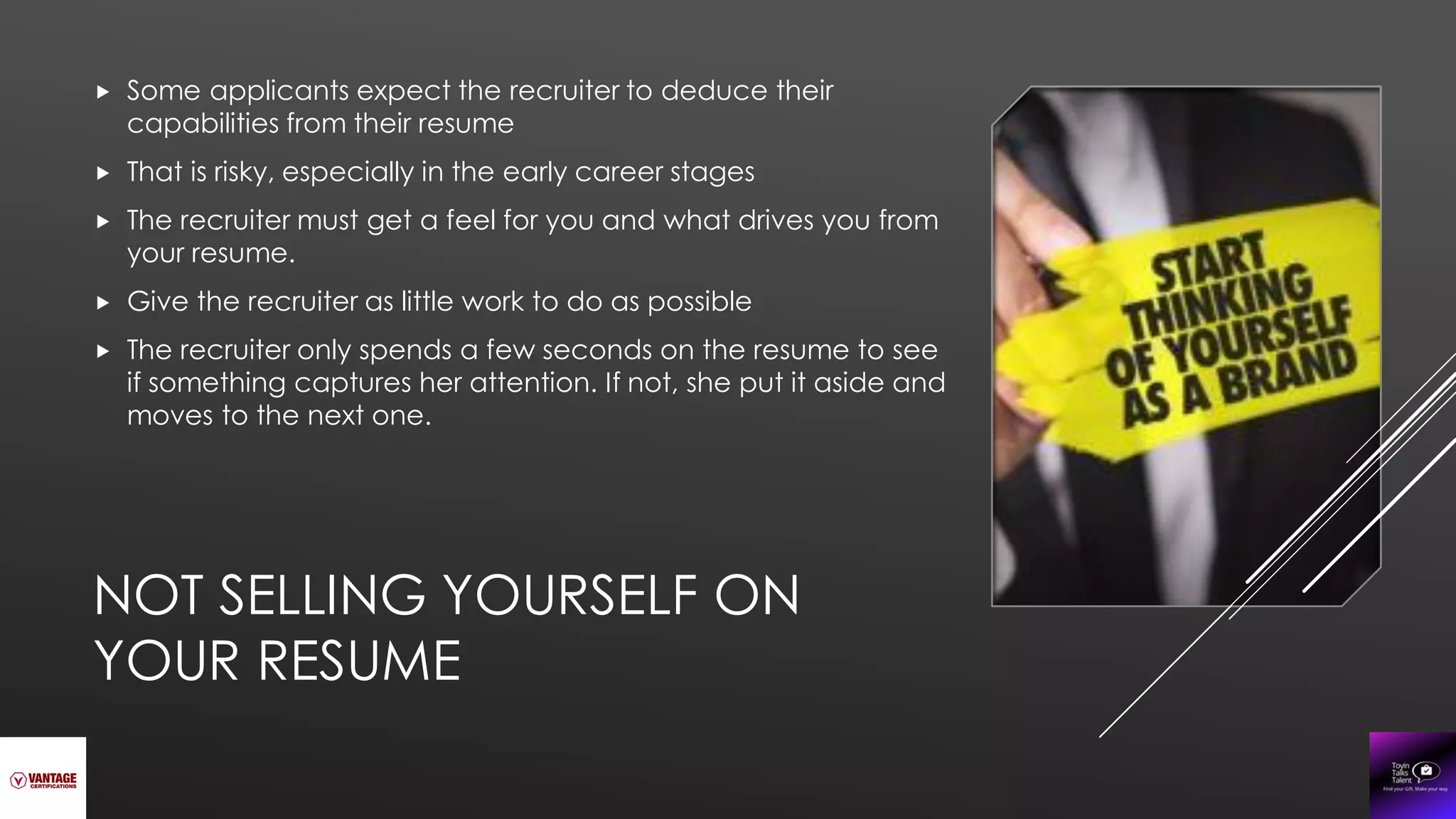
 Some applicants expect the recruiter to deduce their
capabilities from their resume
 That is risky, especially in the early career stages
 The recruiter must get a feel for you and what drives you from
your resume.
 Give the recruiter as little work to do as possible
 The recruiter only spends a few seconds on the resume to see
if something captures her attention. If not, she put it aside and
moves to the next one.
NOT PAYING ATTENTION TO DETAILS
WHEN ACTUALLY APPLYING
 Not using the cover letter in the body of your email to further sell yourself.
 Neglecting to include any subject or the right subject as specified.
 Addressing the recruiter improperly
 Neglecting to state the role you are applying for.
 Sending the application without anything in the body of the email
 Sending the application to the wrong email address
 Sending the application as part of a mail trail!
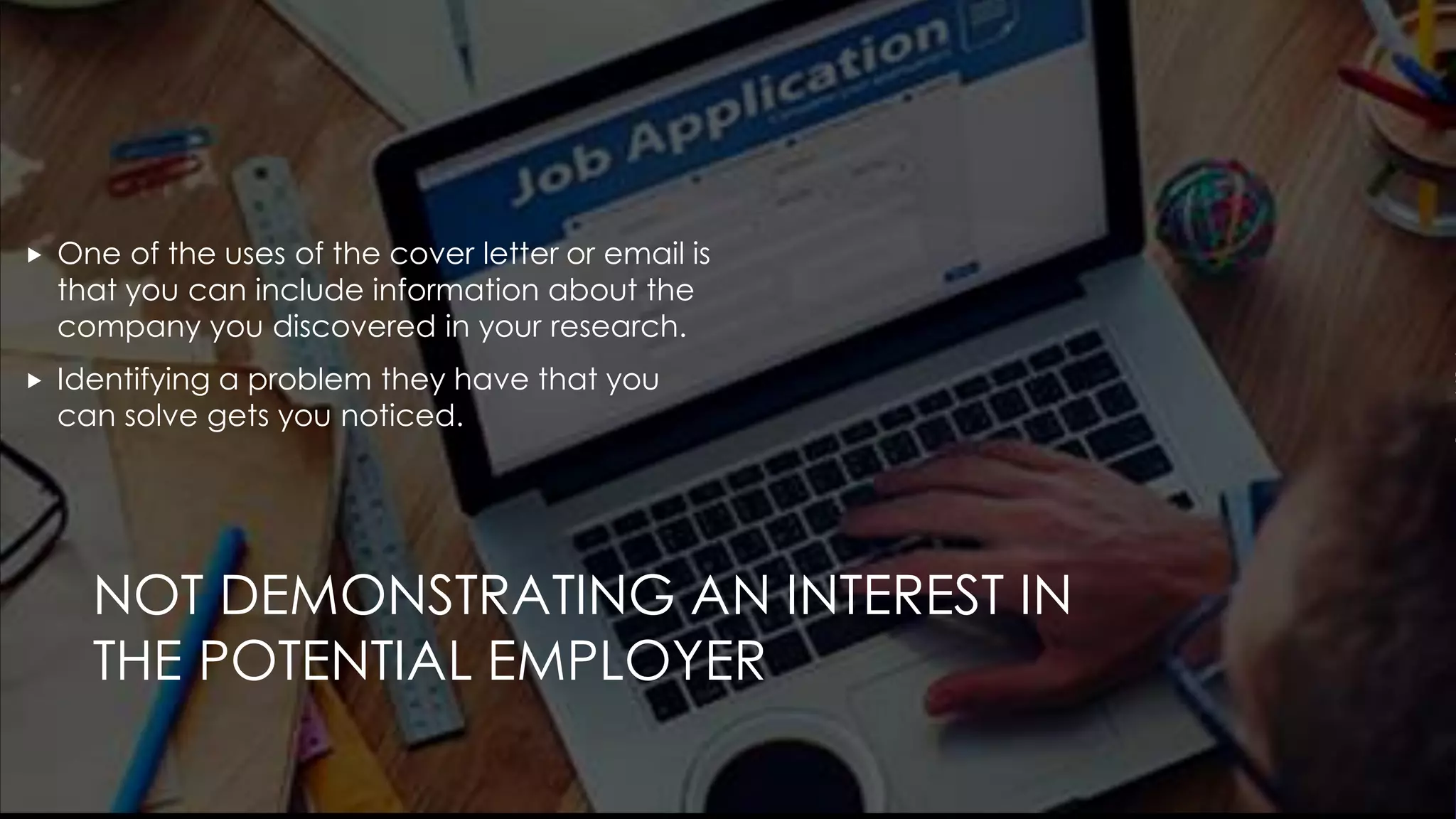
NOT DEMONSTRATING AN INTEREST IN
THE POTENTIAL EMPLOYER
 One of the uses of the cover letter or email is
that you can include information about the
company you discovered in your research.
 Identifying a problem they have that you
can solve gets you noticed.
THE INTERVIEW PHASE
Why you were not selected
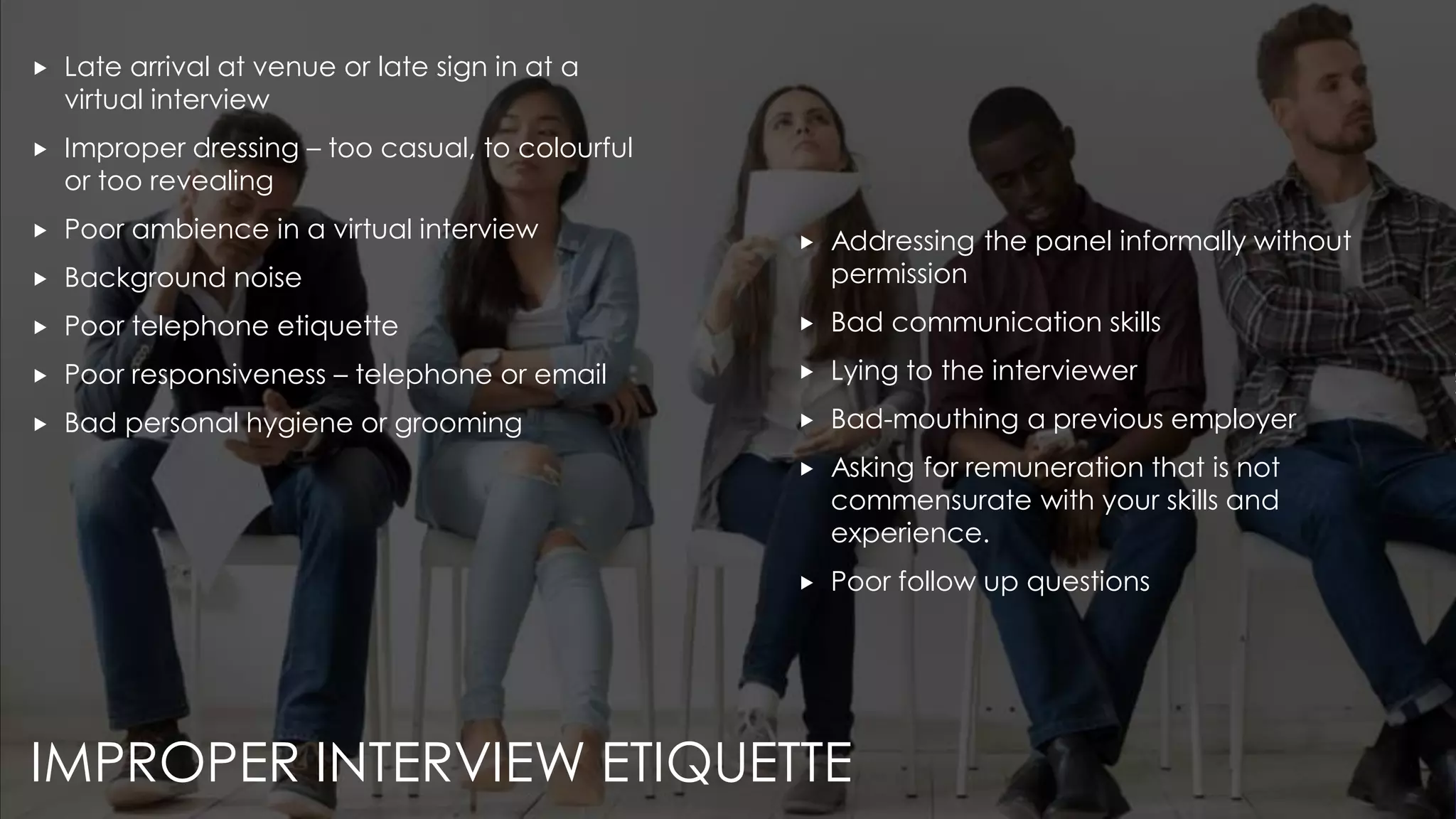
IMPROPER INTERVIEW ETIQUETTE
 Late arrival at venue or late sign in at a
virtual interview
 Improper dressing – too casual, to colourful
or too revealing
 Poor ambience in a virtual interview
 Background noise
 Poor telephone etiquette
 Poor responsiveness – telephone or email
 Bad personal hygiene or grooming
 Addressing the panel informally without
permission
 Bad communication skills
 Lying to the interviewer
 Bad-mouthing a previous employer
 Asking for remuneration that is not
commensurate with your skills and
experience.
 Poor follow up questions
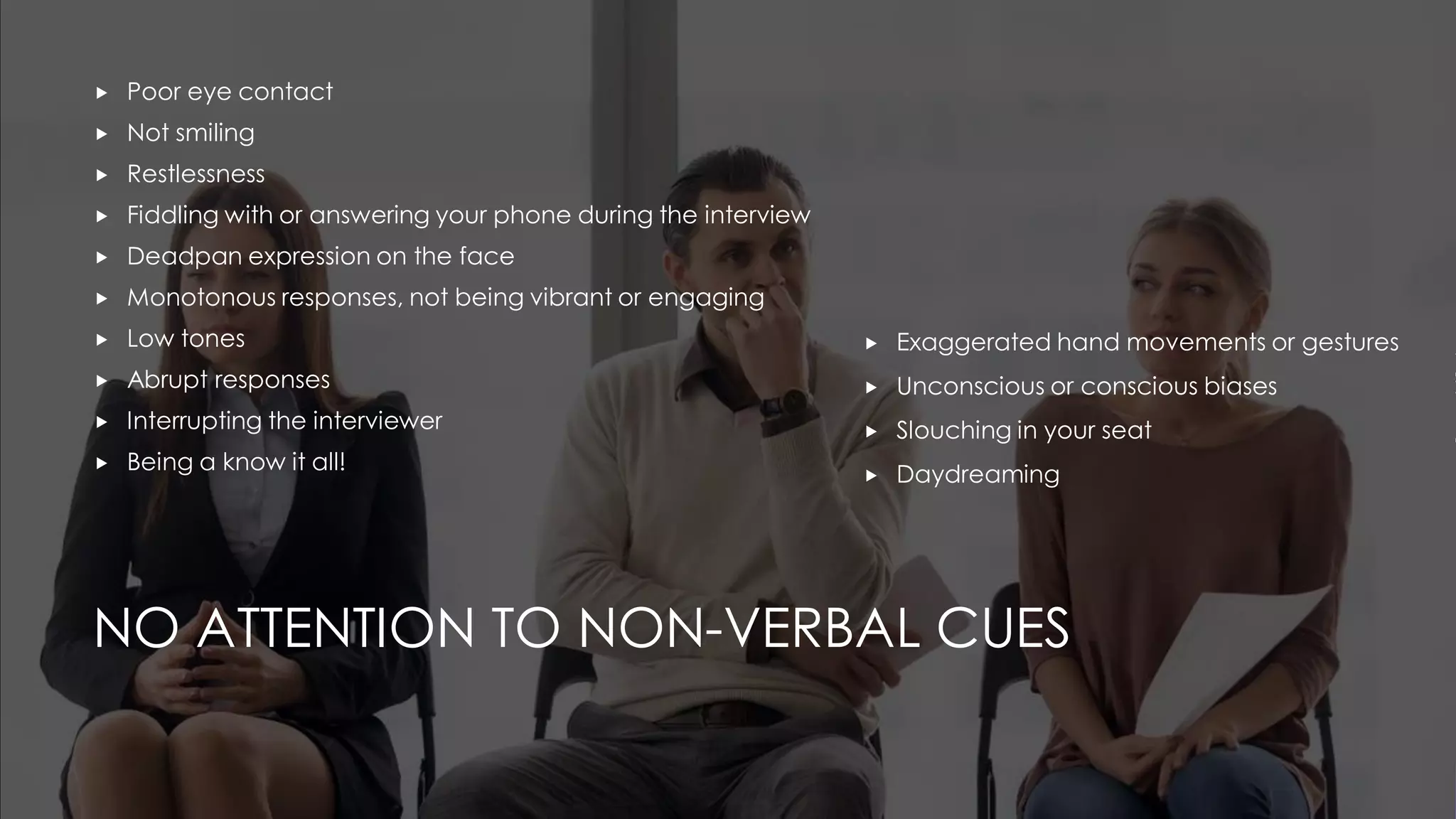
NO ATTENTION TO NON-VERBAL CUES
 Poor eye contact
 Not smiling
 Restlessness
 Fiddling with or answering your phone during the interview
 Deadpan expression on the face
 Monotonous responses, not being vibrant or engaging
 Low tones
 Abrupt responses
 Interrupting the interviewer
 Being a know it all!
 Exaggerated hand movements or gestures
 Unconscious or conscious biases
 Slouching in your seat
 Daydreaming
NOT RESEARCHING THE POTENTIAL
EMPLOYER
 The employer wants to feel like the candidate has a genuine
interest in working with them.
 If they see evidence to the contrary, the candidate does not
proceed further
 Not researching the company is a death knoll that will be a
criterion for rejecting a candidate.
WHAT EMPLOYERS CONSIDER
Selecting the ideal candidate
 Knowledge, skills, qualifications and experience suggested in the
Resume are validated at the interviews
 Attitude required to succeed in that role.
 Fit into the team the candidate will be working with
 The candidate’s motivation
 The candidate’s career plans and aspirations (the 5 years
question)
FIT FOR THE ROLE
FIT FOR THE BUDGET
 Every role has a budget associated with it.
 The candidate’s remuneration expectations should fit within that
budget.
 If it does not, and an argument cannot be made to increase it,
the candidate would not be selected.
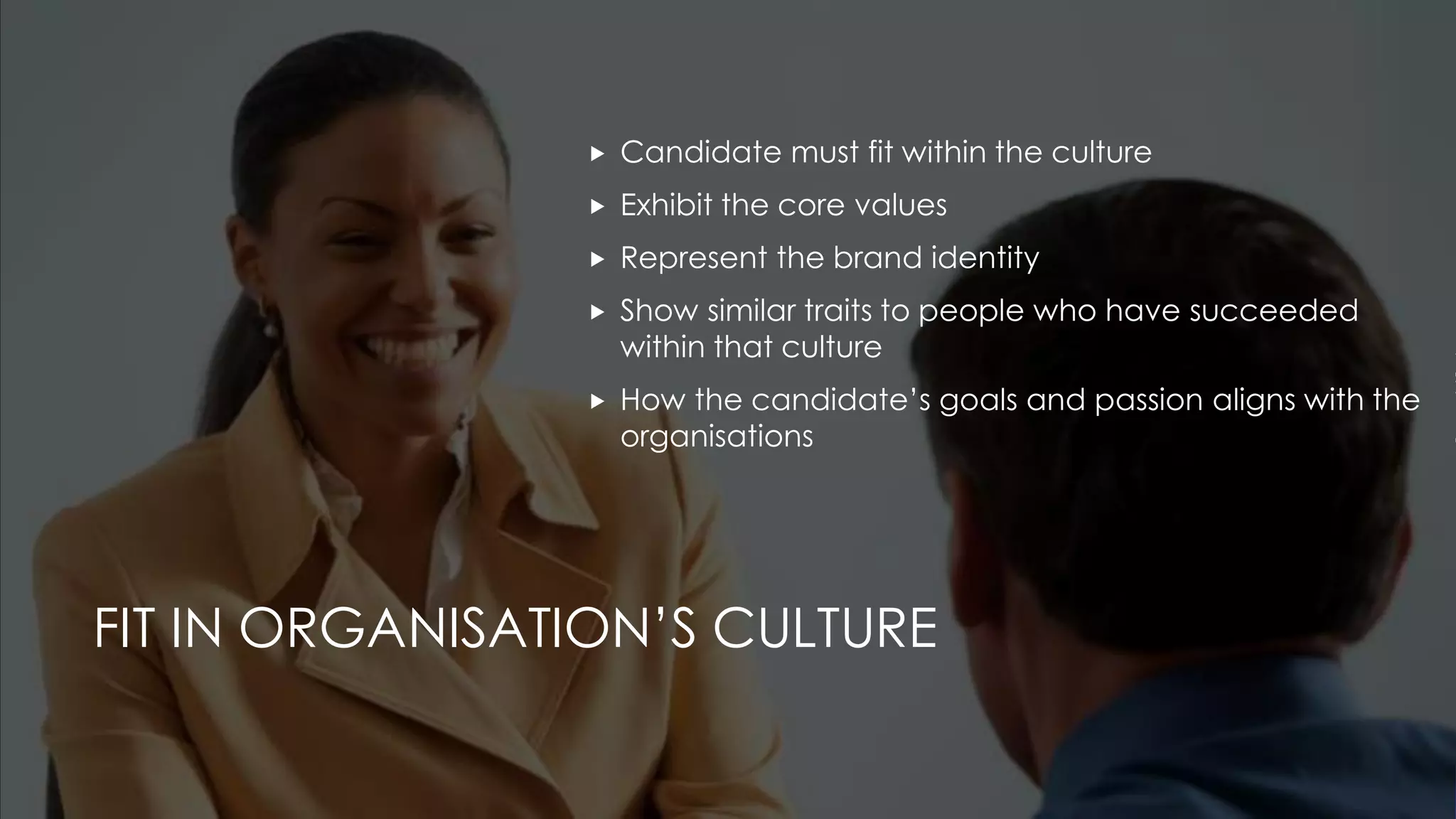
FIT IN ORGANISATION’S CULTURE
 Candidate must fit within the culture
 Exhibit the core values
 Represent the brand identity
 Show similar traits to people who have succeeded
within that culture
 How the candidate’s goals and passion aligns with the
organisations
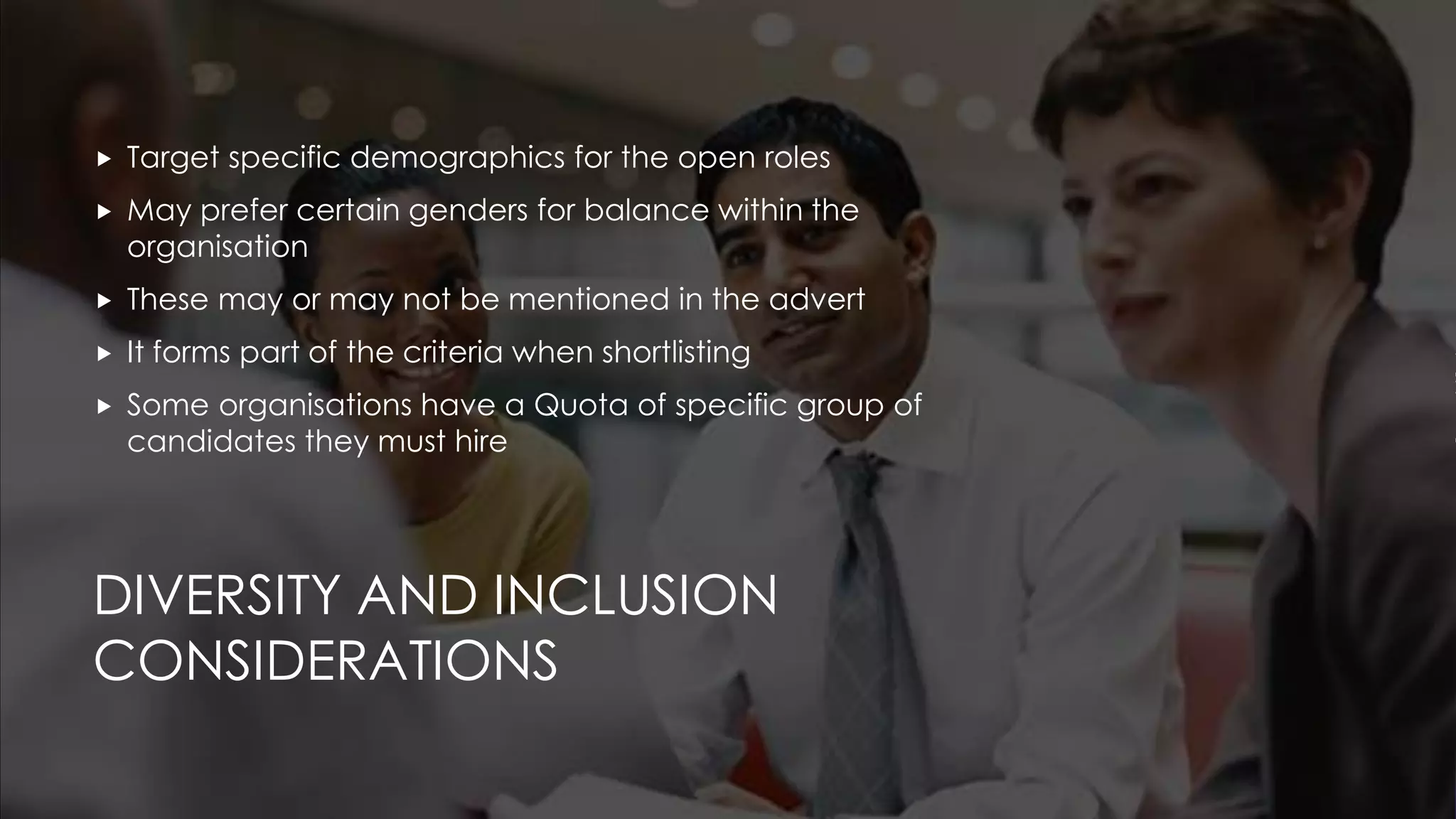
DIVERSITY AND INCLUSION
CONSIDERATIONS
 Target specific demographics for the open roles
 May prefer certain genders for balance within the
organisation
 These may or may not be mentioned in the advert
 It forms part of the criteria when shortlisting
 Some organisations have a Quota of specific group of
candidates they must hire
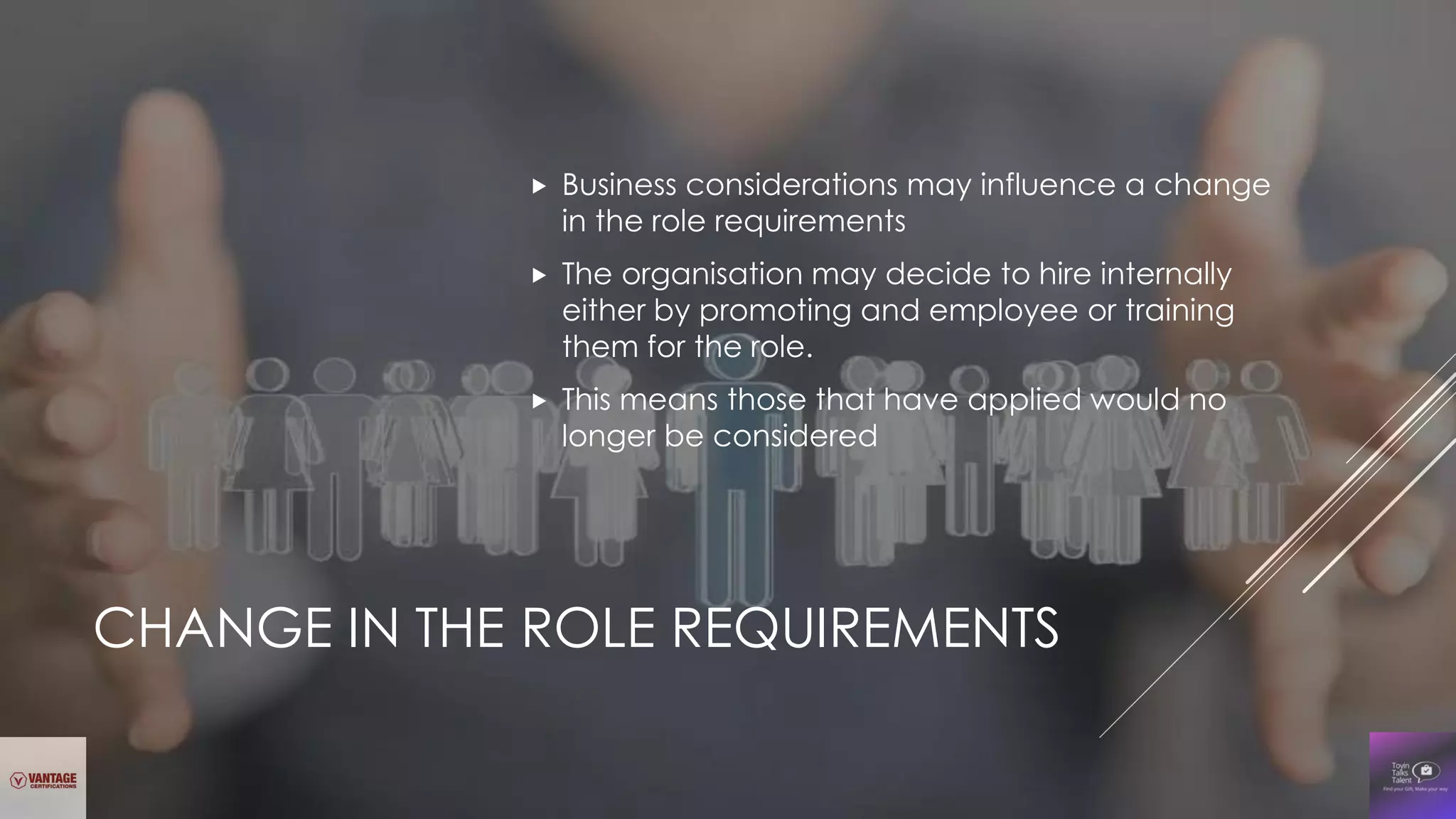
CHANGE IN THE ROLE REQUIREMENTS
 Business considerations may influence a change
in the role requirements
 The organisation may decide to hire internally
either by promoting and employee or training
them for the role.
 This means those that have applied would no
longer be considered
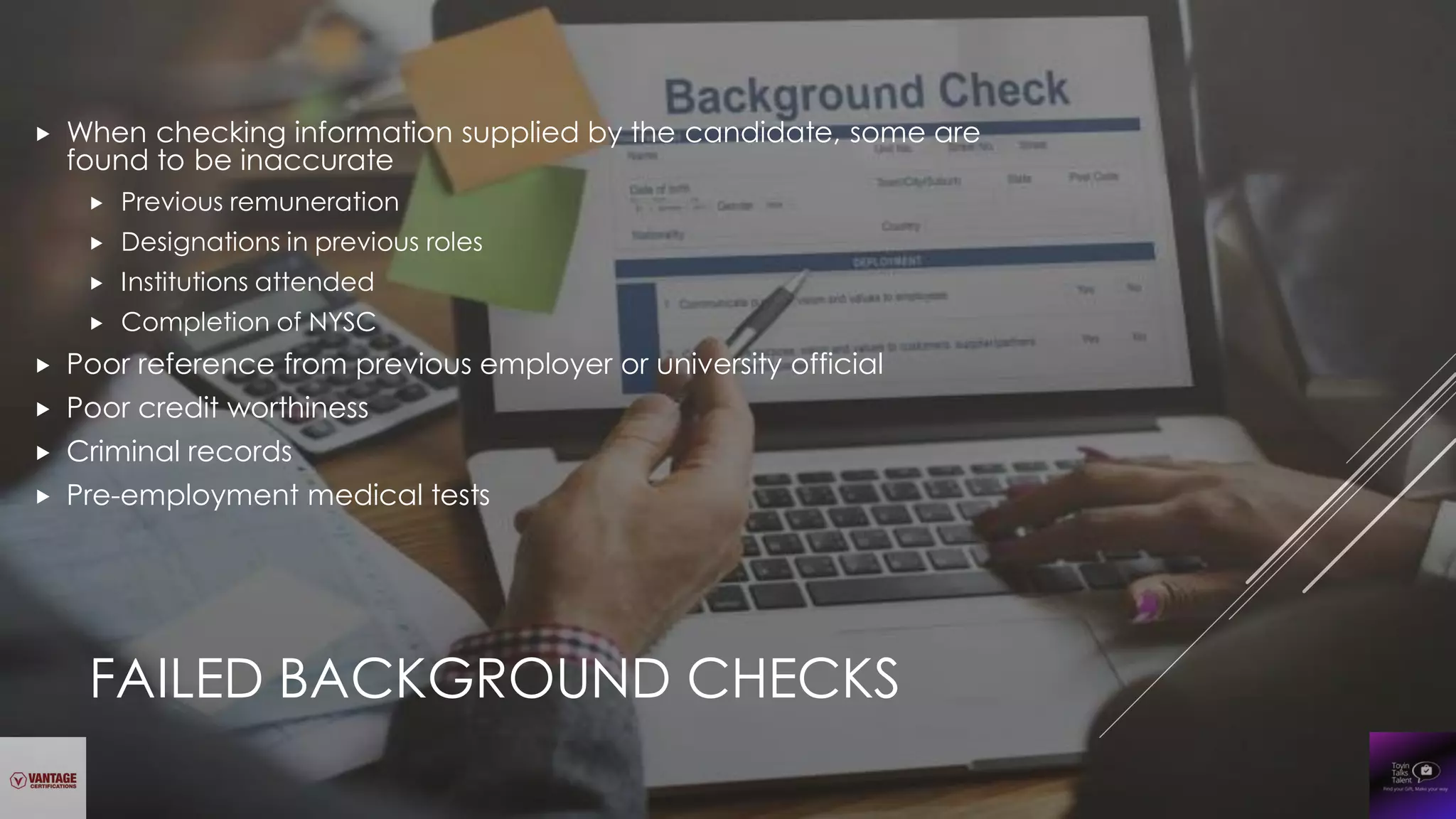
 When checking information supplied by the candidate, some are
found to be inaccurate
 Previous remuneration
 Designations in previous roles
 Institutions attended
 Completion of NYSC
 Poor reference from previous employer or university official
 Poor credit worthiness
 Criminal records
 Pre-employment medical tests
FAILED BACKGROUND CHECKS
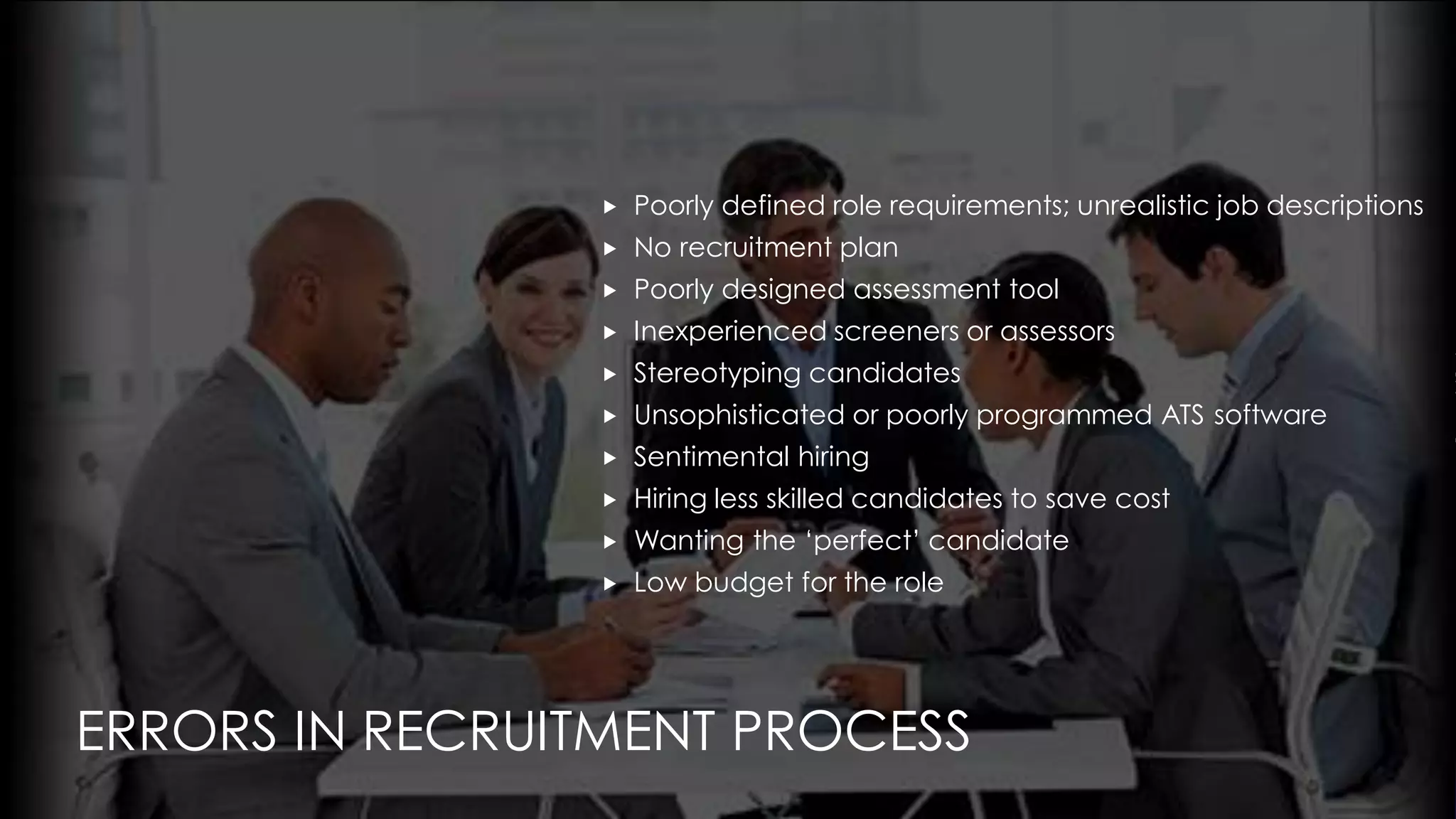
ERRORS IN RECRUITMENT PROCESS
 Poorly defined role requirements; unrealistic job descriptions
 No recruitment plan
 Poorly designed assessment tool
 Inexperienced screeners or assessors
 Stereotyping candidates
 Unsophisticated or poorly programmed ATS software
 Sentimental hiring
 Hiring less skilled candidates to save cost
 Wanting the ‘perfect’ candidate
 Low budget for the role
TIPS FOR ACING THE INTERVIEW
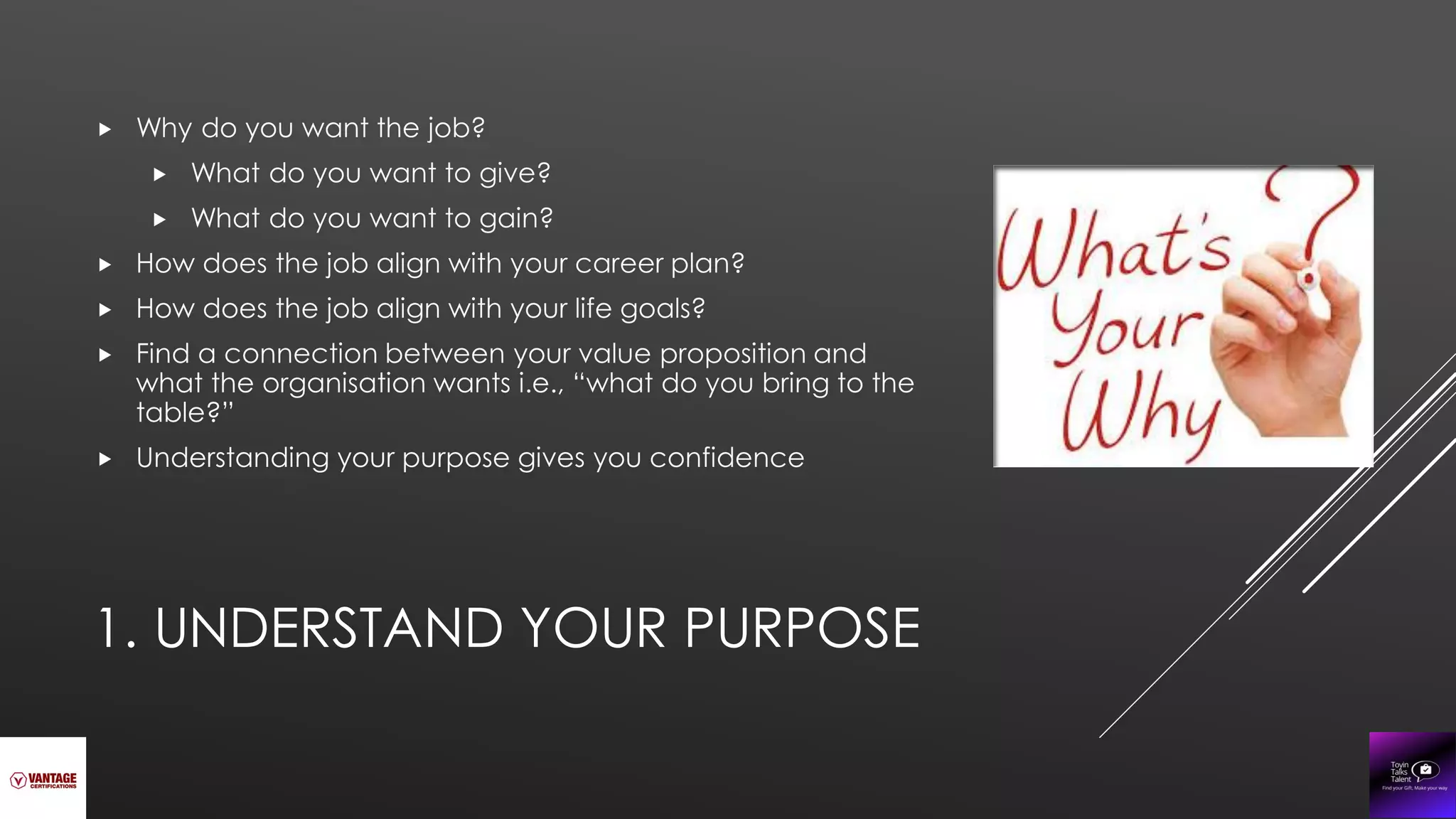
1. UNDERSTAND YOUR PURPOSE
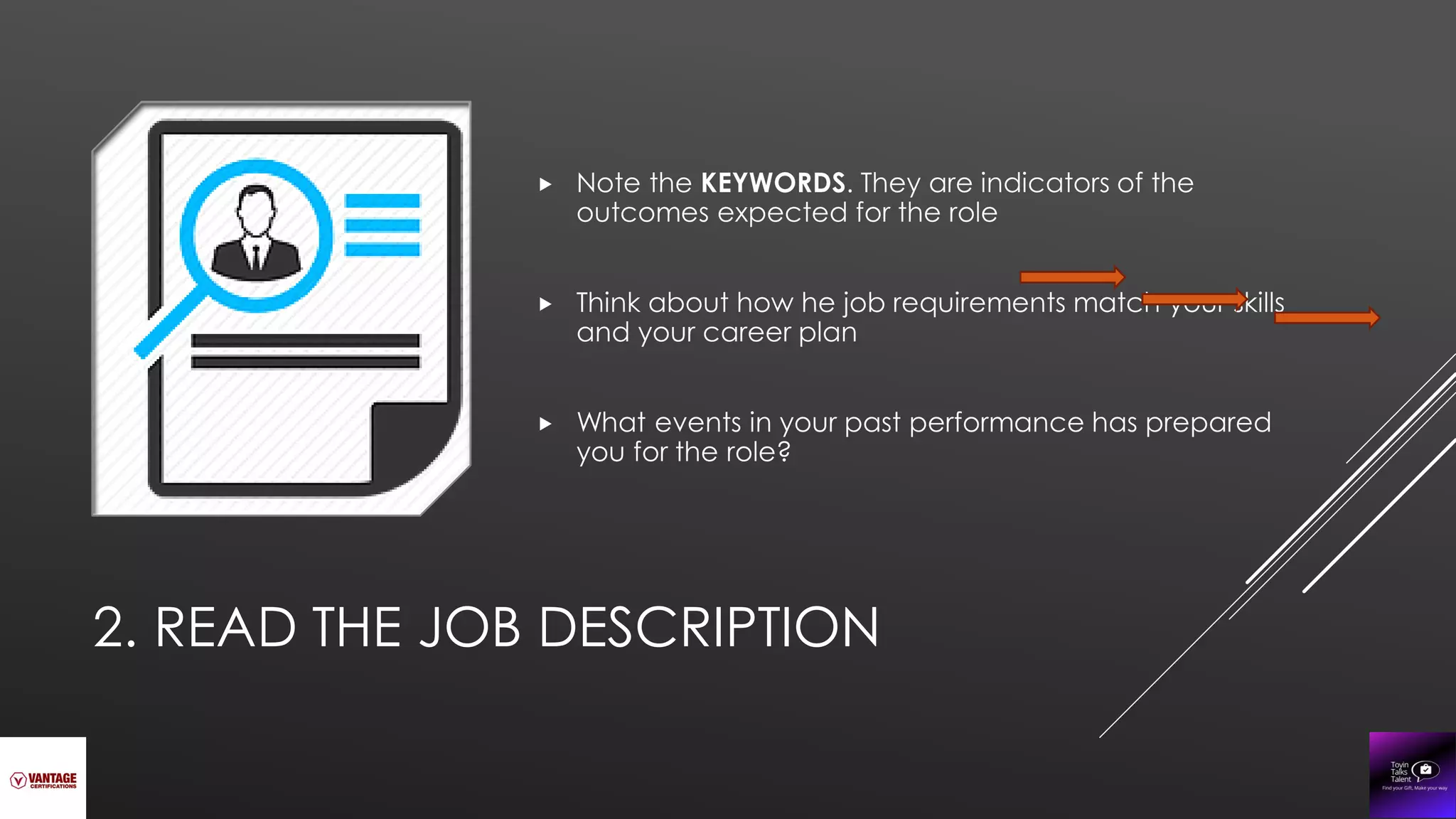
2. READ THE JOB DESCRIPTION
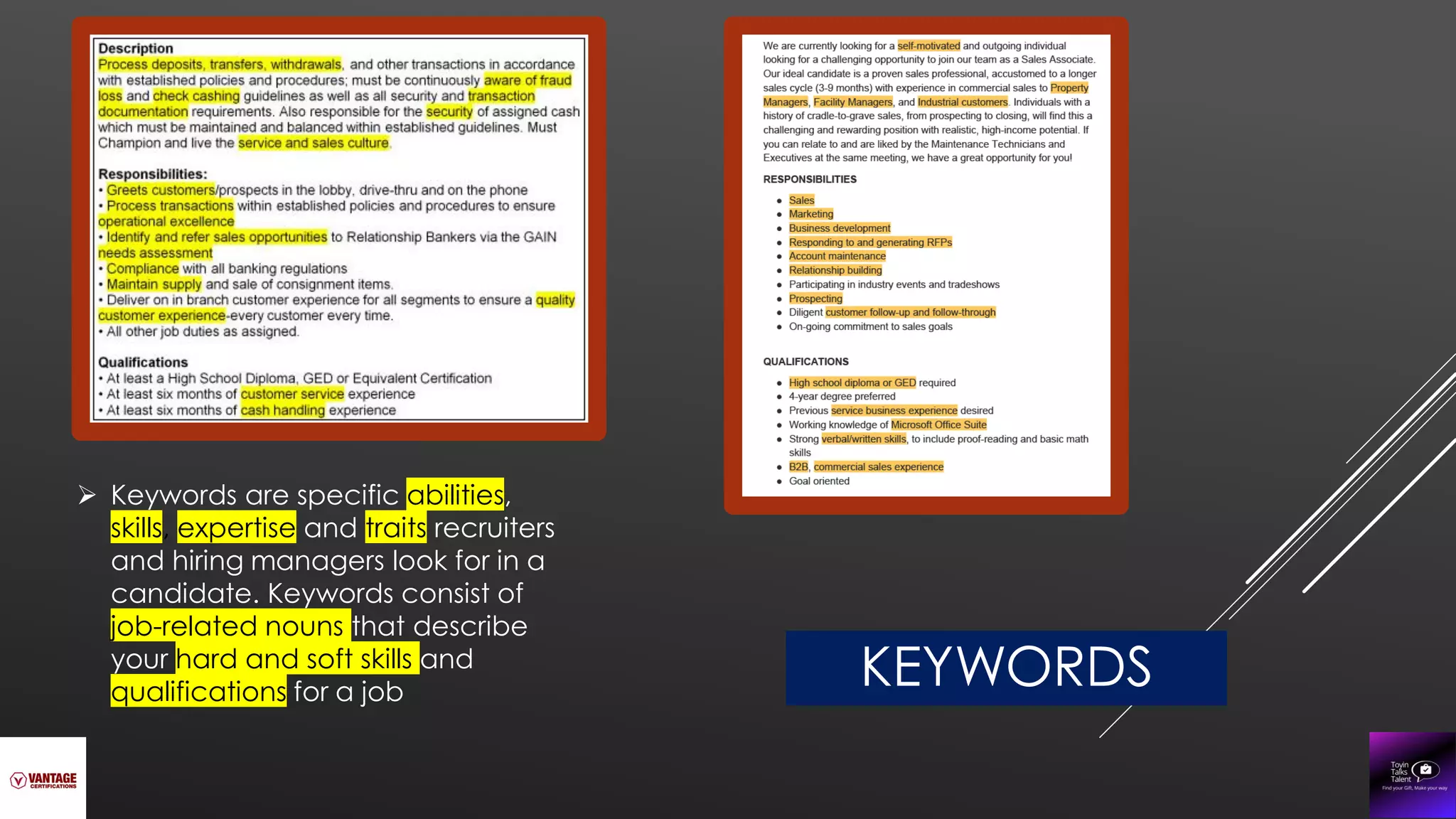
➢ Keywords are specific abilities,
skills, expertise and traits recruiters
and hiring managers look for in a
candidate. Keywords consist of
job-related nouns that describe
your hard and soft skills and
qualifications for a job
KEYWORDS
3. KNOW WHAT YOU KNOW WELL
 You must display a mastery of your
area of expertise consistent with the
level you are at.
 Be able to speak intelligently on your
subject matter area.
 Having data to support your assertions
drives it home
 Evidence in your Resume of trainings
attended or courses done.
4. RESEARCH THE COMPANY
 Visit the company’s website
 Key players in the organization.
 News and recent events about the employer.
 The company's culture, mission, and values.
 Clients, products, and services.
 Insider news
 The person interviewing you, if possible.
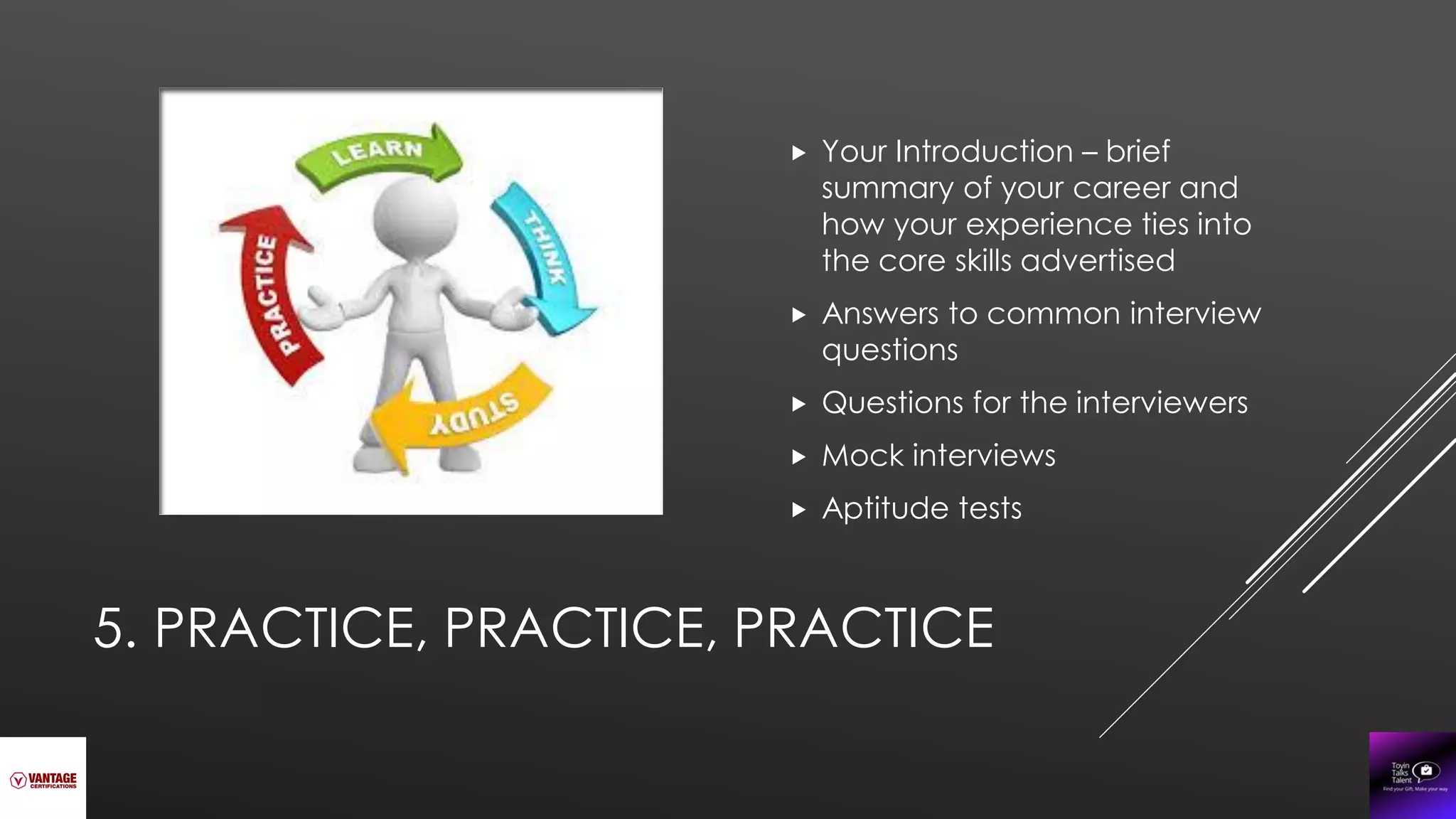
5. PRACTICE, PRACTICE, PRACTICE
 Your Introduction – brief
summary of your career and
how your experience ties into
the core skills advertised
 Answers to common interview
questions
 Questions for the interviewers
 Mock interviews
 Aptitude tests
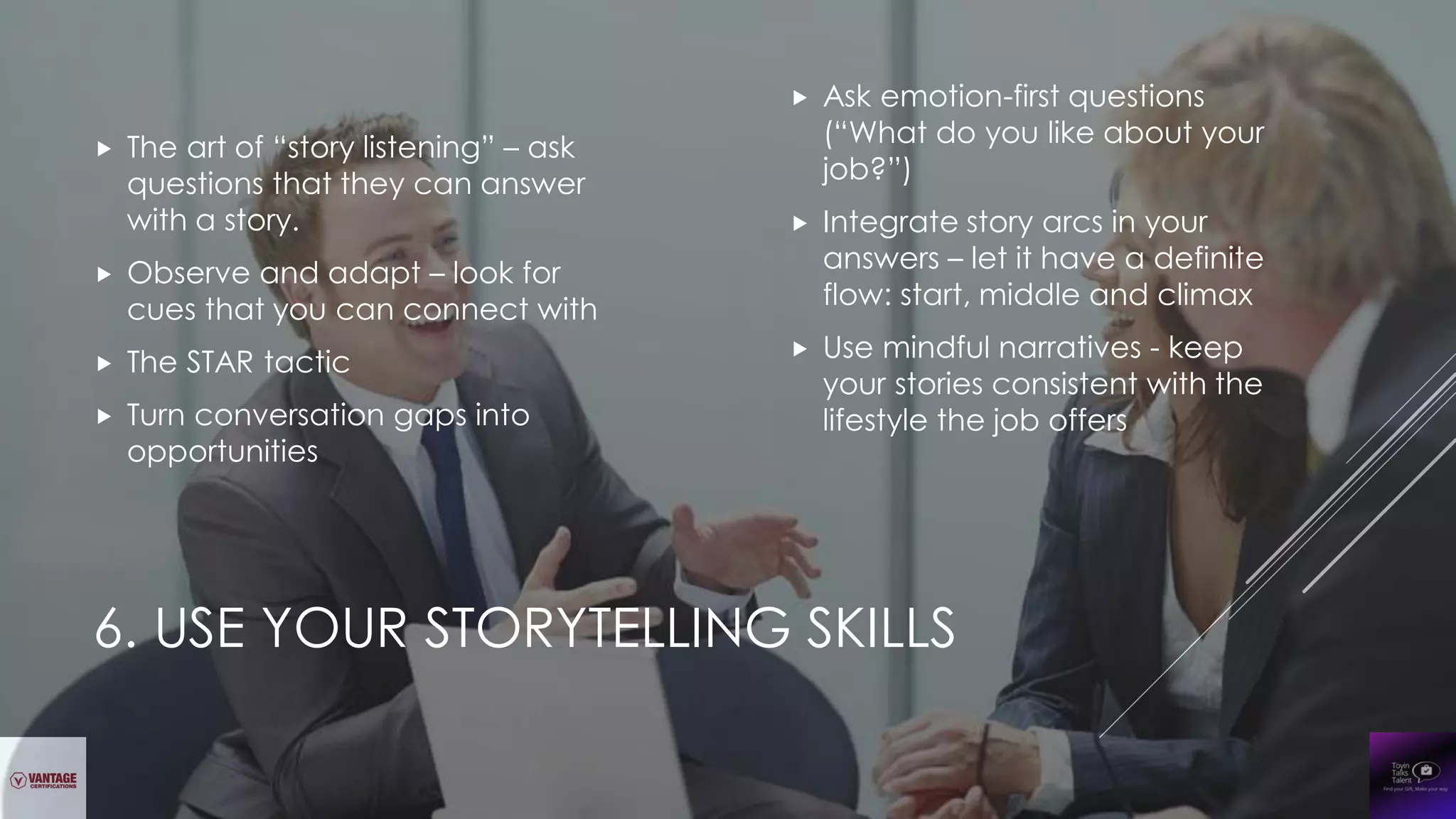
6. USE YOUR STORYTELLING SKILLS
 The art of “story listening” – ask
questions that they can answer
with a story.
 Observe and adapt – look for
cues that you can connect with
 The STAR tactic
 Turn conversation gaps into
opportunities
 Ask emotion-first questions
(“What do you like about your
job?”)
 Integrate story arcs in your
answers – let it have a definite
flow: start, middle and climax
 Use mindful narratives - keep
your stories consistent with the
lifestyle the job offers
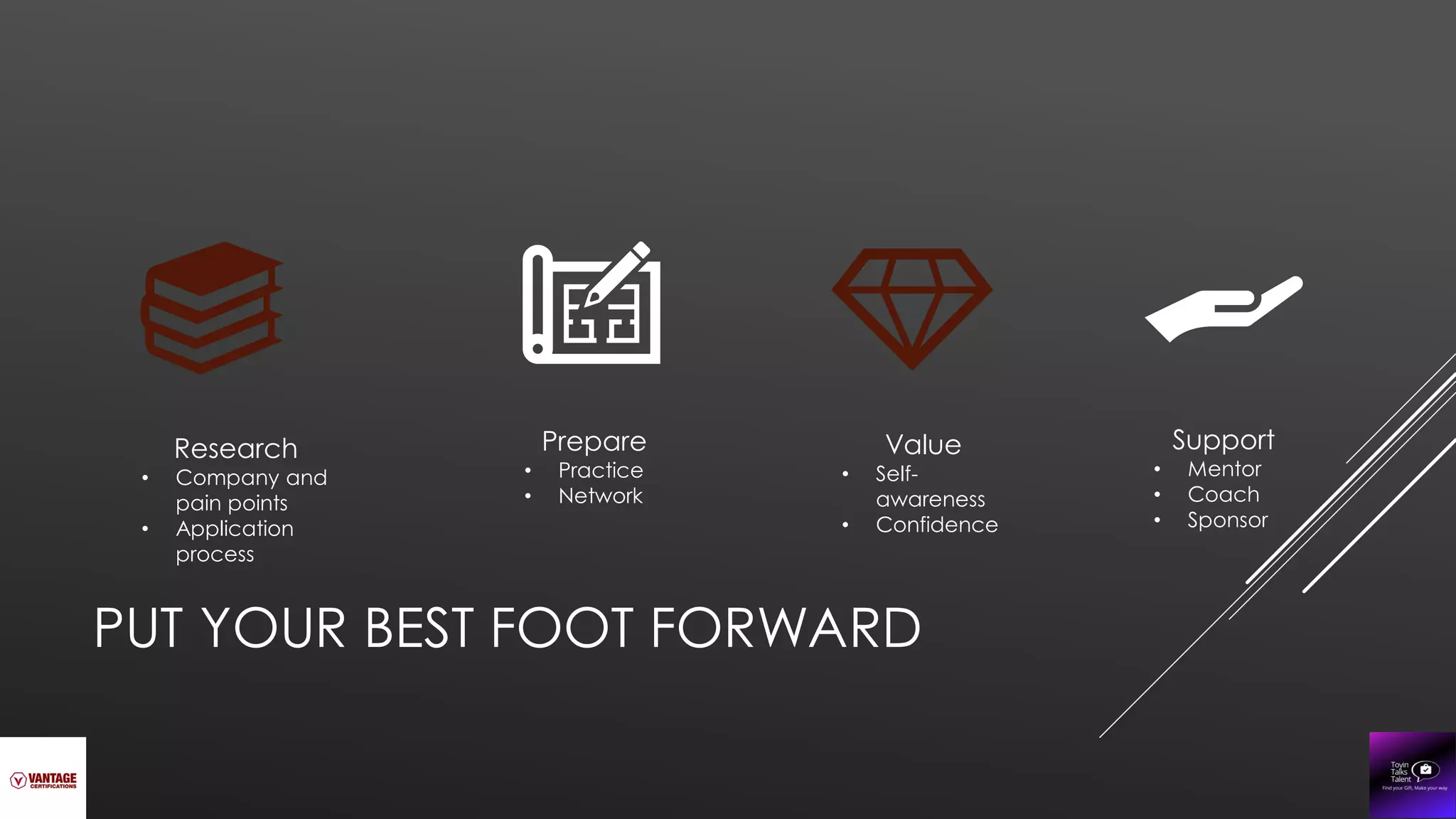
PUT YOUR BEST FOOT FORWARD
Research
• Company and
pain points
• Application
process
Prepare
• Practice
• Network
Value
• Self-
awareness
• Confidence
Support
• Mentor
• Coach
• Sponsor
#toyintalkstalent
QUESTIONS?
Teach a Course 47
OTHER REFERENCES
 Toyintalkstalent (T3) – The Interview process
 Toyintalkstalent (T3) – The Application process
 Localwise.com
 Forbes.com
 Careeraddict.com
 Content.wisestep.com
 Theladders.com

Reasons your job application may not progress

  • 1.
    REASONS YOUR JOB APPLICATIONMAY NOT PROGRESS TO THE NEXT PHASE Oluwatoyin Puddicombe #ToyinTalksTalent
  • 2.
     I aman HR professional with over a decade of active work experience. I have worked in Aviation, Business Services, Consulting, and Insurance, gathering and acquiring skills and competences in Client Services, Relationship Management, Business Development and Human Capital Management with a strong bias for Talent Acquisition and Development.  I believe that our work is a platform for sharing our gifts with the world. Unfortunately, a lot of young graduates underestimate themselves for various reasons; the economy, wrong course choices, wrong career choices, failure to plan their careers, multiple rejections and so on.  I believe that each person is uniquely gifted by God to make their way in the world using those gifts and I would like to help in discovering them and finding fulfilling careers.  This is the reason for Toyin Talks Talent. Oluwatoyin Puddicombe ACIPM, SPHRi, SHRM
  • 3.
    LEARNING OUTCOMES At theend of the session, you should be able to:  Describe how the world of work has changed and how it affect the application and interview processes  Identify mistakes candidates make that affect the progress of their job applications  Learn what employers consider before they choose the ideal candidate
  • 4.
    HOUSEKEEPING Please note your questionsand ask after the session or type in the chat box If you are not asking or responding to a question, please keep your microphone muted We are all here to learn, so let’s participate and have fun!
  • 5.
    TABLE OF CONTENT Overview of how the world of work has changed  Missteps at the Application Phase  Missteps at the Interview Phase  What employers consider before selecting the ideal candidate  Putting your best foot forward
  • 6.
    HOW THE WORLDOF WORK HAS CHANGED
  • 7.
    THE 4TH INDUSTRIAL REVOLUTION •A lot of jobs are being automated and so are now obsolete. • Remote work • Virtual meetings and interviews • Focus on tech skills and tech enhanced work
  • 8.
    RECRUITMENT STRATEGIES ARE DIFFERENT • Lessemphasis on traditional media • Social media activity forms part of the sourcing and shortlisting process • Recruitment Marketing
  • 9.
    YOUR ONLINE PRESENCEIS YOUR NEW CV • How are you demonstrating your KSA’s on social media? • What started prior to COVID-19 has been ramped up in the era of social distancing and increased number of digital options.
  • 10.
    AREA OF EXPERTISE  Whatare you known for?  What are your strengths?
  • 11.
    POWER SHIFT FROMEMPLOYER TO EMPLOYEE
  • 12.
  • 13.
    EVERYONE IS ASALESMAN • The “war for talent” creates a scenario where the employer is the customer, and YOU are the product. • The Salesman mindset is one that connects your value proposition to the employer’s needs.
  • 14.
    THE EFFECT ON “GLOCALIZATION” •The term means putting a local flair on international practices and making them relevant to your environment. • Since the playing field is now online, your competences are being compared to those of your contemporaries all over the world. • This is pointing to an international standardization
  • 15.
    THE CURRENCY CALLED KNOWLEDGE •Almost everything you need to learn is on the internet. • The more you know and can do, the better positioned you are for choice jobs. • An offshoot of this though is that you have fewer excuses.
  • 16.
    SOFT SKILLS VS HARDSKILLS • The top 3 skills in the World Economic Forum 2022 Skills Outlook are soft skills: Analytical Thinking and Innovation, Active Learning and Learning Strategies, Creativity, Originality and Initiative (weforum.org). • While technical skills are the foundation, being able to demonstrate relevant soft skills makes you stand out of the crowd.
  • 17.
    THE APPLICATION PHASE Whyyour application could get rejected
  • 18.
    NOT BEING QUALIFIEDFOR THE JOB  You don’t have the required skills for the job or the skills you do have are not contemporary.  Remember tech is the new oil!  Digital skills are now in high demand with ads for roles like Digital Marketing Manager, Social Media Manager, Full Stack Developer becoming more common.  Do not “try your luck”.
  • 19.
    NOT FOLLOWING APPLICATION GUIDELINES Some job ads specify things like  Email subject matter  Number of times you are permitted to apply  Closing dates  Applying through a link supplied  Documentation to be included in the application
  • 20.
    NOT HAVING ANATS COMPLIANT RESUME • The Applicant Tracking System requires a specific format which your resume lacks. • The absence of Key Words in your Resume
  • 21.
    NOT HAVING ANISSUE-FREE RESUME  Problems with formatting and inconsistencies in front, spacing etc.  Spelling and grammatical errors  Cliches in career summaries and core skills  Including irrelevant information  Not prioritizing relevant information  Not aligning experiences with expectations for the role  Putting most recent work experience last.  Lying about any information on your resume  Exaggerating your abilities
  • 22.
    NOT HAVING ANISSUE-FREE RESUME  Including irrelevant or obsolete skills  Not including contemporary skills  Not including responsibilities in each role in your work history  Speaking passively rather than actively about performance in past roles  Leaving out achievements or not making the SMART  Including unnecessary graphics and colours  Leaving out vital contact information  Having an unprofessional sounding email address e.g., slimshady@hotmail.com
  • 23.
    NOT SELLING YOURSELFON YOUR RESUME  Some applicants expect the recruiter to deduce their capabilities from their resume  That is risky, especially in the early career stages  The recruiter must get a feel for you and what drives you from your resume.  Give the recruiter as little work to do as possible  The recruiter only spends a few seconds on the resume to see if something captures her attention. If not, she put it aside and moves to the next one.
  • 24.
    NOT PAYING ATTENTIONTO DETAILS WHEN ACTUALLY APPLYING  Not using the cover letter in the body of your email to further sell yourself.  Neglecting to include any subject or the right subject as specified.  Addressing the recruiter improperly  Neglecting to state the role you are applying for.  Sending the application without anything in the body of the email  Sending the application to the wrong email address  Sending the application as part of a mail trail!
  • 25.
    NOT DEMONSTRATING ANINTEREST IN THE POTENTIAL EMPLOYER  One of the uses of the cover letter or email is that you can include information about the company you discovered in your research.  Identifying a problem they have that you can solve gets you noticed.
  • 26.
    THE INTERVIEW PHASE Whyyou were not selected
  • 27.
    IMPROPER INTERVIEW ETIQUETTE Late arrival at venue or late sign in at a virtual interview  Improper dressing – too casual, to colourful or too revealing  Poor ambience in a virtual interview  Background noise  Poor telephone etiquette  Poor responsiveness – telephone or email  Bad personal hygiene or grooming  Addressing the panel informally without permission  Bad communication skills  Lying to the interviewer  Bad-mouthing a previous employer  Asking for remuneration that is not commensurate with your skills and experience.  Poor follow up questions
  • 28.
    NO ATTENTION TONON-VERBAL CUES  Poor eye contact  Not smiling  Restlessness  Fiddling with or answering your phone during the interview  Deadpan expression on the face  Monotonous responses, not being vibrant or engaging  Low tones  Abrupt responses  Interrupting the interviewer  Being a know it all!  Exaggerated hand movements or gestures  Unconscious or conscious biases  Slouching in your seat  Daydreaming
  • 29.
    NOT RESEARCHING THEPOTENTIAL EMPLOYER  The employer wants to feel like the candidate has a genuine interest in working with them.  If they see evidence to the contrary, the candidate does not proceed further  Not researching the company is a death knoll that will be a criterion for rejecting a candidate.
  • 30.
  • 31.
     Knowledge, skills,qualifications and experience suggested in the Resume are validated at the interviews  Attitude required to succeed in that role.  Fit into the team the candidate will be working with  The candidate’s motivation  The candidate’s career plans and aspirations (the 5 years question) FIT FOR THE ROLE
  • 32.
    FIT FOR THEBUDGET  Every role has a budget associated with it.  The candidate’s remuneration expectations should fit within that budget.  If it does not, and an argument cannot be made to increase it, the candidate would not be selected.
  • 33.
    FIT IN ORGANISATION’SCULTURE  Candidate must fit within the culture  Exhibit the core values  Represent the brand identity  Show similar traits to people who have succeeded within that culture  How the candidate’s goals and passion aligns with the organisations
  • 34.
    DIVERSITY AND INCLUSION CONSIDERATIONS Target specific demographics for the open roles  May prefer certain genders for balance within the organisation  These may or may not be mentioned in the advert  It forms part of the criteria when shortlisting  Some organisations have a Quota of specific group of candidates they must hire
  • 35.
    CHANGE IN THEROLE REQUIREMENTS  Business considerations may influence a change in the role requirements  The organisation may decide to hire internally either by promoting and employee or training them for the role.  This means those that have applied would no longer be considered
  • 36.
     When checkinginformation supplied by the candidate, some are found to be inaccurate  Previous remuneration  Designations in previous roles  Institutions attended  Completion of NYSC  Poor reference from previous employer or university official  Poor credit worthiness  Criminal records  Pre-employment medical tests FAILED BACKGROUND CHECKS
  • 37.
    ERRORS IN RECRUITMENTPROCESS  Poorly defined role requirements; unrealistic job descriptions  No recruitment plan  Poorly designed assessment tool  Inexperienced screeners or assessors  Stereotyping candidates  Unsophisticated or poorly programmed ATS software  Sentimental hiring  Hiring less skilled candidates to save cost  Wanting the ‘perfect’ candidate  Low budget for the role
  • 38.
    TIPS FOR ACINGTHE INTERVIEW
  • 39.
  • 40.
    2. READ THEJOB DESCRIPTION
  • 41.
    ➢ Keywords arespecific abilities, skills, expertise and traits recruiters and hiring managers look for in a candidate. Keywords consist of job-related nouns that describe your hard and soft skills and qualifications for a job KEYWORDS
  • 42.
    3. KNOW WHATYOU KNOW WELL  You must display a mastery of your area of expertise consistent with the level you are at.  Be able to speak intelligently on your subject matter area.  Having data to support your assertions drives it home  Evidence in your Resume of trainings attended or courses done.
  • 43.
    4. RESEARCH THECOMPANY  Visit the company’s website  Key players in the organization.  News and recent events about the employer.  The company's culture, mission, and values.  Clients, products, and services.  Insider news  The person interviewing you, if possible.
  • 44.
    5. PRACTICE, PRACTICE,PRACTICE  Your Introduction – brief summary of your career and how your experience ties into the core skills advertised  Answers to common interview questions  Questions for the interviewers  Mock interviews  Aptitude tests
  • 45.
    6. USE YOURSTORYTELLING SKILLS  The art of “story listening” – ask questions that they can answer with a story.  Observe and adapt – look for cues that you can connect with  The STAR tactic  Turn conversation gaps into opportunities  Ask emotion-first questions (“What do you like about your job?”)  Integrate story arcs in your answers – let it have a definite flow: start, middle and climax  Use mindful narratives - keep your stories consistent with the lifestyle the job offers
  • 46.
    PUT YOUR BESTFOOT FORWARD Research • Company and pain points • Application process Prepare • Practice • Network Value • Self- awareness • Confidence Support • Mentor • Coach • Sponsor
  • 47.
  • 49.
    OTHER REFERENCES  Toyintalkstalent(T3) – The Interview process  Toyintalkstalent (T3) – The Application process  Localwise.com  Forbes.com  Careeraddict.com  Content.wisestep.com  Theladders.com