WOMEN, CASTE AND
REFORM
19th
Century
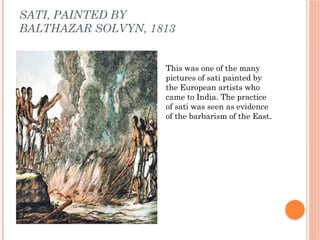
SATI, PAINTED BY
BALTHAZAR SOLVYN, 1813
This was one of the many
pictures of sati painted by
the European artists who
came to India. The practice
of sati was seen as evidence
of the barbarism of the East.
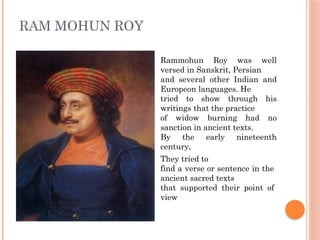
RAM MOHUN ROY
Rammohun Roy was well
versed in Sanskrit, Persian
and several other Indian and
Europeon languages. He
tried to show through his
writings that the practice
of widow burning had no
sanction in ancient texts.
By the early nineteenth
century,
They tried to
find a verse or sentence in the
ancient sacred texts
that supported their point of
view
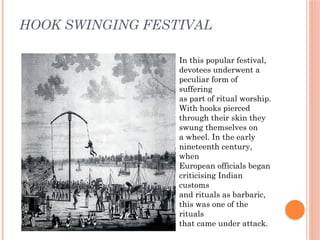
HOOK SWINGING FESTIVAL
In this popular festival,
devotees underwent a
peculiar form of
suffering
as part of ritual worship.
With hooks pierced
through their skin they
swung themselves on
a wheel. In the early
nineteenth century,
when
European officials began
criticising Indian
customs
and rituals as barbaric,
this was one of the
rituals
that came under attack.
 Rammohun Roy published many pamphlets to spread his ideas. Some of
these were written as a dialogue between the advocate and critic of a
traditional practice. Here is one such dialogue on sati:
 ADVOCATE OF SATI:
Women are by nature of inferior understanding, without resolution,
unworthy of trust … Many of them, on the death of their husbands,
become desirous of accompanying them; but to remove every chance
of their trying to escape from the blazing fire, in burning them we first
tie them down to the pile.
 OPPONENT OF SATI:
When did you ever afford them a fair opportunity of exhibiting their
natural capacity? How then can you accuse them of want of
understanding? If, after instruction in knowledge and wisdom, a person
cannot comprehend or retain what has been taught him, we
may consider him as deficient; but if you do not educate women how can
you see them as inferior.
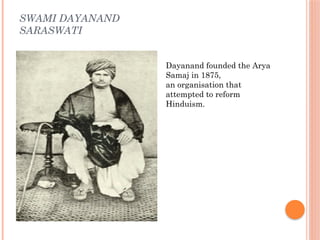
SWAMI DAYANAND
SARASWATI
Dayanand founded the Arya
Samaj in 1875,
an organisation that
attempted to reform
Hinduism.
GIRLS BEGIN GOING TO SCHOOL
Vidyasagar in Calcutta and many other
reformers in Bombay set up schools for
girls.
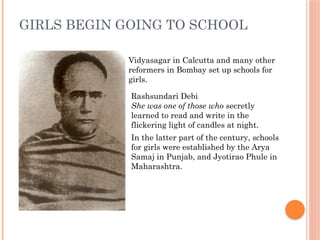
Rashsundari Debi
She was one of those who secretly
learned to read and write in the
flickering light of candles at night.
In the latter part of the century, schools
for girls were established by the Arya
Samaj in Punjab, and Jyotirao Phule in
Maharashtra.
WOMEN WRITE ABOUT
WOMEN
 From the early twentieth century, Muslim women
like the Begums of Bhopal played a notable role in
promoting education among women. They founded
a primary school for girls at Aligarh. Another
remarkable woman, Begum Rokeya Sakhawat
Hossain started schools for Muslim girls in Patna
and Calcutta.
 By the 1880s, Indian women began to enter
universities.
 Tarabai Shinde, a woman educated at home at
Poona, published a book, Stripurushtulna, (A
Comparison between Women and Men), criticising
the social differences between men and women.
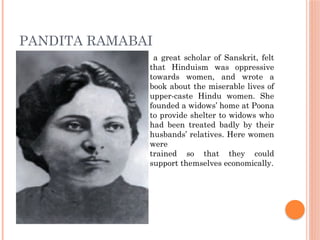
PANDITA RAMABAI
a great scholar of Sanskrit, felt
that Hinduism was oppressive
towards women, and wrote a
book about the miserable lives of
upper-caste Hindu women. She
founded a widows’ home at Poona
to provide shelter to widows who
had been treated badly by their
husbands’ relatives. Here women
were
trained so that they could
support themselves economically.
LAW AGAINST CHILD MARRIAGE
 There were a number of Indian legislators in the
Central Legislative Assembly who fought to
make a law preventing child marriage. In 1929
the Child Marriage Restraint Act was passed
without the kind of bitter debates and struggles
that earlier laws had seen. According to the Act
no man below the age of 18 and woman below the
age of 16 could marry. Subsequently these limits
were raised to 21 for men and 18 for women.
CASTE AND SOCIAL REFORM
 Rammohun Roy translated an old Buddhist text
that was critical of caste. The Prarthana Samaj
adhered to the tradition of Bhakti that believed
in spiritual equality of all castes. In Bombay, the
Paramhans Mandali was founded in 1840 to
work for the abolition of caste.
 Christian missionaries began setting up schools
for tribal groups and “lower”-caste children.
These children were thus equipped with some
resources to make their way into a changing
world.
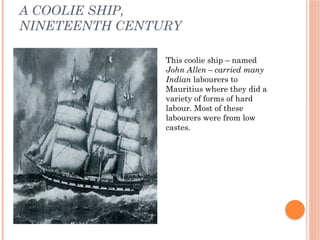
A COOLIE SHIP,
NINETEENTH CENTURY
This coolie ship – named
John Allen – carried many
Indian labourers to
Mauritius where they did a
variety of forms of hard
labour. Most of these
labourers were from low
castes.
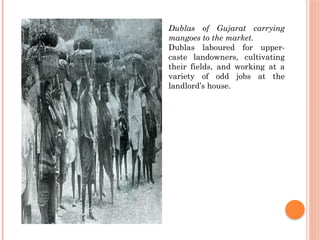
Dublas of Gujarat carrying
mangoes to the market.
Dublas laboured for upper-
caste landowners, cultivating
their fields, and working at a
variety of odd jobs at the
landlord’s house.
 A number of Mahar people, who were regarded
as untouchable, found jobs in the Mahar
Regiment. The father of B.R. Ambedkar, the
leader of Dalit movement, taught at an army
school.
DEMANDS FOR EQUALITY AND
JUSTICE
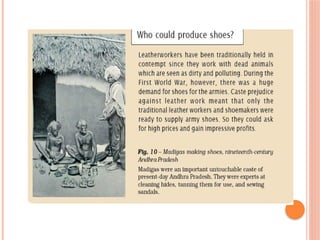
 The Satnami movement in Central India was founded
by Ghasidas who worked among the leatherworkers
and organised a movement to improve their social
status.
 In eastern Bengal, Haridas Thakur’s Matua sect
worked among Chandala cultivators. Haridas
questioned Brahmanical texts that supported the caste
system.
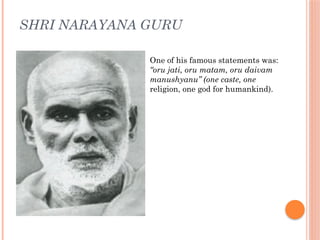
 In what is present-day Kerala, a guru from Ezhava
caste,Shri Narayana Guru, proclaimed the ideals of
unity for his people. He argued against treating people
unequally on the basis of caste differences. According
to him, all human kind belonged to the same caste.
SHRI NARAYANA GURU
One of his famous statements was:
“oru jati, oru matam, oru daivam
manushyanu” (one caste, one
religion, one god for humankind).
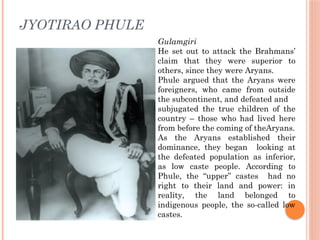
JYOTIRAO PHULE
Gulamgiri
He set out to attack the Brahmans’
claim that they were superior to
others, since they were Aryans.
Phule argued that the Aryans were
foreigners, who came from outside
the subcontinent, and defeated and
subjugated the true children of the
country – those who had lived here
from before the coming of theAryans.
As the Aryans established their
dominance, they began looking at
the defeated population as inferior,
as low caste people. According to
Phule, the “upper” castes had no
right to their land and power: in
reality, the land belonged to
indigenous people, the so-called low
castes.
WHO COULD ENTER TEMPLES?
 In 1927, Ambedkar started a temple entry
movement, in which his Mahar caste followers
participated. Brahman priests were outraged
when the Dalits used water from the temple tank.
 Ambedkar led three such movements for temple
entry between 1927 and 1935.
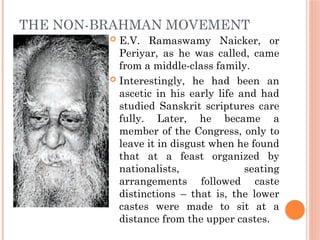
THE NON-BRAHMAN MOVEMENT
 E.V. Ramaswamy Naicker, or
Periyar, as he was called, came
from a middle-class family.
 Interestingly, he had been an
ascetic in his early life and had
studied Sanskrit scriptures care
fully. Later, he became a
member of the Congress, only to
leave it in disgust when he found
that at a feast organized by
nationalists, seating
arrangements followed caste
distinctions – that is, the lower
castes were made to sit at a
distance from the upper castes.
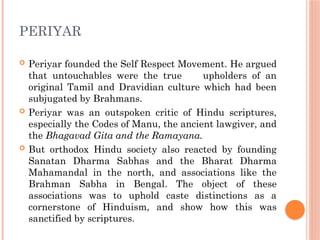
PERIYAR
 Periyar founded the Self Respect Movement. He argued
that untouchables were the true upholders of an
original Tamil and Dravidian culture which had been
subjugated by Brahmans.
 Periyar was an outspoken critic of Hindu scriptures,
especially the Codes of Manu, the ancient lawgiver, and
the Bhagavad Gita and the Ramayana.
 But orthodox Hindu society also reacted by founding
Sanatan Dharma Sabhas and the Bharat Dharma
Mahamandal in the north, and associations like the
Brahman Sabha in Bengal. The object of these
associations was to uphold caste distinctions as a
cornerstone of Hinduism, and show how this was
sanctified by scriptures.
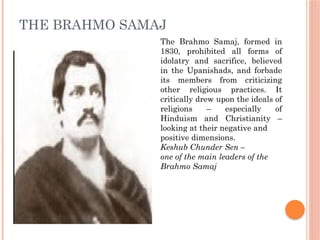
THE BRAHMO SAMAJ
The Brahmo Samaj, formed in
1830, prohibited all forms of
idolatry and sacrifice, believed
in the Upanishads, and forbade
its members from criticizing
other religious practices. It
critically drew upon the ideals of
religions – especially of
Hinduism and Christianity –
looking at their negative and
positive dimensions.
Keshub Chunder Sen –
one of the main leaders of the
Brahmo Samaj
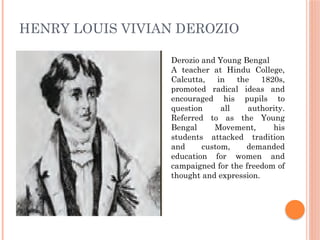
HENRY LOUIS VIVIAN DEROZIO
Derozio and Young Bengal
A teacher at Hindu College,
Calcutta, in the 1820s,
promoted radical ideas and
encouraged his pupils to
question all authority.
Referred to as the Young
Bengal Movement, his
students attacked tradition
and custom, demanded
education for women and
campaigned for the freedom of
thought and expression.
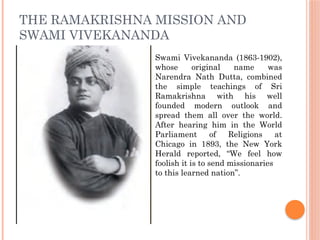
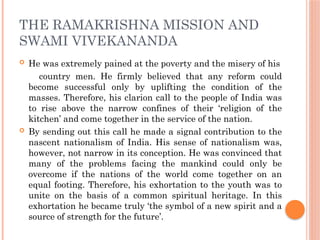
THE RAMAKRISHNA MISSION AND
SWAMI VIVEKANANDA
Swami Vivekananda (1863-1902),
whose original name was
Narendra Nath Dutta, combined
the simple teachings of Sri
Ramakrishna with his well
founded modern outlook and
spread them all over the world.
After hearing him in the World
Parliament of Religions at
Chicago in 1893, the New York
Herald reported, “We feel how
foolish it is to send missionaries
to this learned nation”.
THE RAMAKRISHNA MISSION AND
SWAMI VIVEKANANDA
 He was extremely pained at the poverty and the misery of his
country men. He firmly believed that any reform could
become successful only by uplifting the condition of the
masses. Therefore, his clarion call to the people of India was
to rise above the narrow confines of their ‘religion of the
kitchen’ and come together in the service of the nation.
 By sending out this call he made a signal contribution to the
nascent nationalism of India. His sense of nationalism was,
however, not narrow in its conception. He was convinced that
many of the problems facing the mankind could only be
overcome if the nations of the world come together on an
equal footing. Therefore, his exhortation to the youth was to
unite on the basis of a common spiritual heritage. In this
exhortation he became truly ‘the symbol of a new spirit and a
source of strength for the future’.
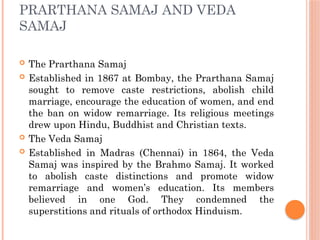
PRARTHANA SAMAJ AND VEDA
SAMAJ
 The Prarthana Samaj
 Established in 1867 at Bombay, the Prarthana Samaj
sought to remove caste restrictions, abolish child
marriage, encourage the education of women, and end
the ban on widow remarriage. Its religious meetings
drew upon Hindu, Buddhist and Christian texts.
 The Veda Samaj
 Established in Madras (Chennai) in 1864, the Veda
Samaj was inspired by the Brahmo Samaj. It worked
to abolish caste distinctions and promote widow
remarriage and women’s education. Its members
believed in one God. They condemned the
superstitions and rituals of orthodox Hinduism.
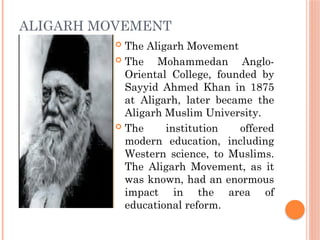
ALIGARH MOVEMENT
 The Aligarh Movement
 The Mohammedan Anglo-
Oriental College, founded by
Sayyid Ahmed Khan in 1875
at Aligarh, later became the
Aligarh Muslim University.
 The institution offered
modern education, including
Western science, to Muslims.
The Aligarh Movement, as it
was known, had an enormous
impact in the area of
educational reform.
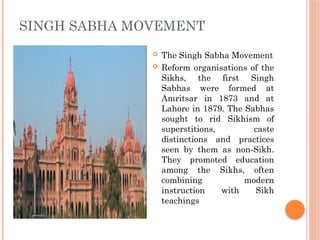
SINGH SABHA MOVEMENT
 The Singh Sabha Movement
 Reform organisations of the
Sikhs, the first Singh
Sabhas were formed at
Amritsar in 1873 and at
Lahore in 1879. The Sabhas
sought to rid Sikhism of
superstitions, caste
distinctions and practices
seen by them as non-Sikh.
They promoted education
among the Sikhs, often
combining modern
instruction with Sikh
teachings
Women, Caste and.pptx...................

Women, Caste and.pptx...................

  • 1.
  • 2.
    SATI, PAINTED BY BALTHAZARSOLVYN, 1813 This was one of the many pictures of sati painted by the European artists who came to India. The practice of sati was seen as evidence of the barbarism of the East.
  • 3.
    RAM MOHUN ROY RammohunRoy was well versed in Sanskrit, Persian and several other Indian and Europeon languages. He tried to show through his writings that the practice of widow burning had no sanction in ancient texts. By the early nineteenth century, They tried to find a verse or sentence in the ancient sacred texts that supported their point of view
  • 4.
    HOOK SWINGING FESTIVAL Inthis popular festival, devotees underwent a peculiar form of suffering as part of ritual worship. With hooks pierced through their skin they swung themselves on a wheel. In the early nineteenth century, when European officials began criticising Indian customs and rituals as barbaric, this was one of the rituals that came under attack.
  • 5.
     Rammohun Roypublished many pamphlets to spread his ideas. Some of these were written as a dialogue between the advocate and critic of a traditional practice. Here is one such dialogue on sati:  ADVOCATE OF SATI: Women are by nature of inferior understanding, without resolution, unworthy of trust … Many of them, on the death of their husbands, become desirous of accompanying them; but to remove every chance of their trying to escape from the blazing fire, in burning them we first tie them down to the pile.  OPPONENT OF SATI: When did you ever afford them a fair opportunity of exhibiting their natural capacity? How then can you accuse them of want of understanding? If, after instruction in knowledge and wisdom, a person cannot comprehend or retain what has been taught him, we may consider him as deficient; but if you do not educate women how can you see them as inferior.
  • 6.
    SWAMI DAYANAND SARASWATI Dayanand foundedthe Arya Samaj in 1875, an organisation that attempted to reform Hinduism.
  • 7.
    GIRLS BEGIN GOINGTO SCHOOL Vidyasagar in Calcutta and many other reformers in Bombay set up schools for girls. Rashsundari Debi She was one of those who secretly learned to read and write in the flickering light of candles at night. In the latter part of the century, schools for girls were established by the Arya Samaj in Punjab, and Jyotirao Phule in Maharashtra.
  • 8.
    WOMEN WRITE ABOUT WOMEN From the early twentieth century, Muslim women like the Begums of Bhopal played a notable role in promoting education among women. They founded a primary school for girls at Aligarh. Another remarkable woman, Begum Rokeya Sakhawat Hossain started schools for Muslim girls in Patna and Calcutta.  By the 1880s, Indian women began to enter universities.  Tarabai Shinde, a woman educated at home at Poona, published a book, Stripurushtulna, (A Comparison between Women and Men), criticising the social differences between men and women.
  • 9.
    PANDITA RAMABAI a greatscholar of Sanskrit, felt that Hinduism was oppressive towards women, and wrote a book about the miserable lives of upper-caste Hindu women. She founded a widows’ home at Poona to provide shelter to widows who had been treated badly by their husbands’ relatives. Here women were trained so that they could support themselves economically.
  • 10.
    LAW AGAINST CHILDMARRIAGE  There were a number of Indian legislators in the Central Legislative Assembly who fought to make a law preventing child marriage. In 1929 the Child Marriage Restraint Act was passed without the kind of bitter debates and struggles that earlier laws had seen. According to the Act no man below the age of 18 and woman below the age of 16 could marry. Subsequently these limits were raised to 21 for men and 18 for women.
  • 11.
    CASTE AND SOCIALREFORM  Rammohun Roy translated an old Buddhist text that was critical of caste. The Prarthana Samaj adhered to the tradition of Bhakti that believed in spiritual equality of all castes. In Bombay, the Paramhans Mandali was founded in 1840 to work for the abolition of caste.  Christian missionaries began setting up schools for tribal groups and “lower”-caste children. These children were thus equipped with some resources to make their way into a changing world.
  • 12.
    A COOLIE SHIP, NINETEENTHCENTURY This coolie ship – named John Allen – carried many Indian labourers to Mauritius where they did a variety of forms of hard labour. Most of these labourers were from low castes.
  • 14.
    Dublas of Gujaratcarrying mangoes to the market. Dublas laboured for upper- caste landowners, cultivating their fields, and working at a variety of odd jobs at the landlord’s house.
  • 15.
     A numberof Mahar people, who were regarded as untouchable, found jobs in the Mahar Regiment. The father of B.R. Ambedkar, the leader of Dalit movement, taught at an army school.
  • 16.
    DEMANDS FOR EQUALITYAND JUSTICE  The Satnami movement in Central India was founded by Ghasidas who worked among the leatherworkers and organised a movement to improve their social status.  In eastern Bengal, Haridas Thakur’s Matua sect worked among Chandala cultivators. Haridas questioned Brahmanical texts that supported the caste system.  In what is present-day Kerala, a guru from Ezhava caste,Shri Narayana Guru, proclaimed the ideals of unity for his people. He argued against treating people unequally on the basis of caste differences. According to him, all human kind belonged to the same caste.
  • 17.
    SHRI NARAYANA GURU Oneof his famous statements was: “oru jati, oru matam, oru daivam manushyanu” (one caste, one religion, one god for humankind).
  • 18.
    JYOTIRAO PHULE Gulamgiri He setout to attack the Brahmans’ claim that they were superior to others, since they were Aryans. Phule argued that the Aryans were foreigners, who came from outside the subcontinent, and defeated and subjugated the true children of the country – those who had lived here from before the coming of theAryans. As the Aryans established their dominance, they began looking at the defeated population as inferior, as low caste people. According to Phule, the “upper” castes had no right to their land and power: in reality, the land belonged to indigenous people, the so-called low castes.
  • 19.
    WHO COULD ENTERTEMPLES?  In 1927, Ambedkar started a temple entry movement, in which his Mahar caste followers participated. Brahman priests were outraged when the Dalits used water from the temple tank.  Ambedkar led three such movements for temple entry between 1927 and 1935.
  • 20.
    THE NON-BRAHMAN MOVEMENT E.V. Ramaswamy Naicker, or Periyar, as he was called, came from a middle-class family.  Interestingly, he had been an ascetic in his early life and had studied Sanskrit scriptures care fully. Later, he became a member of the Congress, only to leave it in disgust when he found that at a feast organized by nationalists, seating arrangements followed caste distinctions – that is, the lower castes were made to sit at a distance from the upper castes.
  • 21.
    PERIYAR  Periyar foundedthe Self Respect Movement. He argued that untouchables were the true upholders of an original Tamil and Dravidian culture which had been subjugated by Brahmans.  Periyar was an outspoken critic of Hindu scriptures, especially the Codes of Manu, the ancient lawgiver, and the Bhagavad Gita and the Ramayana.  But orthodox Hindu society also reacted by founding Sanatan Dharma Sabhas and the Bharat Dharma Mahamandal in the north, and associations like the Brahman Sabha in Bengal. The object of these associations was to uphold caste distinctions as a cornerstone of Hinduism, and show how this was sanctified by scriptures.
  • 22.
    THE BRAHMO SAMAJ TheBrahmo Samaj, formed in 1830, prohibited all forms of idolatry and sacrifice, believed in the Upanishads, and forbade its members from criticizing other religious practices. It critically drew upon the ideals of religions – especially of Hinduism and Christianity – looking at their negative and positive dimensions. Keshub Chunder Sen – one of the main leaders of the Brahmo Samaj
  • 23.
    HENRY LOUIS VIVIANDEROZIO Derozio and Young Bengal A teacher at Hindu College, Calcutta, in the 1820s, promoted radical ideas and encouraged his pupils to question all authority. Referred to as the Young Bengal Movement, his students attacked tradition and custom, demanded education for women and campaigned for the freedom of thought and expression.
  • 24.
    THE RAMAKRISHNA MISSIONAND SWAMI VIVEKANANDA Swami Vivekananda (1863-1902), whose original name was Narendra Nath Dutta, combined the simple teachings of Sri Ramakrishna with his well founded modern outlook and spread them all over the world. After hearing him in the World Parliament of Religions at Chicago in 1893, the New York Herald reported, “We feel how foolish it is to send missionaries to this learned nation”.
  • 25.
    THE RAMAKRISHNA MISSIONAND SWAMI VIVEKANANDA  He was extremely pained at the poverty and the misery of his country men. He firmly believed that any reform could become successful only by uplifting the condition of the masses. Therefore, his clarion call to the people of India was to rise above the narrow confines of their ‘religion of the kitchen’ and come together in the service of the nation.  By sending out this call he made a signal contribution to the nascent nationalism of India. His sense of nationalism was, however, not narrow in its conception. He was convinced that many of the problems facing the mankind could only be overcome if the nations of the world come together on an equal footing. Therefore, his exhortation to the youth was to unite on the basis of a common spiritual heritage. In this exhortation he became truly ‘the symbol of a new spirit and a source of strength for the future’.
  • 26.
    PRARTHANA SAMAJ ANDVEDA SAMAJ  The Prarthana Samaj  Established in 1867 at Bombay, the Prarthana Samaj sought to remove caste restrictions, abolish child marriage, encourage the education of women, and end the ban on widow remarriage. Its religious meetings drew upon Hindu, Buddhist and Christian texts.  The Veda Samaj  Established in Madras (Chennai) in 1864, the Veda Samaj was inspired by the Brahmo Samaj. It worked to abolish caste distinctions and promote widow remarriage and women’s education. Its members believed in one God. They condemned the superstitions and rituals of orthodox Hinduism.
  • 27.
    ALIGARH MOVEMENT  TheAligarh Movement  The Mohammedan Anglo- Oriental College, founded by Sayyid Ahmed Khan in 1875 at Aligarh, later became the Aligarh Muslim University.  The institution offered modern education, including Western science, to Muslims. The Aligarh Movement, as it was known, had an enormous impact in the area of educational reform.
  • 28.
    SINGH SABHA MOVEMENT The Singh Sabha Movement  Reform organisations of the Sikhs, the first Singh Sabhas were formed at Amritsar in 1873 and at Lahore in 1879. The Sabhas sought to rid Sikhism of superstitions, caste distinctions and practices seen by them as non-Sikh. They promoted education among the Sikhs, often combining modern instruction with Sikh teachings