ABC’s of Good Record Keeping:
A Basic Refresher Course on
EI Case Management Documentation
Facilitated by:
Dawn Mastoridis,
Executive/State Director, RCDS/TMN
Oct. 1st 2010
Objectives of the Training
 Understand the context of Early
Intervention law & current regulatory
guidelines

Learn the importance of case note
documentation within an EI Program
 Clarify what information should be
included in an EI record case note
documentation
 Tips & Techniques to a) improve the
quality of your case notes, and b) ways
to manage your time
What is Case Management?
 Ongoing monitoring of services and service
coordination
 Ensure that quality service is being provided
 Evaluating whether a service is effectively meeting
the participant’s need
 Identify any changes in the participant’s condition or
circumstances that would warrant an adjustment to
the care plan.
 Reflects what is happening with
regard the agency’s efforts to provide
& monitor EI service delivery
 Provides required documentation to
support case management activities
within the agency as per the State
and/or local municipality regulatory
guidelines
 Provides a measure of protection to
the agency, State funding entities &
child’s family.
Why are Good Case Notes
So Important?
Individuals with Disabilities
Education Act (IDEA)-Part C
 Federal grant program
that assists States in
operating an Early
Intervention Program
 Early Intervention Program
must be made available to
every eligible child
 States have discretion in
setting the criteria for
eligibility
State Requirements
The child’s record must reflect
the agency’s efforts to comply
with all aspects of service
delivery as per the Federal &
NYS Dept. of Health Guidelines
for Individual with Disabilities
Education Act (IDEA-Part C)
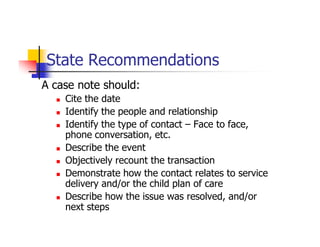
State Recommendations
A case note should:
 Cite the date
 Identify the people and relationship
 Identify the type of contact – Face to face,
phone conversation, etc.
 Describe the event
 Objectively recount the transaction
 Demonstrate how the contact relates to service
delivery and/or the child plan of care
 Describe how the issue was resolved, and/or
next steps
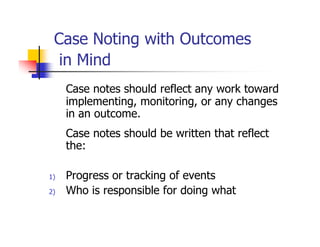
Case Noting with Outcomes
in Mind
Case notes should reflect any work toward
implementing, monitoring, or any changes
in an outcome.
Case notes should be written that reflect
the:
1) Progress or tracking of events
2) Who is responsible for doing what
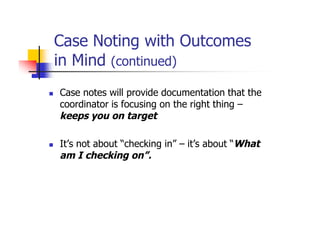
Case Noting with Outcomes
in Mind (continued)
 Case notes will provide documentation that the
coordinator is focusing on the right thing –
keeps you on target
 It’s not about “checking in” – it’s about “What
am I checking on”.
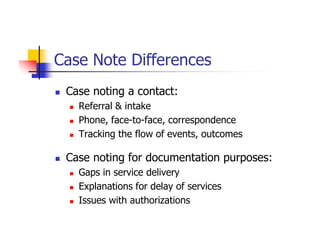
Case Note Differences
 Case noting a contact:
 Referral & intake
 Phone, face-to-face, correspondence
 Tracking the flow of events, outcomes
 Case noting for documentation purposes:
 Gaps in service delivery
 Explanations for delay of services
 Issues with authorizations
Reasons to Record All Activity
 Leave a “paper-trail”
 Provide verification of
activity
 Reminder to coordinator
of case context &
required follow-up steps
 Reference for potential
legal or mediation
issues
 Help co-workers and
supervisors to address
issues when you are out
of the office
 To provide evidence of
agency’s efforts to meet
all DOH compliance
mandates
Warning
Possible Liability Issue
 Recording a “to do” item in the case file and not
following through
 Negative, biased, or prejudicial language
Keep in Mind
 If you didn’t write it down, no one knows it
happened
 Your records might be viewed by:
 Judges
 Attorneys
 Participant
 Guardian
 State Officials
Writing Recommendations
Write in a style that is:
 Factual
 Objective; unbiased
 Specific
 Clear and to the point
Other Writing Tips
 Without jargon
 Don’t write so cryptic that no one one knows
what you are writing
 Omit details of clients intimate lives that do not
have an impact on care plan
 Avoid using medical terms or a diagnosis that
have not been verified
Case Note Exercise
 Read the case
notes provided
 Is the case note
acceptable?
Complete? Why or
why not?
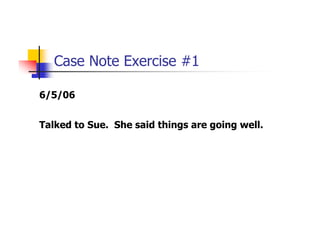
Case Note Exercise #1
6/5/06
Talked to Sue. She said things are going well.
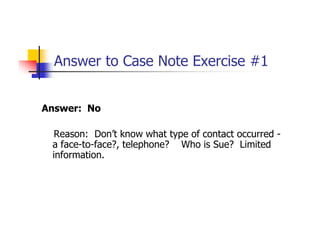
Answer to Case Note Exercise #1
Answer: No
Reason: Don’t know what type of contact occurred -
a face-to-face?, telephone? Who is Sue? Limited
information.
Case Note Exercise #2
6/5/06
Voice mail message from Margaret. She relayed
that Mrs. Roberts cancelled the Physical
Therapist today because Johnny she was not
feeling well.
Answer to Case Note Exercise #2
Answer: No
Reason: Who is Margaret?
Case Note Exercise #3
6/5/06
Staffing Coordinator spoke with Peggy O’Brian- EI
Service Coordinator w/the agency We Do
Everything. Peg relayed that Mrs. Roberts
cancelled Physical Therapy today because Johnny
was not feeling well. Peg relayed that Mrs.
Roberts decided not to reschedule for another
time this week. Mrs. Roberts said it was ok for
the PT to go see Johnny next week at the same
time.
Case Note Exercise #3
Answer: Yes – this case note is acceptable.
Case Note Exercise #4
6/5/06
Talked to Mrs. Roberts. She said things are
going well. Johnny visited his grandmother’s
over the weekend. Had a nice time.
Case Note Exercise #4
Answer: No
Reason: Don’t know what type of contact occurred –
face-to-face? telephone? No documentation to
suggest there was discussion about the parent
regarding the child’s services, health or IFSP outcomes
or other relevant case management activities.
Case Note Exercise #5
6/5/06
Staffing Coordinator Spoke w/ Mrs. Roberts. She
said things are going well. ohnny visited his
grandparents on Saturday afternoon and was
able to walk up the stairs to their apt with
assistance. Mom reports Johnny remains in good
health. PT & OT are arriving as scheduled- she
reported no problems w/ their services. Next
scheduled PT session is for 6/7/06 at 1:00 p.m.
OT scheduled for 6/9/06 at 10 am.
Case Note Exercise #5
Answer: Yes – this case note is acceptable.
Case Note Exercise #6
6/5/06
Evaluation Coordinator spoke w/ Mrs. Roberts.
She confirmed that the Speech Evaluator made
an appt. to assess Johnny, tomorrow at their
apartment at 10:00 am.
Case Note Exercise #6
Answer: Yes – this case note is acceptable.
Case Note Exercise #7
6/5/06
OT reported conducting a home-based session
with Johnny today. Nice visit. Things are status
quo.
Answer to Case Note Exercise #7
Answer: No
Information is limited. No information given regarding
what was accomplished at this session. No information
given regarding the service plan outcomes, child’s
health, family needs, concerns or priorities, etc.
Case Note Exercise #8
6/5/06
SW reported a session with Mrs. Roberts & Johnny
today. SW states mother & child looked awful-
clothes dirty, hair dirty, hair messed up. She stunk.
The apartment smelled liked pee. As usual, she
complained of not feeling good. SW told her to go
see her doctor. Will call EI SC to find out if she
knows anything about why Mrs. Roberts stinks.
Answer to Case Note Exercise #8
Answer: No.
Reason: Unprofessional, biased
Case Note Exercise #9
6/7/06
SW reported concerns following a session w/ Mrs. Roberts &
Johnny today. SW stated that both child & parent
appearance presented as unkempt- clothes stained, hair dirty
& uncombed. Noticeable body odor. Apartment appeared
neat & tidy although urine smell detected. This is the first
time this SW has noticed the urine smell or seen Mrs. Roberts
or child in this appearance in last two months. SW stated
both mother & child appeared alert & oriented during visit.
Staffing Coordinator spoke with Mrs. Roberts who relayed
her SW has been coming regularly and she is pleased with
her services. Staffing Coordinator consulted with Supervisor
& left message with SC to discuss follow-up plan on this case.
Answer to Case Note Exercise #9
Answer: Yes – this case note is acceptable
Take Aways…
 Case notes are lengthy when they are needed to
document all important information that was
observed, or discussed
 Case notes can be short, concise when that is
warranted
 For Service Coordination there must be a logical
correlation between the amount of case management
billed for a contact and what is documented in a case
note.
Tips & Techniques to Consider
 Carry a note pad with you at all times
 Keep a note pad near your phone
 Save a half hour each day to do case noting
 Develop an routine protocol
 Set aside paperwork days and put it on your calendar
 Re-evaluate current forms/templates - are there things that
could make them easier?
 Talk to a co-worker who does case noting well to learn from
him/her
 Secure protected time
 Is it possible to turn your phone off for a half hour?
 Say “no” to other tasks for a limited timeframe
In Summary
Why is Good Case Noting Important?
 Provides a Picture
 Provides Documentation
 Provides Protection
 Keeps you focused on what you are working
on and why
Questions?

2010 Case Noting Revised

  • 1.
    ABC’s of GoodRecord Keeping: A Basic Refresher Course on EI Case Management Documentation Facilitated by: Dawn Mastoridis, Executive/State Director, RCDS/TMN Oct. 1st 2010
  • 2.
    Objectives of theTraining  Understand the context of Early Intervention law & current regulatory guidelines  Learn the importance of case note documentation within an EI Program  Clarify what information should be included in an EI record case note documentation  Tips & Techniques to a) improve the quality of your case notes, and b) ways to manage your time
  • 3.
    What is CaseManagement?  Ongoing monitoring of services and service coordination  Ensure that quality service is being provided  Evaluating whether a service is effectively meeting the participant’s need  Identify any changes in the participant’s condition or circumstances that would warrant an adjustment to the care plan.
  • 4.
     Reflects whatis happening with regard the agency’s efforts to provide & monitor EI service delivery  Provides required documentation to support case management activities within the agency as per the State and/or local municipality regulatory guidelines  Provides a measure of protection to the agency, State funding entities & child’s family. Why are Good Case Notes So Important?
  • 5.
    Individuals with Disabilities EducationAct (IDEA)-Part C  Federal grant program that assists States in operating an Early Intervention Program  Early Intervention Program must be made available to every eligible child  States have discretion in setting the criteria for eligibility
  • 6.
    State Requirements The child’srecord must reflect the agency’s efforts to comply with all aspects of service delivery as per the Federal & NYS Dept. of Health Guidelines for Individual with Disabilities Education Act (IDEA-Part C)
  • 7.
    State Recommendations A casenote should:  Cite the date  Identify the people and relationship  Identify the type of contact – Face to face, phone conversation, etc.  Describe the event  Objectively recount the transaction  Demonstrate how the contact relates to service delivery and/or the child plan of care  Describe how the issue was resolved, and/or next steps
  • 8.
    Case Noting withOutcomes in Mind Case notes should reflect any work toward implementing, monitoring, or any changes in an outcome. Case notes should be written that reflect the: 1) Progress or tracking of events 2) Who is responsible for doing what
  • 9.
    Case Noting withOutcomes in Mind (continued)  Case notes will provide documentation that the coordinator is focusing on the right thing – keeps you on target  It’s not about “checking in” – it’s about “What am I checking on”.
  • 10.
    Case Note Differences Case noting a contact:  Referral & intake  Phone, face-to-face, correspondence  Tracking the flow of events, outcomes  Case noting for documentation purposes:  Gaps in service delivery  Explanations for delay of services  Issues with authorizations
  • 11.
    Reasons to RecordAll Activity  Leave a “paper-trail”  Provide verification of activity  Reminder to coordinator of case context & required follow-up steps  Reference for potential legal or mediation issues  Help co-workers and supervisors to address issues when you are out of the office  To provide evidence of agency’s efforts to meet all DOH compliance mandates
  • 12.
    Warning Possible Liability Issue Recording a “to do” item in the case file and not following through  Negative, biased, or prejudicial language
  • 13.
    Keep in Mind If you didn’t write it down, no one knows it happened  Your records might be viewed by:  Judges  Attorneys  Participant  Guardian  State Officials
  • 14.
    Writing Recommendations Write ina style that is:  Factual  Objective; unbiased  Specific  Clear and to the point
  • 15.
    Other Writing Tips Without jargon  Don’t write so cryptic that no one one knows what you are writing  Omit details of clients intimate lives that do not have an impact on care plan  Avoid using medical terms or a diagnosis that have not been verified
  • 16.
    Case Note Exercise Read the case notes provided  Is the case note acceptable? Complete? Why or why not?
  • 17.
    Case Note Exercise#1 6/5/06 Talked to Sue. She said things are going well.
  • 18.
    Answer to CaseNote Exercise #1 Answer: No Reason: Don’t know what type of contact occurred - a face-to-face?, telephone? Who is Sue? Limited information.
  • 19.
    Case Note Exercise#2 6/5/06 Voice mail message from Margaret. She relayed that Mrs. Roberts cancelled the Physical Therapist today because Johnny she was not feeling well.
  • 20.
    Answer to CaseNote Exercise #2 Answer: No Reason: Who is Margaret?
  • 21.
    Case Note Exercise#3 6/5/06 Staffing Coordinator spoke with Peggy O’Brian- EI Service Coordinator w/the agency We Do Everything. Peg relayed that Mrs. Roberts cancelled Physical Therapy today because Johnny was not feeling well. Peg relayed that Mrs. Roberts decided not to reschedule for another time this week. Mrs. Roberts said it was ok for the PT to go see Johnny next week at the same time.
  • 22.
    Case Note Exercise#3 Answer: Yes – this case note is acceptable.
  • 23.
    Case Note Exercise#4 6/5/06 Talked to Mrs. Roberts. She said things are going well. Johnny visited his grandmother’s over the weekend. Had a nice time.
  • 24.
    Case Note Exercise#4 Answer: No Reason: Don’t know what type of contact occurred – face-to-face? telephone? No documentation to suggest there was discussion about the parent regarding the child’s services, health or IFSP outcomes or other relevant case management activities.
  • 25.
    Case Note Exercise#5 6/5/06 Staffing Coordinator Spoke w/ Mrs. Roberts. She said things are going well. ohnny visited his grandparents on Saturday afternoon and was able to walk up the stairs to their apt with assistance. Mom reports Johnny remains in good health. PT & OT are arriving as scheduled- she reported no problems w/ their services. Next scheduled PT session is for 6/7/06 at 1:00 p.m. OT scheduled for 6/9/06 at 10 am.
  • 26.
    Case Note Exercise#5 Answer: Yes – this case note is acceptable.
  • 27.
    Case Note Exercise#6 6/5/06 Evaluation Coordinator spoke w/ Mrs. Roberts. She confirmed that the Speech Evaluator made an appt. to assess Johnny, tomorrow at their apartment at 10:00 am.
  • 28.
    Case Note Exercise#6 Answer: Yes – this case note is acceptable.
  • 29.
    Case Note Exercise#7 6/5/06 OT reported conducting a home-based session with Johnny today. Nice visit. Things are status quo.
  • 30.
    Answer to CaseNote Exercise #7 Answer: No Information is limited. No information given regarding what was accomplished at this session. No information given regarding the service plan outcomes, child’s health, family needs, concerns or priorities, etc.
  • 31.
    Case Note Exercise#8 6/5/06 SW reported a session with Mrs. Roberts & Johnny today. SW states mother & child looked awful- clothes dirty, hair dirty, hair messed up. She stunk. The apartment smelled liked pee. As usual, she complained of not feeling good. SW told her to go see her doctor. Will call EI SC to find out if she knows anything about why Mrs. Roberts stinks.
  • 32.
    Answer to CaseNote Exercise #8 Answer: No. Reason: Unprofessional, biased
  • 33.
    Case Note Exercise#9 6/7/06 SW reported concerns following a session w/ Mrs. Roberts & Johnny today. SW stated that both child & parent appearance presented as unkempt- clothes stained, hair dirty & uncombed. Noticeable body odor. Apartment appeared neat & tidy although urine smell detected. This is the first time this SW has noticed the urine smell or seen Mrs. Roberts or child in this appearance in last two months. SW stated both mother & child appeared alert & oriented during visit. Staffing Coordinator spoke with Mrs. Roberts who relayed her SW has been coming regularly and she is pleased with her services. Staffing Coordinator consulted with Supervisor & left message with SC to discuss follow-up plan on this case.
  • 34.
    Answer to CaseNote Exercise #9 Answer: Yes – this case note is acceptable
  • 35.
    Take Aways…  Casenotes are lengthy when they are needed to document all important information that was observed, or discussed  Case notes can be short, concise when that is warranted  For Service Coordination there must be a logical correlation between the amount of case management billed for a contact and what is documented in a case note.
  • 36.
    Tips & Techniquesto Consider  Carry a note pad with you at all times  Keep a note pad near your phone  Save a half hour each day to do case noting  Develop an routine protocol  Set aside paperwork days and put it on your calendar  Re-evaluate current forms/templates - are there things that could make them easier?  Talk to a co-worker who does case noting well to learn from him/her  Secure protected time  Is it possible to turn your phone off for a half hour?  Say “no” to other tasks for a limited timeframe
  • 37.
    In Summary Why isGood Case Noting Important?  Provides a Picture  Provides Documentation  Provides Protection  Keeps you focused on what you are working on and why
  • 38.