Social security
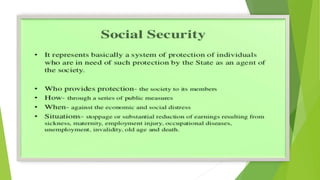
What is Social Security?
 Social security is the security that society
furnishes through appropriate organizations
against certain risks to which its members are
exposed.
 Any of the measures established by legislation to
maintain individual or family income or to provide
income when some or all sources of income are
disrupted or terminated or when exceptionally
heavy expenditures have to be incurred
The security of employment, security of income and
security against health can only be assured through a
system of social assistance scheme.
A welfare state is committed to assure and implement
such assistance to its citizens.
Where there is social justice- there is social security.
They both are the two sides of the same coin
Unemployment benefits, maternity benefits, family
allowances old age grants, death grants, industrial
injury benefits etc. are social measures which every
welfare state should endeavor to provide for its
citizens.
History of Social security
 Abraham Epstein originate the term ‘Social Security’.
(Secretary of American Association of Social Security).
 Germany was the first country to introduce Social security
scheme (1883
 Each member of a particular trade (blacksmiths, painters,
weavers etc.) was required to contribute at regular
intervals;
 Money from this fund was used for food , lodging, hospital
and funeral expenses of aged and disabled members.
 The next contribution in evolution of concept of social
security is from United States of America
 In the United States the federal government took the
steps for insurance scheme only for the soldiers who had
been disabled in war.
 On 14 August, 1935, Franklin Roosevelt introduced the
Social Security Act. Its focus was on unemployment,
poverty, and old age insurance for employees’ security
measures.
 To meet the hazards of old age, unemployment,
and unstable consumption in this modern
industrial age the programme of social security
has been advanced.
 It can be defined as measures providing
protection to workers class against risk like
retirement, resignation, retrenchment, maternity,
old age, unemployment, death, disablement and
other similar conditions.
Three characteristics in common,
 (i) they are established by law;
 (ii) they provide some form of cash payment to
individuals to compensate at least a part of the lost
income that occurs due to such contingencies as
unemployment, maternity, work injury, invalidism,
industrial disease, old age, burial, widowhood, and orphan
hood; and
 (iii) the benefits or services are provided in three ways-
social insurance, social assistance, or public service.
social insurance- features
 (i) Certain risks which cannot be faced by the persons in their individual
capacity are faced collectively by a group of persons.
 (ii) Social insurance is contributory in nature as both the government and the
subscribes have to deposit monthly subscriptions to the social insurance
scheme.
 (iii) Certain, benefits are provided to them in the case of contingency.
 (iv) Benefits are claimed by the insured persons as a matter of their rights in
accordance with their salary.
 (v) They are insured against the risk on compulsory basis, and it is obligatory
for them to contribute under the scheme.
Social Security measures and ILO
 The ill consequences of industrial revolution,
compelled the governments to introduce a spate
of welfare measures and social assistance
schemes.
 The establishment of ILO has contributed a lot for
the enactment of welfare measures in its member
countries.
 According to ILO, “Social security is the security that
society furnishes through appropriate organization against
certain risks to which its members are exposed.
 ILO’s 1944 recommendations on income security and
medical care and the social security (minimum standards)
Convention in 1952 embodied universally accepted basic
principles and common standards of social security
influenced the social security measures through out the
world.
Approaches
 The Specific approach
 The Philosophic approach
 The Specific Approach
• Lord Beveridge was the chief exponent of specific approach.
• Social security denotes the securing of an income to take place of earnings
when all are interrupted by unemployment, sickness or accident
• To provide retirement benefits, provide support against the loss by death, to
provide support on the exceptional situations such as birth, death etc.
• Provide income in case of inability to work, assistance for dependent children
and comprehensive medical care.
• Provide income maintenance/ cash benefits to individuals/ families for specific
contingencies
Demerits
 Family allowance for children were not part of social security.
 Restricting the social security to income maintenance.
 The Philosophic Approach (Pierre Laroque, president of National security Funds
in France)
 Social security as a social objective- a social ideal
 The social ideal envisages the structure of society- enjoys highest material well
being compatible with potential productive resources.
 Pathological social conditions such as unemployment, ill-health, accidents.. Etc
must be removed by providing supports and benefits
 Increase of social security as a part of social development.
 Supported the legislation on social security in the form of social insurance and
social assistance.
 In this approach, the social security represents a guarantee by the whole
community to all its members and to enhance them into a tolerable living
conditions.
Its Emergence in India
 Social security legislations have very recent
origin in India
 The Workmens Compensation Act, 1923, to
protect the workers against employment injury
is the 1st piece of social security legislation in
India.
 Many of the social security legislations were
passed only after Independence
India and social security
 Preamble
 A.38,39,41,42,43,43A
 Legislations
 Provident fund act
 Maternity benefits act
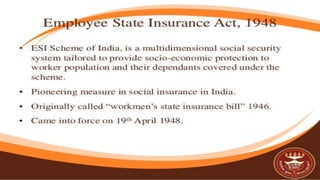
 ESI act
 Employees compensation act
 Factories act
 Minimum wages act
 Payment of wages act
 Regional Director, ESI Corporation v. Francis De Costa,
 the Supreme court held that security against sickness and disablement was a fundamental right
under Art. 21 read with Sec. 39(e) of the Constitution of India.
 Life Insurance Corporation of India v. Consumer Education and Research Centre observed
Government schemes
 Old Age Pension Scheme
 Employment Assurance Scheme
 Swasthya Bima Yojana etc.
Effect of social security measures
 They constitute an important step towards the goal of the
welfare state
 They enable the workers to become more efficient and
reduce the wastage arising from industrial disputes.
 Social security measures are not a burden, but wise
investment which yields good dividends
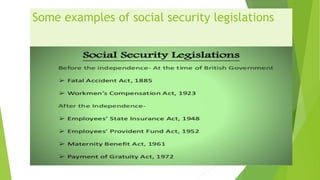
Some examples of social security legislations
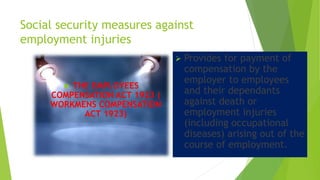
Social security measures against
employment injuries
 THE EMPLOYEES
COMPENSATION ACT 1923 (
WORKMENS COMPENSATION
ACT 1923)
 Provides for payment of
compensation by the
employer to employees
and their dependants
against death or
employment injuries
(including occupational
diseases) arising out of the
course of employment.
social security.pptx

social security.pptx

  • 1.
  • 2.
    What is SocialSecurity?  Social security is the security that society furnishes through appropriate organizations against certain risks to which its members are exposed.  Any of the measures established by legislation to maintain individual or family income or to provide income when some or all sources of income are disrupted or terminated or when exceptionally heavy expenditures have to be incurred
  • 4.
    The security ofemployment, security of income and security against health can only be assured through a system of social assistance scheme. A welfare state is committed to assure and implement such assistance to its citizens. Where there is social justice- there is social security. They both are the two sides of the same coin Unemployment benefits, maternity benefits, family allowances old age grants, death grants, industrial injury benefits etc. are social measures which every welfare state should endeavor to provide for its citizens.
  • 5.
    History of Socialsecurity  Abraham Epstein originate the term ‘Social Security’. (Secretary of American Association of Social Security).  Germany was the first country to introduce Social security scheme (1883  Each member of a particular trade (blacksmiths, painters, weavers etc.) was required to contribute at regular intervals;  Money from this fund was used for food , lodging, hospital and funeral expenses of aged and disabled members.
  • 6.
     The nextcontribution in evolution of concept of social security is from United States of America  In the United States the federal government took the steps for insurance scheme only for the soldiers who had been disabled in war.  On 14 August, 1935, Franklin Roosevelt introduced the Social Security Act. Its focus was on unemployment, poverty, and old age insurance for employees’ security measures.
  • 7.
     To meetthe hazards of old age, unemployment, and unstable consumption in this modern industrial age the programme of social security has been advanced.  It can be defined as measures providing protection to workers class against risk like retirement, resignation, retrenchment, maternity, old age, unemployment, death, disablement and other similar conditions.
  • 8.
    Three characteristics incommon,  (i) they are established by law;  (ii) they provide some form of cash payment to individuals to compensate at least a part of the lost income that occurs due to such contingencies as unemployment, maternity, work injury, invalidism, industrial disease, old age, burial, widowhood, and orphan hood; and  (iii) the benefits or services are provided in three ways- social insurance, social assistance, or public service.
  • 9.
    social insurance- features (i) Certain risks which cannot be faced by the persons in their individual capacity are faced collectively by a group of persons.  (ii) Social insurance is contributory in nature as both the government and the subscribes have to deposit monthly subscriptions to the social insurance scheme.  (iii) Certain, benefits are provided to them in the case of contingency.  (iv) Benefits are claimed by the insured persons as a matter of their rights in accordance with their salary.  (v) They are insured against the risk on compulsory basis, and it is obligatory for them to contribute under the scheme.
  • 10.
    Social Security measuresand ILO  The ill consequences of industrial revolution, compelled the governments to introduce a spate of welfare measures and social assistance schemes.  The establishment of ILO has contributed a lot for the enactment of welfare measures in its member countries.
  • 11.
     According toILO, “Social security is the security that society furnishes through appropriate organization against certain risks to which its members are exposed.
  • 12.
     ILO’s 1944recommendations on income security and medical care and the social security (minimum standards) Convention in 1952 embodied universally accepted basic principles and common standards of social security influenced the social security measures through out the world.
  • 13.
    Approaches  The Specificapproach  The Philosophic approach
  • 14.
     The SpecificApproach • Lord Beveridge was the chief exponent of specific approach. • Social security denotes the securing of an income to take place of earnings when all are interrupted by unemployment, sickness or accident • To provide retirement benefits, provide support against the loss by death, to provide support on the exceptional situations such as birth, death etc. • Provide income in case of inability to work, assistance for dependent children and comprehensive medical care. • Provide income maintenance/ cash benefits to individuals/ families for specific contingencies Demerits  Family allowance for children were not part of social security.  Restricting the social security to income maintenance.
  • 15.
     The PhilosophicApproach (Pierre Laroque, president of National security Funds in France)  Social security as a social objective- a social ideal  The social ideal envisages the structure of society- enjoys highest material well being compatible with potential productive resources.  Pathological social conditions such as unemployment, ill-health, accidents.. Etc must be removed by providing supports and benefits  Increase of social security as a part of social development.  Supported the legislation on social security in the form of social insurance and social assistance.  In this approach, the social security represents a guarantee by the whole community to all its members and to enhance them into a tolerable living conditions.
  • 16.
    Its Emergence inIndia  Social security legislations have very recent origin in India  The Workmens Compensation Act, 1923, to protect the workers against employment injury is the 1st piece of social security legislation in India.  Many of the social security legislations were passed only after Independence
  • 17.
    India and socialsecurity  Preamble  A.38,39,41,42,43,43A  Legislations  Provident fund act  Maternity benefits act  ESI act  Employees compensation act  Factories act  Minimum wages act  Payment of wages act
  • 18.
     Regional Director,ESI Corporation v. Francis De Costa,  the Supreme court held that security against sickness and disablement was a fundamental right under Art. 21 read with Sec. 39(e) of the Constitution of India.  Life Insurance Corporation of India v. Consumer Education and Research Centre observed
  • 19.
    Government schemes  OldAge Pension Scheme  Employment Assurance Scheme  Swasthya Bima Yojana etc.
  • 20.
    Effect of socialsecurity measures  They constitute an important step towards the goal of the welfare state  They enable the workers to become more efficient and reduce the wastage arising from industrial disputes.  Social security measures are not a burden, but wise investment which yields good dividends
  • 21.
    Some examples ofsocial security legislations
  • 22.
    Social security measuresagainst employment injuries  THE EMPLOYEES COMPENSATION ACT 1923 ( WORKMENS COMPENSATION ACT 1923)  Provides for payment of compensation by the employer to employees and their dependants against death or employment injuries (including occupational diseases) arising out of the course of employment.