NGO REGISTRATION METHODS IN
INDIA
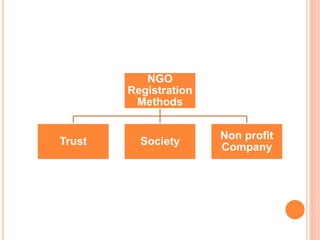
NGO
Registration
Methods
Trust Society
Non profit
Company
In India non profit / public charitable organisations can be
registered as trusts, societies, or a private limited non profit
company, under section-25 companies. Non-profit
organisations in India
• (a) exist independently of the state;
• (b) are self-governed by a board of trustees or ‘managing
committee’/ governing council, comprising individuals who generally
serve in a fiduciary capacity;
• (c) produce benefits for others, generally outside the membership of
the organisation; and
• (d), are ‘non-profit-making’, in as much as they are prohibited from
distributing a monetary residual to their own members.
Section 2(15) of the Income Tax Act – which is applicable
uniformly throughout the Republic of India – defines ‘charitable
purpose’ to include
• ‘relief of the poor,
• education,
• medical relief and
• the advancement of any other object of general public utility’
What is not considered as charitable
• A purpose that relates exclusively to religious teaching or worship is
not considered as charitable. Thus, in ascertaining whether a
purpose is public or private, one has to see if the class to be
benefited, or from which the beneficiaries are to be selected,
constitute a substantial body of the public
• A public charitable purpose has to benefit a sufficiently large section
of the public as distinguished from specified individuals.
Organisations which lack the public element – such as trusts for the
benefit of workmen
• or employees of a company, however numerous – have not been
held to be charitable.
• As long as the beneficiaries of the organisation comprise an
uncertain and fluctuating body of the public answering a particular
description, the fact that the beneficiaries may belong to a certain
religious faith, or a sect of persons of a certain religious persuasion,
would not affect the organisation’s ‘public’ character.
Whether a trust, society or section-25 company, the Income Tax Act
gives all categories equal treatment, in terms of exempting their income and
granting 80G certificates, whereby donors to non-profit organisations may
claim a rebate against donations made.
Foreign contributions to non-profits are governed by FC(R)A regulations and
the Home Ministry.
CAF would like to clarify that this material provides only broad guidelines and
it is recommended that legal and or financial experts be consulted before
taking any important legal or financial decision or arriving at any conclusion.
FORMATION AND REGISTRATION OF A NON -
PROFIT ORGANISATIONS IN INDIA
 I. Trusts
A public charitable trust is usually floated when there is property
involved, especially in terms of land and building.
Legislation : Different states in India have different Trusts Acts in force,
which govern the trusts in the state; in the absence of a Trusts Act in any
particular state or territory the general principles of the Indian Trusts Act
1882 are applied.
Main Instrument : The main instrument of any public charitable trust is
the trust deed, wherein the aims and objects and mode of management
(of the trust) should be enshrined. In every trust deed, the minimum and
maximum number of trustees has to be specified. The trust deed should
clearly spell out the aims and objects of the trust, how the trust should be
managed, how other trustees may be appointed or removed, etc. The
trust deed should be signed by both the settlor/s and trustee/s in the
presence of two witnesses. The trust deed should be executed on non-
judicial stamp paper, the value of which would depend on the valuation of
the trust property.

Trustees : A trust needs a minimum of two trustees; there is no upper
limit to the number of trustees. The Board of Management comprises the
trustees.
 Application for Registration :
 After providing details (in the form) regarding designation by
which the public trust shall be known, names of trustees,
mode of succession, etc., the applicant has to affix a court fee
stamp of Rs.2/- to the form and pay a very nominal
registration fee which may range from Rs.3/- to Rs.25/-,
depending on the value of the trust property.
The application form should be signed by the applicant before
the regional officer or superintendent of the regional office of
the charity commissioner or a notary. The application form
should be submitted, together with a copy of the trust deed.
Two other documents which should be submitted at the time
of making an application for registration are affidavit and
consent letter.
II. SOCIETY
 According to section 20 of the Societies Registration Act,
1860, the following societies can be registered under the Act: ‘
 charitable societies,
 military orphan funds or
 societies established at the several presidencies of India,
 societies established for the promotion of science, literature,
or the fine arts, for instruction, the diffusion of useful
knowledge, the diffusion of political education,
 the foundation or maintenance of libraries or
 reading rooms for general use among the members or
 open to the public, or
 public museums and galleries of paintings
 and other works of art, collection of natural history, mechanical
and philosophical inventions, instruments or designs.’
Legislation :
• Societies are registered under the Societies Registration Act, 1860, which is
a federal act. In certain states, which have a charity commissioner, the
society must not only be registered under the Societies Registration Act, but
also, additionally, under the Bombay Public Trusts Act.
Main Instrument :
• The main instrument of any society is the memorandum of association and
rules and regulations (no stamp paper required), wherein the aims and
objects and mode of management (of the society) should be enshrined.
Trustees :
• A Society needs a minimum of seven managing committee members; there is
no upper limit to the number managing committee members. The Board of
Management is in the form of a governing body or council or a managing or
executive committee
Application for Registration :
• Registration can be done either at the state level (i.e., in the office of the
Registrar of Societies) or at the district level (in the office of the District
Magistrate or the local office of the Registrar of Societies).
Legislation :
• Section-25 companies are registered under section-25 of the Indian
Companies Act. 1956.
Main Instrument :
• For a section-25 company, the main instrument is a Memorandum
and articles of association (no stamp paper required)
III. Section-25 Company
• According to section 25(1)(a) and (b) of the Indian Companies Act,
1956, a section-25 company can be established ‘for promoting
commerce, art, science, religion, charity or any other useful object’,
provided the profits, if any, or other income is applied for promoting
only the objects of the company and no dividend is paid to its
members.
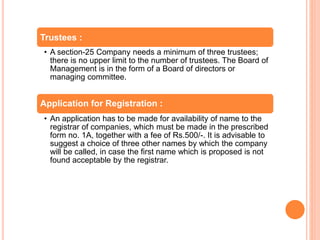
Trustees :
• A section-25 Company needs a minimum of three trustees;
there is no upper limit to the number of trustees. The Board of
Management is in the form of a Board of directors or
managing committee.
Application for Registration :
• An application has to be made for availability of name to the
registrar of companies, which must be made in the prescribed
form no. 1A, together with a fee of Rs.500/-. It is advisable to
suggest a choice of three other names by which the company
will be called, in case the first name which is proposed is not
found acceptable by the registrar.
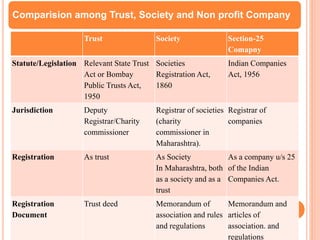
Comparision among Trust, Society and Non profit Company
Trust Society Section-25
Comapny
Statute/Legislation Relevant State Trust
Act or Bombay
Public Trusts Act,
1950
Societies
Registration Act,
1860
Indian Companies
Act, 1956
Jurisdiction Deputy
Registrar/Charity
commissioner
Registrar of societies
(charity
commissioner in
Maharashtra).
Registrar of
companies
Registration As trust As Society
In Maharashtra, both
as a society and as a
trust
As a company u/s 25
of the Indian
Companies Act.
Registration
Document
Trust deed Memorandum of
association and rules
and regulations
Memorandum and
articles of
association. and
regulations
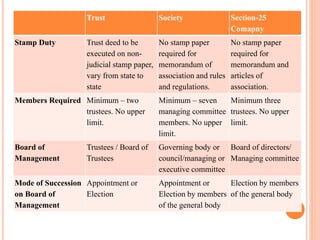
Trust Society Section-25
Comapny
Stamp Duty Trust deed to be
executed on non-
judicial stamp paper,
vary from state to
state
No stamp paper
required for
memorandum of
association and rules
and regulations.
No stamp paper
required for
memorandum and
articles of
association.
Members Required Minimum – two
trustees. No upper
limit.
Minimum – seven
managing committee
members. No upper
limit.
Minimum three
trustees. No upper
limit.
Board of
Management
Trustees / Board of
Trustees
Governing body or
council/managing or
executive committee
Board of directors/
Managing committee
Mode of Succession
on Board of
Management
Appointment or
Election
Appointment or
Election by members
of the general body
Election by members
of the general body

Ngo reg methods

  • 1.
  • 2.
  • 3.
    In India nonprofit / public charitable organisations can be registered as trusts, societies, or a private limited non profit company, under section-25 companies. Non-profit organisations in India • (a) exist independently of the state; • (b) are self-governed by a board of trustees or ‘managing committee’/ governing council, comprising individuals who generally serve in a fiduciary capacity; • (c) produce benefits for others, generally outside the membership of the organisation; and • (d), are ‘non-profit-making’, in as much as they are prohibited from distributing a monetary residual to their own members.
  • 4.
    Section 2(15) ofthe Income Tax Act – which is applicable uniformly throughout the Republic of India – defines ‘charitable purpose’ to include • ‘relief of the poor, • education, • medical relief and • the advancement of any other object of general public utility’
  • 5.
    What is notconsidered as charitable • A purpose that relates exclusively to religious teaching or worship is not considered as charitable. Thus, in ascertaining whether a purpose is public or private, one has to see if the class to be benefited, or from which the beneficiaries are to be selected, constitute a substantial body of the public • A public charitable purpose has to benefit a sufficiently large section of the public as distinguished from specified individuals. Organisations which lack the public element – such as trusts for the benefit of workmen • or employees of a company, however numerous – have not been held to be charitable. • As long as the beneficiaries of the organisation comprise an uncertain and fluctuating body of the public answering a particular description, the fact that the beneficiaries may belong to a certain religious faith, or a sect of persons of a certain religious persuasion, would not affect the organisation’s ‘public’ character.
  • 6.
    Whether a trust,society or section-25 company, the Income Tax Act gives all categories equal treatment, in terms of exempting their income and granting 80G certificates, whereby donors to non-profit organisations may claim a rebate against donations made. Foreign contributions to non-profits are governed by FC(R)A regulations and the Home Ministry. CAF would like to clarify that this material provides only broad guidelines and it is recommended that legal and or financial experts be consulted before taking any important legal or financial decision or arriving at any conclusion.
  • 7.
    FORMATION AND REGISTRATIONOF A NON - PROFIT ORGANISATIONS IN INDIA
  • 8.
     I. Trusts Apublic charitable trust is usually floated when there is property involved, especially in terms of land and building. Legislation : Different states in India have different Trusts Acts in force, which govern the trusts in the state; in the absence of a Trusts Act in any particular state or territory the general principles of the Indian Trusts Act 1882 are applied. Main Instrument : The main instrument of any public charitable trust is the trust deed, wherein the aims and objects and mode of management (of the trust) should be enshrined. In every trust deed, the minimum and maximum number of trustees has to be specified. The trust deed should clearly spell out the aims and objects of the trust, how the trust should be managed, how other trustees may be appointed or removed, etc. The trust deed should be signed by both the settlor/s and trustee/s in the presence of two witnesses. The trust deed should be executed on non- judicial stamp paper, the value of which would depend on the valuation of the trust property.  Trustees : A trust needs a minimum of two trustees; there is no upper limit to the number of trustees. The Board of Management comprises the trustees.
  • 9.
     Application forRegistration :  After providing details (in the form) regarding designation by which the public trust shall be known, names of trustees, mode of succession, etc., the applicant has to affix a court fee stamp of Rs.2/- to the form and pay a very nominal registration fee which may range from Rs.3/- to Rs.25/-, depending on the value of the trust property. The application form should be signed by the applicant before the regional officer or superintendent of the regional office of the charity commissioner or a notary. The application form should be submitted, together with a copy of the trust deed. Two other documents which should be submitted at the time of making an application for registration are affidavit and consent letter.
  • 10.
    II. SOCIETY  Accordingto section 20 of the Societies Registration Act, 1860, the following societies can be registered under the Act: ‘  charitable societies,  military orphan funds or  societies established at the several presidencies of India,  societies established for the promotion of science, literature, or the fine arts, for instruction, the diffusion of useful knowledge, the diffusion of political education,  the foundation or maintenance of libraries or  reading rooms for general use among the members or  open to the public, or  public museums and galleries of paintings  and other works of art, collection of natural history, mechanical and philosophical inventions, instruments or designs.’
  • 11.
    Legislation : • Societiesare registered under the Societies Registration Act, 1860, which is a federal act. In certain states, which have a charity commissioner, the society must not only be registered under the Societies Registration Act, but also, additionally, under the Bombay Public Trusts Act. Main Instrument : • The main instrument of any society is the memorandum of association and rules and regulations (no stamp paper required), wherein the aims and objects and mode of management (of the society) should be enshrined. Trustees : • A Society needs a minimum of seven managing committee members; there is no upper limit to the number managing committee members. The Board of Management is in the form of a governing body or council or a managing or executive committee Application for Registration : • Registration can be done either at the state level (i.e., in the office of the Registrar of Societies) or at the district level (in the office of the District Magistrate or the local office of the Registrar of Societies).
  • 12.
    Legislation : • Section-25companies are registered under section-25 of the Indian Companies Act. 1956. Main Instrument : • For a section-25 company, the main instrument is a Memorandum and articles of association (no stamp paper required) III. Section-25 Company • According to section 25(1)(a) and (b) of the Indian Companies Act, 1956, a section-25 company can be established ‘for promoting commerce, art, science, religion, charity or any other useful object’, provided the profits, if any, or other income is applied for promoting only the objects of the company and no dividend is paid to its members.
  • 13.
    Trustees : • Asection-25 Company needs a minimum of three trustees; there is no upper limit to the number of trustees. The Board of Management is in the form of a Board of directors or managing committee. Application for Registration : • An application has to be made for availability of name to the registrar of companies, which must be made in the prescribed form no. 1A, together with a fee of Rs.500/-. It is advisable to suggest a choice of three other names by which the company will be called, in case the first name which is proposed is not found acceptable by the registrar.
  • 14.
    Comparision among Trust,Society and Non profit Company Trust Society Section-25 Comapny Statute/Legislation Relevant State Trust Act or Bombay Public Trusts Act, 1950 Societies Registration Act, 1860 Indian Companies Act, 1956 Jurisdiction Deputy Registrar/Charity commissioner Registrar of societies (charity commissioner in Maharashtra). Registrar of companies Registration As trust As Society In Maharashtra, both as a society and as a trust As a company u/s 25 of the Indian Companies Act. Registration Document Trust deed Memorandum of association and rules and regulations Memorandum and articles of association. and regulations
  • 15.
    Trust Society Section-25 Comapny StampDuty Trust deed to be executed on non- judicial stamp paper, vary from state to state No stamp paper required for memorandum of association and rules and regulations. No stamp paper required for memorandum and articles of association. Members Required Minimum – two trustees. No upper limit. Minimum – seven managing committee members. No upper limit. Minimum three trustees. No upper limit. Board of Management Trustees / Board of Trustees Governing body or council/managing or executive committee Board of directors/ Managing committee Mode of Succession on Board of Management Appointment or Election Appointment or Election by members of the general body Election by members of the general body

Editor's Notes

  • #5 Section 2(15) of the Income Tax Act – which is applicable uniformly throughout the Republic of India – defines ‘charitable purpose’ to include ‘relief of the poor, education, medical relief and the advancement of any other object of general public utility’ A purpose that relates exclusively to religious teaching or worship is not considered as charitable. Thus, in ascertaining whether a purpose is public or private, one has to see if the class to be benefited, or from which the beneficiaries are to be selected, constitute a substantial body of the public