“A COMMUNITY IS LIKE A SHIP;
EVERYONE OUGHT TO BE
PREPARED TO TAKE THE
HELM.”
•words of Henrik Ibsen
Community being an organized social structure
serves as the driving force for civilization.
Human development came side by side with the
development of communal orientation as well as
with the evolution of socio-economic structures.
Anthropological Perspective
ANTHROPOLOGY
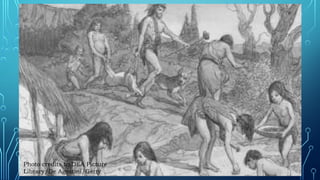
a. paleolithic age (old stone age) –
hunter gatherers
* The earliest humans were able to create tools from rocks and other
solid materials found elsewhere in their environment. Through sheer
ingenuity these early people were able to produce tools for hunting and
chopping. Such display of ingenuity must have been driven by their
sense of community in which gathering of foods was no longer
intended to feed one or two persons but the entire community. In the
process, as the population continues to grow, the early humans were
able to develop a system of holding the entire community together into
one solid unit working collectively for the common good.
Photo credits to DEA Picture
Library/De Agostini/Getty
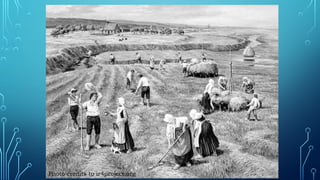
b. mesolithic age (middle stone age) –
horticultural and agricultural
• In this period early people started using tools more
advanced than those in the Paleolithic era. Because the
population is getting bigger so as the demands for
provisions which brought the idea of growing plants for food
instead of just relying on what the nature can provide. This
marked the transition of a community into an agricultural
oriented social system which resulted also in inequality and
conflict within and with other communities.
Photo credits to ir4project.org
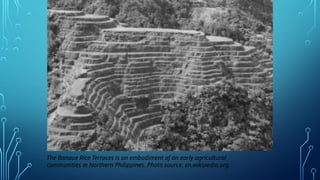
c. neolithic age – agrarian
• This period is characterized by the advancement of technology
which resulted to the large agricultural production and
consequently led to social stratifications. People of the community
saw how the large stockpile of agricultural products can translate
to power. The situation created a competition that was decided by
the size of land owned and technology used in order to produce
more. From then on conflict and competition has played a big role
in the community dynamics.
The Banaue Rice Terraces is an embodiment of an early agricultural
communities in Northern Philippines. Photo source: en.wikipedia.org.
•Sociology is a branch of Social Science that analyzes the
history, evolution, structure, and functions of societies.
Sociologist studied community as a system and tried to
generate empirical data to established theories on various
social phenomena stemming from inter-human
relationships as well as humans to institutions
relationships.
a. Social stratification
• Involves categorization of people in a community into
groups based on several factors which include wealth,
income, occupation, race, gender, power among others.
Social stratification provides a view of the situations
within the community system such as how power is
obtained or shared including the distribution of race and
gender in the population.
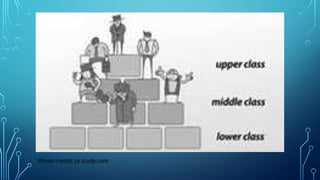
b. Social Class
•Hierarchical categorization of people based on the income
economic capacity. This includes the most basic
classification such as upper class, middle class and lower
class. Politicians and economic planners used this kind
of categorization to have a clearer vision of how certain
socio-economic policies will affect people in the economic
system work or how certain policy will affect the people.
Photo credits to study.com
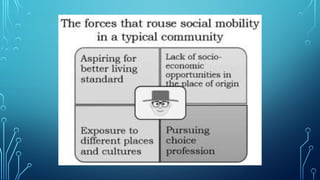
c. Social Mobility
• Refers to the movement of an individual or group within or
between social strata. It results in change in social status
relative so one’s positions or location.
• One example of social mobility is the movement from one lower
position to a higher position in a political system.
• Another manifestations of social mobility is the shift in social
class of OFWs from lower to upper class of OFWs resulting
from increased in financial capability.
d. Gender Equality Movements
•It involves how individuals view themselves in
the light of their freedom to choose what
gender view they will intend to follow or
perform certain roles without having to
confront any form of social repercussion.
e. Deviance
•Any form of action or behavior that undermines
social norms, laws or cultural orientations.
Deviance can be a mere result of a person’s
inclination to follow a personal view of a socially
acceptable behavior and not necessarily an
affront to the rules and customary order.
For some Filipinos having tattoos especially among women
is a form of deviance but for anthropologists tattoos has
significant part in our rich culture.
Photo credits to Lars Krutak.
•Politics is about the interrelationship of power and the
community. Political scientists view community as a
system composed of people of diverse views that create
conflicts and competitions. Such kind of interactions
necessitate the need for an authority that will assume
power in order to establish and preserve order.
Institutional
Perspective
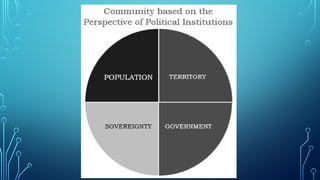
•Community as a political system
composed of the following
elements:
A. POPULATION
• Refers to the people who are bestowed
with duties, rights and privileges in
order to maximize potentials to the
benefits of the community.
B. TERRITORY
• A geographical community occupies
a physical space within which all
social, economic and political views
and activities may be practiced.
C. SOVEREIGNTY
• At the community level it
basically refers to the capacity
of the community to enforce
rules within its territory.
D. GOVERNMENT
• An institution at the community
level that was empowered to
ensure order within its territory.
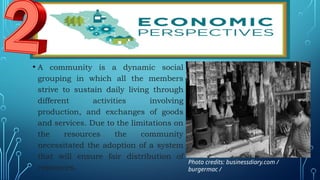
• A community is a dynamic social
grouping in which all the members
strive to sustain daily living through
different activities involving
production, and exchanges of goods
and services. Due to the limitations on
the resources the community
necessitated the adoption of a system
that will ensure fair distribution of
resources.
Photo credits: businessdiary.com /
burgermac /
• Human survival is tied up to the different techniques and
innovations the people can master in order to provide for
their needs. Through the advancement of intellect, people
learned how to adapt to their environment and utilize all the
resources around them to produce their daily necessities. As
social beings, humans live in a community that they share
with others for which they have to relinquish certain aspect
of their freedom to be able to harmoniously coexist.
Education Institution
Perspectives
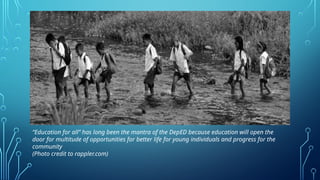
“Education for all” has long been the mantra of the DepED because education will open the
door for multitude of opportunities for better life for young individuals and progress for the
community
(Photo credit to rappler.com)
•In as far as religious perspective is concerned, a
community is consist of people who commit and
practice a common belief system. The culture
system wasn’t always a product of a social process
but by a pre-established code handed down to the
people through and enforced by an anointed leader.
People of different
ages from various
walks of life
gathered to show
their support to the
efforts for a peaceful
Mindanao (Photo
credit to the Office
of the Presidential
Adviser on the Peace
Process /
peace.gov.ph).
Social Science Perspective oooooooo.pptx

Social Science Perspective oooooooo.pptx

  • 2.
    “A COMMUNITY ISLIKE A SHIP; EVERYONE OUGHT TO BE PREPARED TO TAKE THE HELM.” •words of Henrik Ibsen
  • 4.
    Community being anorganized social structure serves as the driving force for civilization. Human development came side by side with the development of communal orientation as well as with the evolution of socio-economic structures. Anthropological Perspective
  • 5.
  • 6.
    a. paleolithic age(old stone age) – hunter gatherers * The earliest humans were able to create tools from rocks and other solid materials found elsewhere in their environment. Through sheer ingenuity these early people were able to produce tools for hunting and chopping. Such display of ingenuity must have been driven by their sense of community in which gathering of foods was no longer intended to feed one or two persons but the entire community. In the process, as the population continues to grow, the early humans were able to develop a system of holding the entire community together into one solid unit working collectively for the common good.
  • 7.
    Photo credits toDEA Picture Library/De Agostini/Getty
  • 8.
    b. mesolithic age(middle stone age) – horticultural and agricultural • In this period early people started using tools more advanced than those in the Paleolithic era. Because the population is getting bigger so as the demands for provisions which brought the idea of growing plants for food instead of just relying on what the nature can provide. This marked the transition of a community into an agricultural oriented social system which resulted also in inequality and conflict within and with other communities.
  • 9.
    Photo credits toir4project.org
  • 10.
    c. neolithic age– agrarian • This period is characterized by the advancement of technology which resulted to the large agricultural production and consequently led to social stratifications. People of the community saw how the large stockpile of agricultural products can translate to power. The situation created a competition that was decided by the size of land owned and technology used in order to produce more. From then on conflict and competition has played a big role in the community dynamics.
  • 11.
    The Banaue RiceTerraces is an embodiment of an early agricultural communities in Northern Philippines. Photo source: en.wikipedia.org.
  • 12.
    •Sociology is abranch of Social Science that analyzes the history, evolution, structure, and functions of societies. Sociologist studied community as a system and tried to generate empirical data to established theories on various social phenomena stemming from inter-human relationships as well as humans to institutions relationships.
  • 13.
    a. Social stratification •Involves categorization of people in a community into groups based on several factors which include wealth, income, occupation, race, gender, power among others. Social stratification provides a view of the situations within the community system such as how power is obtained or shared including the distribution of race and gender in the population.
  • 14.
    b. Social Class •Hierarchicalcategorization of people based on the income economic capacity. This includes the most basic classification such as upper class, middle class and lower class. Politicians and economic planners used this kind of categorization to have a clearer vision of how certain socio-economic policies will affect people in the economic system work or how certain policy will affect the people.
  • 15.
  • 16.
    c. Social Mobility •Refers to the movement of an individual or group within or between social strata. It results in change in social status relative so one’s positions or location. • One example of social mobility is the movement from one lower position to a higher position in a political system. • Another manifestations of social mobility is the shift in social class of OFWs from lower to upper class of OFWs resulting from increased in financial capability.
  • 18.
    d. Gender EqualityMovements •It involves how individuals view themselves in the light of their freedom to choose what gender view they will intend to follow or perform certain roles without having to confront any form of social repercussion.
  • 20.
    e. Deviance •Any formof action or behavior that undermines social norms, laws or cultural orientations. Deviance can be a mere result of a person’s inclination to follow a personal view of a socially acceptable behavior and not necessarily an affront to the rules and customary order.
  • 21.
    For some Filipinoshaving tattoos especially among women is a form of deviance but for anthropologists tattoos has significant part in our rich culture. Photo credits to Lars Krutak.
  • 22.
    •Politics is aboutthe interrelationship of power and the community. Political scientists view community as a system composed of people of diverse views that create conflicts and competitions. Such kind of interactions necessitate the need for an authority that will assume power in order to establish and preserve order.
  • 23.
  • 24.
    •Community as apolitical system composed of the following elements:
  • 26.
    A. POPULATION • Refersto the people who are bestowed with duties, rights and privileges in order to maximize potentials to the benefits of the community.
  • 27.
    B. TERRITORY • Ageographical community occupies a physical space within which all social, economic and political views and activities may be practiced.
  • 28.
    C. SOVEREIGNTY • Atthe community level it basically refers to the capacity of the community to enforce rules within its territory.
  • 29.
    D. GOVERNMENT • Aninstitution at the community level that was empowered to ensure order within its territory.
  • 30.
    • A communityis a dynamic social grouping in which all the members strive to sustain daily living through different activities involving production, and exchanges of goods and services. Due to the limitations on the resources the community necessitated the adoption of a system that will ensure fair distribution of resources. Photo credits: businessdiary.com / burgermac /
  • 31.
    • Human survivalis tied up to the different techniques and innovations the people can master in order to provide for their needs. Through the advancement of intellect, people learned how to adapt to their environment and utilize all the resources around them to produce their daily necessities. As social beings, humans live in a community that they share with others for which they have to relinquish certain aspect of their freedom to be able to harmoniously coexist. Education Institution Perspectives
  • 32.
    “Education for all”has long been the mantra of the DepED because education will open the door for multitude of opportunities for better life for young individuals and progress for the community (Photo credit to rappler.com)
  • 33.
    •In as faras religious perspective is concerned, a community is consist of people who commit and practice a common belief system. The culture system wasn’t always a product of a social process but by a pre-established code handed down to the people through and enforced by an anointed leader.
  • 34.
    People of different agesfrom various walks of life gathered to show their support to the efforts for a peaceful Mindanao (Photo credit to the Office of the Presidential Adviser on the Peace Process / peace.gov.ph).