VARIOUS
PERSPECTIVE IN THE
COMMUNITY
PREPARED BY:
JAMIR,JOHNLOYD,VENNER
MOST
ESSENTIAL
LEARNING
COMPETENCY
• Define using various perspective e.g., social
sciences, institutions, civil society, and local/
grassroots level
LET’S REVIEW!
WHAT IS A
COMMUNITY?
A community is a super organic or
system, made up of the thoughts,
outlook and conduct of individual
human beings full of divisions and
conflicts brought about by differences
DIFFERENCES: religion, ethnicity,
gender, access to resources, class,
education level, income level,
ownership of properties, language,
personality
ETYMOLOGICAL
ORIGIN
Community – Late middle English term
Latin – “communitas”- fellowship
Latin roots – communis – common
Com – with or together
Munire – to strengthen, to fortify
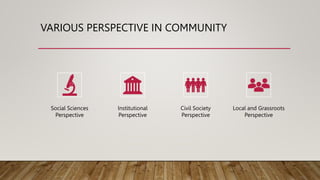
VARIOUS PERSPECTIVE IN COMMUNITY
Social Sciences
Perspective
Institutional
Perspective
Civil Society
Perspective
Local and Grassroots
Perspective
SOCIAL SCIENCE
PERSPECTIVE
• Views community as composed of people
interacting with one another, sensitive to each
other’s emotions, as well as interest and subjective
points of view.
• Social Science is an umbrella term for various field
of study which examine social relations and
human society.
SOCIAL SCIENCE PERSPECTIVE
In Social Science perspective a community is describe as a
group of people in a particular area interacting together.
Social Sciences has a several fields including Anthropology,
Economics, Political Science, Psychology, and Sociology.
WHY DO PEOPLE INTERACT WITH ONE
ANOTHER?
HOW WILL YOU DESCRIBE THE IMPORTANCE
OF LEARNING THE BASIC CONCEPTS OF
SOCIAL SCIENCE PERSPECTIVE?
ANTHROPOLOGY
• This field examine the various aspects of
humans, such as their biology, behavior,
culture and social interactions.
• It also studies how people adapt their ways of
living to different environment.
• Example is determining ways to help a
community solve health related concerns. This
can be addressed by understanding the
situation through interacting with the people
in the community, connecting its history with
its present conditions, and eventually solving
the community's concerns.
ECONOMICS
This field studies the production,
allocation and consumption of goods
and services.
In any community, one finds various
forms of wealth distribution.
The ultimate goal of economics is to
improve the lives of people, such as
that their needs are satisfied.
POLITICAL
SCIENCE
This field encompasses the various ways and
means of allocating power, influence, and
decision making.
This includes the types of governments and
management systems, and how people in a
small bands or informal groups make decisions
when they do not have recognized leader.
All communities have some form of political
system . The members of a community should
understand how its political system works, how
power and influence are distributed and what
change of occur.
PSYCHOLOGY
• This discipline studies he human mind, brain,
and social behavior. This extends to
interactions between people and
interpersonal relationships. Psychology in
general is most often associated with the
study, diagnosis, and treatment of mental
illnesses.
Sub-fields of Psychology
- Abnormal psychology
- Developmental psychology
-Cognitive psychology
-Social psychology.
SOCIOLOGY
This field is the study of society, social order, social
interactions, and social behavior. It introduces the
concepts of social capital and communitarianism.
Social capital is defined as the networks of
relationships among people who live and work in a
particular society for the effective functioning of
the community.
The concept of communitarianism explains the
connection between the individual and the
community. Every person has a special role in one's
society, and it is part of human nature to relate
with other people in various conditions or
situations.
INSTITUTIONAL
PERSPECTIVE
• The institutional perspective views the
concept of community in three different
dimensions.
• First, it is an existing establishment or physical
space where members of the community go
for a certain purpose. Examples of this are the
companies, hospitals, or educational
institutions.
INSTITUTIONAL
PERSPECTIVE
• Second is the institutional community as social
model. This is defined by networks and
institutions where community groups are formed
in certain areas such as schools, churches or
companies, and member is to gather to meet
their needs. People join clubs and associations to
hone their skills, join religious organizations to
deepen their faith, participate in media activities
to improve their communication skills, and meet
with friends and family at restaurants to satisfy
their hunger. Some of the religious organizations
based in the philippines are the catholic church,
the Agama Islam Society, Couples for Christ, and
Simbahang Lingkod ng Bayan.
INSTITUTIONAL
PERSPECTIVE
• The youth also participate in
various fellowship activities
around the country. It is an
avenue for them to reflect,
interact and strengthen their
faith
INSTITUTIONAL
PERSPECTIVE
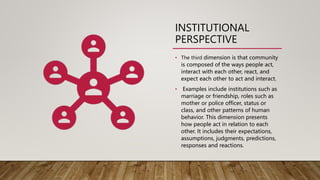
• The third dimension is that community
is composed of the ways people act,
interact with each other, react, and
expect each other to act and interact.
• Examples include institutions such as
marriage or friendship, roles such as
mother or police officer, status or
class, and other patterns of human
behavior. This dimension presents
how people act in relation to each
other. It includes their expectations,
assumptions, judgments, predictions,
responses and reactions.
INSTITUTIONAL
PERSPECTIVE
• It perceives patterns of relationships sometimes
identified as roles and status, and the
formation of groups and institutions that
derived from those patterns. For example, a
"father" is both a role and an institution. This
explains that in a community, its social
organization is the sum total of all those and
relationships and patterns.
• Based on the given definition of institutional
communities, cite three similar communities
that you are involved in, and state their goals.
CIVIL SOCIETY
PERSPECTIVE
• The Civil society perspective stresses the idea
of forming a group, foundation or an
organization in service to society. This
perspective views society as community of
citizens linked by common interest and
collective activity. Examples include people's
organization, civic organizations, and social
movements.
• This is considered effective model of
community since a sense of belonging is
achieved due to the collaboration of shared
interests and identities in serving the
humanity.
EXAMPLE
Groups of people come together regardless of location and
organize plants to render support and assistance to society.
some examples of civic organizations in the Philippines are
ABS-CBN foundation, Ayala Red Cross Foundation, Boy and
Girl Scouts of the Philippines and Caritas Manila.
The human rights movement, on the other hand is an
example of a social movement.
LOCAL AND
GRASSROOTS
PERSPECTIVE
• This perspective highlights volunteerism.
Members of different communities may
involve themselves in various programs or
activities. Definitely uses self organization and
encourages the local citizens to contribute to
the community by taking responsibilities and
actions.
Leaders and other members identify the sources of
concerns in a local setting and determine ways to
address these problems. Volunteers are mobilized in
cooperation with government decision makers who will
be accountable for their actions. The community also
formulate programs for others, and employes actions
according to the needs of the community.
EXAMPLE:
Doctors and dentist in different communities come
together to organize medical and dental missions,
especially for families affected by calamities. When
typhoon Haiyan hit the country in 2013, children and
elderly became weak and sick, and a medical mission
was implemented to improve their health condition.

VARIOUS-PERSPECTIVE-IN-THE-COMMUNITY-2.pptx

  • 1.
  • 2.
    MOST ESSENTIAL LEARNING COMPETENCY • Define usingvarious perspective e.g., social sciences, institutions, civil society, and local/ grassroots level
  • 3.
    LET’S REVIEW! WHAT ISA COMMUNITY? A community is a super organic or system, made up of the thoughts, outlook and conduct of individual human beings full of divisions and conflicts brought about by differences DIFFERENCES: religion, ethnicity, gender, access to resources, class, education level, income level, ownership of properties, language, personality
  • 4.
    ETYMOLOGICAL ORIGIN Community – Latemiddle English term Latin – “communitas”- fellowship Latin roots – communis – common Com – with or together Munire – to strengthen, to fortify
  • 5.
    VARIOUS PERSPECTIVE INCOMMUNITY Social Sciences Perspective Institutional Perspective Civil Society Perspective Local and Grassroots Perspective
  • 6.
    SOCIAL SCIENCE PERSPECTIVE • Viewscommunity as composed of people interacting with one another, sensitive to each other’s emotions, as well as interest and subjective points of view. • Social Science is an umbrella term for various field of study which examine social relations and human society.
  • 7.
    SOCIAL SCIENCE PERSPECTIVE InSocial Science perspective a community is describe as a group of people in a particular area interacting together. Social Sciences has a several fields including Anthropology, Economics, Political Science, Psychology, and Sociology.
  • 8.
    WHY DO PEOPLEINTERACT WITH ONE ANOTHER? HOW WILL YOU DESCRIBE THE IMPORTANCE OF LEARNING THE BASIC CONCEPTS OF SOCIAL SCIENCE PERSPECTIVE?
  • 9.
    ANTHROPOLOGY • This fieldexamine the various aspects of humans, such as their biology, behavior, culture and social interactions. • It also studies how people adapt their ways of living to different environment. • Example is determining ways to help a community solve health related concerns. This can be addressed by understanding the situation through interacting with the people in the community, connecting its history with its present conditions, and eventually solving the community's concerns.
  • 10.
    ECONOMICS This field studiesthe production, allocation and consumption of goods and services. In any community, one finds various forms of wealth distribution. The ultimate goal of economics is to improve the lives of people, such as that their needs are satisfied.
  • 11.
    POLITICAL SCIENCE This field encompassesthe various ways and means of allocating power, influence, and decision making. This includes the types of governments and management systems, and how people in a small bands or informal groups make decisions when they do not have recognized leader. All communities have some form of political system . The members of a community should understand how its political system works, how power and influence are distributed and what change of occur.
  • 12.
    PSYCHOLOGY • This disciplinestudies he human mind, brain, and social behavior. This extends to interactions between people and interpersonal relationships. Psychology in general is most often associated with the study, diagnosis, and treatment of mental illnesses. Sub-fields of Psychology - Abnormal psychology - Developmental psychology -Cognitive psychology -Social psychology.
  • 13.
    SOCIOLOGY This field isthe study of society, social order, social interactions, and social behavior. It introduces the concepts of social capital and communitarianism. Social capital is defined as the networks of relationships among people who live and work in a particular society for the effective functioning of the community. The concept of communitarianism explains the connection between the individual and the community. Every person has a special role in one's society, and it is part of human nature to relate with other people in various conditions or situations.
  • 14.
    INSTITUTIONAL PERSPECTIVE • The institutionalperspective views the concept of community in three different dimensions. • First, it is an existing establishment or physical space where members of the community go for a certain purpose. Examples of this are the companies, hospitals, or educational institutions.
  • 15.
    INSTITUTIONAL PERSPECTIVE • Second isthe institutional community as social model. This is defined by networks and institutions where community groups are formed in certain areas such as schools, churches or companies, and member is to gather to meet their needs. People join clubs and associations to hone their skills, join religious organizations to deepen their faith, participate in media activities to improve their communication skills, and meet with friends and family at restaurants to satisfy their hunger. Some of the religious organizations based in the philippines are the catholic church, the Agama Islam Society, Couples for Christ, and Simbahang Lingkod ng Bayan.
  • 16.
    INSTITUTIONAL PERSPECTIVE • The youthalso participate in various fellowship activities around the country. It is an avenue for them to reflect, interact and strengthen their faith
  • 17.
    INSTITUTIONAL PERSPECTIVE • The thirddimension is that community is composed of the ways people act, interact with each other, react, and expect each other to act and interact. • Examples include institutions such as marriage or friendship, roles such as mother or police officer, status or class, and other patterns of human behavior. This dimension presents how people act in relation to each other. It includes their expectations, assumptions, judgments, predictions, responses and reactions.
  • 18.
    INSTITUTIONAL PERSPECTIVE • It perceivespatterns of relationships sometimes identified as roles and status, and the formation of groups and institutions that derived from those patterns. For example, a "father" is both a role and an institution. This explains that in a community, its social organization is the sum total of all those and relationships and patterns. • Based on the given definition of institutional communities, cite three similar communities that you are involved in, and state their goals.
  • 19.
    CIVIL SOCIETY PERSPECTIVE • TheCivil society perspective stresses the idea of forming a group, foundation or an organization in service to society. This perspective views society as community of citizens linked by common interest and collective activity. Examples include people's organization, civic organizations, and social movements. • This is considered effective model of community since a sense of belonging is achieved due to the collaboration of shared interests and identities in serving the humanity.
  • 20.
    EXAMPLE Groups of peoplecome together regardless of location and organize plants to render support and assistance to society. some examples of civic organizations in the Philippines are ABS-CBN foundation, Ayala Red Cross Foundation, Boy and Girl Scouts of the Philippines and Caritas Manila. The human rights movement, on the other hand is an example of a social movement.
  • 21.
    LOCAL AND GRASSROOTS PERSPECTIVE • Thisperspective highlights volunteerism. Members of different communities may involve themselves in various programs or activities. Definitely uses self organization and encourages the local citizens to contribute to the community by taking responsibilities and actions.
  • 22.
    Leaders and othermembers identify the sources of concerns in a local setting and determine ways to address these problems. Volunteers are mobilized in cooperation with government decision makers who will be accountable for their actions. The community also formulate programs for others, and employes actions according to the needs of the community. EXAMPLE: Doctors and dentist in different communities come together to organize medical and dental missions, especially for families affected by calamities. When typhoon Haiyan hit the country in 2013, children and elderly became weak and sick, and a medical mission was implemented to improve their health condition.