Downloaded 254 times






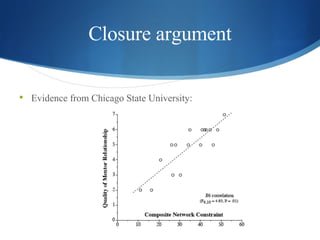






1. Social capital refers to the benefits obtained from social networks and relationships. Structural holes refer to weak connections between different groups in a social network. 2. Individuals who bridge structural holes gain competitive advantages from access to non-redundant information and control over third-party relationships. This "structural hole hypothesis" has received empirical support. 3. Dense networks alone do not improve performance. However, closure within groups helps realize the added value from brokerage between groups. Social capital is maximized when networks have both structural holes and closure.


