Social Networking isn’t just for kids!   Tim Hawes Vice Principal/Assistant IT Manager Ottawa-Carleton
Three reasons why this topic is important to me Philosophical Personal Practical
What makes me loose sleep at night… (Philosophical) I’m nervous about “web 2.0” and what is means for education… but not for the reasons you might think… Media coverage of social networking is almost exclusively fear-mongering Despite efforts to educate teens about how to safely exist online, most districts (including my own) block all access to social networking/media sites Warning – Blatant generalization   Teachers (and adults in general) are completely disconnected from the emerging online “participatory culture” While our students are increasingly engaging more and more in this new culture, they are doing it in the absence of any mature influences
Web 2.0 – Technology is different today… The Internet today is very different from the place we first began to explore together with our students in the late-90s… See  http://youtube.com/watch?v=6gmP4nk0EOE Play
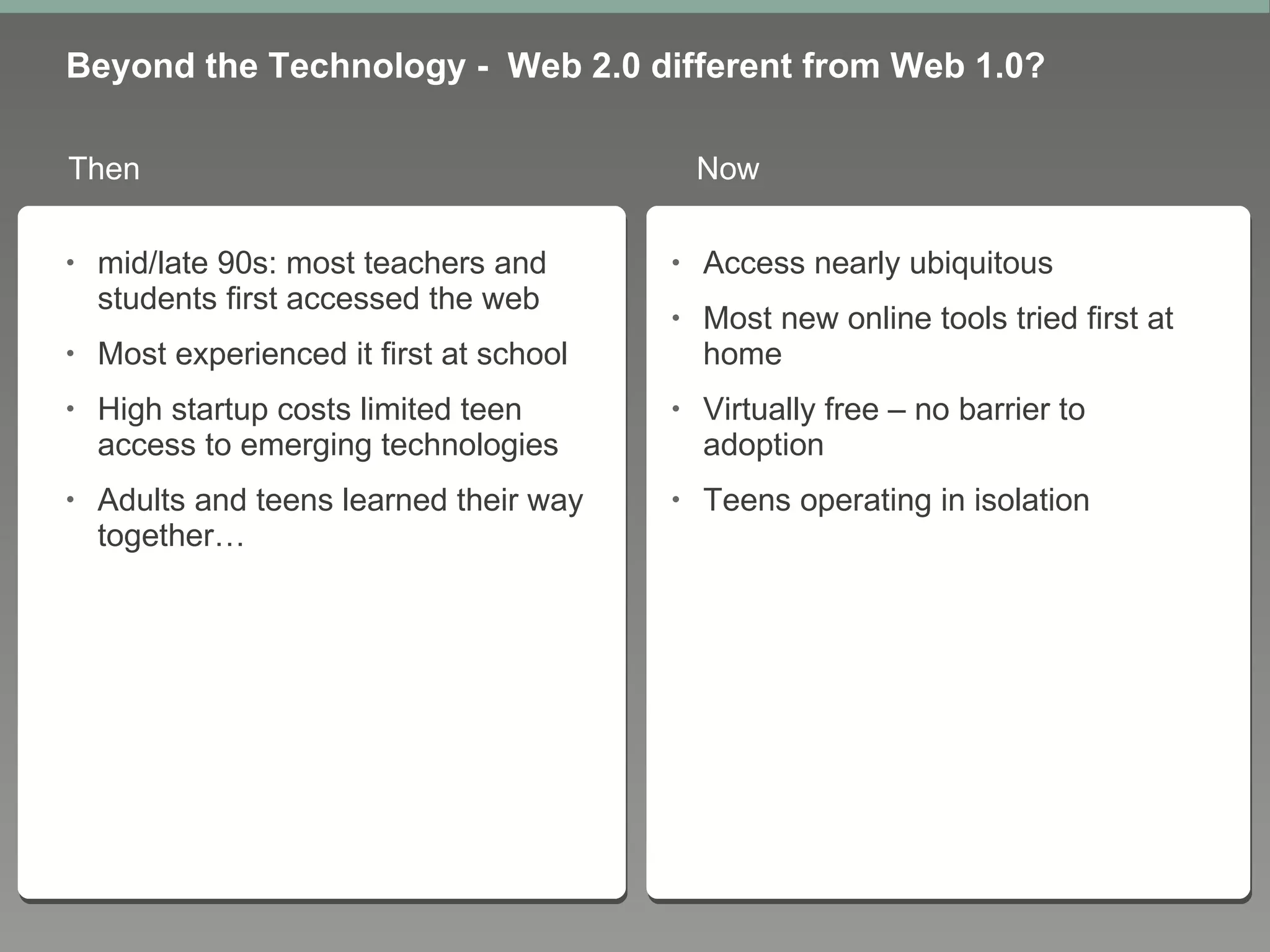
Beyond the Technology -  Web 2.0 different from Web 1.0? mid/late 90s: most teachers and students first accessed the web Most experienced it first at school High startup costs limited teen access to emerging technologies Adults and teens learned their way together… Access nearly ubiquitous Most new online tools tried first at home Virtually free – no barrier to adoption Teens operating in isolation Then Now
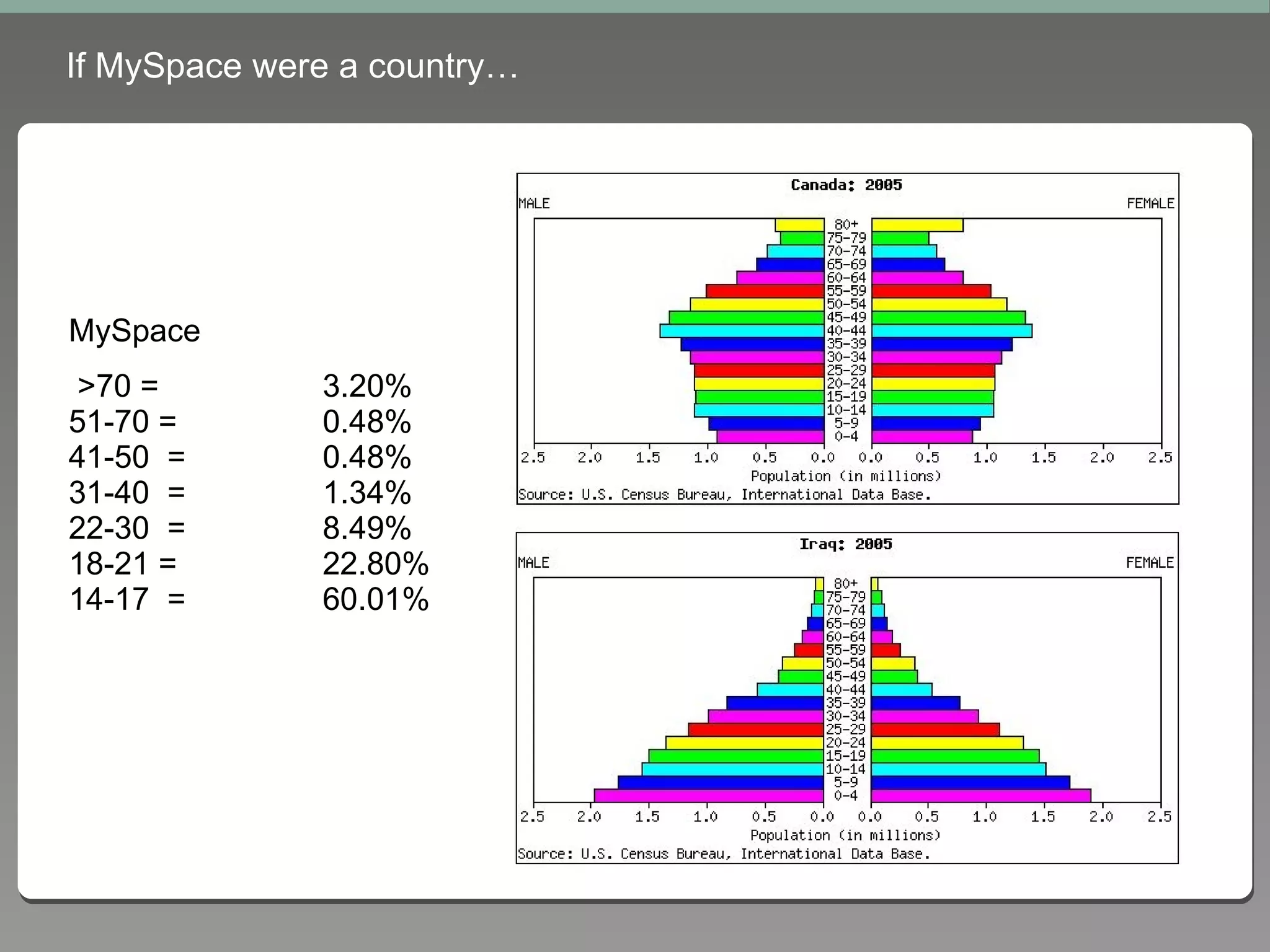
If MySpace were a country… If MySpace were a country, it would be the 11 th  largest in the world (between Japan and Mexico) 8 th  largest, between Russia and Nigeria Are you comfortable with your kids “growing up” in a country without any teachers?
If MySpace were a country… MySpace >70 = 3.20% 51-70 = 0.48% 41-50  =  0.48%  31-40  =  1.34% 22-30  =  8.49% 18-21 = 22.80%  14-17  =  60.01%
Web 2.0 = Participatory Culture "While to adults the Internet primarily means the world wide web, for children it means email, chat, games-- and here they are already content producers. Too often neglected, except as a source of risk, these communication and entertainment focused activities, by contrast with the information-focused uses at the centre of public and policy agendas, are driving emerging media literacy. Through such uses, children are most engaged-- multi-tasking, becoming proficient at navigation and maneuver so as to win, judging their participation and that of others, etc.... In terms of personal development, identity, expression and their social consequences-- participation, social capital, civic culture- these are the activities that serve to network today's younger generation." -- Sonia Livingstone.
Participatory Culture Let’s define participatory culture as one: With relatively low barriers to artistic expression and civic engagement With strong support for creating and sharing one's creations with other. With some type of informal mentorship whereby what is known by the most experienced is passed along to novices  Where members believe that their contributions matter Where members feel some degree of social connection with one another (at the least they care what other people think about what they have created). Not every member must contribute, but all must believe they are free to contribute when ready and that what they contribute will be appropriately valued. http://henryjenkins.org/2006/10/confronting_the_challenges_of.html
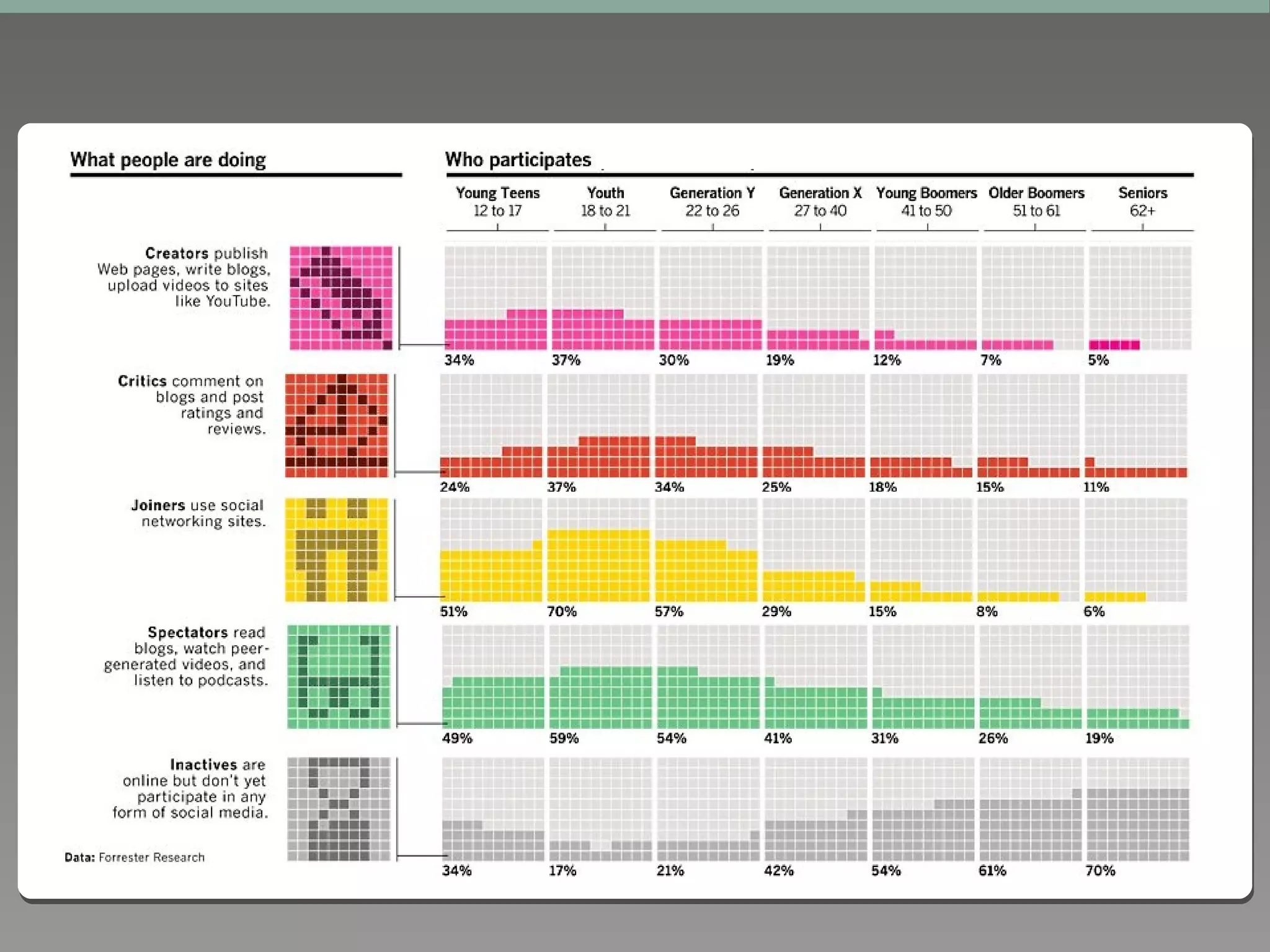
Participatory Culture Doesn’t that sound like it describes an ideal classroom? Doesn’t it also sound a lot like YouTube and Flickr and MySpace?
 
“ Teaching” Social Network skills… If there is a grain of truth in this, then what are we to do? How should we respond as educators? Do we need to “teach” social networking? Everything I need to know if life I learned from watching Sesame Street… (see  http://youtube.com/watch?v=Z4VNMERVsC4 ) PLAY
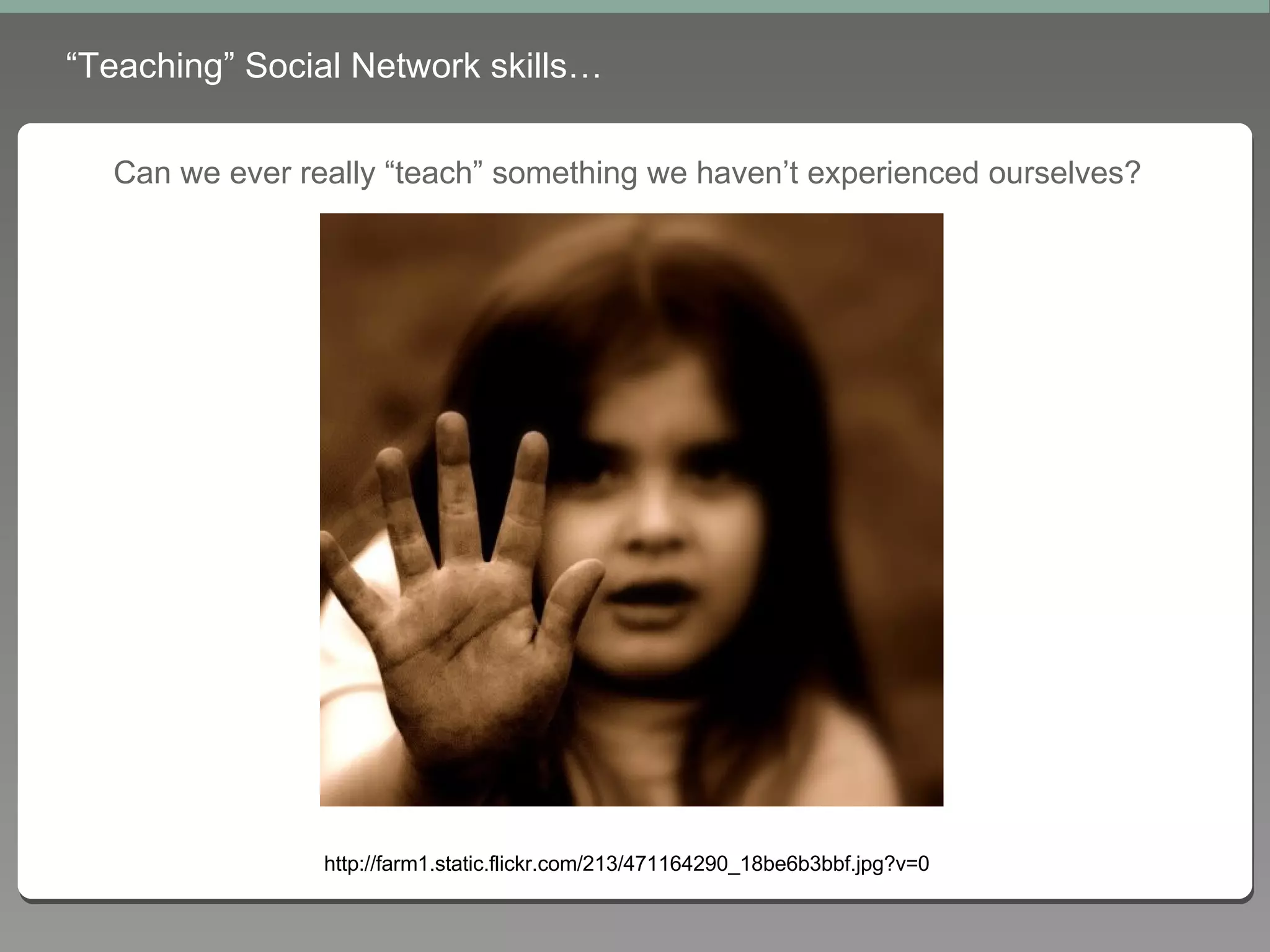
“ Teaching” Social Network skills… Can we ever really “teach” something we haven’t experienced ourselves? http://farm1.static.flickr.com/213/471164290_18be6b3bbf.jpg?v=0
What to do… TIME Magazine this year named “You” the person of the Year.
What to do… I don’t always recommend running out and becoming an active “MySpacer”
Getting Your Hands Dirty… Commun-IT.org A social network just for us A chance to experience social learning and build an online professional learning community Start to develop an independent community voice for those of us who are involved in ICT and eLearning 2 birds, one stone : engage in participatory culture and meaningful PD at the same time
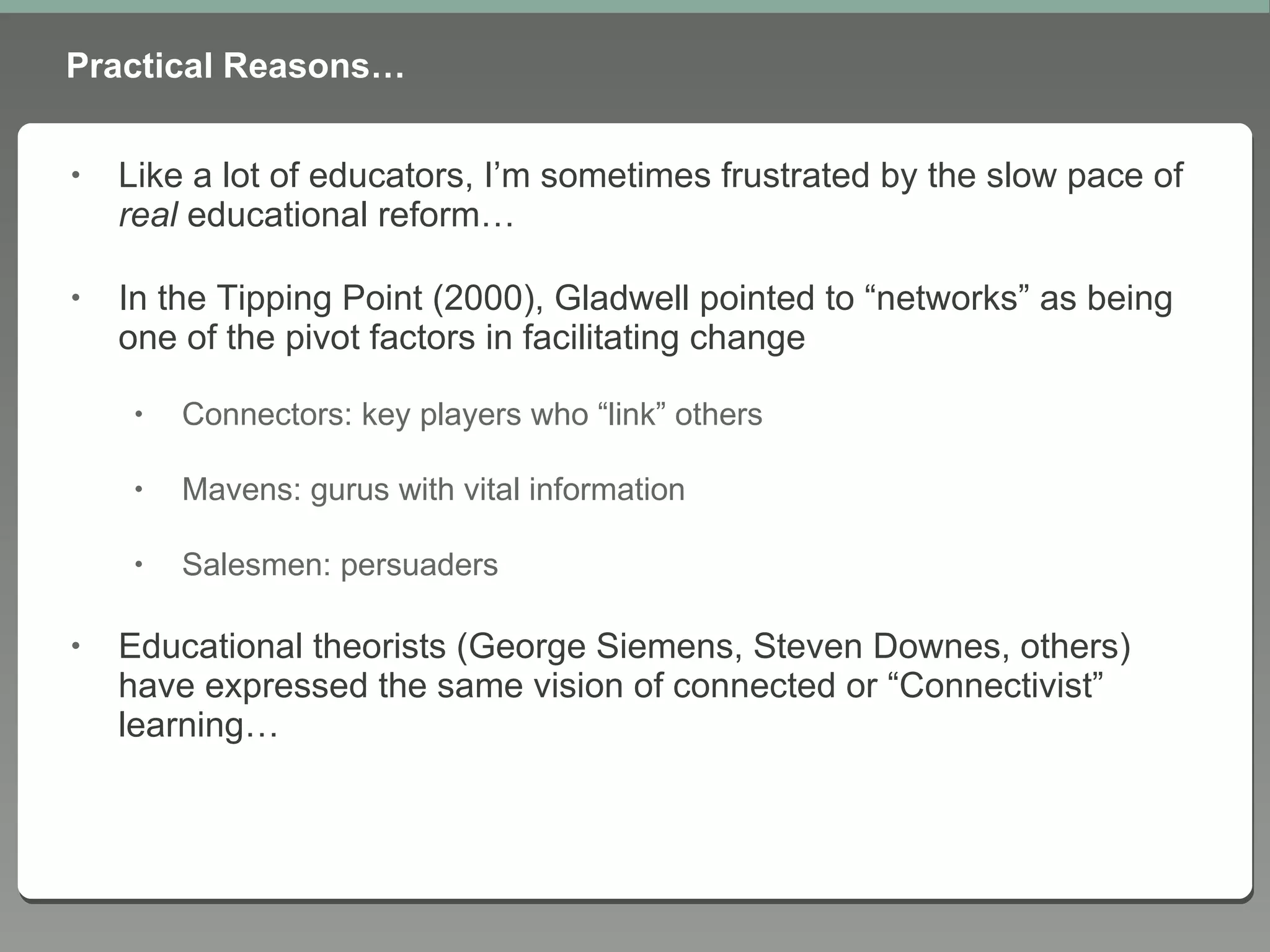
Practical Reasons… Like a lot of educators, I’m sometimes frustrated by the slow pace of  real  educational reform… In the Tipping Point (2000), Gladwell pointed to “networks” as being one of the pivot factors in facilitating change Connectors: key players who “link” others Mavens: gurus with vital information Salesmen: persuaders Educational theorists (George Siemens, Steven Downes, others) have expressed the same vision of connected or “Connectivist” learning…
Practical Reasons… Each of us (in our own districts) is working in isolation Even if we are fortunate to be among the select few who travel frequently, attend conferences – we still work far too often on our own Is it an coincidence that schools and prisons look alike? http://farm1.static.flickr.com/2/1907910_fb81511771.jpg?v=0
Personal Reasons… Our recent experiences (OCDSB) have forced us to come to terms with the fact that we can’t – and shouldn’t – try to do it on our own Wealth of resources for ICT integration, but impossible to maintain and keep fresh on our own We needed to take a more open approach and collaborate with others
Recommended Readings PEW Internet : Social Networking and Teens http://www.pewinternet.org/PPF/r/198/report_display.asp George Siemens, Learning In Sync With Life http://www.elearnspace.org/Articles/google_whitepaper.pdf Australian Flexible Learning Framework: Networks, Connections and Community: Learning with Social Software http://www.flexiblelearning.net.au/flx/go/pid/377

Social networking isn't just for kids!

  • 1.
    Social Networking isn’tjust for kids! Tim Hawes Vice Principal/Assistant IT Manager Ottawa-Carleton
  • 2.
    Three reasons whythis topic is important to me Philosophical Personal Practical
  • 3.
    What makes meloose sleep at night… (Philosophical) I’m nervous about “web 2.0” and what is means for education… but not for the reasons you might think… Media coverage of social networking is almost exclusively fear-mongering Despite efforts to educate teens about how to safely exist online, most districts (including my own) block all access to social networking/media sites Warning – Blatant generalization  Teachers (and adults in general) are completely disconnected from the emerging online “participatory culture” While our students are increasingly engaging more and more in this new culture, they are doing it in the absence of any mature influences
  • 4.
    Web 2.0 –Technology is different today… The Internet today is very different from the place we first began to explore together with our students in the late-90s… See http://youtube.com/watch?v=6gmP4nk0EOE Play
  • 5.
    Beyond the Technology- Web 2.0 different from Web 1.0? mid/late 90s: most teachers and students first accessed the web Most experienced it first at school High startup costs limited teen access to emerging technologies Adults and teens learned their way together… Access nearly ubiquitous Most new online tools tried first at home Virtually free – no barrier to adoption Teens operating in isolation Then Now
  • 6.
    If MySpace werea country… If MySpace were a country, it would be the 11 th largest in the world (between Japan and Mexico) 8 th largest, between Russia and Nigeria Are you comfortable with your kids “growing up” in a country without any teachers?
  • 7.
    If MySpace werea country… MySpace >70 = 3.20% 51-70 = 0.48% 41-50 = 0.48% 31-40 = 1.34% 22-30 = 8.49% 18-21 = 22.80% 14-17 = 60.01%
  • 8.
    Web 2.0 =Participatory Culture "While to adults the Internet primarily means the world wide web, for children it means email, chat, games-- and here they are already content producers. Too often neglected, except as a source of risk, these communication and entertainment focused activities, by contrast with the information-focused uses at the centre of public and policy agendas, are driving emerging media literacy. Through such uses, children are most engaged-- multi-tasking, becoming proficient at navigation and maneuver so as to win, judging their participation and that of others, etc.... In terms of personal development, identity, expression and their social consequences-- participation, social capital, civic culture- these are the activities that serve to network today's younger generation." -- Sonia Livingstone.
  • 9.
    Participatory Culture Let’sdefine participatory culture as one: With relatively low barriers to artistic expression and civic engagement With strong support for creating and sharing one's creations with other. With some type of informal mentorship whereby what is known by the most experienced is passed along to novices Where members believe that their contributions matter Where members feel some degree of social connection with one another (at the least they care what other people think about what they have created). Not every member must contribute, but all must believe they are free to contribute when ready and that what they contribute will be appropriately valued. http://henryjenkins.org/2006/10/confronting_the_challenges_of.html
  • 10.
    Participatory Culture Doesn’tthat sound like it describes an ideal classroom? Doesn’t it also sound a lot like YouTube and Flickr and MySpace?
  • 11.
  • 12.
    “ Teaching” SocialNetwork skills… If there is a grain of truth in this, then what are we to do? How should we respond as educators? Do we need to “teach” social networking? Everything I need to know if life I learned from watching Sesame Street… (see http://youtube.com/watch?v=Z4VNMERVsC4 ) PLAY
  • 13.
    “ Teaching” SocialNetwork skills… Can we ever really “teach” something we haven’t experienced ourselves? http://farm1.static.flickr.com/213/471164290_18be6b3bbf.jpg?v=0
  • 14.
    What to do…TIME Magazine this year named “You” the person of the Year.
  • 15.
    What to do…I don’t always recommend running out and becoming an active “MySpacer”
  • 16.
    Getting Your HandsDirty… Commun-IT.org A social network just for us A chance to experience social learning and build an online professional learning community Start to develop an independent community voice for those of us who are involved in ICT and eLearning 2 birds, one stone : engage in participatory culture and meaningful PD at the same time
  • 17.
    Practical Reasons… Likea lot of educators, I’m sometimes frustrated by the slow pace of real educational reform… In the Tipping Point (2000), Gladwell pointed to “networks” as being one of the pivot factors in facilitating change Connectors: key players who “link” others Mavens: gurus with vital information Salesmen: persuaders Educational theorists (George Siemens, Steven Downes, others) have expressed the same vision of connected or “Connectivist” learning…
  • 18.
    Practical Reasons… Eachof us (in our own districts) is working in isolation Even if we are fortunate to be among the select few who travel frequently, attend conferences – we still work far too often on our own Is it an coincidence that schools and prisons look alike? http://farm1.static.flickr.com/2/1907910_fb81511771.jpg?v=0
  • 19.
    Personal Reasons… Ourrecent experiences (OCDSB) have forced us to come to terms with the fact that we can’t – and shouldn’t – try to do it on our own Wealth of resources for ICT integration, but impossible to maintain and keep fresh on our own We needed to take a more open approach and collaborate with others
  • 20.
    Recommended Readings PEWInternet : Social Networking and Teens http://www.pewinternet.org/PPF/r/198/report_display.asp George Siemens, Learning In Sync With Life http://www.elearnspace.org/Articles/google_whitepaper.pdf Australian Flexible Learning Framework: Networks, Connections and Community: Learning with Social Software http://www.flexiblelearning.net.au/flx/go/pid/377