



WELCOME
A presentation by :-
Social
Networking
The use of dedicated
websites and applications to
interact with other users, or
to find people with similar
interests to one's own. In
fact Social networking is the
practice of expanding the
number of one's business
and/or social contacts by
making connections through
individual.
What is Social Network?
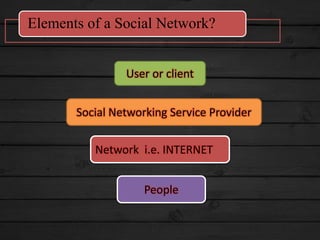
Elements of a Social Network?
User or client
Social Networking Service Provider
Network i.e. INTERNET
People
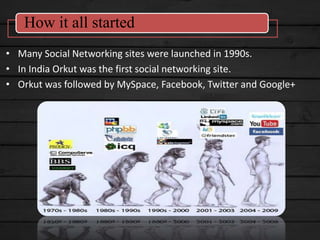
• Many Social Networking sites were launched in 1990s.
• In India Orkut was the first social networking site.
• Orkut was followed by MySpace, Facebook, Twitter and Google+
How it all started
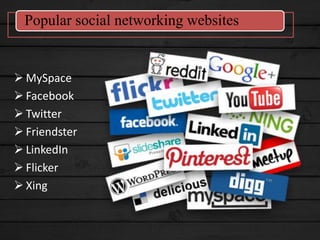
 MySpace
 Facebook
 Twitter
 Friendster
 LinkedIn
 Flicker
 Xing
Popular social networking websites
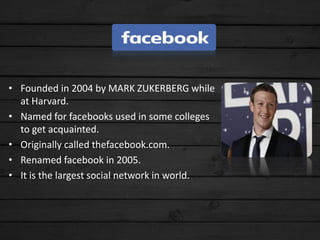
• Founded in 2004 by MARK ZUKERBERG while
at Harvard.
• Named for facebooks used in some colleges
to get acquainted.
• Originally called thefacebook.com.
• Renamed facebook in 2005.
• It is the largest social network in world.
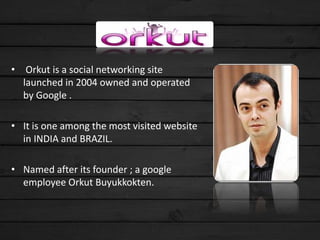
• Orkut is a social networking site
launched in 2004 owned and operated
by Google .
• It is one among the most visited website
in INDIA and BRAZIL.
• Named after its founder ; a google
employee Orkut Buyukkokten.
• Pros:
– Allows you to stay connected with friends
– Meet new people &find old friends
• Cons:
– Privacy issues
– Potential for misuse
• Overall:
– Social networking sites are a good thing if
used carefully.
What do we think ?
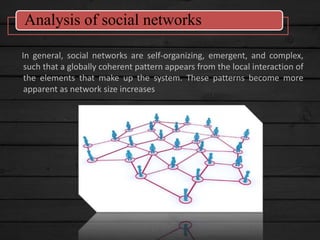
In general, social networks are self-organizing, emergent, and complex,
such that a globally coherent pattern appears from the local interaction of
the elements that make up the system. These patterns become more
apparent as network size increases
Analysis of social networks
Although levels of analysis are not necessarily mutually exclusive,
there are three general levels into which networks may fall: micro-
level, meso-level, and macro-level.
micro
meso
macro
Levels Of Analysis
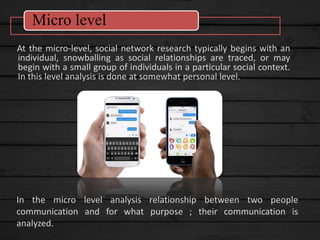
At the micro-level, social network research typically begins with an
individual, snowballing as social relationships are traced, or may
begin with a small group of individuals in a particular social context.
In this level analysis is done at somewhat personal level.
Micro level
In the micro level analysis relationship between two people
communication and for what purpose ; their communication is
analyzed.
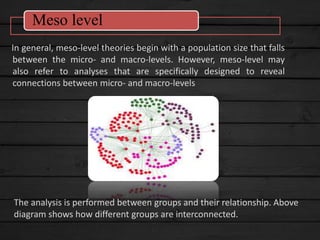
In general, meso-level theories begin with a population size that falls
between the micro- and macro-levels. However, meso-level may
also refer to analyses that are specifically designed to reveal
connections between micro- and macro-levels
Meso level
The analysis is performed between groups and their relationship. Above
diagram shows how different groups are interconnected.
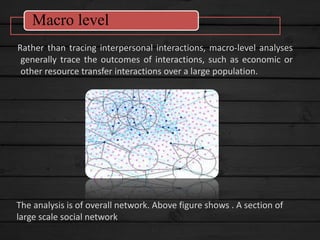
Rather than tracing interpersonal interactions, macro-level analyses
generally trace the outcomes of interactions, such as economic or
other resource transfer interactions over a large population.
Macro level
The analysis is of overall network. Above figure shows . A section of
large scale social network
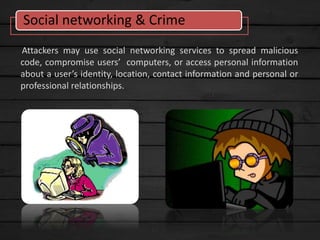
Attackers may use social networking services to spread malicious
code, compromise users’ computers, or access personal information
about a user’s identity, location, contact information and personal or
professional relationships.
Social networking & Crime
• Limit the information you put in the social networking sites.
• Don’t put personal information like your family details, addresses,
personal photographs, video, etc. In case if you put your personal
photographs try to change settings and make visible only for friends
• Be careful if you want to meet social networking friends in
personal, sometimes it may not be their true identity which is
posted on the social networking sites.
Safe Social Networking
• Always clean browser’s cookies and cache .
• Don’t ever share your password with anyone; and keep changing your
password regularly. Always use proper password (min 8 digits with a
mix of alpha numeric & special characters)
• Use Virtual Keyboard, wherever possible to enter your password for
better security as these cannot be captured by key-loggers.
Safe Social Networking
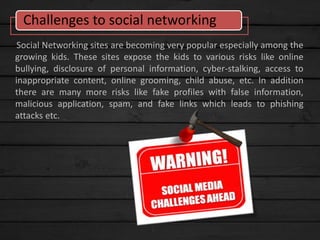
Social Networking sites are becoming very popular especially among the
growing kids. These sites expose the kids to various risks like online
bullying, disclosure of personal information, cyber-stalking, access to
inappropriate content, online grooming, child abuse, etc. In addition
there are many more risks like fake profiles with false information,
malicious application, spam, and fake links which leads to phishing
attacks etc.
Challenges to social networking
Though the social networking is beneficial, the problem that arises is
of information overload and security. Social networks, unlike the
common media, do not have a pattern as to how much information
has to be conveyed and where to draw the line.
Too much of information may confuse users. Security might be another
area of concern where people can get illegal access to a user’s
information. The future of social networking looks very promising but
still it has to deal with the problems associated with it.
Conclusion
Thank You
by :
Ashish
Saini
© Graphic Era University
All Rights Reserved

Social networking

  • 1.
  • 2.
  • 3.
    The use ofdedicated websites and applications to interact with other users, or to find people with similar interests to one's own. In fact Social networking is the practice of expanding the number of one's business and/or social contacts by making connections through individual. What is Social Network?
  • 4.
    Elements of aSocial Network? User or client Social Networking Service Provider Network i.e. INTERNET People
  • 5.
    • Many SocialNetworking sites were launched in 1990s. • In India Orkut was the first social networking site. • Orkut was followed by MySpace, Facebook, Twitter and Google+ How it all started
  • 6.
     MySpace  Facebook Twitter  Friendster  LinkedIn  Flicker  Xing Popular social networking websites
  • 7.
    • Founded in2004 by MARK ZUKERBERG while at Harvard. • Named for facebooks used in some colleges to get acquainted. • Originally called thefacebook.com. • Renamed facebook in 2005. • It is the largest social network in world.
  • 8.
    • Orkut isa social networking site launched in 2004 owned and operated by Google . • It is one among the most visited website in INDIA and BRAZIL. • Named after its founder ; a google employee Orkut Buyukkokten.
  • 9.
    • Pros: – Allowsyou to stay connected with friends – Meet new people &find old friends • Cons: – Privacy issues – Potential for misuse • Overall: – Social networking sites are a good thing if used carefully. What do we think ?
  • 10.
    In general, socialnetworks are self-organizing, emergent, and complex, such that a globally coherent pattern appears from the local interaction of the elements that make up the system. These patterns become more apparent as network size increases Analysis of social networks
  • 11.
    Although levels ofanalysis are not necessarily mutually exclusive, there are three general levels into which networks may fall: micro- level, meso-level, and macro-level. micro meso macro Levels Of Analysis
  • 12.
    At the micro-level,social network research typically begins with an individual, snowballing as social relationships are traced, or may begin with a small group of individuals in a particular social context. In this level analysis is done at somewhat personal level. Micro level In the micro level analysis relationship between two people communication and for what purpose ; their communication is analyzed.
  • 13.
    In general, meso-leveltheories begin with a population size that falls between the micro- and macro-levels. However, meso-level may also refer to analyses that are specifically designed to reveal connections between micro- and macro-levels Meso level The analysis is performed between groups and their relationship. Above diagram shows how different groups are interconnected.
  • 14.
    Rather than tracinginterpersonal interactions, macro-level analyses generally trace the outcomes of interactions, such as economic or other resource transfer interactions over a large population. Macro level The analysis is of overall network. Above figure shows . A section of large scale social network
  • 15.
    Attackers may usesocial networking services to spread malicious code, compromise users’ computers, or access personal information about a user’s identity, location, contact information and personal or professional relationships. Social networking & Crime
  • 16.
    • Limit theinformation you put in the social networking sites. • Don’t put personal information like your family details, addresses, personal photographs, video, etc. In case if you put your personal photographs try to change settings and make visible only for friends • Be careful if you want to meet social networking friends in personal, sometimes it may not be their true identity which is posted on the social networking sites. Safe Social Networking
  • 17.
    • Always cleanbrowser’s cookies and cache . • Don’t ever share your password with anyone; and keep changing your password regularly. Always use proper password (min 8 digits with a mix of alpha numeric & special characters) • Use Virtual Keyboard, wherever possible to enter your password for better security as these cannot be captured by key-loggers. Safe Social Networking
  • 18.
    Social Networking sitesare becoming very popular especially among the growing kids. These sites expose the kids to various risks like online bullying, disclosure of personal information, cyber-stalking, access to inappropriate content, online grooming, child abuse, etc. In addition there are many more risks like fake profiles with false information, malicious application, spam, and fake links which leads to phishing attacks etc. Challenges to social networking
  • 19.
    Though the socialnetworking is beneficial, the problem that arises is of information overload and security. Social networks, unlike the common media, do not have a pattern as to how much information has to be conveyed and where to draw the line. Too much of information may confuse users. Security might be another area of concern where people can get illegal access to a user’s information. The future of social networking looks very promising but still it has to deal with the problems associated with it. Conclusion
  • 21.
    Thank You by : Ashish Saini ©Graphic Era University All Rights Reserved