INTRODUCTION TO WEB 2.0  Social Networks Hugh Murphy
What we will cover   What is a social network? History Why are people members? Concerns about social networking Future of social networking
What is a social network? A social network service focuses on building online communities of people who share interests and activities, or who are interested in exploring the interests and activities of others. Most social network services are web based and provide a variety of ways for users to interact, such as e-mail and instant messaging services. (Wikipedia) web-based services that allow individuals to (1) construct a public or semi-public profile within a bounded system, (2) articulate a list of other users with whom they share a connection, and (3) view and traverse their list of connections and those made by others within the system. (Boyd & Ellison)
Seriously though…what is a social network Interactive,  online  membership community Create a profile Connect to others SHARE PEOPLE PEOPLE PEOPLE!!  (sometimes  dogs , sometimes  cats ..)
General elements of a Social Network Profile List of Friends Applications Multimedia content Privacy Control Messaging ability
History of social networking Internet facilitates differing types of communication: Email  Instant messaging Skype Ultimately, communication brings people together in communities
History of social networking SixDegrees  founded 1997 closed 2000. Evolution from existing networks, such as  professional (LinkedIN), school, (Facebook) language (Voxswap / Oxlingo) Revenue model based on advertising. Facebook attracted 132.1 million unique visitors in June 2008, compared to MySpace, which attracted 117.6 million Myspace Sold for $580 million. Facebook valued at $15 billion
All very Web 2.0 Youtube, Flickr etc were forced to add social networking element or face becoming irrelevant. Increasing possibilities for ‘mashups’ and APIs User defined content Increasing move by SNS to ‘real time web’ – following the example of twitter – e.g. Facebook buying FriendFeed, 2009
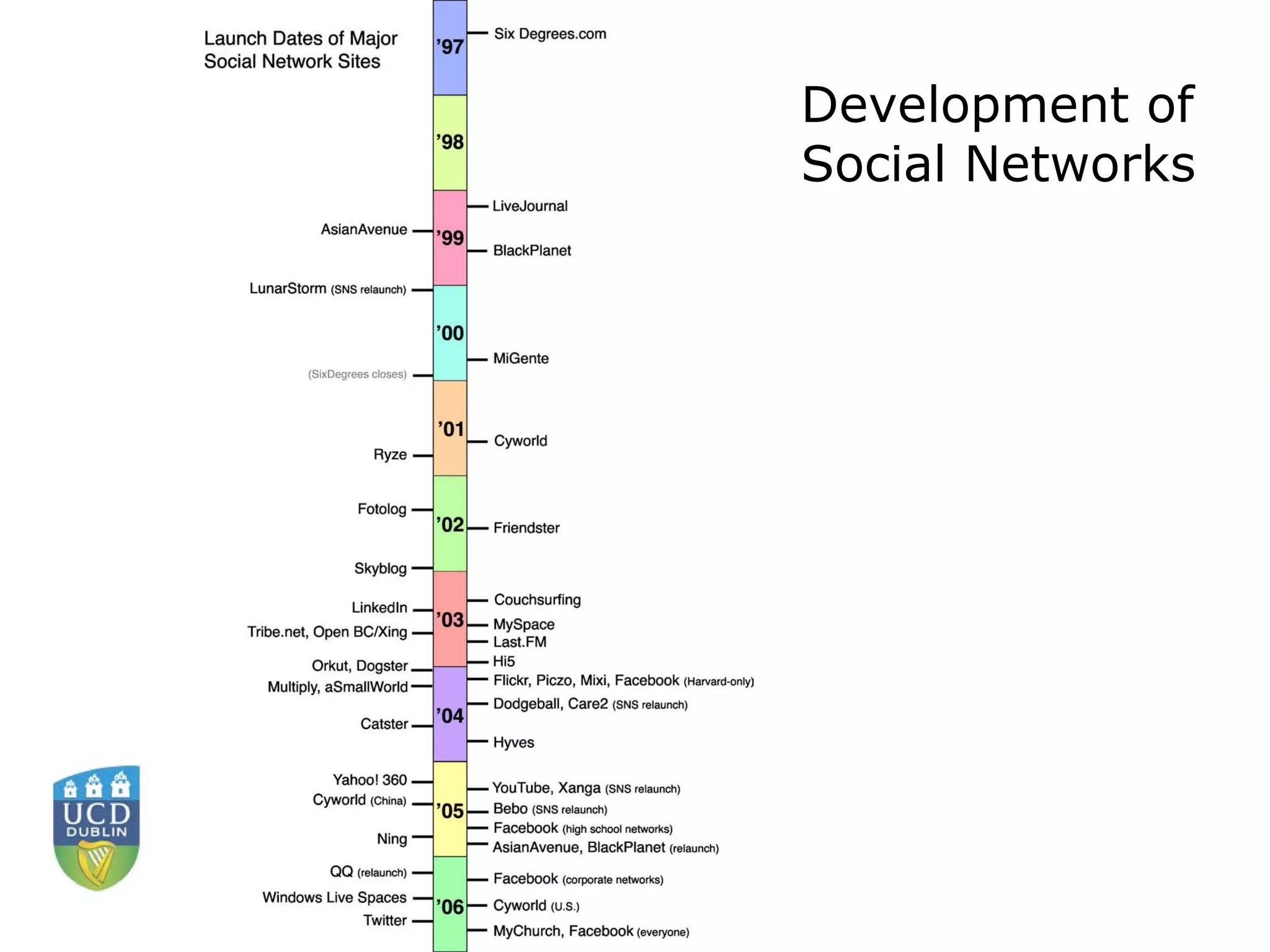
Development of  Social Networks
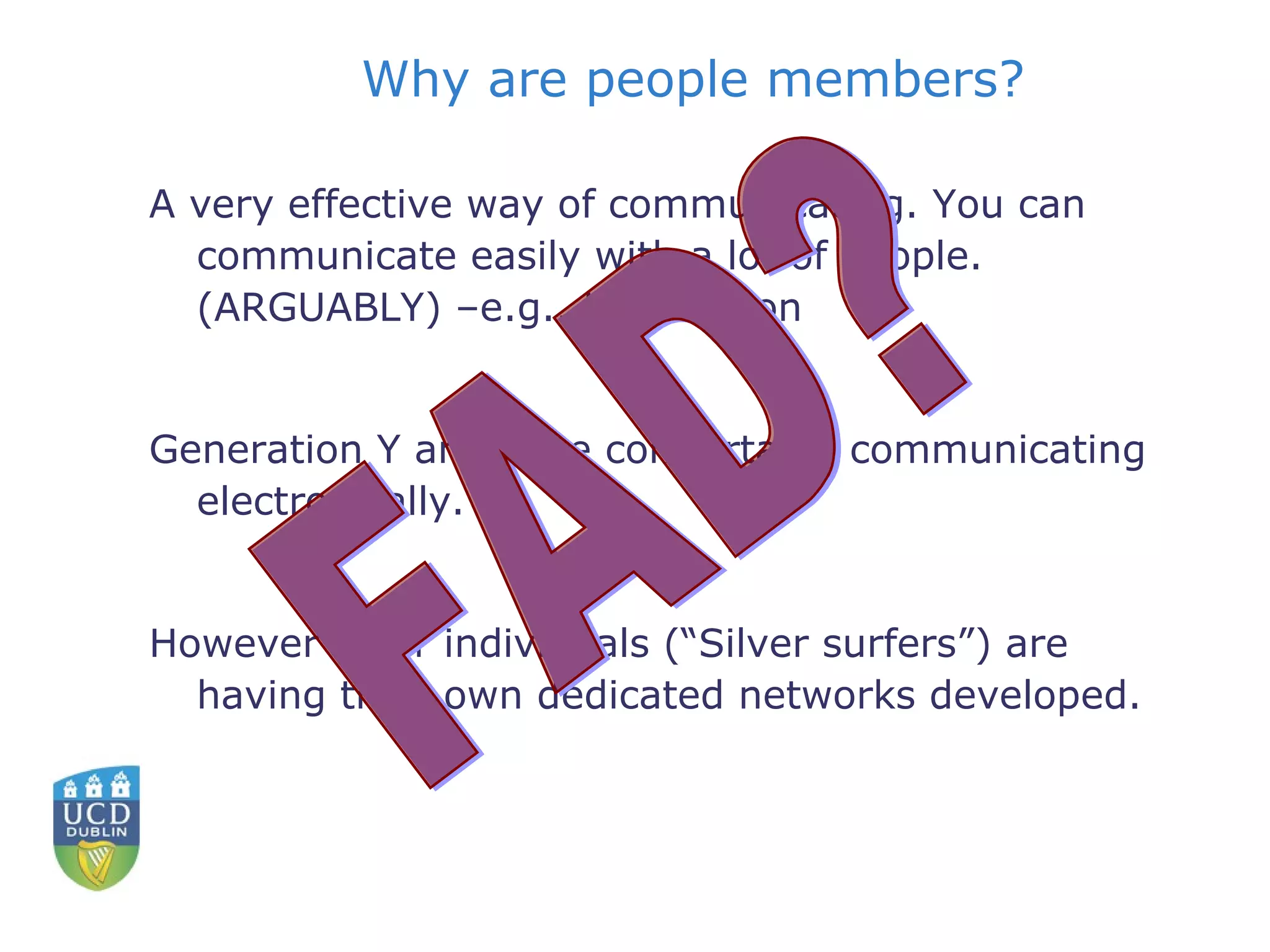
Why are people members? A very effective way of communicating. You can communicate easily with a lot of people. (ARGUABLY) –e.g.. US election Generation Y are more comfortable communicating electronically.  However older individuals (“Silver surfers”) are having their own dedicated networks developed. FAD?
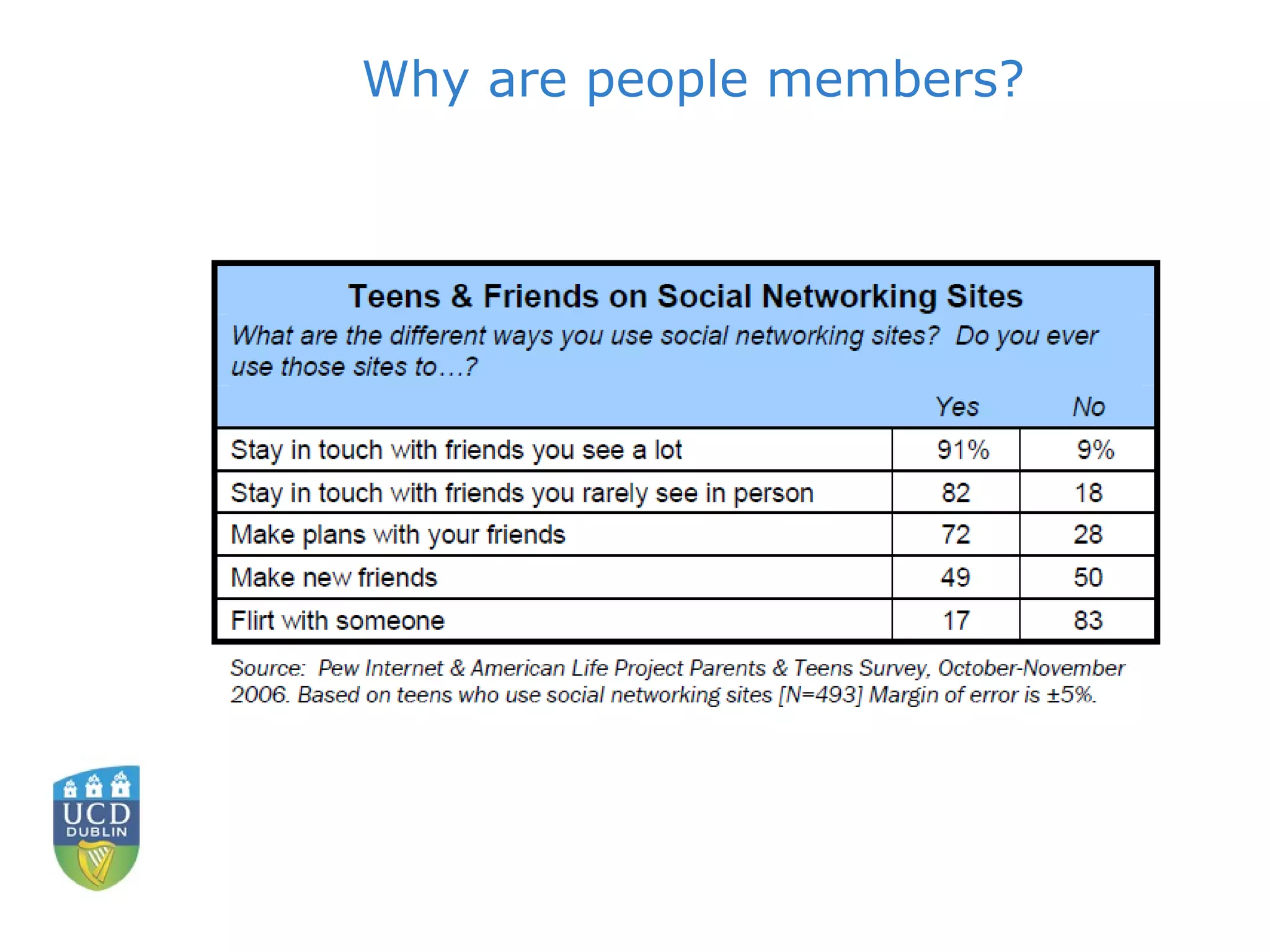
Why are people members?
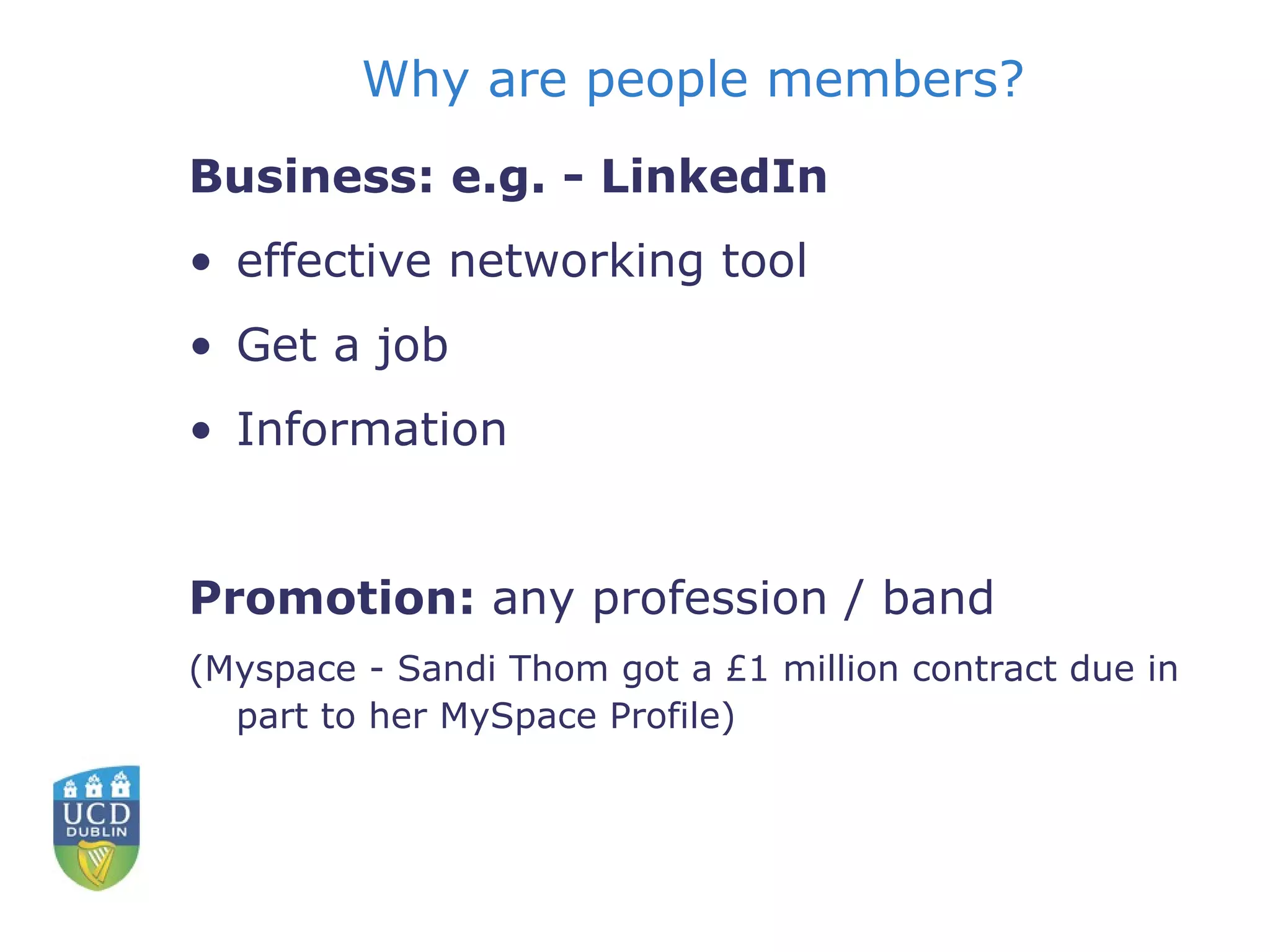
Why are people members? Business: e.g. - LinkedIn effective networking tool  Get a job Information Promotion:  any profession / band  (Myspace - Sandi Thom got a £1 million contract due in part to her MySpace Profile)
Concerns about social networking Phishing Stalking Bullying Job Seeking Trust / Privacy Cult of self celebrity
Phishing Phishing is an e-mail fraud method in which the perpetrator sends out legitimate-looking email in an attempt to gather personal and financial information from recipients. Typically, the messages appear to come from well known and trustworthy Web sites. Concerns were raised as to how the amount of publically available information on social networks would make phishing easier
Phishing A study conducted in Indiana University found that students who were approached within a social network framework  were nearly 5 times more likely to be successfully phished than students who weren't approached in that way
Stalking Social Network Sites could inadvertently facilitate children being stalked online by sexual predators.  Social Networking do work to counter this (screening applications, taking down profiles) Only way to be sure is to verify the identity of each profile. To date  this appears to have been over exaggerated in the media
Bullying Just as bullying can be a element of any social network, i.e. School. Online is no different. This has been  reported  on the BBC. This can some times have tragic  consequences .
Job Seeking In America more than one in five employers search social networking sites to screen job candidates Information about alcohol or drug use (41% of managers said this was a top concern) Inappropriate photos or information posted on a candidate's page (40%) Poor communication skills (29%) Bad-mouthing of former employers or fellow employees (28%) Inaccurate qualifications (27%) Unprofessional screen names (22%) Notes showing links to criminal behaviour (21%) Confidential information about past employers (19%)
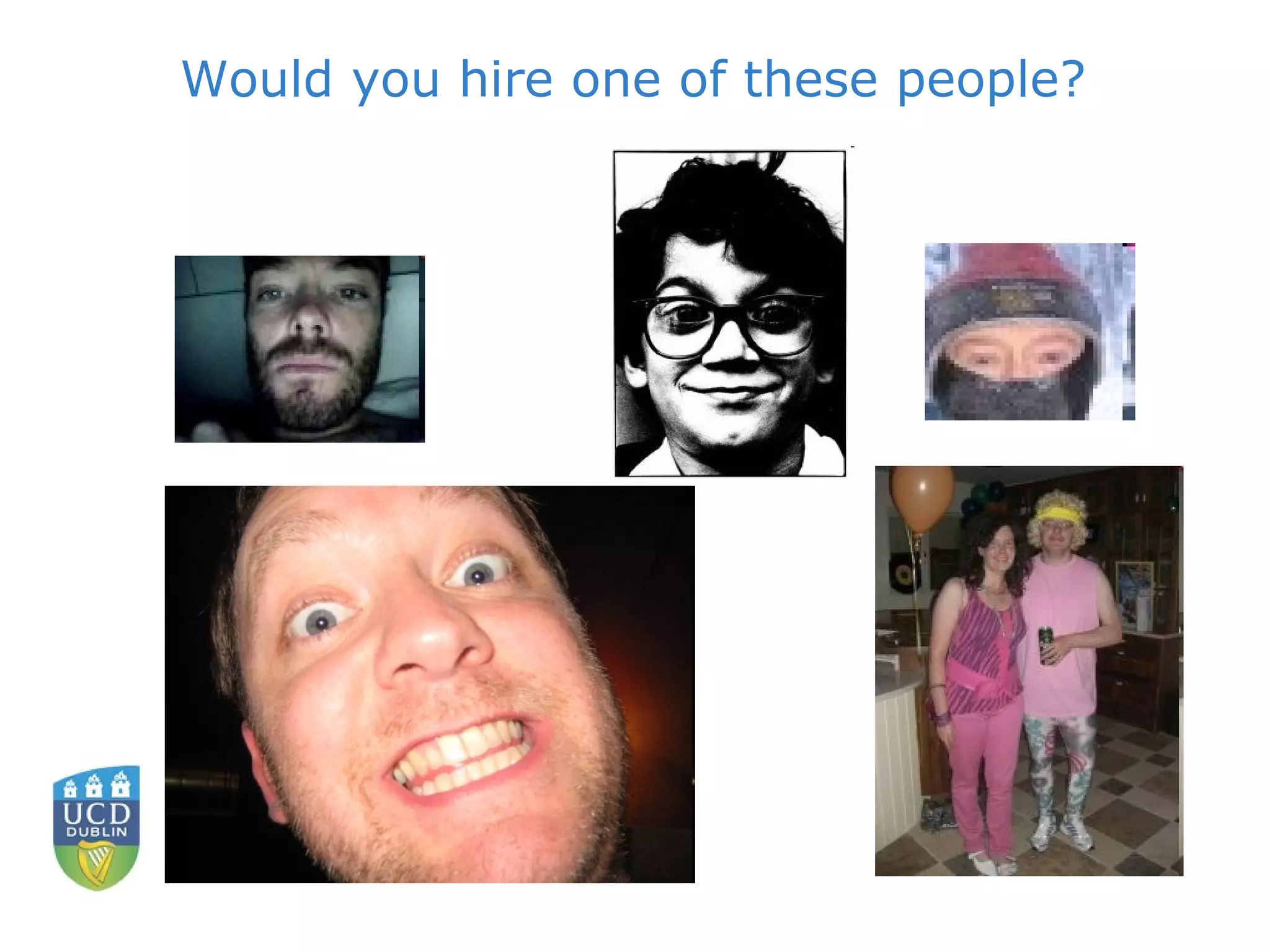
Would you hire one of these people?
Trust / Privacy Did you adjust your privacy settings? 80 – 20 rule “ Myspace Angles” Convenience v privacy Just who are you  connected to ? Who owns your content ( not you !!) Who is doing what with your information? (Advertising)
Cult of self celebrity If you have 100 friends in Facebook, are you more popular / important than the person with 7? Is everything I post important? Does it encourage narcissism? Is it impacting on our ability to relate to people? Finally I get to sit at the cool kids table! Do I actually want to?
Future of Social Networking Mobile Social Networking Social Graph –Social Capital Migration Privacy / Identity
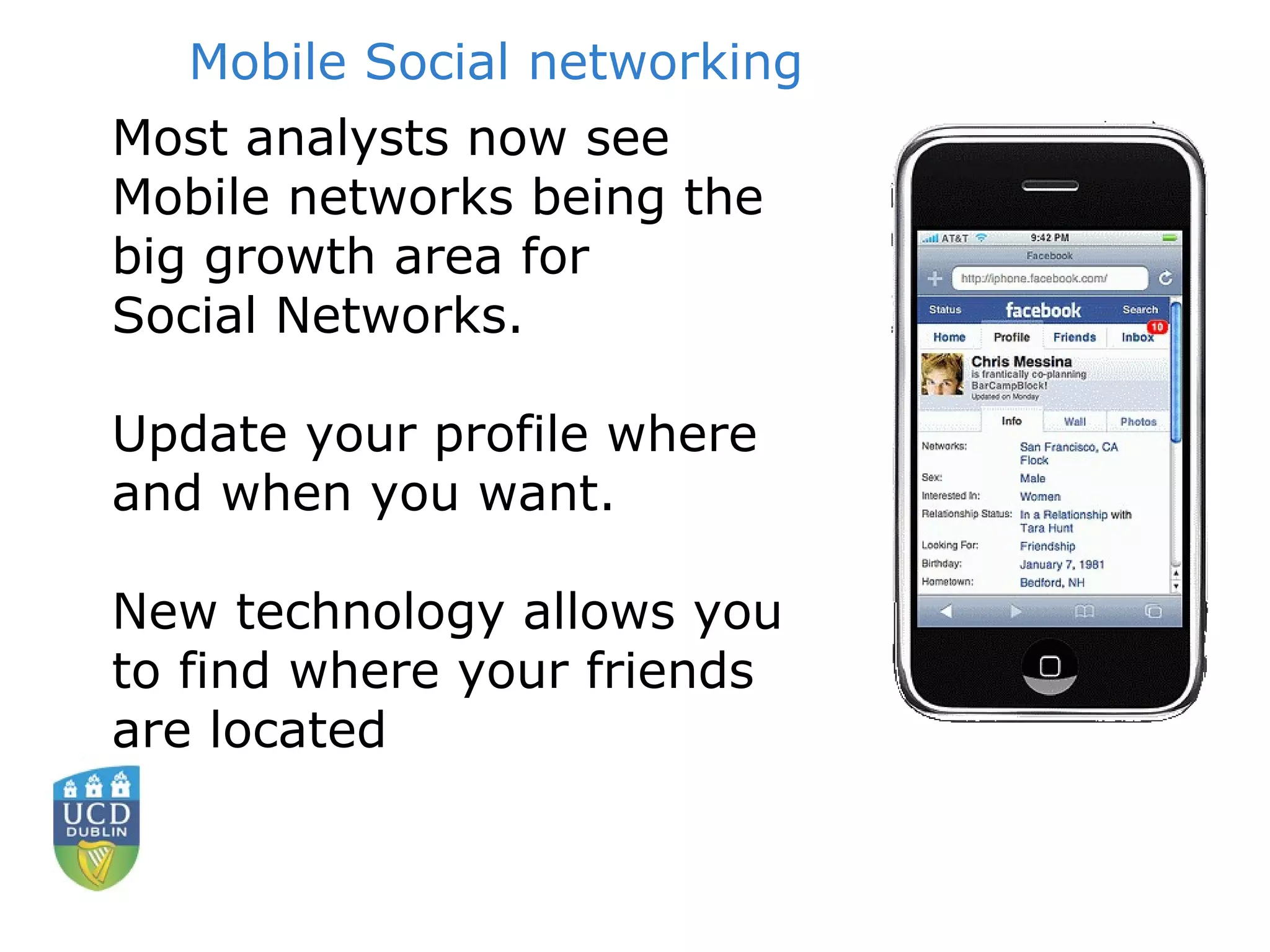
Mobile Social networking Most analysts now see  Mobile networks being the big growth area for Social Networks. Update your profile where and when you want.  New technology allows you to find where your friends are located
Migration Increasingly people can belong to more than one social network. (egg Ning!) Generally, people don’t have an over riding loyalty to one social network and will quickly move onto something new  Choice of social network can be predicated on geographic location (egg Orkut) Quite easily a popular social networking site can find itself unpopular
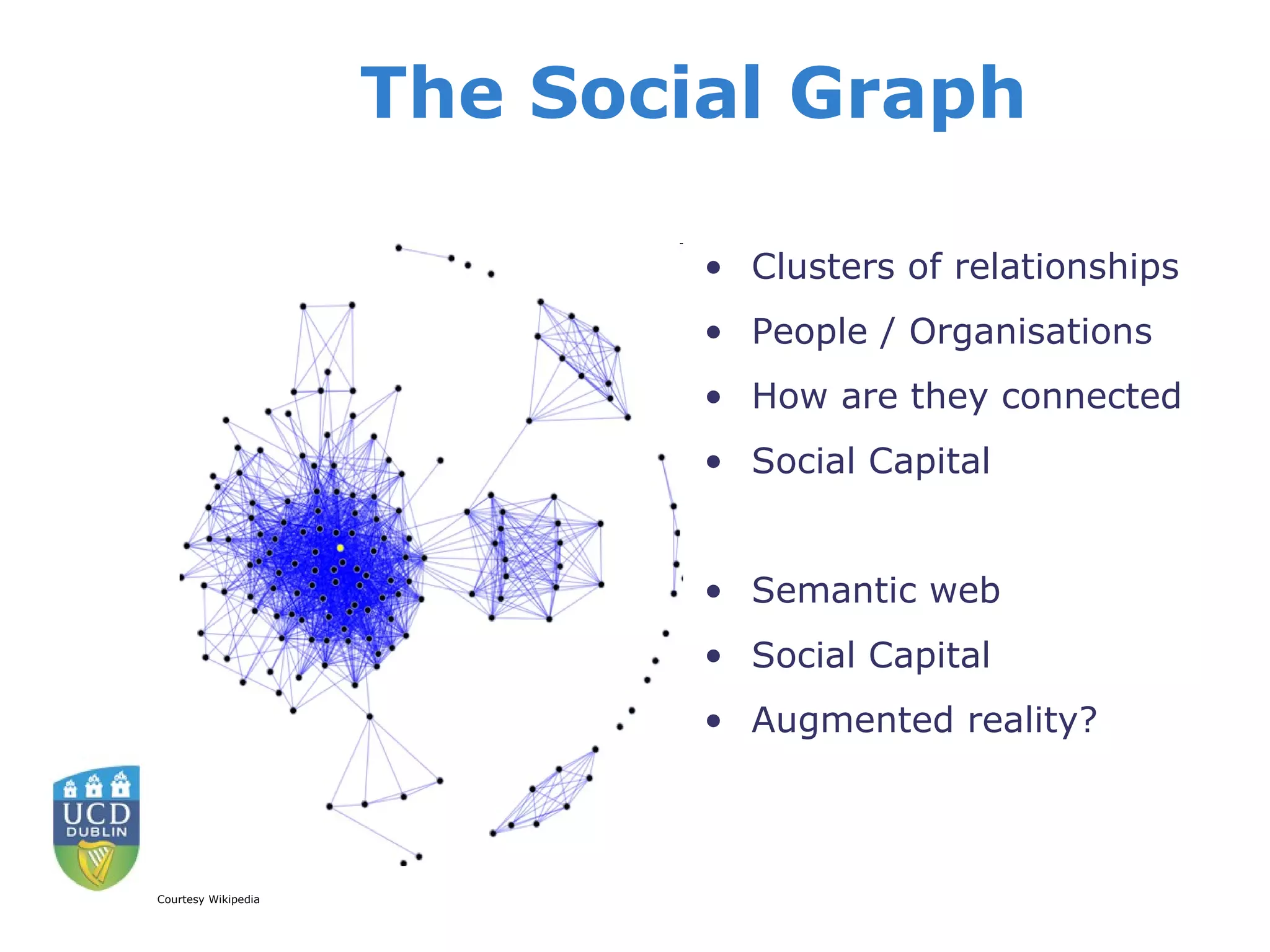
The Social Graph Clusters of relationships People / Organisations How are they connected Social Capital Semantic web Social Capital Augmented reality? Courtesy Wikipedia
Keep your identity! Need for data portability  Because you can be members of a range of different social networking sites this can mean that you have a range of different logins. The wider social network can be lost because of your different identities. Dataportability   – lets you take data and friends from one SNS to another Openid  – single sign on: allow your identity to follow you around It is possible that the rise of the semantic web will address these problems…but create more.
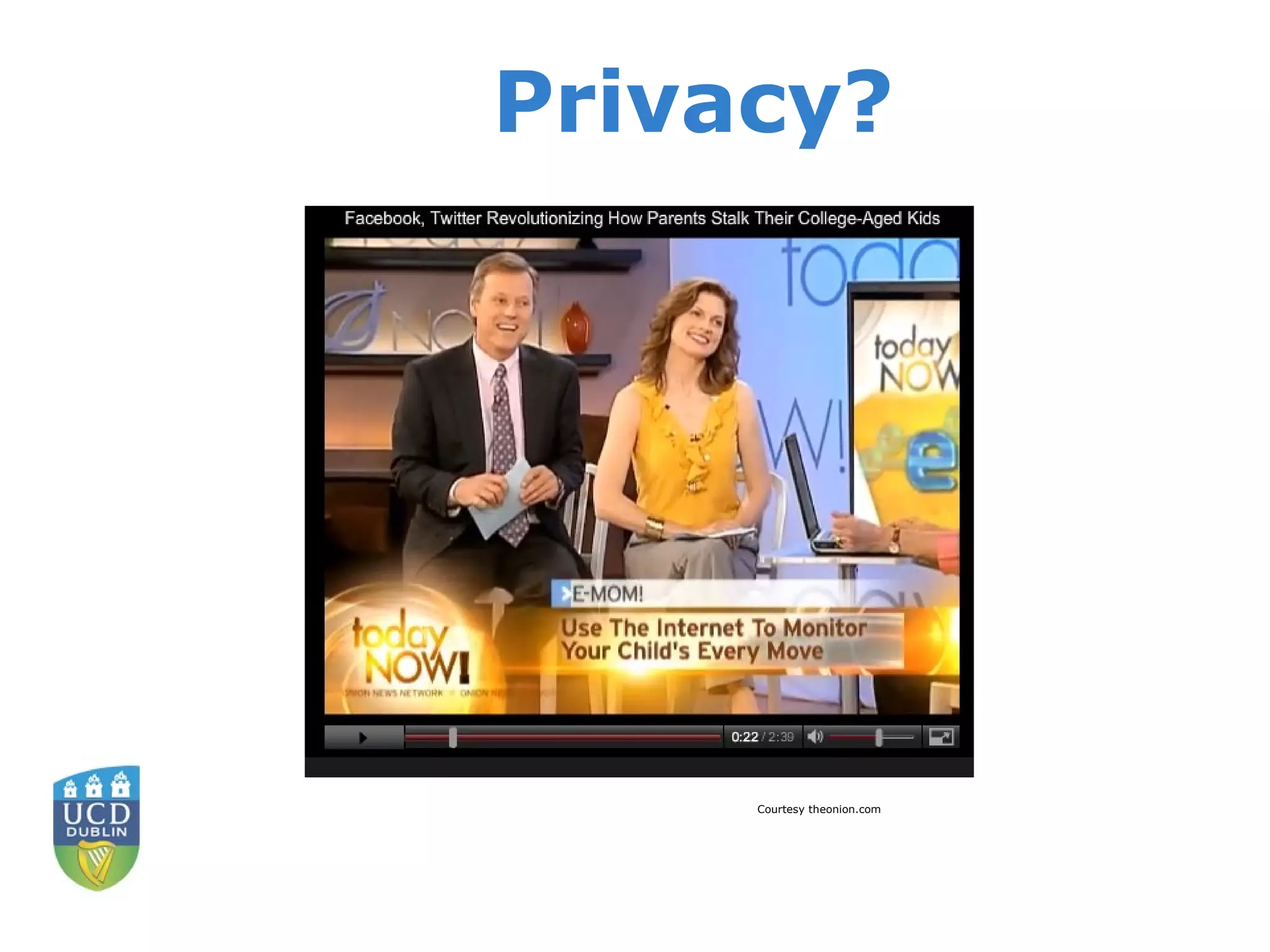
Privacy? Courtesy theonion.com

IS 20090 Week 2 - Social Networks

  • 1.
    INTRODUCTION TO WEB2.0 Social Networks Hugh Murphy
  • 2.
    What we willcover What is a social network? History Why are people members? Concerns about social networking Future of social networking
  • 3.
    What is asocial network? A social network service focuses on building online communities of people who share interests and activities, or who are interested in exploring the interests and activities of others. Most social network services are web based and provide a variety of ways for users to interact, such as e-mail and instant messaging services. (Wikipedia) web-based services that allow individuals to (1) construct a public or semi-public profile within a bounded system, (2) articulate a list of other users with whom they share a connection, and (3) view and traverse their list of connections and those made by others within the system. (Boyd & Ellison)
  • 4.
    Seriously though…what isa social network Interactive, online membership community Create a profile Connect to others SHARE PEOPLE PEOPLE PEOPLE!! (sometimes dogs , sometimes cats ..)
  • 5.
    General elements ofa Social Network Profile List of Friends Applications Multimedia content Privacy Control Messaging ability
  • 6.
    History of socialnetworking Internet facilitates differing types of communication: Email Instant messaging Skype Ultimately, communication brings people together in communities
  • 7.
    History of socialnetworking SixDegrees founded 1997 closed 2000. Evolution from existing networks, such as professional (LinkedIN), school, (Facebook) language (Voxswap / Oxlingo) Revenue model based on advertising. Facebook attracted 132.1 million unique visitors in June 2008, compared to MySpace, which attracted 117.6 million Myspace Sold for $580 million. Facebook valued at $15 billion
  • 8.
    All very Web2.0 Youtube, Flickr etc were forced to add social networking element or face becoming irrelevant. Increasing possibilities for ‘mashups’ and APIs User defined content Increasing move by SNS to ‘real time web’ – following the example of twitter – e.g. Facebook buying FriendFeed, 2009
  • 9.
    Development of Social Networks
  • 10.
    Why are peoplemembers? A very effective way of communicating. You can communicate easily with a lot of people. (ARGUABLY) –e.g.. US election Generation Y are more comfortable communicating electronically. However older individuals (“Silver surfers”) are having their own dedicated networks developed. FAD?
  • 11.
  • 12.
    Why are peoplemembers? Business: e.g. - LinkedIn effective networking tool Get a job Information Promotion: any profession / band (Myspace - Sandi Thom got a £1 million contract due in part to her MySpace Profile)
  • 13.
    Concerns about socialnetworking Phishing Stalking Bullying Job Seeking Trust / Privacy Cult of self celebrity
  • 14.
    Phishing Phishing isan e-mail fraud method in which the perpetrator sends out legitimate-looking email in an attempt to gather personal and financial information from recipients. Typically, the messages appear to come from well known and trustworthy Web sites. Concerns were raised as to how the amount of publically available information on social networks would make phishing easier
  • 15.
    Phishing A studyconducted in Indiana University found that students who were approached within a social network framework were nearly 5 times more likely to be successfully phished than students who weren't approached in that way
  • 16.
    Stalking Social NetworkSites could inadvertently facilitate children being stalked online by sexual predators. Social Networking do work to counter this (screening applications, taking down profiles) Only way to be sure is to verify the identity of each profile. To date this appears to have been over exaggerated in the media
  • 17.
    Bullying Just asbullying can be a element of any social network, i.e. School. Online is no different. This has been reported on the BBC. This can some times have tragic consequences .
  • 18.
    Job Seeking InAmerica more than one in five employers search social networking sites to screen job candidates Information about alcohol or drug use (41% of managers said this was a top concern) Inappropriate photos or information posted on a candidate's page (40%) Poor communication skills (29%) Bad-mouthing of former employers or fellow employees (28%) Inaccurate qualifications (27%) Unprofessional screen names (22%) Notes showing links to criminal behaviour (21%) Confidential information about past employers (19%)
  • 19.
    Would you hireone of these people?
  • 20.
    Trust / PrivacyDid you adjust your privacy settings? 80 – 20 rule “ Myspace Angles” Convenience v privacy Just who are you connected to ? Who owns your content ( not you !!) Who is doing what with your information? (Advertising)
  • 21.
    Cult of selfcelebrity If you have 100 friends in Facebook, are you more popular / important than the person with 7? Is everything I post important? Does it encourage narcissism? Is it impacting on our ability to relate to people? Finally I get to sit at the cool kids table! Do I actually want to?
  • 22.
    Future of SocialNetworking Mobile Social Networking Social Graph –Social Capital Migration Privacy / Identity
  • 23.
    Mobile Social networkingMost analysts now see Mobile networks being the big growth area for Social Networks. Update your profile where and when you want. New technology allows you to find where your friends are located
  • 24.
    Migration Increasingly peoplecan belong to more than one social network. (egg Ning!) Generally, people don’t have an over riding loyalty to one social network and will quickly move onto something new Choice of social network can be predicated on geographic location (egg Orkut) Quite easily a popular social networking site can find itself unpopular
  • 25.
    The Social GraphClusters of relationships People / Organisations How are they connected Social Capital Semantic web Social Capital Augmented reality? Courtesy Wikipedia
  • 26.
    Keep your identity!Need for data portability Because you can be members of a range of different social networking sites this can mean that you have a range of different logins. The wider social network can be lost because of your different identities. Dataportability – lets you take data and friends from one SNS to another Openid – single sign on: allow your identity to follow you around It is possible that the rise of the semantic web will address these problems…but create more.
  • 27.

Editor's Notes

  • #4 Add another quote here - simpler