Agility, retrospectives and
human relationships
DrupalCamp Baltics 2017
Very briefly about me
● Perttu Ehn
https://www.drupal.org/u/rpsu
@ropsue
● Competence manager at Exove Ltd www.exove.com
● 11 years of Drupal, contrib module maintainer.
● A scout since 35 years. Leadership trainer.
Topics covered in this session
● Agility - via lens of one typical sprint @ Exove
● Retrospective - what and why
● Human relationships - why does it matter
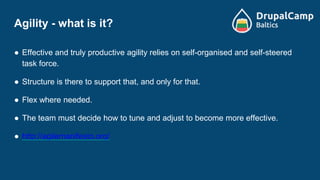
Agility - what is it?
● Business needs first -approach
● Small frequent releases
● Work side by side (client, developers)
● Empower everyone, embrace ownership
● Prefer direct conversations, F2F
● Simplicity! Less work = more value.
Agility - what is it?
● Effective and truly productive agility relies on self-organised and self-steered
task force.
● Structure is there to support that, and only for that.
● Flex where needed.
● The team must decide how to tune and adjust to become more effective.
● http://agilemanifesto.org/
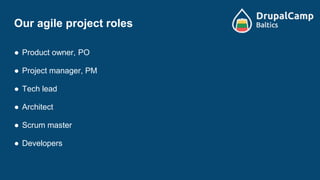
Our agile project roles
● Product owner, PO
● Project manager, PM
● Tech lead
● Architect
● Scrum master
● Developers
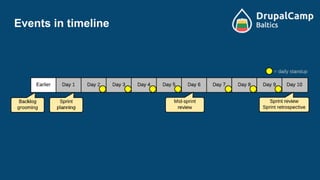
Events
● Work in 2 week long sprints
○ Backlog grooming
○ Sprint planning
○ Daily standup
○ (Mid-sprint review)
○ Sprint review
○ Sprint retrospective
Events in timeline
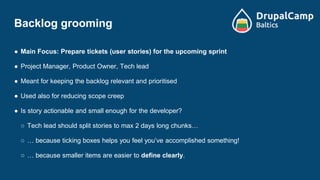
Backlog grooming
● Main Focus: Prepare tickets (user stories) for the upcoming sprint
● Project Manager, Product Owner, Tech lead
● Meant for keeping the backlog relevant and prioritised
● Used also for reducing scope creep
● Is story actionable and small enough for the developer?
○ Tech lead should split stories to max 2 days long chunks…
○ … because ticking boxes helps you feel you’ve accomplished something!
○ … because smaller items are easier to define clearly.
Sprint planning
● Main Focus: Define sprint goal, build sprint backlog
● Product owner describes the highest priority features.
● The team (!) decides what they want to achieve during the sprint, write it
together with Product owner.
● Backlog building == The team picks tasks/issues/user stories/whatever you
have -items to work on to fulfil sprint goal.
Daily standup (a.k.a daily scrum meeting)
● Every day at the same time (morning)
● Scrum master runs the show
● Keep standing through the meeting
● Everyone answers these questions briefly:
1. What did I achieve yesterday?
2. What will I achieve today?
3. What is blocking me?
Sprint review
● What have we achieved, time to be proud!
● Prepare something to show to the Product Owner
● The success of the sprint is evaluated against the sprint goal (not against items
in the backlog).
Retrospective - what and why
● Time when the team can freely talk about the good and the bad in the sprint
● It’s important that the atmosphere is open and honest.
● Main questions to discuss: What team should
1. start doing,
2. stop doing and
3. continue doing
● Improving the working culture!
● Identify an actionable change, an improvement that can be reached during the next sprint. Repeat.
Human relationships - why does it matter
● “It’s important that the atmosphere is open and honest.”
● Groups of people do not form a highly performant team on their own, except in
fairly rare cases (17 %).
● More than half of the groups fail to fulfil their expected goals.
● Highly performant teams produce much more, and of a better quality.
● High performance translates to €€€ very easily.
Group process
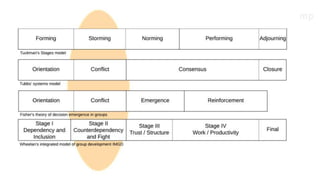
● Several studies and lots of research on this since 1940’s
● Several models, but in overall most of them are well aligned
● But…
Stage I Dependency and Inclusion
● Dependency on the designated leader
● Concerns about safety and about feeling included in the group.
● Fear of rejection.
● Members rely on the leader and powerful group members to provide direction.
● Group goal possible unclear, but members won’t try to clarify it.
● Group assumes consensus about groups goal (!).
● Sign of this stage: Leader asks a question but no-one answers.
Stage II Counterdependency and Fight
● Disagreements on group goals and procedures, roles - clarification process
starts.
● Conflict is inevitable.
● Conflict is a positive sign of groups process!
● Conflict resolution is necessary for the establishment of trust and a climate in
which members feel free to disagree with each other.
● Interpersonal conflicts may stop group process - focus on group goals.
Stage III Trust / Structure
● Increase of trust and commitment to the group.
● Willingness to cooperate increase.
● More open and task-oriented, “professional” communication.
● Focus from power, status and influence issues to work tasks.
● More mature negotiations about roles, organisation, and procedures.
● Leader’s role changes to more consultative role
● Cohesion and member satisfaction increases
Stage IV Work / Productivity
● It is rare to have opportunity to be in a group in this stage!
● Group performance is really high, both in quality and quantity.
● Team’s goals, group roles and individual statuses are clear and accepted.
● Group uses members skills efficiently.
● Team expects to be successful.
● Team encourages innovation.
● Team norms encourage high performance and quality.
Using group process as a tool
● Make conscious choice if investing in group process makes sense.
1. Either keep group in Inclusion -phase…
○ rotate group members regularly
○ keep focus purely in tasks at hand, not in interpersonal relationships
○ keep short, task -focused meetings, no hanging around!
○ (This is a good idea in various situations!)
2. … or help group evolve!
In stage I: Focus on inclusion
● To feel included, people want to feel
○ Significant - feeling of being noticed and personal needs covered (food,
space, etc.).
○ Competent - feeling of being listened to, ones expressed opinions are
listened to.
○ Loved - feeling of been paid attention to, acknowledged, given feedback to.
In stage II: Focus on openness and trust
● Value and express gratitude.
● Be constructive. Use structural feedback tools if necessary.
● Focus on work issues, avoid conflicts based on personality or incompatibility
issues.
● Remember this is positive sign of group development.
● Be patient.
How to help teams to self-evolve?
● Educate people about group process (science -backed, no snake oil magic)
● Do not get fooled by “rock climbing helps your team” -claims.
○ In a context of group performance - inefficient.
● Give and ask feedback. Lot’s of it. Repeat. Repeat. Repeat.
● Enough space and mandate to work the task.
How to help teams to self-evolve?
● Ask team to set its own goals. Works well at any stage!
○ In essence this way you hand over ownership of the team evolvement to the
group members.
● Patience. Group process takes time.
Recap
● Agility - via lens of one typical sprint @ Exove
● Retrospective - what and why
● Human relationships - why does it matter
Questions?
Thank you!
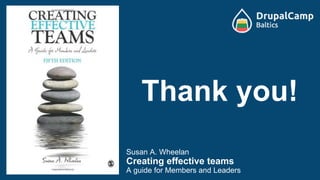
Susan A. Wheelan
Creating effective teams
A guide for Members and Leaders

Agility, retrospectives and human relationships

  • 1.
    Agility, retrospectives and humanrelationships DrupalCamp Baltics 2017
  • 2.
    Very briefly aboutme ● Perttu Ehn https://www.drupal.org/u/rpsu @ropsue ● Competence manager at Exove Ltd www.exove.com ● 11 years of Drupal, contrib module maintainer. ● A scout since 35 years. Leadership trainer.
  • 3.
    Topics covered inthis session ● Agility - via lens of one typical sprint @ Exove ● Retrospective - what and why ● Human relationships - why does it matter
  • 4.
    Agility - whatis it? ● Business needs first -approach ● Small frequent releases ● Work side by side (client, developers) ● Empower everyone, embrace ownership ● Prefer direct conversations, F2F ● Simplicity! Less work = more value.
  • 5.
    Agility - whatis it? ● Effective and truly productive agility relies on self-organised and self-steered task force. ● Structure is there to support that, and only for that. ● Flex where needed. ● The team must decide how to tune and adjust to become more effective. ● http://agilemanifesto.org/
  • 6.
    Our agile projectroles ● Product owner, PO ● Project manager, PM ● Tech lead ● Architect ● Scrum master ● Developers
  • 7.
    Events ● Work in2 week long sprints ○ Backlog grooming ○ Sprint planning ○ Daily standup ○ (Mid-sprint review) ○ Sprint review ○ Sprint retrospective
  • 8.
  • 9.
    Backlog grooming ● MainFocus: Prepare tickets (user stories) for the upcoming sprint ● Project Manager, Product Owner, Tech lead ● Meant for keeping the backlog relevant and prioritised ● Used also for reducing scope creep ● Is story actionable and small enough for the developer? ○ Tech lead should split stories to max 2 days long chunks… ○ … because ticking boxes helps you feel you’ve accomplished something! ○ … because smaller items are easier to define clearly.
  • 10.
    Sprint planning ● MainFocus: Define sprint goal, build sprint backlog ● Product owner describes the highest priority features. ● The team (!) decides what they want to achieve during the sprint, write it together with Product owner. ● Backlog building == The team picks tasks/issues/user stories/whatever you have -items to work on to fulfil sprint goal.
  • 11.
    Daily standup (a.k.adaily scrum meeting) ● Every day at the same time (morning) ● Scrum master runs the show ● Keep standing through the meeting ● Everyone answers these questions briefly: 1. What did I achieve yesterday? 2. What will I achieve today? 3. What is blocking me?
  • 12.
    Sprint review ● Whathave we achieved, time to be proud! ● Prepare something to show to the Product Owner ● The success of the sprint is evaluated against the sprint goal (not against items in the backlog).
  • 13.
    Retrospective - whatand why ● Time when the team can freely talk about the good and the bad in the sprint ● It’s important that the atmosphere is open and honest. ● Main questions to discuss: What team should 1. start doing, 2. stop doing and 3. continue doing ● Improving the working culture! ● Identify an actionable change, an improvement that can be reached during the next sprint. Repeat.
  • 14.
    Human relationships -why does it matter
  • 15.
    Human relationships -why does it matter ● “It’s important that the atmosphere is open and honest.” ● Groups of people do not form a highly performant team on their own, except in fairly rare cases (17 %). ● More than half of the groups fail to fulfil their expected goals. ● Highly performant teams produce much more, and of a better quality. ● High performance translates to €€€ very easily.
  • 16.
    Group process ● Severalstudies and lots of research on this since 1940’s ● Several models, but in overall most of them are well aligned ● But…
  • 18.
    Stage I Dependencyand Inclusion ● Dependency on the designated leader ● Concerns about safety and about feeling included in the group. ● Fear of rejection. ● Members rely on the leader and powerful group members to provide direction. ● Group goal possible unclear, but members won’t try to clarify it. ● Group assumes consensus about groups goal (!). ● Sign of this stage: Leader asks a question but no-one answers.
  • 19.
    Stage II Counterdependencyand Fight ● Disagreements on group goals and procedures, roles - clarification process starts. ● Conflict is inevitable. ● Conflict is a positive sign of groups process! ● Conflict resolution is necessary for the establishment of trust and a climate in which members feel free to disagree with each other. ● Interpersonal conflicts may stop group process - focus on group goals.
  • 20.
    Stage III Trust/ Structure ● Increase of trust and commitment to the group. ● Willingness to cooperate increase. ● More open and task-oriented, “professional” communication. ● Focus from power, status and influence issues to work tasks. ● More mature negotiations about roles, organisation, and procedures. ● Leader’s role changes to more consultative role ● Cohesion and member satisfaction increases
  • 21.
    Stage IV Work/ Productivity ● It is rare to have opportunity to be in a group in this stage! ● Group performance is really high, both in quality and quantity. ● Team’s goals, group roles and individual statuses are clear and accepted. ● Group uses members skills efficiently. ● Team expects to be successful. ● Team encourages innovation. ● Team norms encourage high performance and quality.
  • 22.
    Using group processas a tool ● Make conscious choice if investing in group process makes sense. 1. Either keep group in Inclusion -phase… ○ rotate group members regularly ○ keep focus purely in tasks at hand, not in interpersonal relationships ○ keep short, task -focused meetings, no hanging around! ○ (This is a good idea in various situations!) 2. … or help group evolve!
  • 23.
    In stage I:Focus on inclusion ● To feel included, people want to feel ○ Significant - feeling of being noticed and personal needs covered (food, space, etc.). ○ Competent - feeling of being listened to, ones expressed opinions are listened to. ○ Loved - feeling of been paid attention to, acknowledged, given feedback to.
  • 24.
    In stage II:Focus on openness and trust ● Value and express gratitude. ● Be constructive. Use structural feedback tools if necessary. ● Focus on work issues, avoid conflicts based on personality or incompatibility issues. ● Remember this is positive sign of group development. ● Be patient.
  • 25.
    How to helpteams to self-evolve? ● Educate people about group process (science -backed, no snake oil magic) ● Do not get fooled by “rock climbing helps your team” -claims. ○ In a context of group performance - inefficient. ● Give and ask feedback. Lot’s of it. Repeat. Repeat. Repeat. ● Enough space and mandate to work the task.
  • 26.
    How to helpteams to self-evolve? ● Ask team to set its own goals. Works well at any stage! ○ In essence this way you hand over ownership of the team evolvement to the group members. ● Patience. Group process takes time.
  • 27.
    Recap ● Agility -via lens of one typical sprint @ Exove ● Retrospective - what and why ● Human relationships - why does it matter
  • 28.
  • 29.
    Thank you! Susan A.Wheelan Creating effective teams A guide for Members and Leaders

Editor's Notes

  • #5  Simplicity --the art of maximizing the amount  of work not done--is essential.
  • #7  PO makes product related decisions. Owns the backlog. PM takes care we’ll stay within the scope (no bloating!) TL is the lead developer in Exove’s project team. Builds the project backlog. Owns the backlog. Architect helps TL for planning, but doesn’t implement Scrum master owns sprint backlog, manages Sprints, takes care of team (blockers), facilitates tech/non-tech PO/PM, runs sprint events DEV deliver solutions. escalate blockers or unclear, especially changing requirements.
  • #8 Backlog grooming - PM, PO, TL Sprint retrospective - maybe just the DEV team
  • #11  The sprint goal can be used as a quick report to those outside of the project.
  • #12 Standing (it keeps talks short, max 15 min - and it is good for your physics)
  • #17 Look for words “Group development” (or “Group dynamics”)
  • #18 https://en.wikipedia.org/wiki/Group_development
  • #20 Conflict is an inevitable part of this process. Group's task is to develop a unified set of goals, values, and operational procedures - which generates conflict.
  • #21 Leader’s role changes from giving directives to more consultative role
  • #23 Stage I Dependency and Inclusion really good idea when … flight crew - avoid conflicts in the cockpit short projects - no point investing if time prevents benefitting of performing group
  • #24 (Stage I Dependency and Inclusion) Will Schutz/FIRO Opposite of being loved is being ignored.
  • #25 (Stage I Dependency and Inclusion) Will Schutz/FIRO Opposite of being loved is being ignored.
  • #26 Fun or distasteful… no evidence it facilitates changes in team process!
  • #27 stage 1-2: 2..4 months stage 3: 4…6 months stage 4: 6..7 months IF EVERYTHING GOES AS USUAL