Protect your
—end users
WEAKEST
SECURITY LINK
A GUIDE TO DEFENDING AGAINST SOCIAL ENGINEERING ATTACKS
Protect your weakest security link—end users 1
2015 MARKED AN IMPORTANT YEAR
in the world of network security. For
the first time, social engineering attacks
outnumbered attacks on software
vulnerabilities and exploits. This is a
serious problem.
For companies to stay productive,
they need employees to be able to
work from anywhere on any device,
often collaborating with people
around the world. This mobility drives
not only the need for secure file
sharing and email accounts but also
a fundamental shift in our approach
to computer security.
Since January 2015, the number of
victims identified by the FBI has
increased 270%, costing businesses
more than $2.3 billion1
. The message
to network security professionals is
clear.Hackersaretargetingtheweakest
link in any security perimeter—the
end user.
This book is your guide to helping you
detect and prevent social engineering
attacks,andtobetterunderstandhow
to defend your company from what
has grown to become the dominant
global cyberthreat.
AMATEURS
HACK COMPUTERS.
PROFESSIONALS
HACK HUMANS.
Protect your weakest security link—end users 2
Social engineering happens
when someone uses manipu-
lation, influence or deception
to get another person to release
information or to perform some sort
of action that benefits a hacker.
Hackers will often take advantage
of genuine security gaps in your
network. But at organizations of any
size, layers of sophisticated computer
security can be undone in seconds
because one employee—whether
because of trust, lack of awareness,
or carelessness—reveals company
information to someone with
malicious intent.
Your employees could be tricked into
anything from allowing someone to
tailgate them into your data center
to giving up their passwords or user
IDs over the phone. Social engineers
go to great lengths to gain access to
data they can exploit, such as:
PERSONAL INFO
passwords, account numbers
COMPANY INFO
phone lists, identity badges
SERVER INFO
servers, networks, non-public URLs
Familiarizing yourself with social
engineering techniques is your first
line of defense.
SOCIAL
ENGINEERING?
what is
So,what does a social
engineer sound like?
“This is Kevin from IT. We've been notified of a virus
on your department’s machines.”
One of the most common scams—a hacker poses
as an IT help desk worker to glean sensitive info
such asapasswordsfromanunsuspectingemployee.
“Hi, I’m the service tech from HP and I think Ellen is
expecting me at 1pm.”
This is why it’s so important that well-meaning staff
members and other insiders need to be educated
as to how and why they could be targeted—and
what to do if they suspect a potential threat.
“Oh! Wait, could you please hold the door?
I left my key/access card in my car.”
Peoplewanttobehelpful,andtheyoftendownplay
the risks of engaging with someone they don’t
know—and that can be a perilous mix.
ON THE PHONE
AT THE RECEPTION DESK
AT THE BUILDING ENTRANCE
You might believe that social engineers
wouldbeeasytospot.Butoftenenough,
they sound like people you run into at
work every day.
Protect your weakest security link—end users 3
SPEAR
PHISHING
Spear phishing is a targeted email
attack in which a hacker uses email to
masquerade as someone the target
knowsandtrusts.Thisisoftenas simple
as copying the name of a CEO from a
company website and then sending
an email using this name to anyone
on the company’s corporate domain.
Spear phishing is the single most
common (and effective) social engineer-
ing tactic. You’ve likely seen subject
lines like these before and hopefully
hit “delete” right away:
"Notice of pending layoff: Click here
to register for severance pay."
"Inanefforttocutcosts,we’resending
this year’s W-2s electronically."
But hackers are getting more
convincing and creative with email
that, when opened, infects your
machine. Here are a few tactics to
watch for…
USING THE NEWS AGAINST
YOU – Whatever’s getting attention
in the news can be used as social
engineering lures. For example, 2016
has seen a rise in the number of
spam messages related to the
presidential campaign.
ABUSING FAITH IN SOCIAL
NETWORKING SITES – Millions
of people use social networking
sites like Facebook and LinkedIn
daily, so they develop a certain trust
in them. Then, when an email says,
“Your Facebook account is undergoing
routine maintenance, please click to
update your information,” you don’t
think twice before you click.
tactic
no.
1
Protect your weakest security link—end users 4
Dumpster diving is exactly what it
sounds like: A hacker digs through the
trash that unsuspecting employees
have thrown away. Valuable finds
might include:
Junk mail (especially credit card
offers), which can contain personal
identification info that’s just the ticket
to identity theft.
Company phone lists and org
charts that offer numbers and locations
that make it easier to impersonate
management-level team members.
Corporate letterhead that can
be used to fake official-looking
correspondence.
Hackers will also buy refurbished
computers and will pull confidential
information from hard drives, even
after users think they have deleted it.
DUMPSTER
DIVING
tactic
no.
2
Protect your weakest security link—end users 5
SOCIAL ENGINEERING
ATTACKS HAVE THE
POTENTIAL TO
CRIPPLE BUSINESSES.
Protect your weakest security link—end users 6
10° OF
SEPARATION
tactic
no.
3
Social engineers are clever, me-
thodical, and patient. They often
start by building a rapport with more
accessible people in an organization—
like an administrative assistant or a
guardatthegate—togetinformation
about their ultimate target, who
may be as many as ten steps higher
up on the corporate food chain.
The criminal may begin by gathering
personal nuggets about team mem-
bers, as well as other "social cues"
to build trust or even successfully
masquerade as an employee. Some
of their strategies are incredibly
simple, and insidious:
THEY LEARN YOUR INDUSTRY
SHORTHAND–Ahackerwillstudythe
acronyms and jargon of your industry
so she can build trust by speaking the
language you recognize.
THEY BORROW YOUR 'HOLD'
MUSIC – In this deceptively simple
scheme, the criminal calls, gets put
on hold, and records the music.
Then, when he calls his victims and
puts them on hold, the familiar
music serves as a psychological cue
that the caller is trustworthy and on
the inside.
THEY SPOOF YOUR PHONE
NUMBER – Criminals make an inside
number show up on the victim’s
caller ID, which makes the victim
more willing to offer confidential
information like passwords over
the phone.
Protect your weakest security link—end users 7
1
2
3
IMPACT
let's talk about Social engineering is a very real problem with very few real solutions. In addition
to the obvious financial toll, a company’s reputation can take a major hit when
a hack becomes public. Compromised personal data can erode the faith and
goodwill of its customer base—and that too affects the bottom line. Here's what we know…
Attackers are increasingly infecting computers by
tricking people into doing it themselves
On social media, phishing is 10 times more likely
than malware
More than 2 billion mobile apps that steal personal
data have been willingly downloaded
A mind-blowing 99.7% of docs used in attachment-based campaigns relied on social engineering
and macros. And 98% of URLs in malicious messages link to hosted malware.2
Because creating fake social media accounts for known brands is so easy, phishing is the
fastest growing social media threat. Distinguishing the fraudulent from the legitimate is
tough too: 40% of accounts claiming to represent Fortune 100 companies on Facebook and
20% on Twitter are unauthorized.3
Email and social media are not the only social engineering playgrounds—these criminals
do big business via malicious mobile apps too. More than 12,000 have been discovered in
app stores alone.4
Protect your weakest security link—end users 8
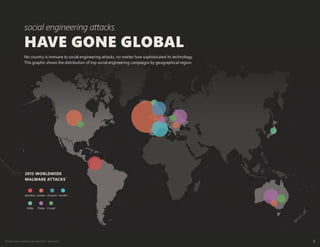
2015 WORLDWIDE
MALWARE ATTACKS
HAVE GONE GLOBAL
social engineering attacks
No country is immune to social engineering attacks, no matter how sophisticated its technology.
This graphic shows the distribution of top social engineering campaigns by geographical region.
5
Protect your weakest security link—end users 9
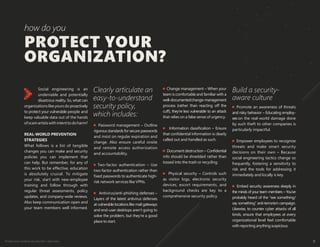
PROTECT YOUR
ORGANIZATION?
how do you
Social engineering is an
undeniable and potentially
disastrous reality. So, what can
organizationslikeyoursdoproactively
to protect your vulnerable people and
keep valuable data out of the hands
ofscamartistswithintenttodoharm?
REAL-WORLD PREVENTION
STRATEGIES
What follows is a list of tangible
changes you can make and security
policies you can implement that
can help. But remember, for any of
this work to be effective, education
is absolutely crucial. To mitigate
your risk, start with new-employee
training and follow through with
regular threat assessments, policy
updates, and company-wide reviews.
Also keep communication open and
your team members well informed.
Change management – When your
team is comfortable and familiar with a
well-documentedchange-management
process (rather than reacting off the
cuff), they’re less vulnerable to an attack
that relies on a false sense of urgency.
Information classification – Ensure
that confidential information is clearly
called out and handled as such.
Document destruction – Confidential
info should be shredded rather than
tossed into the trash or recycling.
Physical security – Controls such
as visitor logs, electronic security
devices, escort requirements, and
background checks are key to a
comprehensive security policy.
Promote an awareness of threats
and risky behavior – Educating employ-
ees on the real-world damage done
by such theft to other companies is
particularly impactful.
Empower employees to recognize
threats and make smart security
decisions on their own – Because
social engineering tactics change so
frequently, fostering a sensitivity to
risk and the tools for addressing it
immediately and locally is key.
Embed security awareness deeply in
the minds of your team members – You’ve
probably heard of the “see something/
say something” anti-terrorism campaign.
Likewise, to counter cyber attacks of all
kinds, ensure that employees at every
organizational level feel comfortable
with reporting anything suspicious.
Password management – Outline
rigorous standards for secure passwords
and insist on regular expiration and
change. Also ensure careful onsite
and remote access authorization
and accountability.
Two-factor authentication – Use
two-factor authentication rather than
fixed passwords to authenticate high-
risk network services like VPNs.
Antivirus/anti-phishing defenses –
Layers of the latest antivirus defenses
at vulnerable locations like mail gateways
and end-user desktops aren’t going to
solve the problem, but they’re a good
place to start.
Clearly articulate an
easy-to-understand
security policy,
which includes:
Build a security-
aware culture
Protect your weakest security link—end users 10
THE WORLD IS NOW
MADE OF COMPANIES
THAT HAVE BEEN HACKED,
AND COMPANIES THAT ARE
ABOUT TO BE HACKED.
Protect your weakest security link—end users 11
First of all, no matter how strong
your technical security is, your
organization’s people are often the
most vulnerable link in the chain.
But, with thorough, thoughtful, and
regular education, they can also be
your biggest asset in your fight
against social engineering. However,
this is only possible when every
individual in the organization clearly
understands the very real risks, the
strategies that can offer protection, and
the big-picture goals and limitations
of enterprise security.
Finally, because the fight against
social engineering is so complex and
challenging, no ONE suggestion or
strategy outlined here will guarantee
security. But, by proactively attacking
the problem from all sides, adopting
viable prevention strategies, and pro-
moting a security-aware culture, you
can help to protect your organization,
your data, and your people from this
insidious 21st century threat.
what's
YOUR EMPLOYEES
ARE ONE OF
THE BEST
RESOURCES YOU
HAVE TO PROTECT
YOUR SYSTEM.
ALL OVER THE GLOBE, SOCIAL ENGINEERING IS A DOMINANT
AND GROWING THREAT TO ORGANIZATIONAL SECURITY.
Microsoft invests over $1 billion a year in cybersecurity research, and has developed a state-of-the-
art Cyber Defense Operations Center, that brings together security response experts from across the
company to help protect, detect and respond to threats in real time.
1. 9th Annual Report. Information Security Trends. ComTIA
https://www.comptia.org/resources/9th-annual-information-security-trends
2. Proofpoint Report, 2016. The Human Factor
3. Research Paper: The State of Social Media Infrastrucutre. NextGate
4. Proofpoint Report, 2016. The Human Factor
5. (Map) Proofpoint Report, 2016. The Human Factor

Insiders Guide to Social Engineering - End-Users are the Weakest Link

  • 1.
    Protect your —end users WEAKEST SECURITYLINK A GUIDE TO DEFENDING AGAINST SOCIAL ENGINEERING ATTACKS
  • 2.
    Protect your weakestsecurity link—end users 1 2015 MARKED AN IMPORTANT YEAR in the world of network security. For the first time, social engineering attacks outnumbered attacks on software vulnerabilities and exploits. This is a serious problem. For companies to stay productive, they need employees to be able to work from anywhere on any device, often collaborating with people around the world. This mobility drives not only the need for secure file sharing and email accounts but also a fundamental shift in our approach to computer security. Since January 2015, the number of victims identified by the FBI has increased 270%, costing businesses more than $2.3 billion1 . The message to network security professionals is clear.Hackersaretargetingtheweakest link in any security perimeter—the end user. This book is your guide to helping you detect and prevent social engineering attacks,andtobetterunderstandhow to defend your company from what has grown to become the dominant global cyberthreat. AMATEURS HACK COMPUTERS. PROFESSIONALS HACK HUMANS.
  • 3.
    Protect your weakestsecurity link—end users 2 Social engineering happens when someone uses manipu- lation, influence or deception to get another person to release information or to perform some sort of action that benefits a hacker. Hackers will often take advantage of genuine security gaps in your network. But at organizations of any size, layers of sophisticated computer security can be undone in seconds because one employee—whether because of trust, lack of awareness, or carelessness—reveals company information to someone with malicious intent. Your employees could be tricked into anything from allowing someone to tailgate them into your data center to giving up their passwords or user IDs over the phone. Social engineers go to great lengths to gain access to data they can exploit, such as: PERSONAL INFO passwords, account numbers COMPANY INFO phone lists, identity badges SERVER INFO servers, networks, non-public URLs Familiarizing yourself with social engineering techniques is your first line of defense. SOCIAL ENGINEERING? what is So,what does a social engineer sound like? “This is Kevin from IT. We've been notified of a virus on your department’s machines.” One of the most common scams—a hacker poses as an IT help desk worker to glean sensitive info such asapasswordsfromanunsuspectingemployee. “Hi, I’m the service tech from HP and I think Ellen is expecting me at 1pm.” This is why it’s so important that well-meaning staff members and other insiders need to be educated as to how and why they could be targeted—and what to do if they suspect a potential threat. “Oh! Wait, could you please hold the door? I left my key/access card in my car.” Peoplewanttobehelpful,andtheyoftendownplay the risks of engaging with someone they don’t know—and that can be a perilous mix. ON THE PHONE AT THE RECEPTION DESK AT THE BUILDING ENTRANCE You might believe that social engineers wouldbeeasytospot.Butoftenenough, they sound like people you run into at work every day.
  • 4.
    Protect your weakestsecurity link—end users 3 SPEAR PHISHING Spear phishing is a targeted email attack in which a hacker uses email to masquerade as someone the target knowsandtrusts.Thisisoftenas simple as copying the name of a CEO from a company website and then sending an email using this name to anyone on the company’s corporate domain. Spear phishing is the single most common (and effective) social engineer- ing tactic. You’ve likely seen subject lines like these before and hopefully hit “delete” right away: "Notice of pending layoff: Click here to register for severance pay." "Inanefforttocutcosts,we’resending this year’s W-2s electronically." But hackers are getting more convincing and creative with email that, when opened, infects your machine. Here are a few tactics to watch for… USING THE NEWS AGAINST YOU – Whatever’s getting attention in the news can be used as social engineering lures. For example, 2016 has seen a rise in the number of spam messages related to the presidential campaign. ABUSING FAITH IN SOCIAL NETWORKING SITES – Millions of people use social networking sites like Facebook and LinkedIn daily, so they develop a certain trust in them. Then, when an email says, “Your Facebook account is undergoing routine maintenance, please click to update your information,” you don’t think twice before you click. tactic no. 1
  • 5.
    Protect your weakestsecurity link—end users 4 Dumpster diving is exactly what it sounds like: A hacker digs through the trash that unsuspecting employees have thrown away. Valuable finds might include: Junk mail (especially credit card offers), which can contain personal identification info that’s just the ticket to identity theft. Company phone lists and org charts that offer numbers and locations that make it easier to impersonate management-level team members. Corporate letterhead that can be used to fake official-looking correspondence. Hackers will also buy refurbished computers and will pull confidential information from hard drives, even after users think they have deleted it. DUMPSTER DIVING tactic no. 2
  • 6.
    Protect your weakestsecurity link—end users 5 SOCIAL ENGINEERING ATTACKS HAVE THE POTENTIAL TO CRIPPLE BUSINESSES.
  • 7.
    Protect your weakestsecurity link—end users 6 10° OF SEPARATION tactic no. 3 Social engineers are clever, me- thodical, and patient. They often start by building a rapport with more accessible people in an organization— like an administrative assistant or a guardatthegate—togetinformation about their ultimate target, who may be as many as ten steps higher up on the corporate food chain. The criminal may begin by gathering personal nuggets about team mem- bers, as well as other "social cues" to build trust or even successfully masquerade as an employee. Some of their strategies are incredibly simple, and insidious: THEY LEARN YOUR INDUSTRY SHORTHAND–Ahackerwillstudythe acronyms and jargon of your industry so she can build trust by speaking the language you recognize. THEY BORROW YOUR 'HOLD' MUSIC – In this deceptively simple scheme, the criminal calls, gets put on hold, and records the music. Then, when he calls his victims and puts them on hold, the familiar music serves as a psychological cue that the caller is trustworthy and on the inside. THEY SPOOF YOUR PHONE NUMBER – Criminals make an inside number show up on the victim’s caller ID, which makes the victim more willing to offer confidential information like passwords over the phone.
  • 8.
    Protect your weakestsecurity link—end users 7 1 2 3 IMPACT let's talk about Social engineering is a very real problem with very few real solutions. In addition to the obvious financial toll, a company’s reputation can take a major hit when a hack becomes public. Compromised personal data can erode the faith and goodwill of its customer base—and that too affects the bottom line. Here's what we know… Attackers are increasingly infecting computers by tricking people into doing it themselves On social media, phishing is 10 times more likely than malware More than 2 billion mobile apps that steal personal data have been willingly downloaded A mind-blowing 99.7% of docs used in attachment-based campaigns relied on social engineering and macros. And 98% of URLs in malicious messages link to hosted malware.2 Because creating fake social media accounts for known brands is so easy, phishing is the fastest growing social media threat. Distinguishing the fraudulent from the legitimate is tough too: 40% of accounts claiming to represent Fortune 100 companies on Facebook and 20% on Twitter are unauthorized.3 Email and social media are not the only social engineering playgrounds—these criminals do big business via malicious mobile apps too. More than 12,000 have been discovered in app stores alone.4
  • 9.
    Protect your weakestsecurity link—end users 8 2015 WORLDWIDE MALWARE ATTACKS HAVE GONE GLOBAL social engineering attacks No country is immune to social engineering attacks, no matter how sophisticated its technology. This graphic shows the distribution of top social engineering campaigns by geographical region. 5
  • 10.
    Protect your weakestsecurity link—end users 9 PROTECT YOUR ORGANIZATION? how do you Social engineering is an undeniable and potentially disastrous reality. So, what can organizationslikeyoursdoproactively to protect your vulnerable people and keep valuable data out of the hands ofscamartistswithintenttodoharm? REAL-WORLD PREVENTION STRATEGIES What follows is a list of tangible changes you can make and security policies you can implement that can help. But remember, for any of this work to be effective, education is absolutely crucial. To mitigate your risk, start with new-employee training and follow through with regular threat assessments, policy updates, and company-wide reviews. Also keep communication open and your team members well informed. Change management – When your team is comfortable and familiar with a well-documentedchange-management process (rather than reacting off the cuff), they’re less vulnerable to an attack that relies on a false sense of urgency. Information classification – Ensure that confidential information is clearly called out and handled as such. Document destruction – Confidential info should be shredded rather than tossed into the trash or recycling. Physical security – Controls such as visitor logs, electronic security devices, escort requirements, and background checks are key to a comprehensive security policy. Promote an awareness of threats and risky behavior – Educating employ- ees on the real-world damage done by such theft to other companies is particularly impactful. Empower employees to recognize threats and make smart security decisions on their own – Because social engineering tactics change so frequently, fostering a sensitivity to risk and the tools for addressing it immediately and locally is key. Embed security awareness deeply in the minds of your team members – You’ve probably heard of the “see something/ say something” anti-terrorism campaign. Likewise, to counter cyber attacks of all kinds, ensure that employees at every organizational level feel comfortable with reporting anything suspicious. Password management – Outline rigorous standards for secure passwords and insist on regular expiration and change. Also ensure careful onsite and remote access authorization and accountability. Two-factor authentication – Use two-factor authentication rather than fixed passwords to authenticate high- risk network services like VPNs. Antivirus/anti-phishing defenses – Layers of the latest antivirus defenses at vulnerable locations like mail gateways and end-user desktops aren’t going to solve the problem, but they’re a good place to start. Clearly articulate an easy-to-understand security policy, which includes: Build a security- aware culture
  • 11.
    Protect your weakestsecurity link—end users 10 THE WORLD IS NOW MADE OF COMPANIES THAT HAVE BEEN HACKED, AND COMPANIES THAT ARE ABOUT TO BE HACKED.
  • 12.
    Protect your weakestsecurity link—end users 11 First of all, no matter how strong your technical security is, your organization’s people are often the most vulnerable link in the chain. But, with thorough, thoughtful, and regular education, they can also be your biggest asset in your fight against social engineering. However, this is only possible when every individual in the organization clearly understands the very real risks, the strategies that can offer protection, and the big-picture goals and limitations of enterprise security. Finally, because the fight against social engineering is so complex and challenging, no ONE suggestion or strategy outlined here will guarantee security. But, by proactively attacking the problem from all sides, adopting viable prevention strategies, and pro- moting a security-aware culture, you can help to protect your organization, your data, and your people from this insidious 21st century threat. what's YOUR EMPLOYEES ARE ONE OF THE BEST RESOURCES YOU HAVE TO PROTECT YOUR SYSTEM.
  • 13.
    ALL OVER THEGLOBE, SOCIAL ENGINEERING IS A DOMINANT AND GROWING THREAT TO ORGANIZATIONAL SECURITY. Microsoft invests over $1 billion a year in cybersecurity research, and has developed a state-of-the- art Cyber Defense Operations Center, that brings together security response experts from across the company to help protect, detect and respond to threats in real time. 1. 9th Annual Report. Information Security Trends. ComTIA https://www.comptia.org/resources/9th-annual-information-security-trends 2. Proofpoint Report, 2016. The Human Factor 3. Research Paper: The State of Social Media Infrastrucutre. NextGate 4. Proofpoint Report, 2016. The Human Factor 5. (Map) Proofpoint Report, 2016. The Human Factor