CASEWORK IN HOSPITAL SETTING
Khushboo shah
Psychiatric Social Work (PSW)Tutor
Department of Psychiatric Social Work (PSW)Tutor
Central Institute of Psychiatry (CIP)
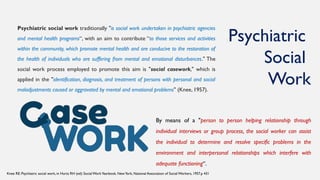
Psychiatric social work traditionally "is social work undertaken in psychiatric agencies
and mental health programs“, with an aim to contribute “to those services and activities
within the community, which promote mental health and are conducive to the restoration of
the health of individuals who are suffering from mental and emotional disturbances." The
social work process employed to promote this aim is "social casework," which is
applied in the "identification, diagnosis, and treatment of persons with personal and social
maladjustments caused or aggravated by mental and emotional problems" (Knee, 1957).
By means of a "person to person helping relationship through
individual interviews or group process, the social worker can assist
the individual to determine and resolve specific problems in the
environment and interpersonal relationships which interfere with
adequate functioning“.
Psychiatric
Social
Work
Knee RE: Psychiatric social work, in Hurtz RH (ed): Social WorkYearbook. NewYork, National Association of Social Workers, 1957.p 431
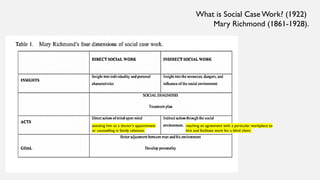
assisting him to a doctor’s appointment
or counselling in family relations.
reaching an agreement with a particular workplace to
hire and facilitate work for a blind client
What is Social Case Work? (1922)
Mary Richmond (1861-1928).
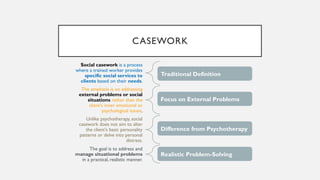
CASEWORK
Social casework is a process
where a trained worker provides
specific social services to
clients based on their needs.
The emphasis is on addressing
external problems or social
situations rather than the
client's inner emotional or
psychological issues.
Unlike psychotherapy, social
casework does not aim to alter
the client's basic personality
patterns or delve into personal
distress.
The goal is to address and
manage situational problems
in a practical, realistic manner.
Traditional Definition
Focus on External Problems
Difference from Psychotherapy
Realistic Problem-Solving
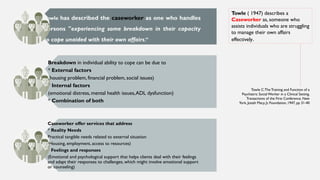
Towle has described the caseworker as one who handles
persons "experiencing some breakdown in their capacity
to cope unaided with their own affairs.”
Breakdown in individual ability to cope can be due to
* External factors
(housing problem, financial problem, social issues)
* Internal factors
(emotional distress, mental health issues,ADL dysfunction)
* Combination of both
Caseworker offer services that address
* Reality Needs
Practical tangible needs related to external situation
(Housing, employment, access to resources)
* Feelings and responses
(Emotional and psychological support that helps clients deal with their feelings
and adapt their responses to challenges, which might involve emotional support
or counseling)
Towle ( 1947) describes a
Caseworker as, someone who
assists individuals who are struggling
to manage their own affairs
effectively.
Towle C:The Training and Function of a
Psychiatric Social Worker in a Clinical Setting.
Transactions of the First Conference. New
York, Josiah Macy, Jr, Foundation, 1947, pp 31-40
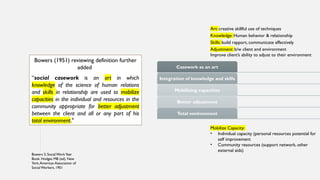
Bowers (1951) reviewing definition further
added
“social casework is an art in which
knowledge of the science of human relations
and skills in relationship are used to mobilize
capacities in the individual and resources in the
community appropriate for better adjustment
between the client and all or any part of his
total environment."
Casework as an art
Integration of knowledge and skills
Mobilizing capacities
Better adjustment
Total environment
Skills: build rapport, communicate effectively
Knowledge: Human behavior & relationship
Art: creative skillful use of techniques
Mobilize Capacity:
• Individual capacity (personal resources potential for
self improvement
• Community resources (support network, other
external aids)
Adjustment: b/w client and environment
Improve client’s ability to adjust to their environment
Bowers S: Social WorkYear
Book. Hodges MB (ed). New
York,American Association of
Social Workers, 1951
C L I E N T S N E E D S A N D W O R K E R R E S P O N S E
• Need to be treated as individual (are physically, emotionally socially, traumatically, problematically, existentially unique)
• Need to be listened to (verbally and non verbally)
• Need to be accepted (accepting as he/she is)
• Need to talk in confidence (Confidentiality)
i. With whom do we share what information?
ii. When do we breach the confidence? (life in danger, risk of death, serious danger to self or other)
iii. How can we guard the information we posses? (to talk in confidence, to keep telephone conversations away from
those not involved (especially other clients), and to keep recorded information away from those not concerned)
• Need to be Understood
i. What it means to this client to ask for/be given help?
ii. What the problem is?
iii. What the problem means to the client?
iv. Who the problem is happening to?
v. Context within which this person with a problem is currently functioning? (material circumstances)
• Need to be helped
CASEWORK IN CLINICAL SOCIAL WORK
• Definition and Significance:
Casework in clinical social work involves the assessment, diagnosis, and treatment of individuals facing
emotional and psychological challenges, essential for improving mental health and well-being.
• Context of Mental Hospital:
Mental hospitals provide a controlled environment for casework interventions, crucial for patients
requiring intensive support and stabilizing treatments.
• Roles of SocialWorkers:
Social workers play multiple roles, including advocate, counselor, and mediator.They facilitate access to
resources and promote clients' rights within the healthcare system
ROLE OF CLINICAL SOCIAL WORKER
• Function in Mental HealthTeams:
Clinical social workers contribute to multidisciplinary teams, bringing a holistic perspective that
integrates social, emotional, and psychological factors into patient care.
• Therapeutic Relationships:
Building strong therapeutic relationships is fundamental for clinical social workers, as trust and
rapport significantly affect treatment outcomes.
• Interdisciplinary Collaboration:
Effective collaboration with psychiatrists, nurses, and psychologists enhances the overall treatment
plan and ensures comprehensive care for patients
ASSESSMENT IN CASEWORK
Cornerstone of Effective Intervention
• Importance of Assessment:
A thorough assessment informs the development of
1. EffectiveTreatment Plans,
2. Identifying strengths, challenges, and areas needing intervention.
• Methods Used:
Standard methods often include interviews, psychological tests, and observational assessments to gather diverse data on clients.
• Tools andTechniques:
Various tools, such as standardized assessment scales and diagnostic criteria, aid in formulating a clear understanding of a client's
needs.
• Gathering Client History:
Collecting comprehensive client histories allows social workers to contextualize current challenges within the individuals' life
narratives
CASE FORMULATION AND PLANNING
• DevelopingTreatment Plans: Crafting treatment plans in collaboration with clients integrates their
preferences and values into the therapeutic process, ensuring relevance and engagement.
• Setting Goals: SMART goals-Specific, Measurable, Achievable, Relevant, and Time-bound-help in directing
the treatment process systematically and effectively.
• Strategies for Intervention: Strategies might include therapy modalities, medication management, and
psychoeducation………….. tailored to individual needs and contexts.
• Client Involvement: Engaging clients in their treatment planning fosters empowerment, leading to improved
adherence to the treatment plan and better outcomes. (Principle of self-determination)
METHOD OF CASEWORK
Casework method based on systematic and orderly practice experiences which includes a
• Processes of intake (Intake Counseling, Case take-up etc.)
• Social study (Psychosocial Assessment/ Family Assessment) and diagnosis (Psychosocial Formulation)
• Treatment (treatment goal, methods and Psychosocial Management plan, Family Interventions etc.)
• Termination (Change of postings, Discharge counseling, ending family intervention or therapy)
• Follow up towards (follow sessions in case of need via in-person or tele-psychotherapy)
i. Problem’s solution and
ii. Social functioning among individuals, couples and families.
TREATMENT METHOD IN CASEWORK
Hamilton treatment is the sum of all activities and services directed towards helping an individual with a problem.
The focus is the relieving of the immediate problem and, if feasible, modifying any basic difficulties which
precipitated it.Typically treatment methods are grouped as
• Direct treatment method
• Indirect treatment method
• Direct treatment method
Perlman sees direct treatment as the provision of a systematic but flexible way in which the client can work
over his problem, his relation to it and possible solutions.
Hamilton sees direct work as a series of interviews with the purpose of inducing or reinforcing attitudes
favorable to the maintenance of emotional equilibrium, constructive decisions, growth or change. She goes on to
distinguish between two types of interviews:
(a) Counselling, which she sees primarily as a rational discussion of issues, focusing on clarification, but
embracing feeling as well as intellect since learning (old and new) involves an emotional element and this
may imply a degree of abreaction (a re-living of emotions experienced elsewhere)
(b) Therapeutic interviewing—of which casework is one form.
• Direct treatment method
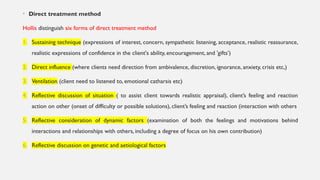
Hollis distinguish six forms of direct treatment method
1. Sustaining technique (expressions of interest, concern, sympathetic listening, acceptance, realistic reassurance,
realistic expressions of confidence in the client's ability, encouragement, and 'gifts’)
2. Direct influence (where clients need direction from ambivalence, discretion, ignorance, anxiety, crisis etc,)
3. Ventilation (client need to listened to, emotional catharsis etc)
4. Reflective discussion of situation ( to assist client towards realistic appraisal), client’s feeling and reaction
action on other (onset of difficulty or possible solutions), client’s feeling and reaction (interaction with others
5. Reflective consideration of dynamic factors (examination of both the feelings and motivations behind
interactions and relationships with others, including a degree of focus on his own contribution)
6. Reflective discussion on genetic and aetiological factors
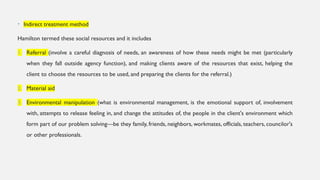
• Indirect treatment method
Hamilton termed these social resources and it includes
1. Referral (involve a careful diagnosis of needs, an awareness of how these needs might be met (particularly
when they fall outside agency function), and making clients aware of the resources that exist, helping the
client to choose the resources to be used, and preparing the clients for the referral.)
2. Material aid
3. Environmental manipulation (what is environmental management, is the emotional support of, involvement
with, attempts to release feeling in, and change the attitudes of, the people in the client's environment which
form part of our problem solving—be they family, friends, neighbors, workmates, officials, teachers, councilor's
or other professionals.
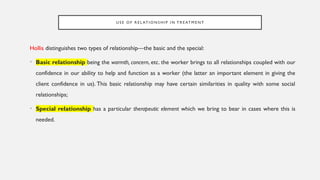
U S E O F R E L AT I O N S H I P I N T R E AT M E N T
Hollis distinguishes two types of relationship—the basic and the special:
• Basic relationship being the warmth, concern, etc. the worker brings to all relationships coupled with our
confidence in our ability to help and function as a worker (the latter an important element in giving the
client confidence in us). This basic relationship may have certain similarities in quality with some social
relationships;
• Special relationship has a particular therapeutic element which we bring to bear in cases where this is
needed.
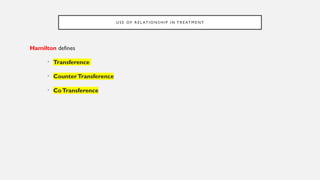
U S E O F R E L AT I O N S H I P I N T R E AT M E N T
Hamilton defines
• Transference
• CounterTransference
• CoTransference
DOCUMENTATION AND RECORD KEEPING
Foundation for Accountability
• Importance of Documentation:Thorough documentation ensures
1. Continuity of care,
2. Enables effective communication among providers, and
3. Supports accountability in clinical practice.
• Legal Aspects: Understanding the legal requirements for documentation
1. Protects client rights and
2. Ensures ethical compliance within clinical practices.
• Ethical Considerations: Ethical documentation practices safeguard
1. Client confidentiality and
2. Promote trust in the therapeutic relationship.
• Case Notes Best Practices: Best practices include being objective, concise, and timely in documenting
interventions and client progress, facilitating effective care management.
COLLABORATION WITH OTHER PROFESSIONALS
Teamwork in Mental Health
• Working with Psychiatrists: Collaboration with psychiatrists enhances medication
management and provides a comprehensive understanding of clients' mental health
needs.
• Collaboration with Nurses: Nurses play a critical role in monitoring patients' physical
health and coordinating care, working closely with social workers to address holistic
needs.
• Working with Psychologists: Interdisciplinary collaboration with psychologists fosters
integrated treatment plans combining therapy and social support interventions.
Effective Communication Strategies: Clear and open communication among team
members is essential for delivering cohesive care and optimizing treatment outcomes.
ETHICAL ISSUES FACED BY CASEWORKER
• Confidentiality
Maintaining client confidentiality is a cornerstone of ethical practice, building trust and promoting open
communication in the therapeutic relationship.
• Dual Relatio
• nships
Navigating dual relationships is critical; social workers must be vigilant to avoid potential conflicts of interest
that can harm the therapeutic relationship.
• Informed Consent
Obtaining informed consent is crucial for ethical treatment, ensuring clients understand their rights and the
nature of the services provided.
• Professional Boundaries
Establishing and maintaining professional boundaries helps to foster effective and ethical therapeutic
relationships, preventing exploitation of clients.
There are more than fourteen models in social work practice which also implies in psychiatric setting.Among
those social casework reports are based on some of these models which are mostly referred to practice in
psychiatric setting.These models included:
(1) Psychosocial model,
(2) Problem solving model,
(3) Behavior modification,
(4) Crisis intervention,
(5) Family therapeutic model and
(6)Task centered model.
Models in
social casework
in psychiatric
setting
CRISIS INTERVENTION TECHNIQUES
• Identifying Crises
Recognizing signs of a crisis, such as acute distress or suicidal ideation, is critical for timely intervention and
support.
• Intervention Models
Models such as the ABC Model (Affect, Behavior, Cognition) help in structuring responses during crises to stabilize
clients effectively.
• Immediate and Long-term Strategies
Strategies encompass both immediate crisis resolution and long-term support planning to prevent recurrence of
crises.
• Case Examples
Real-world examples can illustrate successful interventions and highlight lessons learned from past experiences in
managing crises.
Thank you
Khushboo Shah
PSW Tutor Department of psychiatric Social Work (PSW)
Central Institute of Psychiatry (CIP)

Casework in hospital setting-1.pptx . .

  • 1.
    CASEWORK IN HOSPITALSETTING Khushboo shah Psychiatric Social Work (PSW)Tutor Department of Psychiatric Social Work (PSW)Tutor Central Institute of Psychiatry (CIP)
  • 2.
    Psychiatric social worktraditionally "is social work undertaken in psychiatric agencies and mental health programs“, with an aim to contribute “to those services and activities within the community, which promote mental health and are conducive to the restoration of the health of individuals who are suffering from mental and emotional disturbances." The social work process employed to promote this aim is "social casework," which is applied in the "identification, diagnosis, and treatment of persons with personal and social maladjustments caused or aggravated by mental and emotional problems" (Knee, 1957). By means of a "person to person helping relationship through individual interviews or group process, the social worker can assist the individual to determine and resolve specific problems in the environment and interpersonal relationships which interfere with adequate functioning“. Psychiatric Social Work Knee RE: Psychiatric social work, in Hurtz RH (ed): Social WorkYearbook. NewYork, National Association of Social Workers, 1957.p 431
  • 3.
    assisting him toa doctor’s appointment or counselling in family relations. reaching an agreement with a particular workplace to hire and facilitate work for a blind client What is Social Case Work? (1922) Mary Richmond (1861-1928).
  • 4.
    CASEWORK Social casework isa process where a trained worker provides specific social services to clients based on their needs. The emphasis is on addressing external problems or social situations rather than the client's inner emotional or psychological issues. Unlike psychotherapy, social casework does not aim to alter the client's basic personality patterns or delve into personal distress. The goal is to address and manage situational problems in a practical, realistic manner. Traditional Definition Focus on External Problems Difference from Psychotherapy Realistic Problem-Solving
  • 5.
    Towle has describedthe caseworker as one who handles persons "experiencing some breakdown in their capacity to cope unaided with their own affairs.” Breakdown in individual ability to cope can be due to * External factors (housing problem, financial problem, social issues) * Internal factors (emotional distress, mental health issues,ADL dysfunction) * Combination of both Caseworker offer services that address * Reality Needs Practical tangible needs related to external situation (Housing, employment, access to resources) * Feelings and responses (Emotional and psychological support that helps clients deal with their feelings and adapt their responses to challenges, which might involve emotional support or counseling) Towle ( 1947) describes a Caseworker as, someone who assists individuals who are struggling to manage their own affairs effectively. Towle C:The Training and Function of a Psychiatric Social Worker in a Clinical Setting. Transactions of the First Conference. New York, Josiah Macy, Jr, Foundation, 1947, pp 31-40
  • 6.
    Bowers (1951) reviewingdefinition further added “social casework is an art in which knowledge of the science of human relations and skills in relationship are used to mobilize capacities in the individual and resources in the community appropriate for better adjustment between the client and all or any part of his total environment." Casework as an art Integration of knowledge and skills Mobilizing capacities Better adjustment Total environment Skills: build rapport, communicate effectively Knowledge: Human behavior & relationship Art: creative skillful use of techniques Mobilize Capacity: • Individual capacity (personal resources potential for self improvement • Community resources (support network, other external aids) Adjustment: b/w client and environment Improve client’s ability to adjust to their environment Bowers S: Social WorkYear Book. Hodges MB (ed). New York,American Association of Social Workers, 1951
  • 7.
    C L IE N T S N E E D S A N D W O R K E R R E S P O N S E • Need to be treated as individual (are physically, emotionally socially, traumatically, problematically, existentially unique) • Need to be listened to (verbally and non verbally) • Need to be accepted (accepting as he/she is) • Need to talk in confidence (Confidentiality) i. With whom do we share what information? ii. When do we breach the confidence? (life in danger, risk of death, serious danger to self or other) iii. How can we guard the information we posses? (to talk in confidence, to keep telephone conversations away from those not involved (especially other clients), and to keep recorded information away from those not concerned) • Need to be Understood i. What it means to this client to ask for/be given help? ii. What the problem is? iii. What the problem means to the client? iv. Who the problem is happening to? v. Context within which this person with a problem is currently functioning? (material circumstances) • Need to be helped
  • 8.
    CASEWORK IN CLINICALSOCIAL WORK • Definition and Significance: Casework in clinical social work involves the assessment, diagnosis, and treatment of individuals facing emotional and psychological challenges, essential for improving mental health and well-being. • Context of Mental Hospital: Mental hospitals provide a controlled environment for casework interventions, crucial for patients requiring intensive support and stabilizing treatments. • Roles of SocialWorkers: Social workers play multiple roles, including advocate, counselor, and mediator.They facilitate access to resources and promote clients' rights within the healthcare system
  • 9.
    ROLE OF CLINICALSOCIAL WORKER • Function in Mental HealthTeams: Clinical social workers contribute to multidisciplinary teams, bringing a holistic perspective that integrates social, emotional, and psychological factors into patient care. • Therapeutic Relationships: Building strong therapeutic relationships is fundamental for clinical social workers, as trust and rapport significantly affect treatment outcomes. • Interdisciplinary Collaboration: Effective collaboration with psychiatrists, nurses, and psychologists enhances the overall treatment plan and ensures comprehensive care for patients
  • 10.
    ASSESSMENT IN CASEWORK Cornerstoneof Effective Intervention • Importance of Assessment: A thorough assessment informs the development of 1. EffectiveTreatment Plans, 2. Identifying strengths, challenges, and areas needing intervention. • Methods Used: Standard methods often include interviews, psychological tests, and observational assessments to gather diverse data on clients. • Tools andTechniques: Various tools, such as standardized assessment scales and diagnostic criteria, aid in formulating a clear understanding of a client's needs. • Gathering Client History: Collecting comprehensive client histories allows social workers to contextualize current challenges within the individuals' life narratives
  • 11.
    CASE FORMULATION ANDPLANNING • DevelopingTreatment Plans: Crafting treatment plans in collaboration with clients integrates their preferences and values into the therapeutic process, ensuring relevance and engagement. • Setting Goals: SMART goals-Specific, Measurable, Achievable, Relevant, and Time-bound-help in directing the treatment process systematically and effectively. • Strategies for Intervention: Strategies might include therapy modalities, medication management, and psychoeducation………….. tailored to individual needs and contexts. • Client Involvement: Engaging clients in their treatment planning fosters empowerment, leading to improved adherence to the treatment plan and better outcomes. (Principle of self-determination)
  • 12.
    METHOD OF CASEWORK Caseworkmethod based on systematic and orderly practice experiences which includes a • Processes of intake (Intake Counseling, Case take-up etc.) • Social study (Psychosocial Assessment/ Family Assessment) and diagnosis (Psychosocial Formulation) • Treatment (treatment goal, methods and Psychosocial Management plan, Family Interventions etc.) • Termination (Change of postings, Discharge counseling, ending family intervention or therapy) • Follow up towards (follow sessions in case of need via in-person or tele-psychotherapy) i. Problem’s solution and ii. Social functioning among individuals, couples and families.
  • 13.
    TREATMENT METHOD INCASEWORK Hamilton treatment is the sum of all activities and services directed towards helping an individual with a problem. The focus is the relieving of the immediate problem and, if feasible, modifying any basic difficulties which precipitated it.Typically treatment methods are grouped as • Direct treatment method • Indirect treatment method
  • 14.
    • Direct treatmentmethod Perlman sees direct treatment as the provision of a systematic but flexible way in which the client can work over his problem, his relation to it and possible solutions. Hamilton sees direct work as a series of interviews with the purpose of inducing or reinforcing attitudes favorable to the maintenance of emotional equilibrium, constructive decisions, growth or change. She goes on to distinguish between two types of interviews: (a) Counselling, which she sees primarily as a rational discussion of issues, focusing on clarification, but embracing feeling as well as intellect since learning (old and new) involves an emotional element and this may imply a degree of abreaction (a re-living of emotions experienced elsewhere) (b) Therapeutic interviewing—of which casework is one form.
  • 15.
    • Direct treatmentmethod Hollis distinguish six forms of direct treatment method 1. Sustaining technique (expressions of interest, concern, sympathetic listening, acceptance, realistic reassurance, realistic expressions of confidence in the client's ability, encouragement, and 'gifts’) 2. Direct influence (where clients need direction from ambivalence, discretion, ignorance, anxiety, crisis etc,) 3. Ventilation (client need to listened to, emotional catharsis etc) 4. Reflective discussion of situation ( to assist client towards realistic appraisal), client’s feeling and reaction action on other (onset of difficulty or possible solutions), client’s feeling and reaction (interaction with others 5. Reflective consideration of dynamic factors (examination of both the feelings and motivations behind interactions and relationships with others, including a degree of focus on his own contribution) 6. Reflective discussion on genetic and aetiological factors
  • 16.
    • Indirect treatmentmethod Hamilton termed these social resources and it includes 1. Referral (involve a careful diagnosis of needs, an awareness of how these needs might be met (particularly when they fall outside agency function), and making clients aware of the resources that exist, helping the client to choose the resources to be used, and preparing the clients for the referral.) 2. Material aid 3. Environmental manipulation (what is environmental management, is the emotional support of, involvement with, attempts to release feeling in, and change the attitudes of, the people in the client's environment which form part of our problem solving—be they family, friends, neighbors, workmates, officials, teachers, councilor's or other professionals.
  • 17.
    U S EO F R E L AT I O N S H I P I N T R E AT M E N T Hollis distinguishes two types of relationship—the basic and the special: • Basic relationship being the warmth, concern, etc. the worker brings to all relationships coupled with our confidence in our ability to help and function as a worker (the latter an important element in giving the client confidence in us). This basic relationship may have certain similarities in quality with some social relationships; • Special relationship has a particular therapeutic element which we bring to bear in cases where this is needed.
  • 18.
    U S EO F R E L AT I O N S H I P I N T R E AT M E N T Hamilton defines • Transference • CounterTransference • CoTransference
  • 19.
    DOCUMENTATION AND RECORDKEEPING Foundation for Accountability • Importance of Documentation:Thorough documentation ensures 1. Continuity of care, 2. Enables effective communication among providers, and 3. Supports accountability in clinical practice. • Legal Aspects: Understanding the legal requirements for documentation 1. Protects client rights and 2. Ensures ethical compliance within clinical practices. • Ethical Considerations: Ethical documentation practices safeguard 1. Client confidentiality and 2. Promote trust in the therapeutic relationship. • Case Notes Best Practices: Best practices include being objective, concise, and timely in documenting interventions and client progress, facilitating effective care management.
  • 20.
    COLLABORATION WITH OTHERPROFESSIONALS Teamwork in Mental Health • Working with Psychiatrists: Collaboration with psychiatrists enhances medication management and provides a comprehensive understanding of clients' mental health needs. • Collaboration with Nurses: Nurses play a critical role in monitoring patients' physical health and coordinating care, working closely with social workers to address holistic needs. • Working with Psychologists: Interdisciplinary collaboration with psychologists fosters integrated treatment plans combining therapy and social support interventions. Effective Communication Strategies: Clear and open communication among team members is essential for delivering cohesive care and optimizing treatment outcomes.
  • 21.
    ETHICAL ISSUES FACEDBY CASEWORKER • Confidentiality Maintaining client confidentiality is a cornerstone of ethical practice, building trust and promoting open communication in the therapeutic relationship. • Dual Relatio • nships Navigating dual relationships is critical; social workers must be vigilant to avoid potential conflicts of interest that can harm the therapeutic relationship. • Informed Consent Obtaining informed consent is crucial for ethical treatment, ensuring clients understand their rights and the nature of the services provided. • Professional Boundaries Establishing and maintaining professional boundaries helps to foster effective and ethical therapeutic relationships, preventing exploitation of clients.
  • 22.
    There are morethan fourteen models in social work practice which also implies in psychiatric setting.Among those social casework reports are based on some of these models which are mostly referred to practice in psychiatric setting.These models included: (1) Psychosocial model, (2) Problem solving model, (3) Behavior modification, (4) Crisis intervention, (5) Family therapeutic model and (6)Task centered model. Models in social casework in psychiatric setting
  • 23.
    CRISIS INTERVENTION TECHNIQUES •Identifying Crises Recognizing signs of a crisis, such as acute distress or suicidal ideation, is critical for timely intervention and support. • Intervention Models Models such as the ABC Model (Affect, Behavior, Cognition) help in structuring responses during crises to stabilize clients effectively. • Immediate and Long-term Strategies Strategies encompass both immediate crisis resolution and long-term support planning to prevent recurrence of crises. • Case Examples Real-world examples can illustrate successful interventions and highlight lessons learned from past experiences in managing crises.
  • 24.
    Thank you Khushboo Shah PSWTutor Department of psychiatric Social Work (PSW) Central Institute of Psychiatry (CIP)