SOAL 1 –SOAL	
  BAB	
  2	
  –	
  Permintaan	
  dan	
  Penawaran
Bahasa Indonesia
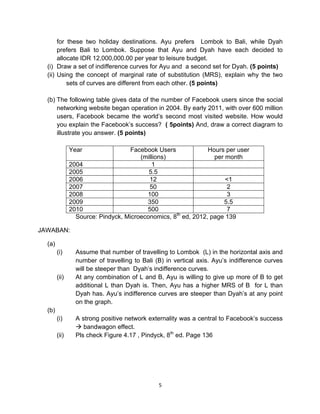
Untuk pasar tebu, diasumsikan kurva permintaan dan penawaran-nya adalah sebagai berikut:
Qd = 800 – 62,5P
Qs = 220 + 82,5P
a. Hitunglah harga dan kuantitas keseimbangan pasar untuk komoditas tebu tersebut.
b. Hitunglah price elastiscity of supply dan price elasticity of demand pada saat keseimbangan.
Jelaskan arti price elasticity of supply dan price elasticity of demand yang Anda peroleh.
c. Apabila pemerintah memberikan subsidi harga sehingga harga tebu per unit di pasar menjadi
sebesar Rp 5/unit, apakah dampaknya terhadap keseimbangan pasar? Hitung berapa besar
excess supply atau excess demand dari tebu yang terjadi akibat kebijakan pemeirntah
tersebut?
Berikan jawaban Anda dalam bentuk matematis dan grafis.
English
Assume market demand and supply curves of sugar canes are as follows:
Qd = 800 – 62.5P
Qs = 220 + 82.5P
a.
b.
c.

Calculate the equilibrium price and quantity for sugar canes
Calculate the price elasticity of supply and price elasticity of demand at the equilibrium.
Explain your results.
If the government gives a price support, so that the price of each unit of sugar cane in the
market becomes Rp 5/unit, what impact will this support price have on the market? If there
is an excess supply or excess demand of sugar canes in the market due to this government
policy, calculate the excess supply or excess demand.

Use mathematics and graphics to answer the questions.

1	


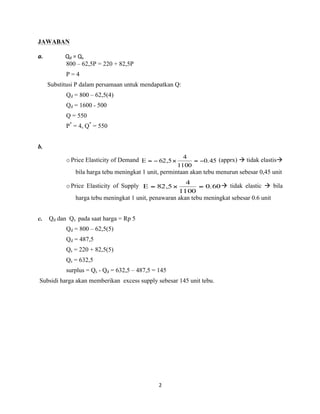
JAWABAN
a.


  Qd	
  =	
  Qs	
  
800 – 62,5P = 220 + 82,5P
P=4
Substitusi P dalam persamaan untuk mendapatkan Q:
Qd = 800 – 62,5(4)
Qd = 1600 - 500
Q = 550
P* = 4, Q* = 550

b.
o Price Elasticity of Demand E = − 62,5 ×

4
= −0.45 (apprx) à tidak elastisà
1100

bila harga tebu meningkat 1 unit, permintaan akan tebu menurun sebesar 0,45 unit

4
= 0.60 à tidak elastic à bila
1100
harga tebu meningkat 1 unit, penawaran akan tebu meningkat sebesar 0.6 unit

o Price Elasticity of Supply E = 82,5 ×

c.

Qd dan Qs pada saat harga = Rp 5
Qd = 800 – 62,5(5)
Qd = 487,5
Qs = 220 + 82,5(5)
Qs = 632,5
surplus = Qs - Qd = 632,5 – 487,5 = 145

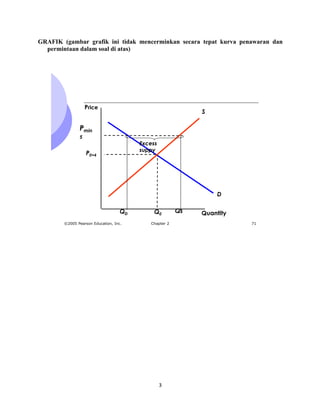
Subsidi harga akan memberikan excess supply sebesar 145 unit tebu.

2	


GRAFIK (gambar grafik ini tidak mencerminkan secara tepat kurva penawaran dan
permintaan dalam soal di atas)


Price

S

Pmin
5

Excess
suppy

P0=4

D
QD
©2005 Pearson Education, Inc.

Q0
Chapter 2


3	


Qs

Quantity
71


SOAL 2
Usulan Soal UTS Mikro 1 (Teori Konsumen: Chapter 3 dan 4): Femmy Roeslan
Bahasa Indonesia
Ayu dan Dyah sama-sama menyukai berlibur ke Lombok atau Bali dan hanya akan
berlibur ke dua daerah wisata tersebut. Namun, mereka memiliki preferensi yang
berbeda terhadap dua daerah tujuan wisata tersebut. Ayu lebih menyukai berlibur di
Lombok dibandingkan Bali, sebaliknya Dyah lebih menyukai Bali dibandingkan Lombok.
Misal, Ayu dan Dyah memutuskan untuk mengalokasikan anggaran untuk berlibur
sebesar Rp 12.000.000,00 per tahun.
(i) Gambarkan kurva-kuva indiferens untuk Ayu (beri label A) dan Dyah (beri label
D). (5 points)
(ii) Dengan menggunakan konsep marginal rate of substitution (MRS), jelaskan
mengapa kedua set kurva indiferens berbeda satu sama lain? (5 points)
(b) Tabel berikut meberikan data tentang jumlah pengguna “Facebook” sejak jejaring
sosial ini mulai beroperasi pada tahun 2004. Di awal 2011, dengan jumlah pengguna
melebihi angka 600 juta, Facebook menjadi situs ke dua yang paling sering digunakan.
Bagaimanakah anda dapat menjelaskan kesuksesan yang telah dicapai oleh
Facebook? (5 points) Dan, lengkapi jawaban anda dengan diagram yang tepat untuk
menjelaskan situasi tersebut. (5 points)
Pengguna Facebook
Jam per orang
(juta)
per bulan
2004
1
2005
5.5
2006
12
<1
2007
50
2
2008
100
3
2009
350
5.5
2010
500
7
Sumber: Pindyck, Microeconomics, 8th ed, 2012, hal 139
0Tahun

English
(a) Ayu and Dyah both like travelling to Lombok or Bali and will choose to consume
positive quantities of both. However, they differ substantially in their preferences
4	


for these two holiday destinations. Ayu prefers Lombok to Bali, while Dyah
prefers Bali to Lombok. Suppose that Ayu and Dyah have each decided to
allocate IDR 12,000,000.00 per year to leisure budget.
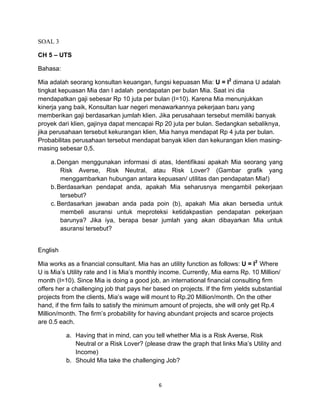
(i) Draw a set of indifference curves for Ayu and a second set for Dyah. (5 points)
(ii) Using the concept of marginal rate of substitution (MRS), explain why the two
sets of curves are different from each other. (5 points)
(b) The following table gives data of the number of Facebook users since the social
networking website began operation in 2004. By early 2011, with over 600 million
users, Facebook became the world’s second most visited website. How would
you explain the Facebook’s success? ( 5points) And, draw a correct diagram to
illustrate you answer. (5 points)
Year

Facebook Users
Hours per user
(millions)
per month
2004
1
2005
5.5
2006
12
<1
2007
50
2
2008
100
3
2009
350
5.5
2010
500
7
Source: Pindyck, Microeconomics, 8th ed, 2012, page 139
JAWABAN:
(a)
(i)

(ii)

Assume that number of travelling to Lombok (L) in the horizontal axis and
number of travelling to Bali (B) in vertical axis. Ayu’s indifference curves
will be steeper than Dyah’s indifference curves.
At any combination of L and B, Ayu is willing to give up more of B to get
additional L than Dyah is. Then, Ayu has a higher MRS of B for L than
Dyah has. Ayu’s indifference curves are steeper than Dyah’s at any point
on the graph.

(b)
(i)
(ii)

A strong positive network externality was a central to Facebook’s success
à bandwagon effect.
Pls check Figure 4.17 , Pindyck, 8th ed. Page 136

5	


SOAL 3
CH 5 – UTS
Bahasa:
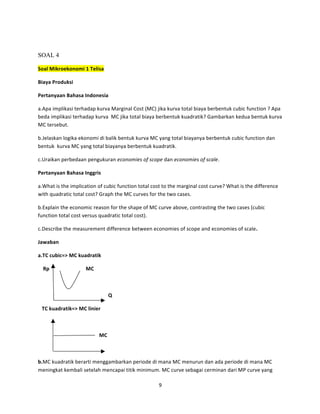
Mia adalah seorang konsultan keuangan, fungsi kepuasan Mia: U = I2 dimana U adalah
tingkat kepuasan Mia dan I adalah pendapatan per bulan Mia. Saat ini dia
mendapatkan gaji sebesar Rp 10 juta per bulan (I=10). Karena Mia menunjukkan
kinerja yang baik, Konsultan luar negeri menawarkannya pekerjaan baru yang
memberikan gaji berdasarkan jumlah klien. Jika perusahaan tersebut memiliki banyak
proyek dari klien, gajinya dapat mencapai Rp 20 juta per bulan. Sedangkan sebaliknya,
jika perusahaan tersebut kekurangan klien, Mia hanya mendapat Rp 4 juta per bulan.
Probabilitas perusahaan tersebut mendapat banyak klien dan kekurangan klien masingmasing sebesar 0,5.
a. Dengan menggunakan informasi di atas, Identifikasi apakah Mia seorang yang
Risk Averse, Risk Neutral, atau Risk Lover? (Gambar grafik yang
menggambarkan hubungan antara kepuasan/ utilitas dan pendapatan Mia!)
b. Berdasarkan pendapat anda, apakah Mia seharusnya mengambil pekerjaan
tersebut?
c. Berdasarkan jawaban anda pada poin (b), apakah Mia akan bersedia untuk
membeli asuransi untuk meproteksi ketidakpastian pendapatan pekerjaan
barunya? Jika iya, berapa besar jumlah yang akan dibayarkan Mia untuk
asuransi tersebut?
English
Mia works as a financial consultant. Mia has an utility function as follows: U = I2 Where
U is Mia’s Utility rate and I is Mia’s monthly income. Currently, Mia earns Rp. 10 Million/
month (I=10). Since Mia is doing a good job, an international financial consulting firm
offers her a challenging job that pays her based on projects. If the firm yields substantial
projects from the clients, Mia’s wage will mount to Rp.20 Million/month. On the other
hand, if the firm fails to satisfy the minimum amount of projects, she will only get Rp.4
Million/month. The firm’s probability for having abundant projects and scarce projects
are 0.5 each.
a. Having that in mind, can you tell whether Mia is a Risk Averse, Risk
Neutral or a Risk Lover? (please draw the graph that links Mia’s Utility and
Income)
b. Should Mia take the challenging Job?

6	


c. Based on your answer in point b, do you think Mia should buy an
insurance to protect her from the uncertainty? How much money worth to
pay?

JAWABAN

a. Mia merupakan seorang yang Risk Averse, tergambar dari kurva di bawah ini
Fungsi utilitas merupakan
bentuk kuadratik dari income,
sehingga kurva akan bebentuk
cembung dan melambangkan
bahwa Mia merupakan
seorang yang Risk Averse

b. Iya, karena Expected
Utility [E(u)] dari Pekerjaan baru lebih besar dari Expected Utility dati pekerjaan
lama
E(u) old job = I2 = 102 = 100
E(u) new job = Prob . u(4) + Prob u(20)
= 0.5 . (42) + 0.5 (202)
= 8 + 200
= 208
c.

Karena Mia merupakan seorang Risk Averse, maka Mia akan
bersedia membeli asuransi sebesar kerugian yang di ekspektasi. Besarnya
kerugian tersebut adalah selisih gaji per bulan terendah yang di dapat dengan
gaji yang semula di terima, yaitu
10 juta – 4 juta = 6 juta, kemudian dikalikan dengan probabilitas terjadinya gaji
terendah tersebut
7	


Rp 6 juta x 0.5 = Rp 3 juta
Maka, Mia akan bersedia untuk membeli asuransi jika harga asuransi tersebut
tidak melebihi Rp 3 juta per bulan

8	


SOAL 4
Soal	
  Mikroekonomi	
  1	
  Telisa	
  	
  
Biaya	
  Produksi	
  
Pertanyaan	
  Bahasa	
  Indonesia	
  
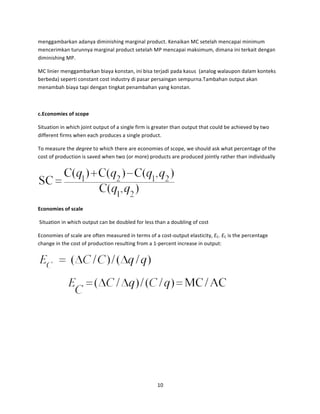
a.Apa	
  implikasi	
  terhadap	
  kurva	
  Marginal	
  Cost	
  (MC)	
  jika	
  kurva	
  total	
  biaya	
  berbentuk	
  cubic	
  function	
  ?	
  Apa	
  
beda	
  implikasi	
  terhadap	
  kurva	
  	
  MC	
  jika	
  total	
  biaya	
  berbentuk	
  kuadratik?	
  Gambarkan	
  kedua	
  bentuk	
  kurva	
  
MC	
  tersebut.	
  
b.Jelaskan	
  logika	
  ekonomi	
  di	
  balik	
  bentuk	
  kurva	
  MC	
  yang	
  total	
  biayanya	
  berbentuk	
  cubic	
  function	
  dan	
  
bentuk	
  	
  kurva	
  MC	
  yang	
  total	
  biayanya	
  berbentuk	
  kuadratik.	
  	
  
c.Uraikan	
  perbedaan	
  pengukuran	
  economies	
  of	
  scope	
  dan	
  economies	
  of	
  scale.	
  	
  
Pertanyaan	
  Bahasa	
  Inggris	
  
a.What	
  is	
  the	
  implication	
  of	
  cubic	
  function	
  total	
  cost	
  to	
  the	
  marginal	
  cost	
  curve?	
  What	
  is	
  the	
  difference	
  
with	
  quadratic	
  total	
  cost?	
  Graph	
  the	
  MC	
  curves	
  for	
  the	
  two	
  cases.	
  
b.Explain	
  the	
  economic	
  reason	
  for	
  the	
  shape	
  of	
  MC	
  curve	
  above,	
  contrasting	
  the	
  two	
  cases	
  (cubic	
  
function	
  total	
  cost	
  versus	
  quadratic	
  total	
  cost).	
  	
  
c.Describe	
  the	
  measurement	
  difference	
  between	
  economies	
  of	
  scope	
  and	
  economies	
  of	
  scale.	
  
Jawaban	
  
a.TC	
  cubic=>	
  MC	
  kuadratik	
  
	
   Rp	
  

MC	


  Q	


  TC	
  kuadratik=>	
  MC	
  linier	


MC	


b.MC	
  kuadratik	
  berarti	
  menggambarkan	
  periode	
  di	
  mana	
  MC	
  menurun	
  dan	
  ada	
  periode	
  di	
  mana	
  MC	
  
meningkat	
  kembali	
  setelah	
  mencapai	
  titik	
  minimum.	
  MC	
  curve	
  sebagai	
  cerminan	
  dari	
  MP	
  curve	
  yang	
  
9	


menggambarkan	
  adanya	
  diminishing	
  marginal	
  product.	
  Kenaikan	
  MC	
  setelah	
  mencapai	
  minimum	
  
mencerimkan	
  turunnya	
  marginal	
  product	
  setelah	
  MP	
  mencapai	
  maksimum,	
  dimana	
  ini	
  terkait	
  dengan	
  
diminishing	
  MP.	
  
MC	
  linier	
  menggambarkan	
  biaya	
  konstan,	
  ini	
  bisa	
  terjadi	
  pada	
  kasus	
  	
  (analog	
  walaupon	
  dalam	
  konteks	
  
berbeda)	
  seperti	
  constant	
  cost	
  industry	
  di	
  pasar	
  persaingan	
  sempurna.Tambahan	
  output	
  akan	
  
menambah	
  biaya	
  tapi	
  dengan	
  tingkat	
  penambahan	
  yang	
  konstan.	


c.Economies	
  of	
  scope	
  
Situation	
  in	
  which	
  joint	
  output	
  of	
  a	
  single	
  firm	
  is	
  greater	
  than	
  output	
  that	
  could	
  be	
  achieved	
  by	
  two	
  
different	
  firms	
  when	
  each	
  produces	
  a	
  single	
  product.	
  
To	
  measure	
  the	
  degree	
  to	
  which	
  there	
  are	
  economies	
  of	
  scope,	
  we	
  should	
  ask	
  what	
  percentage	
  of	
  the	
  
cost	
  of	
  production	
  is	
  saved	
  when	
  two	
  (or	
  more)	
  products	
  are	
  produced	
  jointly	
  rather	
  than	
  individually	


Economies	
  of	
  scale	
  
	
  Situation	
  in	
  which	
  output	
  can	
  be	
  doubled	
  for	
  less	
  than	
  a	
  doubling	
  of	
  cost	
  
Economies	
  of	
  scale	
  are	
  often	
  measured	
  in	
  terms	
  of	
  a	
  cost-­‐output	
  elasticity,	
  EC.	
  EC	
  is	
  the	
  percentage	
  
change	
  in	
  the	
  cost	
  of	
  production	
  resulting	
  from	
  a	
  1-­‐percent	
  increase	
  in	
  output:	


10	


Soal UTS Bab 6. Produksi
Bahasa
Fungsi produksi PT. Aneka yang memproduksi mobil adalah sebagai berikut :
Q = 200(K0,8L0,2)
a.
b.

c.

Jelaskan perbedaan antara fungsi produksi dengan isoquant.
Jika input modal sebesar 4 unit dan input tenaga kerja sebesar 40 unit, Hitunglah
Marginal Product of Labor (MPL) dan Marginal Product of Capital (MPK)
dan periksalah apakah fungsi-fungsi tersebut meningkat atau menurun ? Jelaskan.
Periksalah apakah fungsi produksi bersifat Increasing Return to Scale (IRTS),
Constant Return to Scale (CRTS), Decreasing Return to Scale (DRTS). Jelaskan

Inggris
Production function of PT. Aneka that produces cars are as follows:
Q = 200(K0,8L0,2)
a. Explain the difference between the production function and isoquant.
b. If the capital input is 4 units and labor input is 40 units, calculate the Marginal
Product of Labor (MPL) and the Marginal Product of Capital (MPK) and check
whether these functions are increasing or decreasing. Explain the meaning.
c. Check whether the production function is Increasing Return to Scale (IRTS),
Constant Return to Scale (CRTs), Decreasing Return to Scale (DRTS). Explain the
meaning.
jawaban
a. Isoquant : Kurva yang menunjukkan semua titik kombinasi input yang
menghasilkan output yang sama.
Fungsi produksi : fungsi yang menunjukkan output terbesar yang dapat
dihasilkan oleh setiap kombinasi input yang spesifik.
b. MPK = dQ/dK = 200(0,8) K-0.,2L0,2 =253.58 >0 à increasing
MPL = dQ/dL = 200(0,2) K0.,8L-0,8 =22.188 > 0 à increasing
c. Q = 200(K0,8L0,2)
M f(KL) = 200(MK)0,8(ML)0,2
M f(KL) = 200M0,8 K0,8M0,2L0,2
M f(KL) = M0,8 M0,2 200 K0,8L0,2
M f(KL) = M 200 K0,8L0,2
11	


M f(KL) = M 200 K0,8L0,2
M f(KL) = M Q àCRS atau 0,8 + 0,2 = 1

12	


SOAL 5
Bahasa	
  Indonesia	
  
Sebuah	
  perusahaan	
  yang	
  beroperasi	
  di	
  pasar	
  kompetitif	
  sempurna	
  memiliki	
  biaya	
  produksi	
  sebagai	
  
berikut:	
  
Q	
  

0	
  

1	
  

2	
  

3	
  

4	
  

5	
  

6	
  

7	
  

8	
  

9	
  

10	
  

FC	
  

9	
  

9	
  

9	
  

9	
  

9	
  

9	
  

9	
  

9	
  

9	
  

9	
  

9	
  

VC	
  

0	
  

11	
  

21	
  

30	
  

38	
  

45	
  

51	
  

58	
  

68	
  

81	
  

100	
  

Pertanyaan:	
  
1. Jika	
  hrga	
  pasar	
  adalah	
  13,	
  berapa	
  output	
  yang	
  akan	
  dipilih	
  oleh	
  perusahaan	
  untuk	
  
memaksimumkan	
  laba?	
  Berapa	
  laba	
  maksimum?	
  
2. Misalkan	
  harga	
  pasa	
  turun	
  menjadi	
  6.	
  Berapa	
  output	
  sekarang	
  dan	
  berapa	
  labanya?	
  
3. Gambarkan	
  kurva	
  MC	
  dan	
  AVC.	
  Tunjukkan	
  kurva	
  supply	
  perusahaan	
  dalam	
  jangka	
  pendek.	
  
Bagaimana	
  anda	
  memperolehnya?	


Bahasa	
  Inggris	
  
A	
  perfectly	
  competitive	
  firm	
  is	
  faced	
  with	
  the	
  following	
  costs	
  schedule	
  
Q	
  

0	
  

1	
  

2	
  

3	
  

4	
  

5	
  

6	
  

7	
  

8	
  

9	
  

10	
  

FC	
  

9	
  

9	
  

9	
  

9	
  

9	
  

9	
  

9	
  

9	
  

9	
  

9	
  

9	
  

VC	
  

0	
  

11	
  

21	
  

30	
  

38	
  

45	
  

51	
  

58	
  

68	
  

81	
  

100	
  

Questions	
  
4. If	
  the	
  market	
  price	
  is	
  13,	
  what	
  output	
  will	
  the	
  firm	
  choose	
  to	
  produce	
  to	
  maximize	
  profits?	
  What	
  
is	
  the	
  maximum	
  profit?	
  
5. Suppose	
  the	
  market	
  price	
  falls	
  to	
  6.	
  How	
  much	
  will	
  the	
  firm	
  choose	
  to	
  produce	
  now	
  and	
  what	
  
will	
  be	
  its	
  profit?	
  
6. Graph	
  the	
  firm’s	
  MC	
  and	
  AVC	
  curves.	
  Show	
  the	
  firm’s	
  supply	
  curve	
  in	
  the	
  short	
  run?	
  How	
  did	
  
you	
  derive	
  it?	


13	


Solutions	
  
1.	
  

To	
  maximise	
  profit,	
  set	
  Q	
  such	
  that	
  MR	
  =	
  MC.	
  MR	
  =	
  13	
  at	
  each	
  level	
  of	
  output	
  level.	
  MC	
  schedule	
  is	
  
shown	
  below:	
  
Q	
  

0	
  

1	
  

2	
  

3	
  

4	
  

5	
  

6	
  

7	
  

8	
  

9	
  

10	
  

MC	
  

-­‐	
  

11	
  

10	
  

9	
  

8	
  

7	
  

6	
  

7	
  

10	
  

13	
  

19	
  

AVC	
   -­‐	
  

11	
  

10,5	
  

10	
  

9,5	
  

9	
  

8,25	
  

8,3	
  

8,5	
  

9	
  

10	


Profit	
  is	
  maximized	
  at	
  Q	
  such	
  that	
  MR	
  =	
  MC.	
  Since	
  MR	
  =	
  13	
  everywhere,	
  MC	
  will	
  produce	
  9	
  units	


Π	
  =	
  TR	
  –	
  TC	
  =	
  (13	
  x	
  9)	
  –	
  90	
  =	
  117	
  –	
  90	
  =	
  27	


Maximum	
  profit	
  is	
  27	
  

2.	
  

Again,	
  since	
  the	
  firm	
  is	
  in	
  a	
  perfectly	
  competitive	
  industry,	
  MR	
  =	
  P	
  =	
  6.	


Setting	
  MR	
  =	
  MC,	
  we	
  find	
  that	
  profit	
  is	
  maximized	
  where	
  MC	
  =	
  6,	
  or	
  at	
  an	
  output	
  of	
  6	
  units.	
  
However,	
  when	
  we	
  calculate	
  profit,	
  we	
  find:	


Π	
  =	
  TR	
  –	
  TC	
  =	
  (P	
  x	
  Q)	
  –	
  TC	
  =	
  (6	
  x	
  6)	
  –	
  60	
  =	
  36	
  –	
  60	
  =	
  -­‐24	


That	
  is,	
  the	
  firm	
  suffers	
  a	
  loss	
  of	
  24.	
  However4,	
  if	
  the	
  firm	
  shuts	
  down	
  and	
  produces	
  nothing,	
  it	
  will	
  
incur	
  a	
  total	
  cost	
  of	
  9	
  and	
  earn	
  no	
  revenue,	
  and	
  thus	
  suffer	
  a	
  loss	
  of	
  9.	
  Therefore,	
  the	
  firm	
  will	
  
choose	
  to	
  produce	
  nothing	
  and	
  lose	
  9	
  (rather	
  than	
  produce	
  6	
  ubits	
  and	
  lose	
  24).	
  

3.	
  

The	
  darkly	
  shaded	
  curve	
  are	
  the	
  firm’s	
  supply	
  curve.	
  For	
  any	
  P,	
  a	
  competitive	
  firm	
  has	
  MR	
  =	
  P,	
  so	
  
MR	
   =	
   MC	
   is	
   satisfied	
   for	
   P,	
   Q	
   combinations	
   represented	
   by	
   the	
   rising	
   portion	
   of	
   the	
   MC	
   curve.	
  
However,	
   if	
   P	
   <	
   AVC,	
   the	
   firm’s	
   revenues	
   do	
   not	
   cover	
   variable	
   costs:	
   as	
   a	
   result,	
   the	
   fiem	
   would	
  
lose	
  more	
  than	
  its	
  fixed	
  costs	
  by	
  producing	
  where	
  P	
  <	
  AVC,	
  or	
  where	
  MC	
  [=P]	
  <	
  AVC,	
  (which	
  is	
  the	
  
same	
  thing).	
  Thus,	
  the	
  supply	
  curve	
  is	
  the	
  same	
  as	
  the	
  MC	
  curve	
  above	
  the	
  AVC	
  curve,	
  and	
  Q	
  =	
  0	
  for	
  
any	
  lower	
  price.	
  

14	


SOAl 6
Bahasa	
  
Bensin	
  jenis	
  premium	
  adalah	
  salah	
  satu	
  komoditas	
  yang	
  mendapatkan	
  subsidi	
  harga	
  di	
  Indonesia.	
  	
  Harga	
  
premium	
  tersubsidi	
  adalah	
  Rp4500	
  dan	
  pada	
  tahun	
  2012,	
  diperkirakan	
  konsumsinya	
  mencapati	
  43,5	
  juta	
  
kilo	
  liter.	
  Dengan	
  asumsi	
  harga	
  internasional	
  Rp9000,	
  pemerintah	
  memberikan	
  subsidi	
  melalui	
  PT	
  
Pertamina	
  sebesar	
  Rp4500	
  per	
  liter	
  bensin.	
  
a. Gambarkan	
  dengan	
  kurva	
  keseimbangan	
  pasar	
  premium	
  di	
  Indonesia.	
  
b. Tunjukkan	
  area	
  yang	
  merupakan	
  inefisiensi	
  ekonomi	
  dari	
  premium	
  tersebut.	
  Jelaskan.	
  
c. Merujuk	
  pada	
  hasil	
  estimasi	
  Dahl	
  dan	
  Kurtubi	
  (2001),	
  elastisitas	
  permintaan	
  atas	
  harga	
  di	
  jangka	
  
panjang	
  untuk	
  premium	
  	
  di	
  Indonesia	
  adalah	
  -­‐0,6.	
  Dengan	
  mengasumsikan	
  (i)	
  kurva	
  permintaan	
  
bensin	
  linear,	
  (ii)	
  harga	
  premium	
  jika	
  tidak	
  	
  disubsidi	
  adalah	
  Rp8000;	
  hitunglah	
  nilai	
  atau	
  luas	
  
area	
  inefisiensi	
  pada	
  soal	
  b.	


English	
  
Gasoline	
  (bensin)	
  is	
  subsidized	
  in	
  Indonesia.	
  The	
  subsidized	
  price	
  for	
  gasoline	
  is	
  Rp4500	
  and	
  its	
  
consumption	
  in	
  2012	
  accounts	
  for	
  43.5	
  kilo	
  million	
  litres.	
  With	
  the	
  assumption	
  of	
  international	
  price	
  
equal	
  to	
  Rp9000,	
  the	
  government	
  pays	
  the	
  subsidy	
  per	
  litre	
  to	
  PT	
  Pertamina	
  the	
  amount	
  of	
  Rp4500.	
  
a. Draw	
  market	
  equilibrium	
  for	
  subsidized	
  gasoline	
  in	
  Indonesia.	
  
b. Show	
  the	
  area	
  of	
  inefficiencies	
  due	
  to	
  subsidy.	
  Explain.	
  
c. Dahl	
  and	
  Kurtubi	
  (2001)	
  estimated	
  the	
  price	
  elasticity	
  of	
  demand	
  for	
  gasoline	
  is	
  -­‐0.6.	
  Asume	
  that	
  
(i)	
  the	
  demand	
  curve	
  is	
  linear,	
  (ii)	
  the	
  price	
  of	
  unsubsidized	
  gasoline	
  is	
  Rp8000;	
  find	
  the	
  value	
  of	
  
inefficiency	
  area	
  in	
  part	
  b.	


15	


Jawab	
  
a.	


b.	


16	


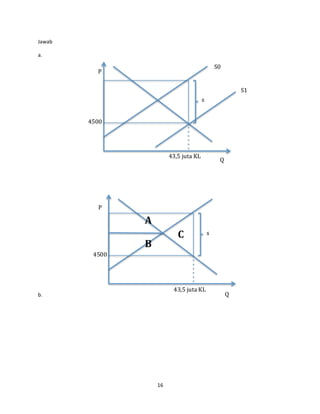
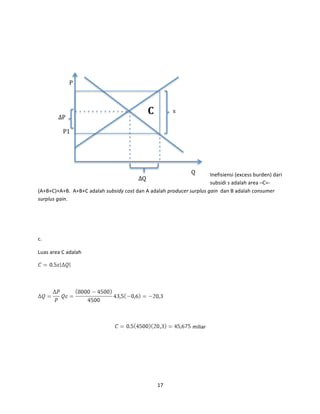
Inefisiensi	
  (excess	
  burden)	
  dari	
  
subsidi	
  s	
  adalah	
  area	
  –C=-­‐
(A+B+C)+A+B.	
  	
  A+B+C	
  adalah	
  subsidy	
  cost	
  dan	
  A	
  adalah	
  producer	
  surplus	
  gain	
  	
  dan	
  B	
  adalah	
  consumer	
  
surplus	
  gain.	


c.	
  
Luas	
  area	
  C	
  adalah	


  miliar	


17	


Soal dan jawaban UTS 25.10.2012

  • 1.
    SOAL 1 –SOAL  BAB  2  –  Permintaan  dan  Penawaran Bahasa Indonesia Untuk pasar tebu, diasumsikan kurva permintaan dan penawaran-nya adalah sebagai berikut: Qd = 800 – 62,5P Qs = 220 + 82,5P a. Hitunglah harga dan kuantitas keseimbangan pasar untuk komoditas tebu tersebut. b. Hitunglah price elastiscity of supply dan price elasticity of demand pada saat keseimbangan. Jelaskan arti price elasticity of supply dan price elasticity of demand yang Anda peroleh. c. Apabila pemerintah memberikan subsidi harga sehingga harga tebu per unit di pasar menjadi sebesar Rp 5/unit, apakah dampaknya terhadap keseimbangan pasar? Hitung berapa besar excess supply atau excess demand dari tebu yang terjadi akibat kebijakan pemeirntah tersebut? Berikan jawaban Anda dalam bentuk matematis dan grafis. English Assume market demand and supply curves of sugar canes are as follows: Qd = 800 – 62.5P Qs = 220 + 82.5P a. b. c. Calculate the equilibrium price and quantity for sugar canes Calculate the price elasticity of supply and price elasticity of demand at the equilibrium. Explain your results. If the government gives a price support, so that the price of each unit of sugar cane in the market becomes Rp 5/unit, what impact will this support price have on the market? If there is an excess supply or excess demand of sugar canes in the market due to this government policy, calculate the excess supply or excess demand. Use mathematics and graphics to answer the questions. 1    
  • 2.
    JAWABAN a.            Qd  =  Qs   800 – 62,5P = 220 + 82,5P P=4 Substitusi P dalam persamaan untuk mendapatkan Q: Qd = 800 – 62,5(4) Qd = 1600 - 500 Q = 550 P* = 4, Q* = 550 b. o Price Elasticity of Demand E = − 62,5 × 4 = −0.45 (apprx) à tidak elastisà 1100 bila harga tebu meningkat 1 unit, permintaan akan tebu menurun sebesar 0,45 unit 4 = 0.60 à tidak elastic à bila 1100 harga tebu meningkat 1 unit, penawaran akan tebu meningkat sebesar 0.6 unit o Price Elasticity of Supply E = 82,5 × c. Qd dan Qs pada saat harga = Rp 5 Qd = 800 – 62,5(5) Qd = 487,5 Qs = 220 + 82,5(5) Qs = 632,5 surplus = Qs - Qd = 632,5 – 487,5 = 145 Subsidi harga akan memberikan excess supply sebesar 145 unit tebu. 2    
  • 3.
    GRAFIK (gambar grafikini tidak mencerminkan secara tepat kurva penawaran dan permintaan dalam soal di atas)   Price S Pmin 5 Excess suppy P0=4 D QD ©2005 Pearson Education, Inc. Q0 Chapter 2     3     Qs Quantity 71  
  • 4.
    SOAL 2 Usulan SoalUTS Mikro 1 (Teori Konsumen: Chapter 3 dan 4): Femmy Roeslan Bahasa Indonesia Ayu dan Dyah sama-sama menyukai berlibur ke Lombok atau Bali dan hanya akan berlibur ke dua daerah wisata tersebut. Namun, mereka memiliki preferensi yang berbeda terhadap dua daerah tujuan wisata tersebut. Ayu lebih menyukai berlibur di Lombok dibandingkan Bali, sebaliknya Dyah lebih menyukai Bali dibandingkan Lombok. Misal, Ayu dan Dyah memutuskan untuk mengalokasikan anggaran untuk berlibur sebesar Rp 12.000.000,00 per tahun. (i) Gambarkan kurva-kuva indiferens untuk Ayu (beri label A) dan Dyah (beri label D). (5 points) (ii) Dengan menggunakan konsep marginal rate of substitution (MRS), jelaskan mengapa kedua set kurva indiferens berbeda satu sama lain? (5 points) (b) Tabel berikut meberikan data tentang jumlah pengguna “Facebook” sejak jejaring sosial ini mulai beroperasi pada tahun 2004. Di awal 2011, dengan jumlah pengguna melebihi angka 600 juta, Facebook menjadi situs ke dua yang paling sering digunakan. Bagaimanakah anda dapat menjelaskan kesuksesan yang telah dicapai oleh Facebook? (5 points) Dan, lengkapi jawaban anda dengan diagram yang tepat untuk menjelaskan situasi tersebut. (5 points) Pengguna Facebook Jam per orang (juta) per bulan 2004 1 2005 5.5 2006 12 <1 2007 50 2 2008 100 3 2009 350 5.5 2010 500 7 Sumber: Pindyck, Microeconomics, 8th ed, 2012, hal 139 0Tahun English (a) Ayu and Dyah both like travelling to Lombok or Bali and will choose to consume positive quantities of both. However, they differ substantially in their preferences 4    
  • 5.
    for these twoholiday destinations. Ayu prefers Lombok to Bali, while Dyah prefers Bali to Lombok. Suppose that Ayu and Dyah have each decided to allocate IDR 12,000,000.00 per year to leisure budget. (i) Draw a set of indifference curves for Ayu and a second set for Dyah. (5 points) (ii) Using the concept of marginal rate of substitution (MRS), explain why the two sets of curves are different from each other. (5 points) (b) The following table gives data of the number of Facebook users since the social networking website began operation in 2004. By early 2011, with over 600 million users, Facebook became the world’s second most visited website. How would you explain the Facebook’s success? ( 5points) And, draw a correct diagram to illustrate you answer. (5 points) Year Facebook Users Hours per user (millions) per month 2004 1 2005 5.5 2006 12 <1 2007 50 2 2008 100 3 2009 350 5.5 2010 500 7 Source: Pindyck, Microeconomics, 8th ed, 2012, page 139 JAWABAN: (a) (i) (ii) Assume that number of travelling to Lombok (L) in the horizontal axis and number of travelling to Bali (B) in vertical axis. Ayu’s indifference curves will be steeper than Dyah’s indifference curves. At any combination of L and B, Ayu is willing to give up more of B to get additional L than Dyah is. Then, Ayu has a higher MRS of B for L than Dyah has. Ayu’s indifference curves are steeper than Dyah’s at any point on the graph. (b) (i) (ii) A strong positive network externality was a central to Facebook’s success à bandwagon effect. Pls check Figure 4.17 , Pindyck, 8th ed. Page 136 5    
  • 6.
    SOAL 3 CH 5– UTS Bahasa: Mia adalah seorang konsultan keuangan, fungsi kepuasan Mia: U = I2 dimana U adalah tingkat kepuasan Mia dan I adalah pendapatan per bulan Mia. Saat ini dia mendapatkan gaji sebesar Rp 10 juta per bulan (I=10). Karena Mia menunjukkan kinerja yang baik, Konsultan luar negeri menawarkannya pekerjaan baru yang memberikan gaji berdasarkan jumlah klien. Jika perusahaan tersebut memiliki banyak proyek dari klien, gajinya dapat mencapai Rp 20 juta per bulan. Sedangkan sebaliknya, jika perusahaan tersebut kekurangan klien, Mia hanya mendapat Rp 4 juta per bulan. Probabilitas perusahaan tersebut mendapat banyak klien dan kekurangan klien masingmasing sebesar 0,5. a. Dengan menggunakan informasi di atas, Identifikasi apakah Mia seorang yang Risk Averse, Risk Neutral, atau Risk Lover? (Gambar grafik yang menggambarkan hubungan antara kepuasan/ utilitas dan pendapatan Mia!) b. Berdasarkan pendapat anda, apakah Mia seharusnya mengambil pekerjaan tersebut? c. Berdasarkan jawaban anda pada poin (b), apakah Mia akan bersedia untuk membeli asuransi untuk meproteksi ketidakpastian pendapatan pekerjaan barunya? Jika iya, berapa besar jumlah yang akan dibayarkan Mia untuk asuransi tersebut? English Mia works as a financial consultant. Mia has an utility function as follows: U = I2 Where U is Mia’s Utility rate and I is Mia’s monthly income. Currently, Mia earns Rp. 10 Million/ month (I=10). Since Mia is doing a good job, an international financial consulting firm offers her a challenging job that pays her based on projects. If the firm yields substantial projects from the clients, Mia’s wage will mount to Rp.20 Million/month. On the other hand, if the firm fails to satisfy the minimum amount of projects, she will only get Rp.4 Million/month. The firm’s probability for having abundant projects and scarce projects are 0.5 each. a. Having that in mind, can you tell whether Mia is a Risk Averse, Risk Neutral or a Risk Lover? (please draw the graph that links Mia’s Utility and Income) b. Should Mia take the challenging Job? 6    
  • 7.
    c. Based onyour answer in point b, do you think Mia should buy an insurance to protect her from the uncertainty? How much money worth to pay? JAWABAN a. Mia merupakan seorang yang Risk Averse, tergambar dari kurva di bawah ini Fungsi utilitas merupakan bentuk kuadratik dari income, sehingga kurva akan bebentuk cembung dan melambangkan bahwa Mia merupakan seorang yang Risk Averse b. Iya, karena Expected Utility [E(u)] dari Pekerjaan baru lebih besar dari Expected Utility dati pekerjaan lama E(u) old job = I2 = 102 = 100 E(u) new job = Prob . u(4) + Prob u(20) = 0.5 . (42) + 0.5 (202) = 8 + 200 = 208 c. Karena Mia merupakan seorang Risk Averse, maka Mia akan bersedia membeli asuransi sebesar kerugian yang di ekspektasi. Besarnya kerugian tersebut adalah selisih gaji per bulan terendah yang di dapat dengan gaji yang semula di terima, yaitu 10 juta – 4 juta = 6 juta, kemudian dikalikan dengan probabilitas terjadinya gaji terendah tersebut 7    
  • 8.
    Rp 6 jutax 0.5 = Rp 3 juta Maka, Mia akan bersedia untuk membeli asuransi jika harga asuransi tersebut tidak melebihi Rp 3 juta per bulan 8    
  • 9.
    SOAL 4 Soal  Mikroekonomi  1  Telisa     Biaya  Produksi   Pertanyaan  Bahasa  Indonesia   a.Apa  implikasi  terhadap  kurva  Marginal  Cost  (MC)  jika  kurva  total  biaya  berbentuk  cubic  function  ?  Apa   beda  implikasi  terhadap  kurva    MC  jika  total  biaya  berbentuk  kuadratik?  Gambarkan  kedua  bentuk  kurva   MC  tersebut.   b.Jelaskan  logika  ekonomi  di  balik  bentuk  kurva  MC  yang  total  biayanya  berbentuk  cubic  function  dan   bentuk    kurva  MC  yang  total  biayanya  berbentuk  kuadratik.     c.Uraikan  perbedaan  pengukuran  economies  of  scope  dan  economies  of  scale.     Pertanyaan  Bahasa  Inggris   a.What  is  the  implication  of  cubic  function  total  cost  to  the  marginal  cost  curve?  What  is  the  difference   with  quadratic  total  cost?  Graph  the  MC  curves  for  the  two  cases.   b.Explain  the  economic  reason  for  the  shape  of  MC  curve  above,  contrasting  the  two  cases  (cubic   function  total  cost  versus  quadratic  total  cost).     c.Describe  the  measurement  difference  between  economies  of  scope  and  economies  of  scale.   Jawaban   a.TC  cubic=>  MC  kuadratik     Rp   MC                                                                                                                Q        TC  kuadratik=>  MC  linier       MC     b.MC  kuadratik  berarti  menggambarkan  periode  di  mana  MC  menurun  dan  ada  periode  di  mana  MC   meningkat  kembali  setelah  mencapai  titik  minimum.  MC  curve  sebagai  cerminan  dari  MP  curve  yang   9    
  • 10.
    menggambarkan  adanya  diminishing  marginal  product.  Kenaikan  MC  setelah  mencapai  minimum   mencerimkan  turunnya  marginal  product  setelah  MP  mencapai  maksimum,  dimana  ini  terkait  dengan   diminishing  MP.   MC  linier  menggambarkan  biaya  konstan,  ini  bisa  terjadi  pada  kasus    (analog  walaupon  dalam  konteks   berbeda)  seperti  constant  cost  industry  di  pasar  persaingan  sempurna.Tambahan  output  akan   menambah  biaya  tapi  dengan  tingkat  penambahan  yang  konstan.       c.Economies  of  scope   Situation  in  which  joint  output  of  a  single  firm  is  greater  than  output  that  could  be  achieved  by  two   different  firms  when  each  produces  a  single  product.   To  measure  the  degree  to  which  there  are  economies  of  scope,  we  should  ask  what  percentage  of  the   cost  of  production  is  saved  when  two  (or  more)  products  are  produced  jointly  rather  than  individually     Economies  of  scale    Situation  in  which  output  can  be  doubled  for  less  than  a  doubling  of  cost   Economies  of  scale  are  often  measured  in  terms  of  a  cost-­‐output  elasticity,  EC.  EC  is  the  percentage   change  in  the  cost  of  production  resulting  from  a  1-­‐percent  increase  in  output:         10    
  • 11.
    Soal UTS Bab6. Produksi Bahasa Fungsi produksi PT. Aneka yang memproduksi mobil adalah sebagai berikut : Q = 200(K0,8L0,2) a. b. c. Jelaskan perbedaan antara fungsi produksi dengan isoquant. Jika input modal sebesar 4 unit dan input tenaga kerja sebesar 40 unit, Hitunglah Marginal Product of Labor (MPL) dan Marginal Product of Capital (MPK) dan periksalah apakah fungsi-fungsi tersebut meningkat atau menurun ? Jelaskan. Periksalah apakah fungsi produksi bersifat Increasing Return to Scale (IRTS), Constant Return to Scale (CRTS), Decreasing Return to Scale (DRTS). Jelaskan Inggris Production function of PT. Aneka that produces cars are as follows: Q = 200(K0,8L0,2) a. Explain the difference between the production function and isoquant. b. If the capital input is 4 units and labor input is 40 units, calculate the Marginal Product of Labor (MPL) and the Marginal Product of Capital (MPK) and check whether these functions are increasing or decreasing. Explain the meaning. c. Check whether the production function is Increasing Return to Scale (IRTS), Constant Return to Scale (CRTs), Decreasing Return to Scale (DRTS). Explain the meaning. jawaban a. Isoquant : Kurva yang menunjukkan semua titik kombinasi input yang menghasilkan output yang sama. Fungsi produksi : fungsi yang menunjukkan output terbesar yang dapat dihasilkan oleh setiap kombinasi input yang spesifik. b. MPK = dQ/dK = 200(0,8) K-0.,2L0,2 =253.58 >0 à increasing MPL = dQ/dL = 200(0,2) K0.,8L-0,8 =22.188 > 0 à increasing c. Q = 200(K0,8L0,2) M f(KL) = 200(MK)0,8(ML)0,2 M f(KL) = 200M0,8 K0,8M0,2L0,2 M f(KL) = M0,8 M0,2 200 K0,8L0,2 M f(KL) = M 200 K0,8L0,2 11    
  • 12.
    M f(KL) =M 200 K0,8L0,2 M f(KL) = M Q àCRS atau 0,8 + 0,2 = 1 12    
  • 13.
    SOAL 5 Bahasa  Indonesia   Sebuah  perusahaan  yang  beroperasi  di  pasar  kompetitif  sempurna  memiliki  biaya  produksi  sebagai   berikut:   Q   0   1   2   3   4   5   6   7   8   9   10   FC   9   9   9   9   9   9   9   9   9   9   9   VC   0   11   21   30   38   45   51   58   68   81   100   Pertanyaan:   1. Jika  hrga  pasar  adalah  13,  berapa  output  yang  akan  dipilih  oleh  perusahaan  untuk   memaksimumkan  laba?  Berapa  laba  maksimum?   2. Misalkan  harga  pasa  turun  menjadi  6.  Berapa  output  sekarang  dan  berapa  labanya?   3. Gambarkan  kurva  MC  dan  AVC.  Tunjukkan  kurva  supply  perusahaan  dalam  jangka  pendek.   Bagaimana  anda  memperolehnya?     Bahasa  Inggris   A  perfectly  competitive  firm  is  faced  with  the  following  costs  schedule   Q   0   1   2   3   4   5   6   7   8   9   10   FC   9   9   9   9   9   9   9   9   9   9   9   VC   0   11   21   30   38   45   51   58   68   81   100   Questions   4. If  the  market  price  is  13,  what  output  will  the  firm  choose  to  produce  to  maximize  profits?  What   is  the  maximum  profit?   5. Suppose  the  market  price  falls  to  6.  How  much  will  the  firm  choose  to  produce  now  and  what   will  be  its  profit?   6. Graph  the  firm’s  MC  and  AVC  curves.  Show  the  firm’s  supply  curve  in  the  short  run?  How  did   you  derive  it?           13    
  • 14.
      Solutions   1.   To  maximise  profit,  set  Q  such  that  MR  =  MC.  MR  =  13  at  each  level  of  output  level.  MC  schedule  is   shown  below:   Q   0   1   2   3   4   5   6   7   8   9   10   MC   -­‐   11   10   9   8   7   6   7   10   13   19   AVC   -­‐   11   10,5   10   9,5   9   8,25   8,3   8,5   9   10       Profit  is  maximized  at  Q  such  that  MR  =  MC.  Since  MR  =  13  everywhere,  MC  will  produce  9  units     Π  =  TR  –  TC  =  (13  x  9)  –  90  =  117  –  90  =  27     Maximum  profit  is  27   2.   Again,  since  the  firm  is  in  a  perfectly  competitive  industry,  MR  =  P  =  6.       Setting  MR  =  MC,  we  find  that  profit  is  maximized  where  MC  =  6,  or  at  an  output  of  6  units.   However,  when  we  calculate  profit,  we  find:     Π  =  TR  –  TC  =  (P  x  Q)  –  TC  =  (6  x  6)  –  60  =  36  –  60  =  -­‐24     That  is,  the  firm  suffers  a  loss  of  24.  However4,  if  the  firm  shuts  down  and  produces  nothing,  it  will   incur  a  total  cost  of  9  and  earn  no  revenue,  and  thus  suffer  a  loss  of  9.  Therefore,  the  firm  will   choose  to  produce  nothing  and  lose  9  (rather  than  produce  6  ubits  and  lose  24).   3.   The  darkly  shaded  curve  are  the  firm’s  supply  curve.  For  any  P,  a  competitive  firm  has  MR  =  P,  so   MR   =   MC   is   satisfied   for   P,   Q   combinations   represented   by   the   rising   portion   of   the   MC   curve.   However,   if   P   <   AVC,   the   firm’s   revenues   do   not   cover   variable   costs:   as   a   result,   the   fiem   would   lose  more  than  its  fixed  costs  by  producing  where  P  <  AVC,  or  where  MC  [=P]  <  AVC,  (which  is  the   same  thing).  Thus,  the  supply  curve  is  the  same  as  the  MC  curve  above  the  AVC  curve,  and  Q  =  0  for   any  lower  price.   14    
  • 15.
    SOAl 6 Bahasa   Bensin  jenis  premium  adalah  salah  satu  komoditas  yang  mendapatkan  subsidi  harga  di  Indonesia.    Harga   premium  tersubsidi  adalah  Rp4500  dan  pada  tahun  2012,  diperkirakan  konsumsinya  mencapati  43,5  juta   kilo  liter.  Dengan  asumsi  harga  internasional  Rp9000,  pemerintah  memberikan  subsidi  melalui  PT   Pertamina  sebesar  Rp4500  per  liter  bensin.   a. Gambarkan  dengan  kurva  keseimbangan  pasar  premium  di  Indonesia.   b. Tunjukkan  area  yang  merupakan  inefisiensi  ekonomi  dari  premium  tersebut.  Jelaskan.   c. Merujuk  pada  hasil  estimasi  Dahl  dan  Kurtubi  (2001),  elastisitas  permintaan  atas  harga  di  jangka   panjang  untuk  premium    di  Indonesia  adalah  -­‐0,6.  Dengan  mengasumsikan  (i)  kurva  permintaan   bensin  linear,  (ii)  harga  premium  jika  tidak    disubsidi  adalah  Rp8000;  hitunglah  nilai  atau  luas   area  inefisiensi  pada  soal  b.     English   Gasoline  (bensin)  is  subsidized  in  Indonesia.  The  subsidized  price  for  gasoline  is  Rp4500  and  its   consumption  in  2012  accounts  for  43.5  kilo  million  litres.  With  the  assumption  of  international  price   equal  to  Rp9000,  the  government  pays  the  subsidy  per  litre  to  PT  Pertamina  the  amount  of  Rp4500.   a. Draw  market  equilibrium  for  subsidized  gasoline  in  Indonesia.   b. Show  the  area  of  inefficiencies  due  to  subsidy.  Explain.   c. Dahl  and  Kurtubi  (2001)  estimated  the  price  elasticity  of  demand  for  gasoline  is  -­‐0.6.  Asume  that   (i)  the  demand  curve  is  linear,  (ii)  the  price  of  unsubsidized  gasoline  is  Rp8000;  find  the  value  of   inefficiency  area  in  part  b.                       15    
  • 16.
    Jawab   a.                                       b.               16    
  • 17.
                        Inefisiensi  (excess  burden)  dari   subsidi  s  adalah  area  –C=-­‐ (A+B+C)+A+B.    A+B+C  adalah  subsidy  cost  dan  A  adalah  producer  surplus  gain    dan  B  adalah  consumer   surplus  gain.       c.   Luas  area  C  adalah              miliar         17