Soaks and Baths in DVL
Soaks
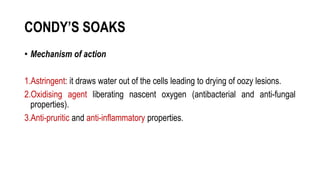
CONDY’S SOAKS
• Mechanism of action
1.Astringent: it draws water out of the cells leading to drying of oozy lesions.
2.Oxidising agent liberating nascent oxygen (antibacterial and anti-fungal
properties).
3.Anti-pruritic and anti-inflammatory properties.
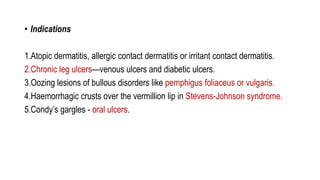
• Indications
1.Atopic dermatitis, allergic contact dermatitis or irritant contact dermatitis.
2.Chronic leg ulcers—venous ulcers and diabetic ulcers.
3.Oozing lesions of bullous disorders like pemphigus foliaceus or vulgaris.
4.Haemorrhagic crusts over the vermillion lip in Stevens-Johnson syndrome.
5.Condy’s gargles - oral ulcers.
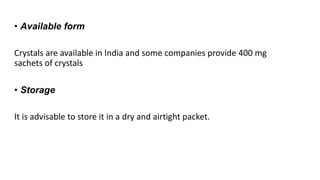
• Available form
Crystals are available in India and some companies provide 400 mg
sachets of crystals
• Storage
It is advisable to store it in a dry and airtight packet.
• Dilution : 1:10,000 (400 mg of potassium permanganate in 4 L of
water)
• clinical practice : dilute the solution to reach a colour that matches
the pink colour of ones nail bed
• contact time for soak solution should be < 15 minutes as oxidation
makes it ineffective.
• There is no need to rinse with water at the end of procedure.
Side effects and their prevention
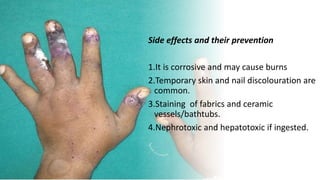
1.It is corrosive and may cause burns
2.Temporary skin and nail discolouration are
common.
3.Staining of fabrics and ceramic
vessels/bathtubs.
4.Nephrotoxic and hepatotoxic if ingested.
ACETIC ACID SOAKS
Mechanism of action
• Enhances lipid solubility, allowing accumulation of fatty acids on the cell membrane or
other cell wall structures leading to the cellular death.
• Lowers the pH thereby inhibiting bacterial carbohydrate metabolism, protease activity,
and growth of micro organisms.
• Improves tissue oxygenation and wound healing (Bohr effect).
• Bacteriostatic activity against Pseudomonas aeruginosa, Staph.aureus,
and Acinetobacter baumannii.
Indications
• Acetic acid is approved for bladder irrigation and treating otitis externa as
0.25% and 2% solution, respectively.
• Its use in dermatology is as follows:
1.Infected wounds.
2.Local wound care in patients with pemphigus vulgaris.
3.Chronic non-healing wounds, including hypergranulating wounds.
4.Reduces Staph. Colonization in atopic dermatitis/eczema
5.Vinegar sock soak for tinea pedis/onychomycosis.
6.Chloronychia.
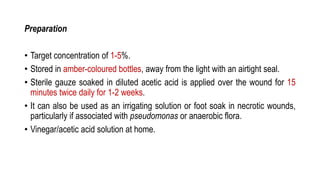
Preparation
• Target concentration of 1-5%.
• Stored in amber-coloured bottles, away from the light with an airtight seal.
• Sterile gauze soaked in diluted acetic acid is applied over the wound for 15
minutes twice daily for 1-2 weeks.
• It can also be used as an irrigating solution or foot soak in necrotic wounds,
particularly if associated with pseudomonas or anaerobic flora.
• Vinegar/acetic acid solution at home.
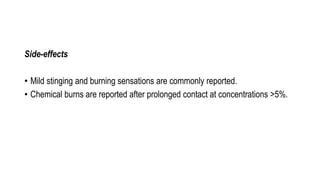
Side-effects
• Mild stinging and burning sensations are commonly reported.
• Chemical burns are reported after prolonged contact at concentrations >5%.
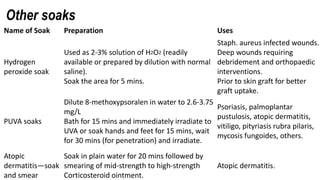
Other soaks
Name of Soak Preparation Uses
Hydrogen
peroxide soak
Used as 2-3% solution of H2O2 (readily
available or prepared by dilution with normal
saline).
Soak the area for 5 mins.
Staph. aureus infected wounds.
Deep wounds requiring
debridement and orthopaedic
interventions.
Prior to skin graft for better
graft uptake.
PUVA soaks
Dilute 8-methoxypsoralen in water to 2.6-3.75
mg/L
Bath for 15 mins and immediately irradiate to
UVA or soak hands and feet for 15 mins, wait
for 30 mins (for penetration) and irradiate.
Psoriasis, palmoplantar
pustulosis, atopic dermatitis,
vitiligo, pityriasis rubra pilaris,
mycosis fungoides, others.
Atopic
dermatitis—soak
and smear
Soak in plain water for 20 mins followed by
smearing of mid-strength to high-strength
Corticosteroid ointment.
Atopic dermatitis.
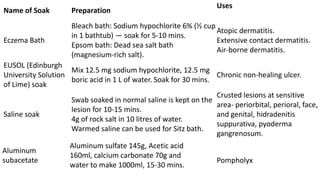
Name of Soak Preparation
Uses
Eczema Bath
Bleach bath: Sodium hypochlorite 6% (½ cup
in 1 bathtub) — soak for 5-10 mins.
Epsom bath: Dead sea salt bath
(magnesium-rich salt).
Atopic dermatitis.
Extensive contact dermatitis.
Air-borne dermatitis.
EUSOL (Edinburgh
University Solution
of Lime) soak
Mix 12.5 mg sodium hypochlorite, 12.5 mg
boric acid in 1 L of water. Soak for 30 mins.
Chronic non-healing ulcer.
Saline soak
Swab soaked in normal saline is kept on the
lesion for 10-15 mins.
4g of rock salt in 10 litres of water.
Warmed saline can be used for Sitz bath.
Crusted lesions at sensitive
area- periorbital, perioral, face,
and genital, hidradenitis
suppurativa, pyoderma
gangrenosum.
Aluminum
subacetate
Aluminum sulfate 145g, Acetic acid
160ml, calcium carbonate 70g and
water to make 1000ml, 15-30 mins.
Pompholyx
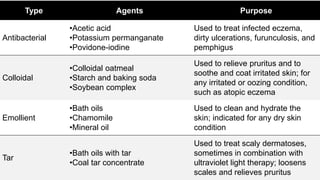
Baths
Type Agents Purpose
Antibacterial
•Acetic acid
•Potassium permanganate
•Povidone-iodine
Used to treat infected eczema,
dirty ulcerations, furunculosis, and
pemphigus
Colloidal
•Colloidal oatmeal
•Starch and baking soda
•Soybean complex
Used to relieve pruritus and to
soothe and coat irritated skin; for
any irritated or oozing condition,
such as atopic eczema
Emollient
•Bath oils
•Chamomile
•Mineral oil
Used to clean and hydrate the
skin; indicated for any dry skin
condition
Tar
•Bath oils with tar
•Coal tar concentrate
Used to treat scaly dermatoses,
sometimes in combination with
ultraviolet light therapy; loosens
scales and relieves pruritus
references
• Kayarkatte MN, Kharghoria G. Soaks and compresses in dermatology revisited. Indian J Dermatol
Venereol Leprol doi: 10.25259/IJDVL_580_2021
• IADVL Textbook of Dermatology E-Book 4th Edition by S.Sacchidanand, Chetan Oberai, and Arun
C. Inamadar
• Arndt KA Manual of Dermatologic Therapeutics With Essentials of Diagnosis Boston,
Mass Little Brown & Co Inc1989;56
• Gutman AB, Kligman AM, Sciacca J, James WD. Soak and Smear: A Standard Technique
Revisited. Arch Dermatol. 2005;141(12):1556–1559. doi:10.1001/archderm.141.12.1556
Thank you

soaks.pptx

  • 1.
  • 2.
  • 3.
    CONDY’S SOAKS • Mechanismof action 1.Astringent: it draws water out of the cells leading to drying of oozy lesions. 2.Oxidising agent liberating nascent oxygen (antibacterial and anti-fungal properties). 3.Anti-pruritic and anti-inflammatory properties.
  • 4.
    • Indications 1.Atopic dermatitis,allergic contact dermatitis or irritant contact dermatitis. 2.Chronic leg ulcers—venous ulcers and diabetic ulcers. 3.Oozing lesions of bullous disorders like pemphigus foliaceus or vulgaris. 4.Haemorrhagic crusts over the vermillion lip in Stevens-Johnson syndrome. 5.Condy’s gargles - oral ulcers.
  • 5.
    • Available form Crystalsare available in India and some companies provide 400 mg sachets of crystals • Storage It is advisable to store it in a dry and airtight packet.
  • 6.
    • Dilution :1:10,000 (400 mg of potassium permanganate in 4 L of water) • clinical practice : dilute the solution to reach a colour that matches the pink colour of ones nail bed • contact time for soak solution should be < 15 minutes as oxidation makes it ineffective. • There is no need to rinse with water at the end of procedure.
  • 7.
    Side effects andtheir prevention 1.It is corrosive and may cause burns 2.Temporary skin and nail discolouration are common. 3.Staining of fabrics and ceramic vessels/bathtubs. 4.Nephrotoxic and hepatotoxic if ingested.
  • 8.
    ACETIC ACID SOAKS Mechanismof action • Enhances lipid solubility, allowing accumulation of fatty acids on the cell membrane or other cell wall structures leading to the cellular death. • Lowers the pH thereby inhibiting bacterial carbohydrate metabolism, protease activity, and growth of micro organisms. • Improves tissue oxygenation and wound healing (Bohr effect). • Bacteriostatic activity against Pseudomonas aeruginosa, Staph.aureus, and Acinetobacter baumannii.
  • 9.
    Indications • Acetic acidis approved for bladder irrigation and treating otitis externa as 0.25% and 2% solution, respectively. • Its use in dermatology is as follows: 1.Infected wounds. 2.Local wound care in patients with pemphigus vulgaris. 3.Chronic non-healing wounds, including hypergranulating wounds. 4.Reduces Staph. Colonization in atopic dermatitis/eczema 5.Vinegar sock soak for tinea pedis/onychomycosis. 6.Chloronychia.
  • 10.
    Preparation • Target concentrationof 1-5%. • Stored in amber-coloured bottles, away from the light with an airtight seal. • Sterile gauze soaked in diluted acetic acid is applied over the wound for 15 minutes twice daily for 1-2 weeks. • It can also be used as an irrigating solution or foot soak in necrotic wounds, particularly if associated with pseudomonas or anaerobic flora. • Vinegar/acetic acid solution at home.
  • 11.
    Side-effects • Mild stingingand burning sensations are commonly reported. • Chemical burns are reported after prolonged contact at concentrations >5%.
  • 12.
    Other soaks Name ofSoak Preparation Uses Hydrogen peroxide soak Used as 2-3% solution of H2O2 (readily available or prepared by dilution with normal saline). Soak the area for 5 mins. Staph. aureus infected wounds. Deep wounds requiring debridement and orthopaedic interventions. Prior to skin graft for better graft uptake. PUVA soaks Dilute 8-methoxypsoralen in water to 2.6-3.75 mg/L Bath for 15 mins and immediately irradiate to UVA or soak hands and feet for 15 mins, wait for 30 mins (for penetration) and irradiate. Psoriasis, palmoplantar pustulosis, atopic dermatitis, vitiligo, pityriasis rubra pilaris, mycosis fungoides, others. Atopic dermatitis—soak and smear Soak in plain water for 20 mins followed by smearing of mid-strength to high-strength Corticosteroid ointment. Atopic dermatitis.
  • 13.
    Name of SoakPreparation Uses Eczema Bath Bleach bath: Sodium hypochlorite 6% (½ cup in 1 bathtub) — soak for 5-10 mins. Epsom bath: Dead sea salt bath (magnesium-rich salt). Atopic dermatitis. Extensive contact dermatitis. Air-borne dermatitis. EUSOL (Edinburgh University Solution of Lime) soak Mix 12.5 mg sodium hypochlorite, 12.5 mg boric acid in 1 L of water. Soak for 30 mins. Chronic non-healing ulcer. Saline soak Swab soaked in normal saline is kept on the lesion for 10-15 mins. 4g of rock salt in 10 litres of water. Warmed saline can be used for Sitz bath. Crusted lesions at sensitive area- periorbital, perioral, face, and genital, hidradenitis suppurativa, pyoderma gangrenosum. Aluminum subacetate Aluminum sulfate 145g, Acetic acid 160ml, calcium carbonate 70g and water to make 1000ml, 15-30 mins. Pompholyx
  • 14.
  • 15.
    Type Agents Purpose Antibacterial •Aceticacid •Potassium permanganate •Povidone-iodine Used to treat infected eczema, dirty ulcerations, furunculosis, and pemphigus Colloidal •Colloidal oatmeal •Starch and baking soda •Soybean complex Used to relieve pruritus and to soothe and coat irritated skin; for any irritated or oozing condition, such as atopic eczema Emollient •Bath oils •Chamomile •Mineral oil Used to clean and hydrate the skin; indicated for any dry skin condition Tar •Bath oils with tar •Coal tar concentrate Used to treat scaly dermatoses, sometimes in combination with ultraviolet light therapy; loosens scales and relieves pruritus
  • 16.
    references • Kayarkatte MN,Kharghoria G. Soaks and compresses in dermatology revisited. Indian J Dermatol Venereol Leprol doi: 10.25259/IJDVL_580_2021 • IADVL Textbook of Dermatology E-Book 4th Edition by S.Sacchidanand, Chetan Oberai, and Arun C. Inamadar • Arndt KA Manual of Dermatologic Therapeutics With Essentials of Diagnosis Boston, Mass Little Brown & Co Inc1989;56 • Gutman AB, Kligman AM, Sciacca J, James WD. Soak and Smear: A Standard Technique Revisited. Arch Dermatol. 2005;141(12):1556–1559. doi:10.1001/archderm.141.12.1556
  • 17.