Service Oriented Architecture: 27
REST and Restful Services
Prof Neeraj Bhargava
Vaibhav Khanna
Department of Computer Science
School of Engineering and Systems Sciences
Maharshi Dayanand Saraswati University Ajmer
Basic SOA Using REST
• The focus is “Implementing SOA components using the
REST paradigm”
• REST stands for Representational State Transfer. It was
first introduced by Roy Fielding1 in his 2000 doctoral
dissertation [Fielding].
• For simple applications, REST is an easy way to get
started
• Simple examples can be worked up, using only HTTP
and servlets, so that learners who are not advanced in
Java can come up the learning curve and get a sense of
the basics before working on the Java Web Services
(JWS) APIs.
What Is REST
• REST-style services (i.e., RESTful services) adhere to a set of
constraints and architectural principles that include the
following:
• ■ RESTful services are stateless. “Each request from client
to server must contain all the information necessary to
understand the request, and cannot take advantage of any
stored context on the server.”
• ■ RESTful services have a uniform interface. This constraint
is usually taken to mean that the only allowed operations
are the HTTP operations: GET, POST, PUT, and DELETE.
• ■ REST-based architectures are built from resources (pieces
of information) that are uniquely identified by URIs. For
example, in a RESTful purchasing system, each purchase
order has a unique URI.
What Is REST
• ■ REST components manipulate resources by exchanging
representations of the resources.
• Fielding writes that “REST-based architectures communicate
primarily through the transfer of representations of resources”
• This is fundamentally different from the Remote Procedure Call
(RPC) approach that encapsulates the notion of invoking a
procedure on the remote server.
• Hence, RPC messages typically contain information about the
procedure to be invoked or action to be taken. This information is
referred to as a verb in a Web service request. In the REST model,
the only verbs allowed are GET, POST, PUT, and DELETE.
• In the RPC approach, typically many operations are invoked at the
same URI. This is to be contrasted with the REST approach of having
a unique URI for each resource.
RESTful Web Services versus SOAP
Web Services
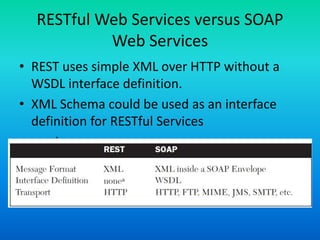
• REST uses simple XML over HTTP without a
WSDL interface definition.
• XML Schema could be used as an interface
definition for RESTful Services
• services.
SOA-style development for the
Enterprise Information System (EIS)
• Structuring EIS Records as XML documents
• ■ Getting EIS records from a REST service (with and without
JWS)
• ■ Posting EIS records to a REST service (with and without
JWS)
• ■ Basic SOA-style integration of REST services using XSLT for
data transformation
• ■ Deploying a REST service to be used for getting EIS
records—in other words, an HTTP GET service (with and
without JWS)
• ■ Deploying a REST service to be used for posting EIS
records—in other words, an HTTP POST service (with and
without JWS)
XML Documents and Schema for EIS
Records
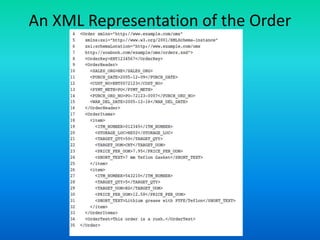
• The first step toward implementing an SOA component that
consumes or provides EIS records involves formatting the EIS
records that need to be exchanged as XML documents.
• This process is formalized by creating an XML Schema to represent
the structure of an XML document for a particular EIS record.
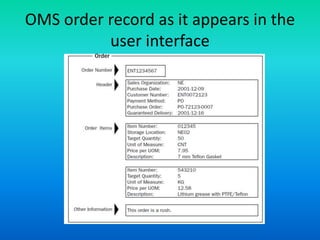
• XYZ Corporation has an Order Management System (OMS) that
needs to be integrated with a Customer Service System (CSS).
• The OMS should be thought of as an EIS, such as SAP, for taking
customer orders and tracking them through delivery.
• The CSS should be thought of as an EIS, such as Oracle’s Siebel
Customer Relationship Management Applications, that is used by
customer service employees as a tool for handling customer
inquiries.
OMS order record as it appears in the
user interface
An XML Representation of the Order
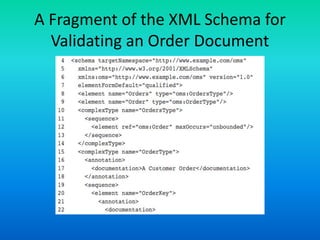
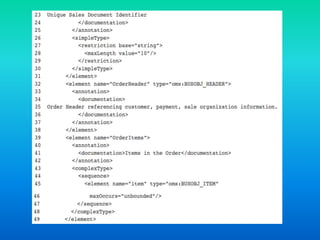
A Fragment of the XML Schema for
Validating an Order Document
Assignment
• Explain the usage and benefits of Restful
Services for implementing SOA

Soa 27 rest and restful services

  • 1.
    Service Oriented Architecture:27 REST and Restful Services Prof Neeraj Bhargava Vaibhav Khanna Department of Computer Science School of Engineering and Systems Sciences Maharshi Dayanand Saraswati University Ajmer
  • 2.
    Basic SOA UsingREST • The focus is “Implementing SOA components using the REST paradigm” • REST stands for Representational State Transfer. It was first introduced by Roy Fielding1 in his 2000 doctoral dissertation [Fielding]. • For simple applications, REST is an easy way to get started • Simple examples can be worked up, using only HTTP and servlets, so that learners who are not advanced in Java can come up the learning curve and get a sense of the basics before working on the Java Web Services (JWS) APIs.
  • 3.
    What Is REST •REST-style services (i.e., RESTful services) adhere to a set of constraints and architectural principles that include the following: • ■ RESTful services are stateless. “Each request from client to server must contain all the information necessary to understand the request, and cannot take advantage of any stored context on the server.” • ■ RESTful services have a uniform interface. This constraint is usually taken to mean that the only allowed operations are the HTTP operations: GET, POST, PUT, and DELETE. • ■ REST-based architectures are built from resources (pieces of information) that are uniquely identified by URIs. For example, in a RESTful purchasing system, each purchase order has a unique URI.
  • 4.
    What Is REST •■ REST components manipulate resources by exchanging representations of the resources. • Fielding writes that “REST-based architectures communicate primarily through the transfer of representations of resources” • This is fundamentally different from the Remote Procedure Call (RPC) approach that encapsulates the notion of invoking a procedure on the remote server. • Hence, RPC messages typically contain information about the procedure to be invoked or action to be taken. This information is referred to as a verb in a Web service request. In the REST model, the only verbs allowed are GET, POST, PUT, and DELETE. • In the RPC approach, typically many operations are invoked at the same URI. This is to be contrasted with the REST approach of having a unique URI for each resource.
  • 5.
    RESTful Web Servicesversus SOAP Web Services • REST uses simple XML over HTTP without a WSDL interface definition. • XML Schema could be used as an interface definition for RESTful Services • services.
  • 6.
    SOA-style development forthe Enterprise Information System (EIS) • Structuring EIS Records as XML documents • ■ Getting EIS records from a REST service (with and without JWS) • ■ Posting EIS records to a REST service (with and without JWS) • ■ Basic SOA-style integration of REST services using XSLT for data transformation • ■ Deploying a REST service to be used for getting EIS records—in other words, an HTTP GET service (with and without JWS) • ■ Deploying a REST service to be used for posting EIS records—in other words, an HTTP POST service (with and without JWS)
  • 7.
    XML Documents andSchema for EIS Records • The first step toward implementing an SOA component that consumes or provides EIS records involves formatting the EIS records that need to be exchanged as XML documents. • This process is formalized by creating an XML Schema to represent the structure of an XML document for a particular EIS record. • XYZ Corporation has an Order Management System (OMS) that needs to be integrated with a Customer Service System (CSS). • The OMS should be thought of as an EIS, such as SAP, for taking customer orders and tracking them through delivery. • The CSS should be thought of as an EIS, such as Oracle’s Siebel Customer Relationship Management Applications, that is used by customer service employees as a tool for handling customer inquiries.
  • 8.
    OMS order recordas it appears in the user interface
  • 9.
  • 10.
    A Fragment ofthe XML Schema for Validating an Order Document
  • 12.
    Assignment • Explain theusage and benefits of Restful Services for implementing SOA