Palmeet Kour , Jaswinder Kour, Diksha Mahajan
Research Cell: An International Journal of Engineering Science, Special Issue December 2017, Vol. 26,
UGC Approved Journal (S.No.63019)
ISSN: 2229-6913(Print), ISSN: 2320-0332(Online), Web Presence: http://ijoe.vidyapublications.com
© 2017 Vidya Publications. Authors are responsible for any plagiarism issues.
1
A Study of Web Services and its implications
1
Palmeet kour, 2
Jaswinder Kour, 2
Diksha Mahajan
1
Lecturer, 2
Assistant Professor, 3
Assistant Professor
1
P.G Department of Computer Science, MBSCET Jammu
2
Department of Information Technology, MBSCET Jammu
3
Department of HSS, MBSCET Jammu
1
rainsonia@gmail.com, 2
nishakour@gmail.com, 3
erdiksha@gmail.com
ABSTRACT
Web services provide most recent style in mobile wireless world and proved as an innovative
and most excellent continually growing technology for wireless applications in communication.
In today’s scenario the most vital need is to supply unremitting, constant, trivial web services to
resource constrained tool in mobile world and they are used to generate necessities with the help
of Web services, as well as to appraise obtainable technologies. This paper presents a
comprehensive assessment of two distinct structures that are suitable for providing web services
via SOAP and REST and shows the pros and cons in these frameworks. This evaluation helps us
to get an insight of these two technologies which helps in evaluating which one is appropriate for
wireless environment. In today scenario SOAP is being used in the enterprise applications,
generally in the legacy code and now the world is moving fast towards the REST’ful Web
Services.
Keywords— Web Services, Wireless, SOAP, REST,REST’ful
INTRODUCTION
Together, the XML data representation format and the HTTP communication protocol provide a
powerful foundation for building Web Services. Web Services makes services available on a
network using technology such as XML and HTTP. The basic vision of Web services is that they
support service- oriented architectures that are development of large scale applications from
distributed collections of loosely coupled service providers. Compared to other frameworks for
developing distributed systems, such as CORBA, DCOM or Java/RMI, these are mainly
applicable in highly coupled distributed systems, in which both client servers are equally
interdependent. Problems like security and compatibility takes place when one uses these
technologies. Web services are platform unbiased and usually text dependent which can be
developed, executed and accessed on heterogeneous technologies. So these are interoperable
Web service can be built using two ways: Standard SOAP based web services and REST’ful
Web service. REST’ful web services are based on the defined REST principle for distributed
hypermedia [1] systems. REST is an architectural approach for distributed hypermedia systems
first described in Roy Fielding in thesis for PhD [2]. The aim of this paper is to make a detailed
and comparative study of both the technologies SOAP and REST’ful web services to show that
REST’ful web services has excellent performance when compared with SOAP.
Palmeet Kour , Jaswinder Kour, Diksha Mahajan
Research Cell: An International Journal of Engineering Science, Special Issue December 2017, Vol. 26,
UGC Approved Journal (S.No.63019)
ISSN: 2229-6913(Print), ISSN: 2320-0332(Online), Web Presence: http://ijoe.vidyapublications.com
© 2017 Vidya Publications. Authors are responsible for any plagiarism issues.
2
SOAP WEB SERVICES
SOAP depends on XML to give messaging services. Middleware technologies like CORBA or
ICE are faster than SOAP due to its XML format. These technologies not successful because
they rely on binary messaging. SOAP employed XML messaging works better over the Internet.
SOAP describes a standard communication protocol specification for XML-based message
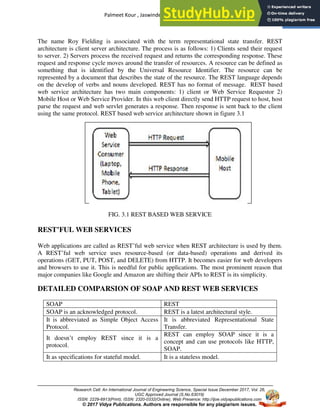
exchange. The architecture of SOAP based web service is shown in fig 2.1 which shows three
different entities: i) Service Requester ii) Service Registry iii) Service Provider. A service
registry is a directory based on network which encloses all the services which are available. The
service provider is the service entity which has a network address. It accepts the requests from
the consumer and processes them. The service consumer can be an application, a service or some
type of software component which require a service. The SOAP and XML protocol manages the
communication amongst these entities. The XML document is read as a SOAP message by the
envelope elements. Information of call and response is in header element. Messages invocation
are identified as XML documents and are sent on the network with the help of a transport
protocol SMTP, FTP, HTTP.
Fig. 2.1 SOAP Web service architecture
SOAP is extremely extensible for other protocols and technologies. Additionally SOAP
supports WS-Addressing, WS-Coordination, WS-Reliable Messaging, and a host of other web
services standards. While it’s rarely needed, some use cases need better transactional reliability
than what can be realized with HTTP if one needs ACID-compliant transactions, SOAP is the
solution. Web services carry complex operations, require content and context to be conserve.
SOAP necessitates less coding in the application layer for transactions, security, trust, and other
basics. SOAP is excellent for those applications which need formal convention flanked by the
applications and consumers. SOAP can implement the formal convention by means of WSDL
(Web Services Description Language). SOAP has an inbuilt security as it has WS-Reliable
messaging .Lastly, SOAP has built-in stateful operations.
Palmeet Kour , Jaswinder Kour, Diksha Mahajan
Research Cell: An International Journal of Engineering Science, Special Issue December 2017, Vol. 26,
UGC Approved Journal (S.No.63019)
ISSN: 2229-6913(Print), ISSN: 2320-0332(Online), Web Presence: http://ijoe.vidyapublications.com
© 2017 Vidya Publications. Authors are responsible for any plagiarism issues.
3
The name Roy Fielding is associated with the term representational state transfer. REST
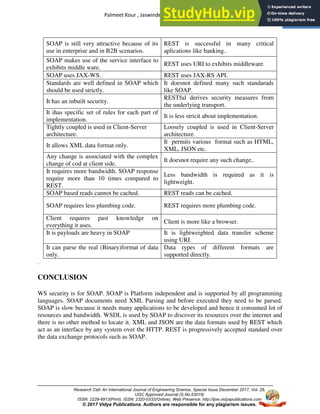
architecture is client server architecture. The process is as follows: 1) Clients send their request
to server. 2) Servers process the received request and returns the corresponding response. These
request and response cycle moves around the transfer of resources. A resource can be defined as
something that is identified by the Universal Resource Identifier. The resource can be
represented by a document that describes the state of the resource. The REST language depends
on the develop of verbs and nouns developed. REST has no format of message. REST based
web service architecture has two main components: 1) client or Web Service Requestor 2)
Mobile Host or Web Service Provider. In this web client directly send HTTP request to host, host
parse the request and web servlet generates a response. Then response is sent back to the client
using the same protocol. REST based web service architecture shown in figure 3.1
FIG. 3.1 REST BASED WEB SERVICE
REST’FUL WEB SERVICES
Web applications are called as REST’ful web service when REST architecture is used by them.
A REST’ful web service uses resource-based (or data-based) operations and derived its
operations (GET, PUT, POST, and DELETE) from HTTP. It becomes easier for web developers
and browsers to use it. This is needful for public applications. The most prominent reason that
major companies like Google and Amazon are shifting their APIs to REST is its simplicity.
DETAILED COMPARSION OF SOAP AND REST WEB SERVICES
SOAP REST
SOAP is an acknowledged protocol. REST is a latest architectural style.
It is abbreviated as Simple Object Access
Protocol.
It is abbreviated Representational State
Transfer.
It doesn’t employ REST since it is a
protocol.
REST can employ SOAP since it is a
concept and can use protocols like HTTP,
SOAP.
It as specifications for stateful model. It is a stateless model.
Palmeet Kour , Jaswinder Kour, Diksha Mahajan
Research Cell: An International Journal of Engineering Science, Special Issue December 2017, Vol. 26,
UGC Approved Journal (S.No.63019)
ISSN: 2229-6913(Print), ISSN: 2320-0332(Online), Web Presence: http://ijoe.vidyapublications.com
© 2017 Vidya Publications. Authors are responsible for any plagiarism issues.
4
.
CONCLUSION
WS security is for SOAP. SOAP is Platform independent and is supported by all programming
languages. SOAP documents need XML Parsing and before executed they need to be parsed.
SOAP is slow because it needs many applications to be developed and hence it consumed lot of
resources and bandwidth. WSDL is used by SOAP to discover its resources over the internet and
there is no other method to locate it. XML and JSON are the data formats used by REST which
act as an interface by any system over the HTTP. REST is progressively accepted standard over
the data exchange protocols such as SOAP.
SOAP is still very attractive because of its
use in enterprise and in B2B scenarios.
REST is successful in many critical
aplications like banking..
SOAP makes use of the service interface to
exhibits middle ware.
REST uses URI to exhibits middleware.
SOAP uses JAX-WS. REST uses JAX-RS API.
Standards are well defined in SOAP which
should be used strictly.
It doesnot defined many such standarads
like SOAP.
It has an inbuilt security.
RESTful derives security measures from
the underlying transport.
It ihas specific set of rules for each part of
implementation.
It is less stricit about implementation.
Tightly coupled is used in Client-Server
architecture.
Loosely coupled is used in Client-Server
architecture.
It allows XML data format only.
It permits various format such as HTML,
XML, JSON etc.
Any change is associated with the complex
change of cod at client side.
It doesnot require any such change..
It requires more bandwidth. SOAP response
require more than 10 times compared to
REST.
Less bandwidth is required as it is
lightweight.
SOAP based reads cannot be cached. REST reads can be cached.
SOAP requires less plumbing code. REST requires more plumbing code.
Client requires past knowledge on
everything it uses.
Client is more like a browser.
It is payloads are heavy in SOAP It is lightweighted data transfer scheme
using URI.
It can parse the real (Binary)format of data
only.
Data types of different formats are
supported directly.
Palmeet Kour , Jaswinder Kour, Diksha Mahajan
Research Cell: An International Journal of Engineering Science, Special Issue December 2017, Vol. 26,
UGC Approved Journal (S.No.63019)
ISSN: 2229-6913(Print), ISSN: 2320-0332(Online), Web Presence: http://ijoe.vidyapublications.com
© 2017 Vidya Publications. Authors are responsible for any plagiarism issues.
5
REFERNCES
[1] Https://en.wikipedia.org/wiki/HATEOAS
[2] R. Fielding.. “Architectural Styles and the Design of Network-based Software Architectures”,
PhD thesis, University of California, Irvine, USA, 2000.
[3] C. Pautasso,O. Zimmermann and F Leymann, “REST’ful Web Services vs. “Big” Web
Services: Making the Right Architectural Decision.”, 17th international conference on World
Wide Web, Beijing, China, ACM Press, pp. 805-814, 2008.
[4] James Nahon, “A Comparative Analysis of REST and SOAP.”, Ph.D. Dissertation, 2011.
K. Waghand Dr. R. Thool, “A Comparative Study of SOAP Vs REST Web Services
Provisioning Techniques for Mobile Host,” Journal of Information Engineering and
Applications, Vol 2, No.5, 2012.
[5] H .Hamad, M. Saad, and R. Abed, “Performance Evaluation of RESTful Web Services for
Mobile Devices”. Int. Arab J. e-Technol. Vol.1, No.3, pp. 72-78, . 2010.
[6] S. Mumbaikar, P. Padiya “Web services based on REST and SOAP principles”International
Journal of Scientific and Research Publications, Vol 3, Issue 5 , 2013.
[7] A. Dudhe, S.S. Sherekar, “Performance Analysis of SOAP and REST’ful Mobile Web
Services in Cloud Environment”. International Journal of Computer Applications (0975 – 8887)
2014.

A Study Of Web Services And Its Implications

  • 1.
    Palmeet Kour ,Jaswinder Kour, Diksha Mahajan Research Cell: An International Journal of Engineering Science, Special Issue December 2017, Vol. 26, UGC Approved Journal (S.No.63019) ISSN: 2229-6913(Print), ISSN: 2320-0332(Online), Web Presence: http://ijoe.vidyapublications.com © 2017 Vidya Publications. Authors are responsible for any plagiarism issues. 1 A Study of Web Services and its implications 1 Palmeet kour, 2 Jaswinder Kour, 2 Diksha Mahajan 1 Lecturer, 2 Assistant Professor, 3 Assistant Professor 1 P.G Department of Computer Science, MBSCET Jammu 2 Department of Information Technology, MBSCET Jammu 3 Department of HSS, MBSCET Jammu 1 rainsonia@gmail.com, 2 nishakour@gmail.com, 3 erdiksha@gmail.com ABSTRACT Web services provide most recent style in mobile wireless world and proved as an innovative and most excellent continually growing technology for wireless applications in communication. In today’s scenario the most vital need is to supply unremitting, constant, trivial web services to resource constrained tool in mobile world and they are used to generate necessities with the help of Web services, as well as to appraise obtainable technologies. This paper presents a comprehensive assessment of two distinct structures that are suitable for providing web services via SOAP and REST and shows the pros and cons in these frameworks. This evaluation helps us to get an insight of these two technologies which helps in evaluating which one is appropriate for wireless environment. In today scenario SOAP is being used in the enterprise applications, generally in the legacy code and now the world is moving fast towards the REST’ful Web Services. Keywords— Web Services, Wireless, SOAP, REST,REST’ful INTRODUCTION Together, the XML data representation format and the HTTP communication protocol provide a powerful foundation for building Web Services. Web Services makes services available on a network using technology such as XML and HTTP. The basic vision of Web services is that they support service- oriented architectures that are development of large scale applications from distributed collections of loosely coupled service providers. Compared to other frameworks for developing distributed systems, such as CORBA, DCOM or Java/RMI, these are mainly applicable in highly coupled distributed systems, in which both client servers are equally interdependent. Problems like security and compatibility takes place when one uses these technologies. Web services are platform unbiased and usually text dependent which can be developed, executed and accessed on heterogeneous technologies. So these are interoperable Web service can be built using two ways: Standard SOAP based web services and REST’ful Web service. REST’ful web services are based on the defined REST principle for distributed hypermedia [1] systems. REST is an architectural approach for distributed hypermedia systems first described in Roy Fielding in thesis for PhD [2]. The aim of this paper is to make a detailed and comparative study of both the technologies SOAP and REST’ful web services to show that REST’ful web services has excellent performance when compared with SOAP.
  • 2.
    Palmeet Kour ,Jaswinder Kour, Diksha Mahajan Research Cell: An International Journal of Engineering Science, Special Issue December 2017, Vol. 26, UGC Approved Journal (S.No.63019) ISSN: 2229-6913(Print), ISSN: 2320-0332(Online), Web Presence: http://ijoe.vidyapublications.com © 2017 Vidya Publications. Authors are responsible for any plagiarism issues. 2 SOAP WEB SERVICES SOAP depends on XML to give messaging services. Middleware technologies like CORBA or ICE are faster than SOAP due to its XML format. These technologies not successful because they rely on binary messaging. SOAP employed XML messaging works better over the Internet. SOAP describes a standard communication protocol specification for XML-based message exchange. The architecture of SOAP based web service is shown in fig 2.1 which shows three different entities: i) Service Requester ii) Service Registry iii) Service Provider. A service registry is a directory based on network which encloses all the services which are available. The service provider is the service entity which has a network address. It accepts the requests from the consumer and processes them. The service consumer can be an application, a service or some type of software component which require a service. The SOAP and XML protocol manages the communication amongst these entities. The XML document is read as a SOAP message by the envelope elements. Information of call and response is in header element. Messages invocation are identified as XML documents and are sent on the network with the help of a transport protocol SMTP, FTP, HTTP. Fig. 2.1 SOAP Web service architecture SOAP is extremely extensible for other protocols and technologies. Additionally SOAP supports WS-Addressing, WS-Coordination, WS-Reliable Messaging, and a host of other web services standards. While it’s rarely needed, some use cases need better transactional reliability than what can be realized with HTTP if one needs ACID-compliant transactions, SOAP is the solution. Web services carry complex operations, require content and context to be conserve. SOAP necessitates less coding in the application layer for transactions, security, trust, and other basics. SOAP is excellent for those applications which need formal convention flanked by the applications and consumers. SOAP can implement the formal convention by means of WSDL (Web Services Description Language). SOAP has an inbuilt security as it has WS-Reliable messaging .Lastly, SOAP has built-in stateful operations.
  • 3.
    Palmeet Kour ,Jaswinder Kour, Diksha Mahajan Research Cell: An International Journal of Engineering Science, Special Issue December 2017, Vol. 26, UGC Approved Journal (S.No.63019) ISSN: 2229-6913(Print), ISSN: 2320-0332(Online), Web Presence: http://ijoe.vidyapublications.com © 2017 Vidya Publications. Authors are responsible for any plagiarism issues. 3 The name Roy Fielding is associated with the term representational state transfer. REST architecture is client server architecture. The process is as follows: 1) Clients send their request to server. 2) Servers process the received request and returns the corresponding response. These request and response cycle moves around the transfer of resources. A resource can be defined as something that is identified by the Universal Resource Identifier. The resource can be represented by a document that describes the state of the resource. The REST language depends on the develop of verbs and nouns developed. REST has no format of message. REST based web service architecture has two main components: 1) client or Web Service Requestor 2) Mobile Host or Web Service Provider. In this web client directly send HTTP request to host, host parse the request and web servlet generates a response. Then response is sent back to the client using the same protocol. REST based web service architecture shown in figure 3.1 FIG. 3.1 REST BASED WEB SERVICE REST’FUL WEB SERVICES Web applications are called as REST’ful web service when REST architecture is used by them. A REST’ful web service uses resource-based (or data-based) operations and derived its operations (GET, PUT, POST, and DELETE) from HTTP. It becomes easier for web developers and browsers to use it. This is needful for public applications. The most prominent reason that major companies like Google and Amazon are shifting their APIs to REST is its simplicity. DETAILED COMPARSION OF SOAP AND REST WEB SERVICES SOAP REST SOAP is an acknowledged protocol. REST is a latest architectural style. It is abbreviated as Simple Object Access Protocol. It is abbreviated Representational State Transfer. It doesn’t employ REST since it is a protocol. REST can employ SOAP since it is a concept and can use protocols like HTTP, SOAP. It as specifications for stateful model. It is a stateless model.
  • 4.
    Palmeet Kour ,Jaswinder Kour, Diksha Mahajan Research Cell: An International Journal of Engineering Science, Special Issue December 2017, Vol. 26, UGC Approved Journal (S.No.63019) ISSN: 2229-6913(Print), ISSN: 2320-0332(Online), Web Presence: http://ijoe.vidyapublications.com © 2017 Vidya Publications. Authors are responsible for any plagiarism issues. 4 . CONCLUSION WS security is for SOAP. SOAP is Platform independent and is supported by all programming languages. SOAP documents need XML Parsing and before executed they need to be parsed. SOAP is slow because it needs many applications to be developed and hence it consumed lot of resources and bandwidth. WSDL is used by SOAP to discover its resources over the internet and there is no other method to locate it. XML and JSON are the data formats used by REST which act as an interface by any system over the HTTP. REST is progressively accepted standard over the data exchange protocols such as SOAP. SOAP is still very attractive because of its use in enterprise and in B2B scenarios. REST is successful in many critical aplications like banking.. SOAP makes use of the service interface to exhibits middle ware. REST uses URI to exhibits middleware. SOAP uses JAX-WS. REST uses JAX-RS API. Standards are well defined in SOAP which should be used strictly. It doesnot defined many such standarads like SOAP. It has an inbuilt security. RESTful derives security measures from the underlying transport. It ihas specific set of rules for each part of implementation. It is less stricit about implementation. Tightly coupled is used in Client-Server architecture. Loosely coupled is used in Client-Server architecture. It allows XML data format only. It permits various format such as HTML, XML, JSON etc. Any change is associated with the complex change of cod at client side. It doesnot require any such change.. It requires more bandwidth. SOAP response require more than 10 times compared to REST. Less bandwidth is required as it is lightweight. SOAP based reads cannot be cached. REST reads can be cached. SOAP requires less plumbing code. REST requires more plumbing code. Client requires past knowledge on everything it uses. Client is more like a browser. It is payloads are heavy in SOAP It is lightweighted data transfer scheme using URI. It can parse the real (Binary)format of data only. Data types of different formats are supported directly.
  • 5.
    Palmeet Kour ,Jaswinder Kour, Diksha Mahajan Research Cell: An International Journal of Engineering Science, Special Issue December 2017, Vol. 26, UGC Approved Journal (S.No.63019) ISSN: 2229-6913(Print), ISSN: 2320-0332(Online), Web Presence: http://ijoe.vidyapublications.com © 2017 Vidya Publications. Authors are responsible for any plagiarism issues. 5 REFERNCES [1] Https://en.wikipedia.org/wiki/HATEOAS [2] R. Fielding.. “Architectural Styles and the Design of Network-based Software Architectures”, PhD thesis, University of California, Irvine, USA, 2000. [3] C. Pautasso,O. Zimmermann and F Leymann, “REST’ful Web Services vs. “Big” Web Services: Making the Right Architectural Decision.”, 17th international conference on World Wide Web, Beijing, China, ACM Press, pp. 805-814, 2008. [4] James Nahon, “A Comparative Analysis of REST and SOAP.”, Ph.D. Dissertation, 2011. K. Waghand Dr. R. Thool, “A Comparative Study of SOAP Vs REST Web Services Provisioning Techniques for Mobile Host,” Journal of Information Engineering and Applications, Vol 2, No.5, 2012. [5] H .Hamad, M. Saad, and R. Abed, “Performance Evaluation of RESTful Web Services for Mobile Devices”. Int. Arab J. e-Technol. Vol.1, No.3, pp. 72-78, . 2010. [6] S. Mumbaikar, P. Padiya “Web services based on REST and SOAP principles”International Journal of Scientific and Research Publications, Vol 3, Issue 5 , 2013. [7] A. Dudhe, S.S. Sherekar, “Performance Analysis of SOAP and REST’ful Mobile Web Services in Cloud Environment”. International Journal of Computer Applications (0975 – 8887) 2014.