Openstack Operations Guide 1st Edition Tom Fifield Diane Fleming
1.
Openstack Operations Guide1st Edition Tom
Fifield Diane Fleming download
https://ebookbell.com/product/openstack-operations-guide-1st-
edition-tom-fifield-diane-fleming-4656184
Explore and download more ebooks at ebookbell.com
2.
Here are somerecommended products that we believe you will be
interested in. You can click the link to download.
Openstack Operations Guide Tom Fifield Diane Fleming Anne Gentle Lorin
Hochstein Jonathan Proulx Everett Toews Joe Topjian
https://ebookbell.com/product/openstack-operations-guide-tom-fifield-
diane-fleming-anne-gentle-lorin-hochstein-jonathan-proulx-everett-
toews-joe-topjian-232212084
Openstack Operations Guide Tom Fifield Diane Fleming Anne Gentle
https://ebookbell.com/product/openstack-operations-guide-tom-fifield-
diane-fleming-anne-gentle-61192188
Mastering Openstack 3rd Edition Implement The Latest Techniques For
Designing And Deploying An Operational Productionready Private Cloud
Omar Khedher
https://ebookbell.com/product/mastering-openstack-3rd-edition-
implement-the-latest-techniques-for-designing-and-deploying-an-
operational-productionready-private-cloud-omar-khedher-90720030
Openstack In Action 1st Edition V K Cody Bumgardner
https://ebookbell.com/product/openstack-in-action-1st-edition-v-k-
cody-bumgardner-49560534
3.
Openstack Cloud ComputingCookbook Kevin Jackson
https://ebookbell.com/product/openstack-cloud-computing-cookbook-
kevin-jackson-2612642
Openstack For Architects 2nd Edition Ben Silverman Michael Solberg
https://ebookbell.com/product/openstack-for-architects-2nd-edition-
ben-silverman-michael-solberg-34794992
Openstack Cloud Computing Cookbook Second Edition 2nd Edition Kevin
Jackson
https://ebookbell.com/product/openstack-cloud-computing-cookbook-
second-edition-2nd-edition-kevin-jackson-4652894
Openstack Trove Amrith Kumar Douglas Shelley Auth
https://ebookbell.com/product/openstack-trove-amrith-kumar-douglas-
shelley-auth-5233940
Openstack Essentials Demystify The Cloud By Building Your Own Private
Openstack Cloud Dan Radez
https://ebookbell.com/product/openstack-essentials-demystify-the-
cloud-by-building-your-own-private-openstack-cloud-dan-radez-5472064
5.
Tom Fifield, DianeFleming, Anne Gentle,
Lorin Hochstein, Jonathan Proulx,
Everett Toews & Joe Topjian
OpenStack
Operations Guide
SET UP AND MANAGE YOUR OPENSTACK CLOUD
6.
Join the globalcommunity!
Get Involved and get more
out of OpenStack!
Take the User Survey and influence the OpenStack Roadmap
Find a local User Group near you and attend a meet up
Attend a Training Course
OVER 70
GLOBAL
USER
GROUPS
7.
by Tom Fifield,Diane Fleming, Anne Gentle, Lorin
Hochstein, Jonathan Proulx, Everett Toews, and Joe
Topjian
OpenStack Operations Guide
Acknowledgments
The OpenStack Foundationsupported the creation of this book with plane tickets to
Austin, lodging (including one adventurous evening without power after a wind‐
storm), and delicious food. For about USD $10,000, we could collaborate intensively
for a week in the same room at the Rackspace Austin office. The authors are all mem‐
bers of the OpenStack Foundation, which you can join. Go to the Foundation web
site at http://openstack.org/join.
We want to acknowledge our excellent host Rackers at Rackspace in Austin:
• Emma Richards of Rackspace Guest Relations took excellent care of our lunch
orders and even set aside a pile of sticky notes that had fallen off the walls.
• Betsy Hagemeier, a Fanatical Executive Assistant, took care of a room reshuffle
and helped us settle in for the week.
• The Real Estate team at Rackspace in Austin, also known as “The Victors,” were
super responsive.
• Adam Powell in Racker IT supplied us with bandwidth each day and second
monitors for those of us needing more screens.
• On Wednesday night we had a fun happy hour with the Austin OpenStack Meet‐
up group and Racker Katie Schmidt took great care of our group.
We also had some excellent input from outside of the room. Tim Bell from CERN
gave us feedback on the outline before we started and reviewed it mid-week. Sébas‐
tien Han has written excellent blogs and generously gave his permission for re-use.
Oisin Feeley read it, made some edits, and provided emailed feedback right when we
asked.
Inside the book sprint room with us each day was our book sprint facilitator Adam
Hyde. Without his tireless support and encouragement, we would have thought a
book of this scope was impossible in five days. Adam has proven the book sprint
xi
18.
method effectively againand again. He creates both tools and faith in collaborative
authoring at http://www.booksprints.net/.
We couldn’t have pulled it off without so much supportive help and encouragement.
xii | Acknowledgments
19.
Document Change History
Thisversion of the document replaces and obsoletes all previous versions. The fol‐
lowing table describes the most recent changes:
Revision Date Summary of Changes
2013-05-13 • Updated description of availability zones.
2013-04-02 • Fixes to ensure samples fit in page size and notes are formatted.
2013-03-22 • Stopped chunking in HTML output.
2013-03-20 • Editorial changes.
• Added glossterm tags to glossary terms.
• Cleaned up formatting in code examples.
• Removed future tense.
2013-03-11 • Moved files to OpenStack github repository.
21.
Preface
OpenStack is anopen source platform that lets you build an Infrastructure as a Ser‐
vice (IaaS) cloud that runs on commodity hardware.
Introduction to OpenStack
OpenStack believes in open source, open design, open development, all in an open
community so anyone can participate. The long-term vision for OpenStack is to pro‐
duce a ubiquitous open source cloud computing platform that meets the needs of
public and private cloud providers regardless of size. OpenStack services control large
pools of compute, storage, and networking resources throughout a data center.
Each service provides a REST API so that all these resources can be managed through
a dashboard that gives administrators control while empowering users to provision
resources through a web interface, through a command-line client, or through soft‐
ware development kits that support the API. Many OpenStack APIs are extensible,
meaning you can keep compatibility with a core set of calls while providing access to
more resources and innovating through API extensions. The OpenStack project is a
global collaboration of developers and cloud computing technologists producing the
open standard cloud computing platform for both public and private clouds. The
project aims to deliver solutions for all types of clouds by being simple to implement,
massively scalable, and feature-rich. The technology consists of a series of interrelated
projects delivering various components for a cloud infrastructure solution.
Okay, you say, OpenStack is open source cloud. Are there others? Yes, Eucalyptus of‐
fers an open source version of their private cloud offering that provides services com‐
patible with Amazon Web Services (AWS) APIs such as EC2 and S3. With Ubuntu
Server 11.10 release, OpenStack became supported by default rather than Eucalyptus
for Ubuntu Server releases. The product targets private cloud deployers who want to
maintain compatibility with Amazon Web Services by partnering with Amazon.
Apache CloudStack is another example of an open source cloud project, but it only
runs on Ubuntu 10.04. It offers computing as a core service, with connections to stor‐
xv
22.
age services. Citrixpurchased the project technology for $200 million in 2011 when
buying cloud.com, then released it to Apache in April 2012. The API compatibility
for CloudStack centers on AWS APIs.
OpenStack is designed for scalability, so you can easily add new compute and storage
resources to grow your cloud over time. Organizations such as HP and Rackspace
have built massive public clouds on top of OpenStack. OpenStack is more than a soft‐
ware package that you run as-is. It lets you integrate a number of different technolo‐
gies to construct a cloud. This approach provides great flexibility, but the number of
options might be bewildering at first.
Who This Book Is For
This guide assumes that you are familiar with the Ubuntu distribution of Linux, SQL
databases, and virtualization. You must be comfortable administering and configur‐
ing multiple Linux machines for networking. You must install and maintain a MySQL
database, and occasionally run SQL queries against it.
One of the most complex aspects of an OpenStack cloud is the networking configura‐
tion. You should be familiar with concepts such as DHCP, Linux bridges, VLANs, and
iptables. You must also have access to a network hardware expert who can configure
the switches and routers required in your OpenStack cloud.
This book is for those of you starting to run OpenStack clouds as well as those of you
who were handed a running one and want to keep it running well. Perhaps you’re on
a devops team, perhaps you are a system administrator starting to dabble in the
cloud, or maybe you want to get on that OpenStack cloud team at your company.
This book is for all of you.
How This Book Is Organized
This book is organized in two parts, the architecture decisions for designing Open‐
Stack clouds and the repeated operations for running OpenStack clouds.
Chapter 1: Provisioning and Deployment: While this book doesn’t describe installa‐
tion, we do recommend automation for deployment and configuration, discussed in
this chapter.
Chapter 2: Cloud Controller Design: The cloud controller is an invention for the sake
of consolidating and describing which services run on which nodes. The chapter dis‐
cusses hardware and network considerations as well as how to design the cloud con‐
troller for performance and separation of services.
Chapter 3: Scaling: This chapter discusses the growth of your cloud resources
through scaling and segregation considerations.
xvi | Preface
23.
Chapter 4: ComputeNodes: This chapter describes the compute nodes, which are
dedicated to run virtual machines. Some hardware choices come into play here as
well as logging and networking descriptions.
Chapter 5: Storage Decisions: Along with other architecture decisions, storage con‐
cepts within OpenStack take a lot of consideration, and this chapter lays out the
choices for you.
Chapter 6: Network Design: Your OpenStack cloud networking needs to fit into your
existing networks while also enabling the best design for your users and administra‐
tors, and this chapter gives you in-depth information about networking decisions.
Chapter 7: Example Architecture: Because of all the decisions the previous chapters
discuss, this chapter describes the decisions made for this particular book and much
of the justification for the example architecture.
Chapter 8: Lay of the Land: This chapter is written to let you get your hands wrapped
around your OpenStack cloud through command line tools and understanding what
is already set up in your cloud.
Chapter 9: Managing Projects and Users: This chapter walks through those user-
enabling processes that all admins must face to manage users, give them quotas to
parcel out resources, and so on.
Chapter 10: User-facing Operations: This chapter moves along to show you how to
use OpenStack cloud resources and train your users as well.
Chapter 11: Maintenance, Failures, and Debugging: This chapter goes into the com‐
mon failures the authors have seen while running clouds in production, including
troubleshooting.
Chapter 12: Network Troubleshooting: Because network troubleshooting is especially
difficult with virtual resources, this chapter is chock-full of helpful tips and tricks to
tracing network traffic, finding the root cause of networking failures, and debugging
related services like DHCP and DNS.
Chapter 13: Logging and Monitoring: This chapter shows you where OpenStack
places logs and how to best to read and manage logs for monitoring purposes.
Chapter 14: Backup and Recovery: This chapter describes what you need to back up
within OpenStack as well as best practices for recovering backups.
Chapter 15: Customize: When you need to get a specialized feature into OpenStack,
this chapter describes how to use DevStack to write custom middleware or a custom
scheduler to rebalance your resources.
Chapter 16: Upstream OpenStack: Because OpenStack is so, well, open, this chapter is
dedicated to helping you navigate the community and find out where you can help
and where you can get help.
Preface | xvii
24.
Chapter 17: AdvancedConfiguration: Much of OpenStack is driver-oriented, where
you can plug in different solutions to the base set of services. This chapter describes
some advanced configuration topics.
Appendix A: Use Cases: You can read a small selection of use cases from the Open‐
Stack community with some technical detail and further resources.
Appendix B: Tales From the Cryp^H^H^H^H Cloud: These are shared legendary
tales of image disappearances, VM massacres, and crazy troubleshooting techniques
to share those hard-learned lessons and wisdom.
Appendix C: Resources: So many OpenStack resources are available online due to the
fast-moving nature of the project, but there are also listed resources the authors
found helpful while learning themselves.
Glossary: A list of terms used in this book is included, which is a subset of the larger
OpenStack Glossary available online.
Why and How We Wrote This Book
We wrote this book because we have deployed and maintained OpenStack clouds for
at least a year, and wanted to be able to distribute this knowledge to others. After
months of being the point people for an OpenStack cloud, we also wanted to have a
document to hand to our system administrators so they’d know how to operate the
cloud on a daily basis — both reactively and proactively. We wanted to provide more
detailed technical information about the decisions that deployers make along the way.
We wrote this book to help you:
• Design and create an architecture for your first non-trivial OpenStack cloud. Af‐
ter you read this guide, you’ll know which questions to ask and how to organize
your compute, networking, storage resources, and the associated software pack‐
ages.
• Perform the day-to-day tasks required to administer a cloud.
We wrote this book in a Book Sprint, which is a facilitated rapid development pro‐
duction method for books. For more information see the Book Sprint site. Your
authors cobbled this book together in five days during February 2013, fueled by caf‐
feine and the best take-out food that Austin, Texas could offer.
On the first day we filled white boards with colorful sticky notes to start to shape this
nebulous book about how to architect and operate clouds.
xviii | Preface
25.
We wrote furiouslyfrom our own experiences and bounced ideas between each other.
At regular intervals we reviewed the shape and organization of the book and further
molded it, leading to what you see today.
The team includes:
• Tom Fifield. After learning about scalability in computing from particle physics
experiments like ATLAS at the LHC, Tom worked on OpenStack clouds in pro‐
duction to support the Australian public research sector. Tom currently serves as
an OpenStack community manager and works on OpenStack documentation in
his spare time.
• Diane Fleming. Diane works on the OpenStack API documentation tirelessly.
She helped out wherever she could on this project.
• Anne Gentle. Anne is the documentation coordinator for OpenStack and also
served as an individual contributor to the Google Doc Summit in 2011, working
with the Open Street Maps team. Anne has worked on doc sprints in the past
with FLOSS Manuals’ Adam Hyde facilitating. Anne lives in Austin, Texas.
• Lorin Hochstein. An academic turned software developer-slash-operator, Lorin
currently works as the Lead Architect for Cloud Services at Nimbis Services
where he deploys OpenStack for technical computing applications. He has been
working with OpenStack since the Cactus release. Previously, he worked on high-
performance computing extensions for OpenStack at University of Southern Cal‐
ifornia’s Information Sciences Institute (USC-ISI).
Preface | xix
26.
• Adam Hyde.Adam facilitated this Book Sprint. He also founded the Book Sprint
methodology and is the most experienced Book Sprint facilitator around. See
http://www.booksprints.net/ for more information. Adam founded FLOSS
Manuals—a community of some 3,000 individuals developing Free Manuals
about Free Software. He is also the founder and project manager for Booktype,
an open source project for writing, editing, and publishing books online and in
print.
• Jonathan Proulx. Jon has been piloting an OpenStack cloud as a senior technical
architect at the MIT Computer Science and Artificial Intelligence Lab for his re‐
searchers to have as much computing power as they need. He started contribu‐
ting to OpenStack documentation and reviewing the documentation so that he
could accelerate his learning.
• Everett Toews. Everett is a Developer Advocate at Rackspace making OpenStack
and the Rackspace Cloud easy to use. Sometimes developer, sometimes advocate,
and sometimes operator. He’s built web applications, taught workshops, given
presentations around the world, and deployed OpenStack for production use by
academia and business.
• Joe Topjian. Joe has designed and deployed several clouds at Cybera, where, as a
non-profit, they are building e-infrastructure to support entrepreneurs and local
researchers in Alberta, Canada. He also actively maintains and operates these
clouds as a systems architect, and his experiences have generated a wealth of
troubleshooting skills for cloud environments.
How to Contribute to This Book
The genesis of this book was an in-person event, but now that the book is in your
hands we want you to contribute to it. OpenStack documentation follows the coding
principles of iterative work, with bug logging, investigating, and fixing. We also store
the source content on Github and invite collaborators through the OpenStack Gerrit
installation, which offers reviews. For the O’Reilly edition of this book, we are using
their Atlas system which also stores source content on Github and enables collabora‐
tion among contributors.
Learn more about how to contribute to the OpenStack docs at Documentation How
To (http://wiki.openstack.org/Documentation/HowTo).
If you find a bug and can’t fix it or aren’t sure it’s really a doc bug, log a bug at Open‐
Stack Manuals (http://bugs.launchpad.net/openstack-manuals). Tag the bug under
Extra options with ops-guide tag to indicate that the bug is in this guide. You can
assign the bug to yourself if you know how to fix it. Also, a member of the OpenStack
doc-core team can triage the doc bug.
xx | Preface
27.
CHAPTER 1
Provisioning andDeployment
A critical part of a cloud’s scalability is the amount of effort that it takes to run your
cloud. To minimize the operational cost of running your cloud, set up and use an au‐
tomated deployment and configuration infrastructure.
This infrastructure includes systems to automatically install the operating system’s in‐
itial configuration and later coordinate the configuration of all services automatically
and centrally, which reduces both manual effort and chance for error.
Automated Deployment
An automated deployment system installs and configures operating systems on new
servers, without intervention, after the absolute minimum amount of manual work,
including physical racking, MAC to IP assignment, power configuration, and so on.
Typically solutions rely on wrappers around PXE boot and TFTP servers for the basic
operating system install, then hand off to an automated configuration management
system.
Ubuntu and Red Hat Linux both include mechanisms for configuring the operating
system, including preseed and kickstart, that you can use after a network boot. Typi‐
cally these are used to bootstrap an automated configuration system. Alternatively,
you can use an image-based approach for deploying the operating system, such as
systemimager. You can use both approaches with a virtualized infrastructure, such as
when you run VMs to separate your control services and physical infrastructure.
When you create a deployment plan, focus on a few vital areas because they are very
hard to modify post-deployment.
21
28.
Disk Partitioning andRAID
At the very base of any operating system are the hard drives on which the OS is in‐
stalled.
You must complete the following configurations on the server’s hard drives:
• Partitioning
• Adding to a RAID array
The simplest option is to use one hard drive with two partitions:
• File system
• Swap space
RAID is not used in this setup.
This option is not recommended for production because if the hard
drive fails, that entire server is down. Instead, we recommend that
you use more than one disk. The number of disks determine what
types of RAID arrays to build.
We recommend that you choose one of the following multiple disk options:
• Option 1: Partition all drives in the same way in a horizontal fashion, as shown
in the following diagram:
With this option, you can assign different partitions to different RAID arrays.
You can allocate partition 1 of disk one and two to the /boot partition mirror.
You can make partition 2 of all disks the root partition mirror. You can use parti‐
22 | Chapter 1: Provisioning and Deployment
29.
tion 3 ofall disks for a cinder-volumes LVM partition running on a RAID 10
array.
While you might end up with unused partitions, such as partition 1 in disk three
and four of this example, it allows for maximum utilization off disk space. I/O
performance might be an issue due to all disks being used for all tasks.
• Option 2: Add all raw disks to one large RAID array, either hardware or software
based. You can partition this large array with the boot, root, swap, and LVM
areas. This option is simple to implement and uses all partitions. However, disk
I/O might suffer.
• Option 3: Dedicate entire disks to certain partitions. For example, you could al‐
locate disk one and two entirely to the boot, root, and swap partitions under a
RAID 1 mirror. Then, allocate disk 3 and 4 entirely to the LVM partition, also
under a RAID 1 mirror. Disk I/O should be better because I/O is focused on
dedicated tasks. However, the LVM partition is much smaller.
As with most architecture choices, the right answer depends on your environment.
Network Configuration
Network configuration is a very large topic that spans multiple areas of this book. For
now, make sure that your servers can PXE boot and successfully communicate with
the deployment server.
For example, you usually cannot configure NICs for VLANs when PXE booting. Ad‐
ditionally, you usually cannot PXE boot with bonded NICs. If you run into this sce‐
nario, consider using a simple 1 GB switch in a private network on which only your
cloud communicates.
Automated Configuration
The purpose of automatic configuration management is to establish and maintain the
consistency of a system with no human intervention. You want to maintain consis‐
tency in your deployments so you can have the same cloud every time, repeatably.
Proper use of automatic configuration management tools ensures that components of
the cloud systems are in particular states, in addition to simplifying deployment, and
configuration change propagation.
These tools also make it possible to test and roll back changes, as they are fully repeat‐
able. Conveniently, a large body of work has been done by the OpenStack community
in this space. Puppet – a configuration management tool – even provides official
modules for OpenStack.
Automated Configuration | 23
30.
An integral partof a configuration management system is the items that it controls.
You should carefully consider all of the items that you want, or do not want, to be
automatically managed.
Remote Management
In our experience, most operators don’t sit right next to the servers running the
cloud, and many don’t necessarily enjoy visiting the data center. OpenStack should be
entirely remotely configurable, but sometimes not everything goes according to plan.
In this instance, having an out-of-band access into nodes running OpenStack compo‐
nents, is a boon. The IPMI protocol is the de-facto standard here, and acquiring
hardware that supports it is highly recommended to achieve that lights-out data cen‐
ter aim.
In addition, consider remote power control as well. While IPMI usually controls the
server’s power state, having remote access to the PDU that the server is plugged into
can really be useful for situations when everything seems wedged.
24 | Chapter 1: Provisioning and Deployment
31.
CHAPTER 2
Cloud ControllerDesign
OpenStack is designed to be massively horizontally scalable, which allows all services
to be distributed widely. However, to simplify this guide we have decided to discuss
services of a more central nature using the concept of a single cloud controller.
For more details about the overall architecture, see the Chapter 7.
As described in this guide, the cloud controller is a single node that hosts the databa‐
ses, message queue service, authentication and authorization service, image manage‐
ment service, user dashboard, and API endpoints.
The cloud controller provides the central management system for multi-node Open‐
Stack deployments. Typically the cloud controller manages authentication and sends
messaging to all the systems through a message queue.
For our example, the cloud controller has a collection of nova-* components that
represent the global state of the cloud, talks to services such as authentication, main‐
tains information about the cloud in a database, communicates to all compute nodes
and storage workers through a queue, and provides API access. Each service running
on a designated cloud controller may be broken out into separate nodes for scalability
or availability.
Hardware Considerations
A cloud controller’s hardware can be the same as a compute node, though you may
want to further specify based on the size and type of cloud that you run.
It’s also possible to use virtual machines for all or some of the services that the cloud
controller manages, such as the message queuing. In this guide, we assume that all
services are running directly on the cloud controller.
25
32.
To size theserver correctly, and determine whether to virtualize any part of it, you
should estimate:
• The number of instances that you expect to run
• The number of compute nodes that you have
• The number of users who will access the compute or storage services
• Whether users interact with your cloud through the REST API or the dashboard
• Whether users authenticate against an external system (such as, LDAP or Active
Directory)
• How long you expect single instances to run
Consideration Ramification
How many instances will run at
once?
Size your database server accordingly, and scale out beyond one cloud
controller if many instances will report status at the same time and
scheduling where a new instance starts up needs computing power.
How many compute nodes will
run at once?
Ensure that your messaging queue handles requests successfully and
size accordingly.
How many users will access the
API?
If many users will make multiple requests, make sure that the CPU load
for the cloud controller can handle it.
How many users will access the
dashboard?
The dashboard makes many requests, even more than the API access, so
add even more CPU if your dashboard is the main interface for your
users.
How many nova-api services do
you run at once for your cloud?
You need to size the controller with a core per service.
How long does a single instance
run?
Starting instances and deleting instances is demanding on the compute
node but also demanding on the controller node because of all the API
queries and scheduling needs.
Does your authentication system
also verify externally?
Ensure network connectivity between the cloud controller and external
authentication system are good and that the cloud controller has the
CPU power to keep up with requests.
26 | Chapter 2: Cloud Controller Design
33.
Separation of Services
Whileour example contains all central services in a single location, it is possible and
indeed often a good idea to separate services onto different physical servers. The fol‐
lowing is a list of deployment scenarios we’ve seen, and their justifications.
Run glance-*
servers on the
swift-proxy
server
This deployment felt the spare I/O on the Object Storage proxy server was sufficient,
and the Image Delivery portion of Glance benefited from being on physical hardware
and having good connectivity to the Object Storage back-end it was using.
Run a central
dedicated database
server
This deployment made a central dedicated server to provide the databases for all
services. This simplified operations by isolating database server updates, and allowed
for the simple creation of slave database servers for failover.
Run one VM per
service
This deployment ran central services on a set of servers running KVM. A dedicated VM
was created for each service (nova-scheduler, rabbitmq, database etc). This assisted
the deployment with scaling as they could tune the resources given to each virtual
machine based on the load they received (something that was not well understood
during installation).
Use an external
load balancer
This deployment had an expensive hardware load balancer in their organisation. They
ran multiple nova-api and swift-proxy servers on different physical servers and
used the load balancer to switch between them.
One choice that always comes up is whether to virtualize or not. Some services, such
as nova-compute, swift-proxy and swift-object servers, should not be virtualized.
However, control servers can often be happily virtualized - the performance penalty
can usually be offset by simply running more of the service.
Database
Most OpenStack Compute central services, and currently also the nova-compute no‐
des, use the database for stateful information. Loss of this ability leads to errors. As a
result, we recommend that you cluster your databases in some way to make them fail‐
ure tolerant.
Message Queue
Most OpenStack Compute services communicate with each other using the Message
Queue. In general, if the message queue fails or becomes inaccessible, the cluster
grinds to a halt and ends up in a “read only” state, with information stuck at the point
Separation of Services | 27
34.
where the lastmessage was sent. Accordingly, we recommend that you cluster the
message queue - and RabbitMQ has in-build abilities to do this.
Application Programming Interface (API)
All public access, whether direct, through a command line client, or through the web-
based dashboard, uses the API service. Find the API reference at http://api.open‐
stack.org/.
You must choose whether you want to support the Amazon EC2 compatibility APIs,
or just the OpenStack APIs. One issue you might encounter when running both APIs
is an inconsistent experience when referring to images and instances.
For example, the EC2 API refers to instances using IDs that contain hexadecimal
whereas the OpenStack API uses names and digits. Similarly, the EC2 API tends to
rely on DNS aliases for contacting virtual machines, as opposed to OpenStack which
typically lists IP addresses.
If OpenStack is not set up in the right way, it is simple to have scenarios where users
are unable to contact their instances due to only having an incorrect DNS alias. De‐
spite this, EC2 compatibility can assist users migrating to your cloud.
Like databases and message queues, having more than one API server is a good thing.
Traditional HTTP load balancing techniques can be used to achieve a highly available
nova-api service.
Extensions
The API Specifications (http://docs.openstack.org/api/api-specs.html) define the core
actions, capabilities, and media-types of the OpenStack API. A client can always de‐
pend on the availability of this core API and implementers are always required to
support it in its entirety. Requiring strict adherence to the core API allows clients to
rely upon a minimal level of functionality when interacting with multiple implemen‐
tations of the same API.
The OpenStack Compute API is extensible. An extension adds capabilities to an API
beyond those defined in the core. The introduction of new features, MIME types, ac‐
tions, states, headers, parameters, and resources can all be accomplished by means of
extensions to the core API. This allows the introduction of new features in the API
without requiring a version change and allows the introduction of vendor-specific ni‐
che functionality.
28 | Chapter 2: Cloud Controller Design
35.
Scheduler
Fitting various sizedvirtual machines (different flavors) into different sized physical
nova-compute nodes is a challenging problem - researched generically in Computer
Science as a packing problem.
You can use various techniques to handle this problem, one of which is to have flavor
sizes scale linearly, be a proportional fraction of your physical node capacity, though
solving this problem is out of the scope of this book. To support your scheduling
choices, OpenStack Compute provides several different types of scheduling drivers, a
full discussion of which is found in the reference manual (http://docs.openstack.org/
folsom/openstack-compute/admin/content/ch_scheduling.html).
For availability purposes, or for very large or high-schedule frequency installations,
you should consider running multiple nova-scheduler services. No special load bal‐
ancing is required, as the nova-scheduler communicates entirely using the message
queue.
Images
The OpenStack Image Catalog and Delivery service consists of two parts - glance-
api and glance-registry. The former is responsible for the delivery of images and
the compute node uses it to download images from the back-end. The latter main‐
tains the metadata information associated with virtual machine images and requires a
database.
The glance-api part is an abstraction layer that allows a choice of back-end. Cur‐
rently, it supports:
• OpenStack Object Storage. Allows you to store images as objects.
• File system. Uses any traditional file system to store the images as files.
• S3. Allows you to fetch images from Amazon S3.
• HTTP. Allows you to fetch images from a web server. You cannot write images by
using this mode.
If you have an OpenStack Object Storage service, we recommend using this as a scal‐
able place to store your images. You can also use a file system with sufficient perfor‐
mance or Amazon S3 - unless you do not need the ability to upload new images
through OpenStack.
Scheduler | 29
36.
Dashboard
The OpenStack Dashboardis implemented as a Python web application that runs in
Apache httpd. Therefore, you may treat it the same as any other web application,
provided it can reach the API servers (including their admin endpoints) over the net‐
work.
Authentication and Authorization
The concepts supporting OpenStack’s authentication and authorization are derived
from well understood and widely used systems of a similar nature. Users have creden‐
tials they can use to authenticate, and they can be a member of one or more groups
(known as projects or tenants interchangeably).
For example, a cloud administrator might be able to list all instances in the cloud,
whereas a user can only see those in their current group. Resources quotas, such as
the number of cores that can be used, disk space, and so on, are associated with a
project.
The OpenStack Identity Service (Keystone) is the point that provides the authentica‐
tion decisions and user attribute information, which is then used by the other Open‐
Stack services to perform authorization. Policy is set in the policy.json file. For infor‐
mation on how to configure these, see Chapter 9.
The Identity Service supports different plugins for back-end authentication decisions,
and storing information. These range from pure storage choices to external systems
and currently include:
• In-memory Key-Value Store
• SQL database
• PAM
• LDAP
Many deployments use the SQL database, however LDAP is also a popular choice for
those with existing authentication infrastructure that needs to be integrated.
Network Considerations
Because the cloud controller handles so many different services, it must be able to
handle the amount of traffic that hits it. For example, if you choose to host the Open‐
Stack Imaging Service on the cloud controller, the cloud controller should be able to
support the transferring of the images at an acceptable speed.
30 | Chapter 2: Cloud Controller Design
37.
As another example,if you choose to use single-host networking where the cloud
controller is the network gateway for all instances, then the Cloud Controller must
support the total amount of traffic that travels between your cloud and the public In‐
ternet.
We recommend that you use a fast NIC, such as 10 GB. You can also choose to use
two 10 GB NICs and bond them together. While you might not be able to get a full
bonded 20 GB speed, different transmission streams use different NICs. For example,
if the Cloud Controller transfers two images, each image uses a different NIC and
gets a full 10 GB of bandwidth.
Network Considerations | 31
39.
CHAPTER 3
Scaling
If yourcloud is successful, eventually you must add resources to meet the increasing
demand. OpenStack is designed to be horizontally scalable. Rather than switching to
larger servers, you procure more servers. Ideally, you scale out and load balance
among functionally-identical services.
The Starting Point
Determining the scalability of your cloud and how to improve it is an exercise with
many variables to balance. No one solution meets everyone’s scalability aims. Howev‐
er, it is helpful to track a number of metrics.
The starting point for most is the core count of your cloud. By applying some ratios,
you can gather information about the number of virtual machines (VMs) you expect
to run ((overcommit fraction × cores) / virtual cores per instance), how
much storage is required (flavor disk size × number of instances). You can
use these ratios to determine how much additional infrastructure you need to sup‐
port your cloud.
The default OpenStack flavors are:
33
40.
Name Virtual coresMemory Disk Ephemeral
m1.tiny 1 512 MB 1 GB 0 GB
m1.small 1 2 GB 10 GB 20 GB
m1.medium 2 4 GB 10 GB 40 GB
m1.large 4 8 GB 10 GB 80 GB
m1.xlarge 8 16 GB 10 GB 160 GB
Assume that the following set-up supports (200 / 2) × 16 = 1600 VM instances and
requires 80 TB of storage for /var/lib/nova/instances:
• 200 physical cores
• Most instances are size m1.medium (2 virtual cores, 50 GB of storage)
• Default CPU over-commit ratio (cpu_allocation_ratio in nova.conf) of 16:1
However, you need more than the core count alone to estimate the load that the API
services, database servers, and queue servers are likely to encounter. You must also
consider the usage patterns of your cloud.
As a specific example, compare a cloud that supports a managed web hosting plat‐
form with one running integration tests for a development project that creates one
VM per code commit. In the former, the heavy work of creating a VM happens only
every few months, whereas the latter puts constant heavy load on the cloud controller.
You must consider your average VM lifetime, as a larger number generally means less
load on the cloud controller.
Aside from the creation and termination of VMs, you must consider the impact of
users accessing the service — particularly on nova-api and its associated database.
Listing instances garners a great deal of information and, given the frequency with
which users run this operation, a cloud with a large number of users can increase the
load significantly. This can even occur without their knowledge — leaving the Open‐
Stack Dashboard instances tab open in the browser refreshes the list of VMs every 30
seconds.
After you consider these factors, you can determine how many cloud controller cores
you require. A typical 8 core, 8 GB of RAM server is sufficient for up to a rack of
compute nodes — given the above caveats.
You must also consider key hardware specifications for the performance of user VMs.
You must consider both budget and performance needs. Examples include: Storage
34 | Chapter 3: Scaling
41.
performance (spindles/core), memoryavailability (RAM/core), network bandwidth
(Gbps/core), and overall CPU performance (CPU/core).
For which metrics to track to determine how to scale your cloud, see Chapter 13.
Adding Controller Nodes
You can facilitate the horizontal expansion of your cloud by adding nodes. Adding
compute nodes is straightforward — they are easily picked up by the existing installa‐
tion. However, you must consider some important points when you design your clus‐
ter to be highly available.
Recall that a cloud controller node runs several different services. You can install
services that communicate only using the message queue internally — nova-
scheduler and nova-console — on a new server for expansion. However, other inte‐
gral parts require more care.
You should load balance user-facing services such as Dashboard, nova-api or the Ob‐
ject Storage proxy. Use any standard HTTP load balancing method (DNS round rob‐
in, hardware load balancer, software like Pound or HAProxy). One caveat with Dash‐
board is the VNC proxy, which uses the WebSocket protocol — something that a L7
load balancer might struggle with. See also Horizon session storage (http://
docs.openstack.org/developer/horizon/topics/deployment.html#session-storage).
You can configure some services, such as nova-api and glance-api, to use multiple
processes by changing a flag in their configuration file — allowing them to share
work between multiple cores on the one machine.
Several options are available for MySQL load balancing, and RabbitMQ has in-built
clustering support. Information on how to configure these and many of the other
services can be found in the Operations Section.
Segregating Your Cloud
Use one of the following OpenStack methods to segregate your cloud: cells, regions,
zones and host aggregates. Each method provides different functionality, as described
in the following table:
Adding Controller Nodes | 35
42.
Cells Regions AvailabilityZones Host Aggregates
Use when
you need
A single API endpoint
for compute, or you
require a second level
of scheduling.
Discrete regions with
separate API
endpoints and no
coordination between
regions.
Logical separation
within your nova
deployment for
physical isolation or
redundancy.
To schedule a group
of hosts with
common features.
Example A cloud with multiple
sites where you can
schedule VMs
“anywhere” or on a
particular site.
A cloud with multiple
sites, where you
schedule VMs to a
particular site and you
want a shared
infrastructure.
A single site cloud
with equipment fed
by separate power
supplies.
Scheduling to hosts
with trusted
hardware support.
Overhead
• A new service,
nova-cells
• Each cell has a
full nova
installation
except nova-
api
• A different API
endpoint for
every region.
• Each region has
a full nova
installation.
• Configuration
changes to
nova.conf
• Configuration
changes to
nova.conf
Shared
services
Keystone
nova-api
Keystone Keystone
All nova services
Keystone
All nova services
This array of options can be best divided into two — those which result in running
separate nova deployments (cells and regions), and those which merely divide a sin‐
gle deployment (availability zones and host aggregates).
Cells and Regions
OpenStack Compute cells are designed to allow running the cloud in a distributed
fashion without having to use more complicated technologies, or being invasive to
existing nova installations. Hosts in a cloud are partitioned into groups called cells.
Cells are configured in a tree. The top-level cell (“API cell”) has a host that runs the
nova-api service, but no nova-compute services. Each child cell runs all of the other
typical nova-* services found in a regular installation, except for the nova-api ser‐
vice. Each cell has its own message queue and database service, and also runs nova-
cells — which manages the communication between the API cell and child cells.
36 | Chapter 3: Scaling
43.
This allows fora single API server being used to control access to multiple cloud in‐
stallations. Introducing a second level of scheduling (the cell selection), in addition to
the regular nova-scheduler selection of hosts, provides greater flexibility to control
where virtual machines are run.
Contrast this with regions. Regions have a separate API endpoint per installation, al‐
lowing for a more discrete separation. Users wishing to run instances across sites
have to explicitly select a region. However, the additional complexity of a running a
new service is not required.
The OpenStack Dashboard (Horizon) currently only uses a single region, so one
dashboard service should be run per region. Regions are a robust way to share some
infrastructure between OpenStack Compute installations, while allowing for a high
degree of failure tolerance.
Availability Zones and Host Aggregates
You can use availability zones, host aggregates, or both to partition a nova deploy‐
ment.
Availability zones are implemented through and configured in a similar way to host
aggregates.
However, you use an availability zone and a host aggregate for different reasons:
• Availability zone. Enables you to arrange OpenStack Compute hosts into logical
groups, and provides a form of physical isolation and redundancy from other
availability zones, such as by using separate power supply or network equipment.
You define the availability zone in which a specified Compute host resides locally
on each server. An availability zone is commonly used to identify a set of servers
that have a common attribute. For instance, if some of the racks in your data cen‐
ter are on a separate power source, you can put servers in those racks in their
own availability zone. Availability zones can also help separate different classes of
hardware.
When users provision resources, they can specify from which availability zone
they would like their instance to be built. This allows cloud consumers to ensure
that their application resources are spread across disparate machines to achieve
high availability in the event of hardware failure.
• Host aggregate. Enables you to partition OpenStack Compute deployments into
logical groups for load balancing and instance distribution. You can use host ag‐
gregates to further partition an availability zone. For example, you might use host
aggregates to partition an availability zone into groups of hosts that either share
common resources, such as storage and network, or have a special property, such
as trusted computing hardware.
Segregating Your Cloud | 37
44.
A common useof host aggregates is to provide information for use with the
nova-scheduler. For example, you might use a host aggregate to group a set of
hosts that share specific flavors or images.
Previously, all services had an availability zone. Currently, only the
nova-compute service has its own availability zone. Services such as
nova-scheduler, nova-network, nova-conductor have always span‐
ned all availability zones.
When you run any of the following operations, the services appear in
their own internal availability zone (CONF.internal_service_availa‐
bility_zone):
• nova host-list (os-hosts)
• euca-describe-availability-zones verbose
• nova-manage service list
The internal availability zone is hidden in euca-describe-
availability_zones (non-verbose).
CONF.node_availability_zone has been renamed to CONF.de‐
fault_availability_zone and is only used by the nova-api and nova-
scheduler services.
CONF.node_availability_zone still works but is deprecated.
Scalable Hardware
While several resources already exist to help with deploying and installing Open‐
Stack, it’s very important to make sure you have your deployment planned out ahead
of time. This guide expects at least a rack has been set aside for the OpenStack cloud
but also offers suggestions for when and what to scale.
Hardware Procurement
“The Cloud” has been described as a volatile environment where servers can be cre‐
ated and terminated at will. While this may be true, it does not mean that your
servers must be volatile. Ensuring your cloud’s hardware is stable and configured cor‐
rectly means your cloud environment remains up and running. Basically, put effort
into creating a stable hardware environment so you can host a cloud that users may
treat as unstable and volatile.
OpenStack can be deployed on any hardware supported by an OpenStack-compatible
Linux distribution, such as Ubuntu 12.04 as used in this books’ reference architec‐
ture.
38 | Chapter 3: Scaling
45.
Hardware does nothave to be consistent, but should at least have the same type of
CPU to support instance migration.
The typical hardware recommended for use with OpenStack is the standard value-
for-money offerings that most hardware vendors stock. It should be straightforward
to divide your procurement into building blocks such as “compute,” “object storage,”
and “cloud controller,” and request as many of these as desired. Alternately should
you be unable to spend more, if you have existing servers, provided they meet your
performance requirements and virtualization technology, these are quite likely to be
able to support OpenStack.
Capacity Planning
OpenStack is designed to increase in size in a straightforward manner. Taking into
account the considerations in the Scalability chapter — particularly on the sizing of
the cloud controller — it should be possible to procure additional compute or object
storage nodes as needed. New nodes do not need to be the same specification, or even
vendor, as existing nodes.
For compute nodes, nova-scheduler will take care of differences in sizing to do with
core count and RAM amounts, however you should consider the user experience
changes with differing CPU speeds. When adding object storage nodes, a weight
should be specified that reflects the capability of the node.
Monitoring the resource usage and user growth will enable you to know when to pro‐
cure. The Monitoring chapter details some useful metrics.
Burn-in Testing
Server hardware’s chance of failure is high at the start and the end of its life. As a re‐
sult, much effort in dealing with hardware failures while in production can be avoi‐
ded by appropriate burn-in testing to attempt to trigger the early-stage failures. The
general principle is to stress the hardware to its limits. Examples of burn-in tests in‐
clude running a CPU or disk benchmark for several days.
Scalable Hardware | 39
47.
CHAPTER 4
Compute Nodes
Computenodes form the resource core of the OpenStack Compute cloud, providing
the processing, memory, network and storage resources to run instances.
CPU Choice
The type of CPU in your compute node is a very important choice. First, ensure the
CPU supports virtualization by way of VT-x for Intel chips and AMD-v for AMD
chips.
The number of cores that the CPU has also affects the decision. It’s common for cur‐
rent CPUs to have up to 12 cores. Additionally, if the CPU supports Hyper-threading,
those 12 cores are doubled to 24 cores. If you purchase a server that supports multiple
CPUs, the number of cores is further multiplied.
Whether you should enable hyper-threading on your CPUs depends upon your use
case. We recommend you do performance testing with your local workload with both
hyper-threading on and off to determine what is more appropriate in your case.
Hypervisor Choice
OpenStack Compute supports many hypervisors to various degrees, including KVM,
LXC, QEMU, UML, VMWare ESX/ESXi, Xen, PowerVM, Hyper-V.
Probably the most important factor in your choice of hypervisor is your current usage
or experience. Aside from that, there are practical concerns to do with feature parity,
documentation, and the level of community experience.
For example, KVM is the most widely adopted hypervisor in the OpenStack commu‐
nity. Besides KVM, more deployments exist running Xen, LXC, VMWare and Hyper-
41
48.
V than theothers listed — however, each of these are lacking some feature support or
the documentation on how to use them with OpenStack is out of date.
The best information available to support your choice is found on the Hypervisor
Support Matrix (https://wiki.openstack.org/wiki/HypervisorSupportMatrix), and in
the configuration reference (http://docs.openstack.org/trunk/config-reference/
content/section_compute-hypervisors.html).
It is also possible to run multiple hypervisors in a single deployment
using Host Aggregates or Cells. However, an individual compute
node can only run a single hypervisor at a time.
Instance Storage Solutions
As part of the procurement for a compute cluster, you must specify some storage for
the disk on which the instantiated instance runs. There are three main approaches to
providing this temporary-style storage, and it is important to understand the implica‐
tions of the choice.
They are:
• Off compute node storage – shared file system
• On compute node storage – shared file system
• On compute node storage – non-shared file system
In general, the questions you should be asking when selecting the storage are as fol‐
lows:
• What is the platter count you can achieve?
• Do more spindles result in better I/O despite network access?
• Which one results in the best cost-performance scenario you’re aiming for?
• How do you manage the storage operationally?
Off Compute Node Storage – Shared File System
Many operators use separate compute and storage hosts. Compute services and stor‐
age services have different requirements, compute hosts typically require more CPU
and RAM than storage hosts. Therefore, for a fixed budget, it makes sense to have
different configurations for your compute nodes and your storage nodes with com‐
pute nodes invested in CPU and RAM, and storage nodes invested in block storage.
42 | Chapter 4: Compute Nodes
49.
Also, if youuse separate compute and storage hosts then you can treat your compute
hosts as “stateless”. This simplifies maintenance for the compute hosts. As long as you
don’t have any instances currently running on a compute host, you can take it offline
or wipe it completely without having any effect on the rest of your cloud.
However, if you are more restricted in the number of physical hosts you have avail‐
able for creating your cloud and you want to be able to dedicate as many of your
hosts as possible to running instances, it makes sense to run compute and storage on
the same machines.
In this option, the disks storing the running instances are hosted in servers outside of
the compute nodes. There are also several advantages to this approach:
• If a compute node fails, instances are usually easily recoverable.
• Running a dedicated storage system can be operationally simpler.
• Being able to scale to any number of spindles.
• It may be possible to share the external storage for other purposes.
The main downsides to this approach are:
• Depending on design, heavy I/O usage from some instances can affect unrelated
instances.
• Use of the network can decrease performance.
On Compute Node Storage – Shared File System
In this option, each nova-compute node is specified with a significant amount of
disks, but a distributed file system ties the disks from each compute node into a single
mount. The main advantage of this option is that it scales to external storage when
you require additional storage.
However, this option has several downsides:
• Running a distributed file system can make you lose your data locality compared
with non-shared storage.
• Recovery of instances is complicated by depending on multiple hosts.
• The chassis size of the compute node can limit the number of spindles able to be
used in a compute node.
• Use of the network can decrease performance.
Instance Storage Solutions | 43
50.
On Compute NodeStorage – Non-shared File System
In this option, each nova-compute node is specified with enough disks to store the
instances it hosts. There are two main reasons why this is a good idea:
• Heavy I/O usage on one compute node does not affect instances on other com‐
pute nodes.
• Direct I/O access can increase performance.
This has several downsides:
• If a compute node fails, the instances running on that node are lost.
• The chassis size of the compute node can limit the number of spindles able to be
used in a compute node.
• Migrations of instances from one node to another are more complicated, and rely
on features which may not continue to be developed.
• If additional storage is required, this option does not to scale.
Issues with Live Migration
We consider live migration an integral part of the operations of the cloud. This fea‐
ture provides the ability to seamlessly move instances from one physical host to an‐
other, a necessity for performing upgrades that require reboots of the compute hosts,
but only works well with shared storage.
Live migration can be also done with non-shared storage, using a feature known as
KVM live block migration. While an earlier implementation of block-based migration
in KVM and QEMU was considered unreliable, there is a newer, more reliable imple‐
mentation of block-based live migration as of QEMU 1.4 and libvirt 1.0.2 that is also
compatible with OpenStack. However, none of the authors of this guide have first-
hand experience using live block migration.
Choice of File System
If you want to support shared storage live migration, you’ll need to configure a dis‐
tributed file system.
Possible options include:
• NFS (default for Linux)
• GlusterFS
• MooseFS
44 | Chapter 4: Compute Nodes
51.
• Lustre
We’ve seendeployments with all, and recommend you choose the one you are most
familiar with operating.
Overcommitting
OpenStack allows you to overcommit CPU and RAM on compute nodes. This allows
you to increase the number of instances you can have running on your cloud, at the
cost of reducing the performance of the instances. OpenStack Compute uses the fol‐
lowing ratios by default:
• CPU allocation ratio: 16
• RAM allocation ratio: 1.5
The default CPU allocation ratio of 16 means that the scheduler allocates up to 16
virtual cores on a node per physical core. For example, if a physical node has 12 cores,
the scheduler allocates up to 192 virtual cores to instances (such as, 48 instances, in
the case where each instance has 4 virtual cores).
Similarly, the default RAM allocation ratio of 1.5 means that the scheduler allocates
instances to a physical node as long as the total amount of RAM associated with the
instances is less than 1.5 times the amount of RAM available on the physical node.
For example, if a physical node has 48 GB of RAM, the scheduler allocates instances
to that node until the sum of the RAM associated with the instances reaches 72 GB
(such as nine instances, in the case where each instance has 8 GB of RAM).
You must select the appropriate CPU and RAM allocation ratio for your particular
use case.
Logging
Logging is detailed more fully in the section called “Logging”. However it is an im‐
portant design consideration to take into account before commencing operations of
your cloud.
OpenStack produces a great deal of useful logging information, however, in order for
it to be useful for operations purposes you should consider having a central logging
server to send logs to, and a log parsing/analysis system (such as logstash).
Networking
Networking in OpenStack is a complex, multi-faceted challenge. See Chapter 6.
Overcommitting | 45
53.
CHAPTER 5
Storage Decisions
Storageis found in many parts of the OpenStack stack, and the differing types can
cause confusion to even experienced cloud engineers. This section focuses on persis‐
tent storage options you can configure with your cloud.
OpenStack Storage Concepts
Ephemeral storage Block storage Object storage
Used to… Run operating system and
scratch space
Add additional persistent
storage to a virtual machine
(VM)
Store data, including
VM images
Accessed
through…
A file system A block device that can be
partitioned, formatted and
mounted (such as, /dev/vdc)
REST API
Accessible
from…
Within a VM Within a VM Anywhere
Managed by… OpenStack Compute (Nova) OpenStack Block Storage
(Cinder)
OpenStack Object
Storage (Swift)
Persists until… VM is terminated Deleted by user Deleted by user
47
54.
Ephemeral storage Blockstorage Object storage
Sizing determined
by…
Administrator configures
size settings, known as
flavors
Specified by user in initial
request
Amount of available
physical storage
Example of typical
usage…
10 GB first disk, 30GB
second disk
1 TB disk 10s of TBs of dataset
storage
If you only deploy the OpenStack Compute Service (nova), your users do not have
access to any form of persistent storage by default. The disks associated with VMs are
“ephemeral”, meaning that (from the user’s point of view) they effectively disappear
when a virtual machine is terminated. You must identify what type of persistent stor‐
age you want to support for your users.
Today, OpenStack clouds explicitly support two types of persistent storage: object
storage and block storage.
Object Storage
With object storage, users access binary objects through a REST API. You may be fa‐
miliar with Amazon S3, which is a well-known example of an object storage system.
If your intended users need to archive or manage large datasets, you want to provide
them with object storage. In addition, OpenStack can store your virtual machine
(VM) images inside of an object storage system, as an alternative to storing the im‐
ages on a file system.
Block Storage
Block storage (sometimes referred to as volume storage) exposes a block device to the
user. Users interact with block storage by attaching volumes to their running VM in‐
stances.
These volumes are persistent: they can be detached from one instance and re-
attached to another, and the data remains intact. Block storage is implemented in
OpenStack by the OpenStack Block Storage (Cinder) project, which supports multi‐
ple back-ends in the form of drivers. Your choice of a storage back-end must be sup‐
ported by a Block Storage driver.
Most block storage drivers allow the instance to have direct access to the underlying
storage hardware’s block device. This helps increase the overall read/write IO.
Experimental support for utilizing files as volumes began in the Folsom release. This
initially started as a reference driver for using NFS with Cinder. By Grizzly’s release,
this has expanded into a full NFS driver as well as a GlusterFS driver.
48 | Chapter 5: Storage Decisions
"And that itdisplaces twenty-eight tons, or in other words 56,000
lbs., and that consequently it floats!"
Ah! what stress the worthy man laid on the verb "float!" And it was
true! All, yes! all these savants had forgotten this fundamental law,
namely, that on account of its specific lightness, the projectile, after
having been drawn by its fall to the greatest depths of the ocean,
must naturally return to the surface. And now it was floating quietly
at the mercy of the waves.
The boats were put to sea. J. T. Maston and his friends had rushed
into them! Excitement was at its height! Every heart beat loudly
whilst they advanced to the projectile. What did it contain? Living or
dead? Living, yes! living, at least unless death had struck Barbicane
and his two friends since they had hoisted the flag. Profound silence
reigned on the boats. All were breathless. Eyes no longer saw. One
of the scuttles of the projectile was open. Some pieces of glass
remained in the frame, showing that it had been broken. This scuttle
was actually five feet above the water.
A boat came alongside, that of J. T. Maston, and J. T. Maston rushed
to the broken window.
At that moment they heard a clear and merry voice, the voice of
Michel Ardan, exclaiming in an accent of triumph,—
"White all, Barbicane, white all!"
Barbicane, Michel Ardan, and Nicholl were playing at dominoes!
CHAPTER XXIII.
THE END
Wemay remember the intense sympathy which had accompanied
the travellers on their departure. If at the beginning of the
enterprise they had excited such emotion both in the old and new
world, with what enthusiasm would they be received on their return!
The millions of spectators which had beset the peninsula of Florida,
would they not rush to meet these sublime adventurers? Those
legions of strangers, hurrying from all parts of the globe towards the
American shores, would they leave the Union without having seen
Barbicane, Nicholl, and Michel Ardan? No! and the ardent passion of
the public was bound to respond worthily to the greatness of the
enterprise. Human creatures who had left the terrestrial sphere, and
returned after this strange voyage into celestial space, could not fail
to be received as the prophet Elias would be if he came back to
earth. To see them first, and then to hear them, such was the
universal longing.
Barbicane, Michel Ardan, Nicholl, and the delegates of the Gun Club,
returning without delay to Baltimore, were received with
indescribable enthusiasm. The notes of President Barbicane's voyage
were ready to be given to the public. The New York Herald bought
the manuscript at a price not yet known, but which must have been
very high. Indeed, during the publication of "A Journey to the
Moon," the sale of this paper amounted to five millions of copies.
Three days after the return of the travellers to the earth, the
slightest detail of their expedition was known. There remained
nothing more but to see the heroes of this superhuman enterprise.
61.
The expedition ofBarbicane and his friends round the moon had
enabled them to correct the many admitted theories regarding the
terrestrial satellite. These savants had observed de visu, and under
particular circumstances. They knew what systems should be
rejected, what retained with regard to the formation of that orb, its
origin, its habitability. Its past, present, and future had even given
up their last secrets. Who could advance objections against
conscientious observers, who at less than twenty-four miles distance
had marked that curious mountain of Tycho, the strangest system of
lunar orography? How answer those savants whose sight had
penetrated the abyss of Pluto's circle? How contradict those bold
ones whom the chances of their enterprise had borne over that
invisible face of the disc, which no human eye until then had ever
seen? It was now their turn to impose some limit on that
Selenographic science, which had reconstructed the lunar world as
Cuvier did the skeleton of a fossil, and say, "The moon was this, a
habitable world, inhabited before the earth! The moon is that, a
world uninhabitable, and now uninhabited."
To celebrate the return of its most illustrious member and his two
companions, the Gun Club decided upon giving a banquet, but a
banquet worthy of the conquerors, worthy of the American people,
and under such conditions that all the inhabitants of the Union could
directly take part in it.
All the head lines of railroads in the State were joined by flying rails;
and on all the platforms, lined with the same flags, and decorated
with the same ornaments, were tables laid and all served alike. At
certain hours, successively calculated, marked by electric clocks
which beat the seconds at the same time, the population were
invited to take their place at the banquet tables. For four days, from
the 5th to the 9th of January, the trains were stopped as they are on
Sundays on the railways of the United States, and every road was
open. One engine only at full speed, drawing a triumphal carriage,
had the right of travelling for those four days on the railroads of the
United States. The engine was manned by a driver and a stoker, and
62.
bore, by specialfavour, the Hon. J. T. Maston, Secretary of the Gun
Club. The carriage was reserved for President Barbicane, Colonel
Nicholl, and Michel Ardan. At the whistle of the driver, amid the
hurrahs, and all the admiring vociferations of the American
language, the train left the platform of Baltimore. It travelled at a
speed of 160 miles in the hour. But what was this speed compared
with that which had carried the three heroes from the mouth of the
Columbiad?
Thus they sped from one town to the other, finding whole
populations at table on their road, saluting them with the same
acclamations, lavishing the same bravos! They travelled in this way
through the east of the Union, Pennsylvania, Connecticut,
Massachusetts, Vermont, Maine, and New Hampshire; the north and
the west by New York, Ohio, Michigan, and Wisconsin; returning to
the south by Illinois, Missouri, Arkansas, Texas, and Louisiana; they
went to the southeast by Alabama and Florida, going up by Georgia
and the Carolinas, visiting the centre by Tennessee, Kentucky,
Virginia, and Indiana, and, after quitting the Washington station, re-
entered Baltimore, where for four days one would have thought that
the United States of America were seated at one immense banquet,
saluting them simultaneously with the same hurrahs! The apotheosis
was worthy of these three heroes whom fable would have placed in
the rank of demigods.
And now will this attempt, unprecedented in the annals of travels,
lead to any practical result? Will direct communication with the moon
ever be established? Will they ever lay the foundation of a travelling
service through the solar world? Will they go from one planet to
another, from Jupiter to Mercury, and after awhile from one star to
another, from the Polar to Sirius? Will this means of locomotion allow
us to visit those suns which swarm in the firmament?
To such questions no answer can be given. But knowing the bold
ingenuity of the Anglo-Saxon race, no one would be astonished if the
Americans seek to make some use of President Barbicane's attempt.
Thus, some timeafter the return of the travellers, the public
received with marked favour the announcement of a company,
limited, with a capital of a hundred million of dollars, divided into a
hundred thousand shares of a thousand dollars each, under the
name of the "National Company of Interstellary Communication."
President Barbicane; Vice-president, Captain Nicholl; Secretary, J. T.
Maston; Director of Movements, Michel Ardan.
And as it is part of the American temperament to foresee everything
in business, even failure, the Honourable Harry Trolloppe, judge
commissioner, and Francis Drayton, magistrate, were nominated
beforehand!
Transcribers Note:
Minor inconsistencies in the spelling of character names have been regularized.
The spelling of the names of historical scientists "Bœer and Moedler" have been regularized
to be consistent as possible with the author's inconsistent spelling, which today are spelled
variously but perhaps most commonly "Beer and Moedler".
Obvious minor typesetting errors have been silently corrected.
Cover art titling was done by the transcriber, who puts any claim of copyright in the public
domain.
66.
*** END OFTHE PROJECT GUTENBERG EBOOK FROM THE EARTH
TO THE MOON, DIRECT IN NINETY-SEVEN HOURS AND TWENTY
MINUTES: AND A TRIP ROUND IT ***
Updated editions will replace the previous one—the old editions will
be renamed.
Creating the works from print editions not protected by U.S.
copyright law means that no one owns a United States copyright in
these works, so the Foundation (and you!) can copy and distribute it
in the United States without permission and without paying
copyright royalties. Special rules, set forth in the General Terms of
Use part of this license, apply to copying and distributing Project
Gutenberg™ electronic works to protect the PROJECT GUTENBERG™
concept and trademark. Project Gutenberg is a registered trademark,
and may not be used if you charge for an eBook, except by following
the terms of the trademark license, including paying royalties for use
of the Project Gutenberg trademark. If you do not charge anything
for copies of this eBook, complying with the trademark license is
very easy. You may use this eBook for nearly any purpose such as
creation of derivative works, reports, performances and research.
Project Gutenberg eBooks may be modified and printed and given
away—you may do practically ANYTHING in the United States with
eBooks not protected by U.S. copyright law. Redistribution is subject
to the trademark license, especially commercial redistribution.
START: FULL LICENSE
PLEASE READ THISBEFORE YOU DISTRIBUTE OR USE THIS WORK
To protect the Project Gutenberg™ mission of promoting the free
distribution of electronic works, by using or distributing this work (or
any other work associated in any way with the phrase “Project
Gutenberg”), you agree to comply with all the terms of the Full
Project Gutenberg™ License available with this file or online at
www.gutenberg.org/license.
Section 1. General Terms of Use and
Redistributing Project Gutenberg™
electronic works
1.A. By reading or using any part of this Project Gutenberg™
electronic work, you indicate that you have read, understand, agree
to and accept all the terms of this license and intellectual property
(trademark/copyright) agreement. If you do not agree to abide by all
the terms of this agreement, you must cease using and return or
destroy all copies of Project Gutenberg™ electronic works in your
possession. If you paid a fee for obtaining a copy of or access to a
Project Gutenberg™ electronic work and you do not agree to be
bound by the terms of this agreement, you may obtain a refund
from the person or entity to whom you paid the fee as set forth in
paragraph 1.E.8.
1.B. “Project Gutenberg” is a registered trademark. It may only be
used on or associated in any way with an electronic work by people
who agree to be bound by the terms of this agreement. There are a
few things that you can do with most Project Gutenberg™ electronic
works even without complying with the full terms of this agreement.
See paragraph 1.C below. There are a lot of things you can do with
Project Gutenberg™ electronic works if you follow the terms of this
agreement and help preserve free future access to Project
Gutenberg™ electronic works. See paragraph 1.E below.
69.
1.C. The ProjectGutenberg Literary Archive Foundation (“the
Foundation” or PGLAF), owns a compilation copyright in the
collection of Project Gutenberg™ electronic works. Nearly all the
individual works in the collection are in the public domain in the
United States. If an individual work is unprotected by copyright law
in the United States and you are located in the United States, we do
not claim a right to prevent you from copying, distributing,
performing, displaying or creating derivative works based on the
work as long as all references to Project Gutenberg are removed. Of
course, we hope that you will support the Project Gutenberg™
mission of promoting free access to electronic works by freely
sharing Project Gutenberg™ works in compliance with the terms of
this agreement for keeping the Project Gutenberg™ name associated
with the work. You can easily comply with the terms of this
agreement by keeping this work in the same format with its attached
full Project Gutenberg™ License when you share it without charge
with others.
1.D. The copyright laws of the place where you are located also
govern what you can do with this work. Copyright laws in most
countries are in a constant state of change. If you are outside the
United States, check the laws of your country in addition to the
terms of this agreement before downloading, copying, displaying,
performing, distributing or creating derivative works based on this
work or any other Project Gutenberg™ work. The Foundation makes
no representations concerning the copyright status of any work in
any country other than the United States.
1.E. Unless you have removed all references to Project Gutenberg:
1.E.1. The following sentence, with active links to, or other
immediate access to, the full Project Gutenberg™ License must
appear prominently whenever any copy of a Project Gutenberg™
work (any work on which the phrase “Project Gutenberg” appears,
or with which the phrase “Project Gutenberg” is associated) is
accessed, displayed, performed, viewed, copied or distributed:
70.
This eBook isfor the use of anyone anywhere in the United
States and most other parts of the world at no cost and with
almost no restrictions whatsoever. You may copy it, give it away
or re-use it under the terms of the Project Gutenberg License
included with this eBook or online at www.gutenberg.org. If you
are not located in the United States, you will have to check the
laws of the country where you are located before using this
eBook.
1.E.2. If an individual Project Gutenberg™ electronic work is derived
from texts not protected by U.S. copyright law (does not contain a
notice indicating that it is posted with permission of the copyright
holder), the work can be copied and distributed to anyone in the
United States without paying any fees or charges. If you are
redistributing or providing access to a work with the phrase “Project
Gutenberg” associated with or appearing on the work, you must
comply either with the requirements of paragraphs 1.E.1 through
1.E.7 or obtain permission for the use of the work and the Project
Gutenberg™ trademark as set forth in paragraphs 1.E.8 or 1.E.9.
1.E.3. If an individual Project Gutenberg™ electronic work is posted
with the permission of the copyright holder, your use and distribution
must comply with both paragraphs 1.E.1 through 1.E.7 and any
additional terms imposed by the copyright holder. Additional terms
will be linked to the Project Gutenberg™ License for all works posted
with the permission of the copyright holder found at the beginning
of this work.
1.E.4. Do not unlink or detach or remove the full Project
Gutenberg™ License terms from this work, or any files containing a
part of this work or any other work associated with Project
Gutenberg™.
1.E.5. Do not copy, display, perform, distribute or redistribute this
electronic work, or any part of this electronic work, without
prominently displaying the sentence set forth in paragraph 1.E.1
71.
with active linksor immediate access to the full terms of the Project
Gutenberg™ License.
1.E.6. You may convert to and distribute this work in any binary,
compressed, marked up, nonproprietary or proprietary form,
including any word processing or hypertext form. However, if you
provide access to or distribute copies of a Project Gutenberg™ work
in a format other than “Plain Vanilla ASCII” or other format used in
the official version posted on the official Project Gutenberg™ website
(www.gutenberg.org), you must, at no additional cost, fee or
expense to the user, provide a copy, a means of exporting a copy, or
a means of obtaining a copy upon request, of the work in its original
“Plain Vanilla ASCII” or other form. Any alternate format must
include the full Project Gutenberg™ License as specified in
paragraph 1.E.1.
1.E.7. Do not charge a fee for access to, viewing, displaying,
performing, copying or distributing any Project Gutenberg™ works
unless you comply with paragraph 1.E.8 or 1.E.9.
1.E.8. You may charge a reasonable fee for copies of or providing
access to or distributing Project Gutenberg™ electronic works
provided that:
• You pay a royalty fee of 20% of the gross profits you derive
from the use of Project Gutenberg™ works calculated using the
method you already use to calculate your applicable taxes. The
fee is owed to the owner of the Project Gutenberg™ trademark,
but he has agreed to donate royalties under this paragraph to
the Project Gutenberg Literary Archive Foundation. Royalty
payments must be paid within 60 days following each date on
which you prepare (or are legally required to prepare) your
periodic tax returns. Royalty payments should be clearly marked
as such and sent to the Project Gutenberg Literary Archive
Foundation at the address specified in Section 4, “Information
72.
about donations tothe Project Gutenberg Literary Archive
Foundation.”
• You provide a full refund of any money paid by a user who
notifies you in writing (or by e-mail) within 30 days of receipt
that s/he does not agree to the terms of the full Project
Gutenberg™ License. You must require such a user to return or
destroy all copies of the works possessed in a physical medium
and discontinue all use of and all access to other copies of
Project Gutenberg™ works.
• You provide, in accordance with paragraph 1.F.3, a full refund of
any money paid for a work or a replacement copy, if a defect in
the electronic work is discovered and reported to you within 90
days of receipt of the work.
• You comply with all other terms of this agreement for free
distribution of Project Gutenberg™ works.
1.E.9. If you wish to charge a fee or distribute a Project Gutenberg™
electronic work or group of works on different terms than are set
forth in this agreement, you must obtain permission in writing from
the Project Gutenberg Literary Archive Foundation, the manager of
the Project Gutenberg™ trademark. Contact the Foundation as set
forth in Section 3 below.
1.F.
1.F.1. Project Gutenberg volunteers and employees expend
considerable effort to identify, do copyright research on, transcribe
and proofread works not protected by U.S. copyright law in creating
the Project Gutenberg™ collection. Despite these efforts, Project
Gutenberg™ electronic works, and the medium on which they may
be stored, may contain “Defects,” such as, but not limited to,
incomplete, inaccurate or corrupt data, transcription errors, a
copyright or other intellectual property infringement, a defective or
73.
damaged disk orother medium, a computer virus, or computer
codes that damage or cannot be read by your equipment.
1.F.2. LIMITED WARRANTY, DISCLAIMER OF DAMAGES - Except for
the “Right of Replacement or Refund” described in paragraph 1.F.3,
the Project Gutenberg Literary Archive Foundation, the owner of the
Project Gutenberg™ trademark, and any other party distributing a
Project Gutenberg™ electronic work under this agreement, disclaim
all liability to you for damages, costs and expenses, including legal
fees. YOU AGREE THAT YOU HAVE NO REMEDIES FOR
NEGLIGENCE, STRICT LIABILITY, BREACH OF WARRANTY OR
BREACH OF CONTRACT EXCEPT THOSE PROVIDED IN PARAGRAPH
1.F.3. YOU AGREE THAT THE FOUNDATION, THE TRADEMARK
OWNER, AND ANY DISTRIBUTOR UNDER THIS AGREEMENT WILL
NOT BE LIABLE TO YOU FOR ACTUAL, DIRECT, INDIRECT,
CONSEQUENTIAL, PUNITIVE OR INCIDENTAL DAMAGES EVEN IF
YOU GIVE NOTICE OF THE POSSIBILITY OF SUCH DAMAGE.
1.F.3. LIMITED RIGHT OF REPLACEMENT OR REFUND - If you
discover a defect in this electronic work within 90 days of receiving
it, you can receive a refund of the money (if any) you paid for it by
sending a written explanation to the person you received the work
from. If you received the work on a physical medium, you must
return the medium with your written explanation. The person or
entity that provided you with the defective work may elect to provide
a replacement copy in lieu of a refund. If you received the work
electronically, the person or entity providing it to you may choose to
give you a second opportunity to receive the work electronically in
lieu of a refund. If the second copy is also defective, you may
demand a refund in writing without further opportunities to fix the
problem.
1.F.4. Except for the limited right of replacement or refund set forth
in paragraph 1.F.3, this work is provided to you ‘AS-IS’, WITH NO
OTHER WARRANTIES OF ANY KIND, EXPRESS OR IMPLIED,
74.
INCLUDING BUT NOTLIMITED TO WARRANTIES OF
MERCHANTABILITY OR FITNESS FOR ANY PURPOSE.
1.F.5. Some states do not allow disclaimers of certain implied
warranties or the exclusion or limitation of certain types of damages.
If any disclaimer or limitation set forth in this agreement violates the
law of the state applicable to this agreement, the agreement shall be
interpreted to make the maximum disclaimer or limitation permitted
by the applicable state law. The invalidity or unenforceability of any
provision of this agreement shall not void the remaining provisions.
1.F.6. INDEMNITY - You agree to indemnify and hold the Foundation,
the trademark owner, any agent or employee of the Foundation,
anyone providing copies of Project Gutenberg™ electronic works in
accordance with this agreement, and any volunteers associated with
the production, promotion and distribution of Project Gutenberg™
electronic works, harmless from all liability, costs and expenses,
including legal fees, that arise directly or indirectly from any of the
following which you do or cause to occur: (a) distribution of this or
any Project Gutenberg™ work, (b) alteration, modification, or
additions or deletions to any Project Gutenberg™ work, and (c) any
Defect you cause.
Section 2. Information about the Mission
of Project Gutenberg™
Project Gutenberg™ is synonymous with the free distribution of
electronic works in formats readable by the widest variety of
computers including obsolete, old, middle-aged and new computers.
It exists because of the efforts of hundreds of volunteers and
donations from people in all walks of life.
Volunteers and financial support to provide volunteers with the
assistance they need are critical to reaching Project Gutenberg™’s
goals and ensuring that the Project Gutenberg™ collection will
75.
remain freely availablefor generations to come. In 2001, the Project
Gutenberg Literary Archive Foundation was created to provide a
secure and permanent future for Project Gutenberg™ and future
generations. To learn more about the Project Gutenberg Literary
Archive Foundation and how your efforts and donations can help,
see Sections 3 and 4 and the Foundation information page at
www.gutenberg.org.
Section 3. Information about the Project
Gutenberg Literary Archive Foundation
The Project Gutenberg Literary Archive Foundation is a non-profit
501(c)(3) educational corporation organized under the laws of the
state of Mississippi and granted tax exempt status by the Internal
Revenue Service. The Foundation’s EIN or federal tax identification
number is 64-6221541. Contributions to the Project Gutenberg
Literary Archive Foundation are tax deductible to the full extent
permitted by U.S. federal laws and your state’s laws.
The Foundation’s business office is located at 809 North 1500 West,
Salt Lake City, UT 84116, (801) 596-1887. Email contact links and up
to date contact information can be found at the Foundation’s website
and official page at www.gutenberg.org/contact
Section 4. Information about Donations to
the Project Gutenberg Literary Archive
Foundation
Project Gutenberg™ depends upon and cannot survive without
widespread public support and donations to carry out its mission of
increasing the number of public domain and licensed works that can
be freely distributed in machine-readable form accessible by the
widest array of equipment including outdated equipment. Many
76.
small donations ($1to $5,000) are particularly important to
maintaining tax exempt status with the IRS.
The Foundation is committed to complying with the laws regulating
charities and charitable donations in all 50 states of the United
States. Compliance requirements are not uniform and it takes a
considerable effort, much paperwork and many fees to meet and
keep up with these requirements. We do not solicit donations in
locations where we have not received written confirmation of
compliance. To SEND DONATIONS or determine the status of
compliance for any particular state visit www.gutenberg.org/donate.
While we cannot and do not solicit contributions from states where
we have not met the solicitation requirements, we know of no
prohibition against accepting unsolicited donations from donors in
such states who approach us with offers to donate.
International donations are gratefully accepted, but we cannot make
any statements concerning tax treatment of donations received from
outside the United States. U.S. laws alone swamp our small staff.
Please check the Project Gutenberg web pages for current donation
methods and addresses. Donations are accepted in a number of
other ways including checks, online payments and credit card
donations. To donate, please visit: www.gutenberg.org/donate.
Section 5. General Information About
Project Gutenberg™ electronic works
Professor Michael S. Hart was the originator of the Project
Gutenberg™ concept of a library of electronic works that could be
freely shared with anyone. For forty years, he produced and
distributed Project Gutenberg™ eBooks with only a loose network of
volunteer support.
77.
Project Gutenberg™ eBooksare often created from several printed
editions, all of which are confirmed as not protected by copyright in
the U.S. unless a copyright notice is included. Thus, we do not
necessarily keep eBooks in compliance with any particular paper
edition.
Most people start at our website which has the main PG search
facility: www.gutenberg.org.
This website includes information about Project Gutenberg™,
including how to make donations to the Project Gutenberg Literary
Archive Foundation, how to help produce our new eBooks, and how
to subscribe to our email newsletter to hear about new eBooks.
78.
Welcome to ourwebsite – the perfect destination for book lovers and
knowledge seekers. We believe that every book holds a new world,
offering opportunities for learning, discovery, and personal growth.
That’s why we are dedicated to bringing you a diverse collection of
books, ranging from classic literature and specialized publications to
self-development guides and children's books.
More than just a book-buying platform, we strive to be a bridge
connecting you with timeless cultural and intellectual values. With an
elegant, user-friendly interface and a smart search system, you can
quickly find the books that best suit your interests. Additionally,
our special promotions and home delivery services help you save time
and fully enjoy the joy of reading.
Join us on a journey of knowledge exploration, passion nurturing, and
personal growth every day!
ebookbell.com

![978-1-491-94695-4
[LSI]
OpenStack Operations Guide
by Tom Fifield, Diane Fleming, Anne Gentle, Lorin Hochstein, Jonathan Proulx, Everett Toews, and Joe
Topjian
Copyright © 2014 OpenStack Foundation. All rights reserved.
Printed in the United States of America.
Published by O'Reilly Media, Inc., 1005 Gravenstein Highway North, Sebastopol, CA 95472.
O'Reilly books may be purchased for educational, business, or sales promotional use. Online editions are
also available for most titles (http://my.safaribooksonline.com). For more information, contact our corpo‐
rate/institutional sales department: 800-998-9938 or corporate@oreilly.com.
Editors: Andy Oram and Brian Anderson Interior Designer: David Futato
Cover Designer: Karen Montgomery
March 2014: First Edition
See http://oreilly.com/catalog/errata.csp?isbn=9781491946954 for release details.
Nutshell Handbook, the Nutshell Handbook logo, and the O'Reilly logo are registered trademarks of
O'Reilly Media, Inc. OpenStack Operations Guide, the image of a Crested Agouti, and related trade dress
are trademarks of O'Reilly Media, Inc.
Many of the designations used by manufacturers and sellers to distinguish their products are claimed as
trademarks. Where those designations appear in this book, and O'Reilly Media, Inc., was aware of a trade‐
mark claim, the designations have been printed in caps or initial caps.
While every precaution has been taken in the preparation of this book, the publisher and authors assume
no responsibility for errors or omissions, or for damages resulting from the use of the information con‐
tained herein.](https://image.slidesharecdn.com/2328092-250520122606-15e3e1a9/85/Openstack-Operations-Guide-1st-Edition-Tom-Fifield-Diane-Fleming-8-320.jpg)
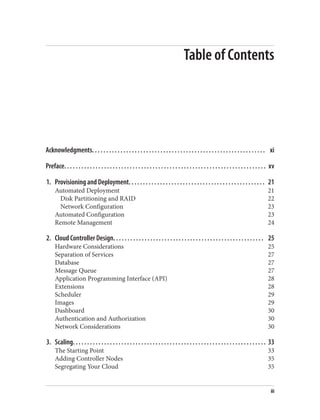
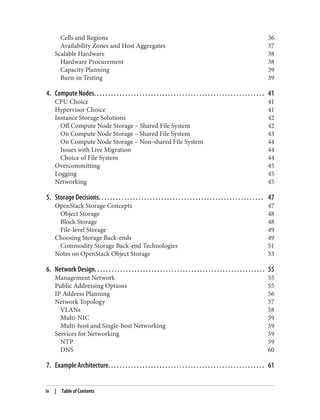
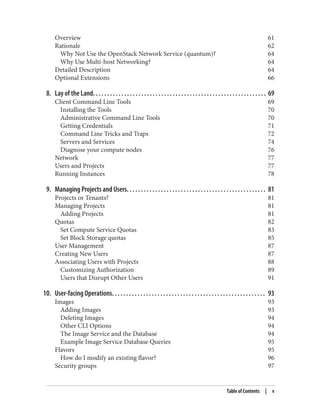
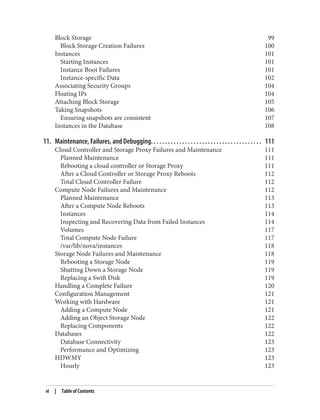
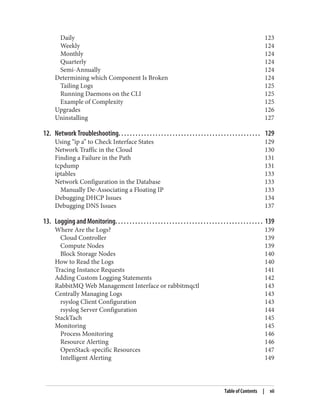




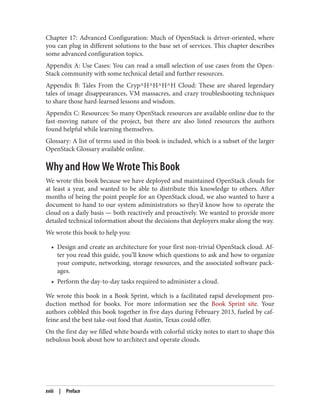
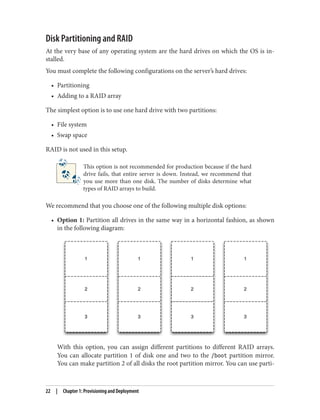
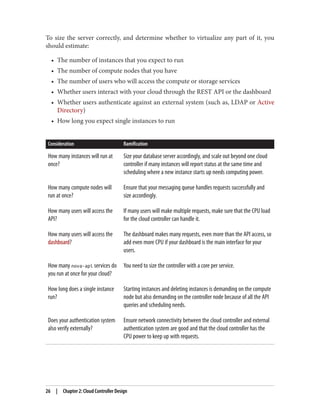
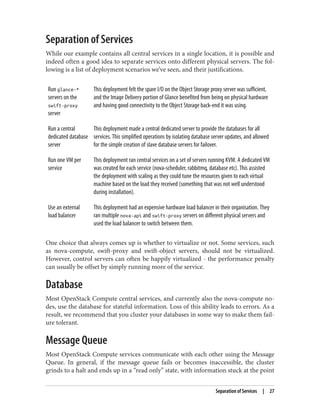

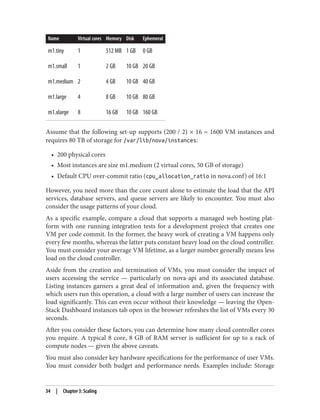


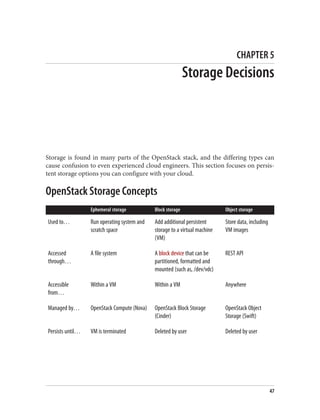
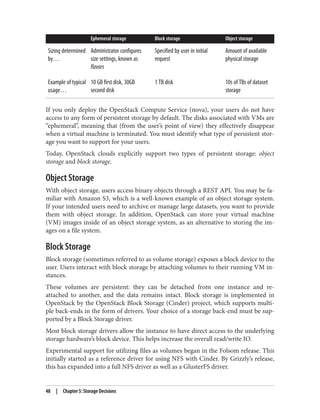


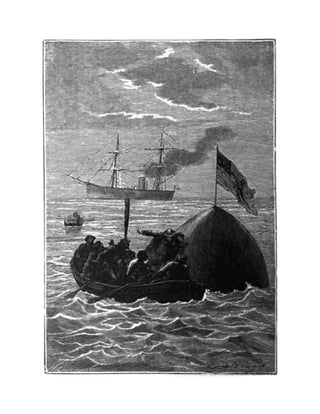




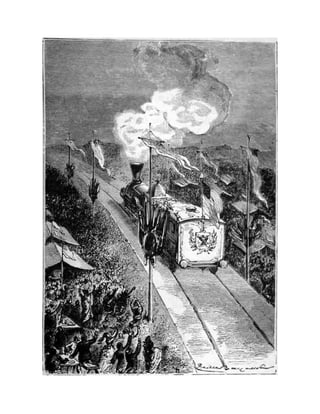







![[Rakuten TechConf2014] [F-4] At Rakuten, The Rakuten OpenStack Platform and B...](https://cdn.slidesharecdn.com/ss_thumbnails/f4openstackrakutentechnologyconference20141025-141105211349-conversion-gate02-thumbnail.jpg?width=640&height=640&fit=bounds)


