M3 Marine Expertise Pte Ltd
                    GST and Co. Reg No. 201001640W
                    1 Commonwealth Lane
                    #06-21 ONE Commonwealth
                    Singapore 149544
                    Tel: +65 6327 4606
                    Fax: +65 6221 4606
                    Email: expert@m3marine.com.sg
                    Web: www.m3marine.com.sg


                               Project Cargo Risk Management
Even in difficult economic times, the development of oil and gas terminals, offshore installations, mineral
export and processing terminals, port development and Greenfield projects continue apace. The modules
and specialist components for these projects are typically manufactured vast geographical distances away
from project sites and need to be shipped to site as project cargo.
It is important that these high value, often very heavy, oversized
and damage susceptible project cargoes arrive at their destination
on time and undamaged. This allows the end user to realise on
time and on budget project execution. There are a number of
stakeholders involved in such specialised project shipments,
including: the end user, main contractor, sub-contractors, freight
forwarder, insurance broker, lead cargo insurer and cargo
surveyors. With a lack of training and investment in expertise
over preceding years, we find that even amongst established
marine contractors, there is an ever increasing lack of marine
expertise available or involved in the shipment of these high value
project cargoes. It should be a key consideration for any party
engaged in the shipment of high value project cargoes that
specialist, independent marine personnel or insurer’s in-house
experts are engaged early on in the project schedule to ensure
that the end user and insurers interests are protected. The risk
during transit is most prevalent when an item is being lifted,
moved or shipped in an open seaway. There is a need for all
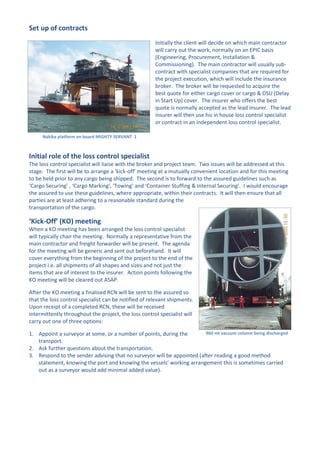
                                                                       Discharge from ship to SPMT’s on a barge
involved in a project to be aware of this and then to lower the risk
to a reasonable ALARP (As Low As Reasonably Possible) level
without incurring unacceptable cost.


Methods of loss prevention and control
There are at least three methods of carrying out loss control for a project. They are:

1. Survey ‘cradle to grave’ i.e. everything from the project planning phases, to the manufacturing facilities,
   the packaging and preparation phase, during the land and sea logistics and all the way until the arrival at
   final destination and even installation.
2. Insurer to review the list of items to be shipped and with the help of his appointed specialised experts
   choose which items to survey, when and where.
3. Insurer to provide a one page ‘Risk Control Notification’ (RCN) to the client, so that for notifiable
   shipments a RCN is completed and sent to the loss control specialist.

I will address the third option as I believe that this is the most cost effective and pro-active method of
approach. It is also the approach that I adopted during my nine years as a major cargo insurers in-house loss
control specialist.
Set up of contracts
                                                      Initially the client will decide on which main contractor
                                                      will carry out the work, normally on an EPIC basis
                                                      (Engineering, Procurement, Installation &
                                                      Commissioning). The main contractor will usually sub-
                                                      contract with specialist companies that are required for
                                                      the project execution, which will include the insurance
                                                      broker. The broker will be requested to acquire the
                                                      best quote for either cargo cover or cargo & DSU (Delay
                                                      in Start Up) cover. The insurer who offers the best
                                                      quote is normally accepted as the lead insurer. The lead
                                                      insurer will then use his in house loss control specialist
                                                      or contract in an independent loss control specialist.

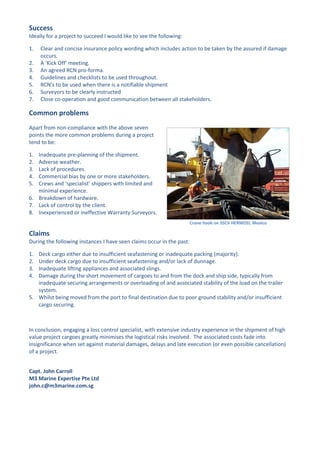
     Nakika platform on board MIGHTY SERVANT 1


Initial role of the loss control specialist
The loss control specialist will liaise with the broker and project team. Two issues will be addressed at this
stage. The first will be to arrange a ‘kick-off’ meeting at a mutually convenient location and for this meeting
to be held prior to any cargo being shipped. The second is to forward to the assured guidelines such as
‘Cargo Securing’ , ‘Cargo Marking’, ‘Towing’ and ‘Container Stuffing & Internal Securing’. I would encourage
the assured to use these guidelines, where appropriate, within their contracts. It will then ensure that all
parties are at least adhering to a reasonable standard during the
transportation of the cargo.

‘Kick-Off’ (KO) meeting
When a KO meeting has been arranged the loss control specialist
will typically chair the meeting. Normally a representative from the
main contractor and freight forwarder will be present. The agenda
for the meeting will be generic and sent out beforehand. It will
cover everything from the beginning of the project to the end of the
project i.e. all shipments of all shapes and sizes and not just the
items that are of interest to the insurer. Action points following the
KO meeting will be cleared out ASAP.

After the KO meeting a finalised RCN will be sent to the assured so
that the loss control specialist can be notified of relevant shipments.
Upon receipt of a completed RCN, these will be received
intermittently throughout the project, the loss control specialist will
carry out one of three options:

1. Appoint a surveyor at some, or a number of points, during the        960 mt vacuum column being discharged
   transport.
2. Ask further questions about the transportation.
3. Respond to the sender advising that no surveyor will be appointed (after reading a good method
   statement, knowing the port and knowing the vessels’ working arrangement this is sometimes carried
   out as a surveyor would add minimal added value).
Success
Ideally for a project to succeed I would like to see the following:

1.   Clear and concise insurance policy wording which includes action to be taken by the assured if damage
     occurs.
2.   A ‘Kick Off’ meeting.
3.   An agreed RCN pro-forma.
4.   Guidelines and checklists to be used throughout.
5.   RCN’s to be used when there is a notifiable shipment
6.   Surveyors to be clearly instructed
7.   Close co-operation and good communication between all stakeholders.

Common problems
Apart from non-compliance with the above seven
points the more common problems during a project
tend to be:

1. Inadequate pre-planning of the shipment.
2. Adverse weather.
3. Lack of procedures.
4. Commercial bias by one or more stakeholders.
5. Crews and ‘specialist’ shippers with limited and
   minimal experience.
6. Breakdown of hardware.
7. Lack of control by the client.
8. Inexperienced or ineffective Warranty Surveyors.
                                                                       Crane hook on SSCV HERMOD; Mexico

Claims
During the following instances I have seen claims occur in the past:

1. Deck cargo either due to insufficient seafastening or inadequate packing (majority).
2. Under deck cargo due to insufficient seafastening and/or lack of dunnage.
3. Inadequate lifting appliances and associated slings.
4. Damage during the short movement of cargoes to and from the dock and ship side, typically from
   inadequate securing arrangements or overloading of and associated stability of the load on the trailer
   system.
5. Whilst being moved from the port to final destination due to poor ground stability and/or insufficient
   cargo securing.


In conclusion, engaging a loss control specialist, with extensive industry experience in the shipment of high
value project cargoes greatly minimises the logistical risks involved. The associated costs fade into
insignificance when set against material damages, delays and late execution (or even possible cancellation)
of a project.


Capt. John Carroll
M3 Marine Expertise Pte Ltd
john.c@m3marine.com.sg

Project Cargo Risk Management

  • 1.
    M3 Marine ExpertisePte Ltd GST and Co. Reg No. 201001640W 1 Commonwealth Lane #06-21 ONE Commonwealth Singapore 149544 Tel: +65 6327 4606 Fax: +65 6221 4606 Email: expert@m3marine.com.sg Web: www.m3marine.com.sg Project Cargo Risk Management Even in difficult economic times, the development of oil and gas terminals, offshore installations, mineral export and processing terminals, port development and Greenfield projects continue apace. The modules and specialist components for these projects are typically manufactured vast geographical distances away from project sites and need to be shipped to site as project cargo. It is important that these high value, often very heavy, oversized and damage susceptible project cargoes arrive at their destination on time and undamaged. This allows the end user to realise on time and on budget project execution. There are a number of stakeholders involved in such specialised project shipments, including: the end user, main contractor, sub-contractors, freight forwarder, insurance broker, lead cargo insurer and cargo surveyors. With a lack of training and investment in expertise over preceding years, we find that even amongst established marine contractors, there is an ever increasing lack of marine expertise available or involved in the shipment of these high value project cargoes. It should be a key consideration for any party engaged in the shipment of high value project cargoes that specialist, independent marine personnel or insurer’s in-house experts are engaged early on in the project schedule to ensure that the end user and insurers interests are protected. The risk during transit is most prevalent when an item is being lifted, moved or shipped in an open seaway. There is a need for all Discharge from ship to SPMT’s on a barge involved in a project to be aware of this and then to lower the risk to a reasonable ALARP (As Low As Reasonably Possible) level without incurring unacceptable cost. Methods of loss prevention and control There are at least three methods of carrying out loss control for a project. They are: 1. Survey ‘cradle to grave’ i.e. everything from the project planning phases, to the manufacturing facilities, the packaging and preparation phase, during the land and sea logistics and all the way until the arrival at final destination and even installation. 2. Insurer to review the list of items to be shipped and with the help of his appointed specialised experts choose which items to survey, when and where. 3. Insurer to provide a one page ‘Risk Control Notification’ (RCN) to the client, so that for notifiable shipments a RCN is completed and sent to the loss control specialist. I will address the third option as I believe that this is the most cost effective and pro-active method of approach. It is also the approach that I adopted during my nine years as a major cargo insurers in-house loss control specialist.
  • 2.
    Set up ofcontracts Initially the client will decide on which main contractor will carry out the work, normally on an EPIC basis (Engineering, Procurement, Installation & Commissioning). The main contractor will usually sub- contract with specialist companies that are required for the project execution, which will include the insurance broker. The broker will be requested to acquire the best quote for either cargo cover or cargo & DSU (Delay in Start Up) cover. The insurer who offers the best quote is normally accepted as the lead insurer. The lead insurer will then use his in house loss control specialist or contract in an independent loss control specialist. Nakika platform on board MIGHTY SERVANT 1 Initial role of the loss control specialist The loss control specialist will liaise with the broker and project team. Two issues will be addressed at this stage. The first will be to arrange a ‘kick-off’ meeting at a mutually convenient location and for this meeting to be held prior to any cargo being shipped. The second is to forward to the assured guidelines such as ‘Cargo Securing’ , ‘Cargo Marking’, ‘Towing’ and ‘Container Stuffing & Internal Securing’. I would encourage the assured to use these guidelines, where appropriate, within their contracts. It will then ensure that all parties are at least adhering to a reasonable standard during the transportation of the cargo. ‘Kick-Off’ (KO) meeting When a KO meeting has been arranged the loss control specialist will typically chair the meeting. Normally a representative from the main contractor and freight forwarder will be present. The agenda for the meeting will be generic and sent out beforehand. It will cover everything from the beginning of the project to the end of the project i.e. all shipments of all shapes and sizes and not just the items that are of interest to the insurer. Action points following the KO meeting will be cleared out ASAP. After the KO meeting a finalised RCN will be sent to the assured so that the loss control specialist can be notified of relevant shipments. Upon receipt of a completed RCN, these will be received intermittently throughout the project, the loss control specialist will carry out one of three options: 1. Appoint a surveyor at some, or a number of points, during the 960 mt vacuum column being discharged transport. 2. Ask further questions about the transportation. 3. Respond to the sender advising that no surveyor will be appointed (after reading a good method statement, knowing the port and knowing the vessels’ working arrangement this is sometimes carried out as a surveyor would add minimal added value).
  • 3.
    Success Ideally for aproject to succeed I would like to see the following: 1. Clear and concise insurance policy wording which includes action to be taken by the assured if damage occurs. 2. A ‘Kick Off’ meeting. 3. An agreed RCN pro-forma. 4. Guidelines and checklists to be used throughout. 5. RCN’s to be used when there is a notifiable shipment 6. Surveyors to be clearly instructed 7. Close co-operation and good communication between all stakeholders. Common problems Apart from non-compliance with the above seven points the more common problems during a project tend to be: 1. Inadequate pre-planning of the shipment. 2. Adverse weather. 3. Lack of procedures. 4. Commercial bias by one or more stakeholders. 5. Crews and ‘specialist’ shippers with limited and minimal experience. 6. Breakdown of hardware. 7. Lack of control by the client. 8. Inexperienced or ineffective Warranty Surveyors. Crane hook on SSCV HERMOD; Mexico Claims During the following instances I have seen claims occur in the past: 1. Deck cargo either due to insufficient seafastening or inadequate packing (majority). 2. Under deck cargo due to insufficient seafastening and/or lack of dunnage. 3. Inadequate lifting appliances and associated slings. 4. Damage during the short movement of cargoes to and from the dock and ship side, typically from inadequate securing arrangements or overloading of and associated stability of the load on the trailer system. 5. Whilst being moved from the port to final destination due to poor ground stability and/or insufficient cargo securing. In conclusion, engaging a loss control specialist, with extensive industry experience in the shipment of high value project cargoes greatly minimises the logistical risks involved. The associated costs fade into insignificance when set against material damages, delays and late execution (or even possible cancellation) of a project. Capt. John Carroll M3 Marine Expertise Pte Ltd john.c@m3marine.com.sg