Response-able Digital
Storytelling to Reimagine HE
Classrooms Practices
Kristian Stewart, University of Michigan Dearborn
Daniela Gachago, Cape Peninsula University of Technology
Our j0urney
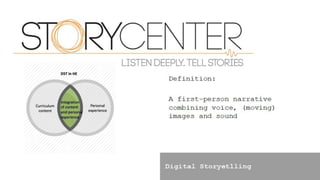
Unpacking digital storytelling
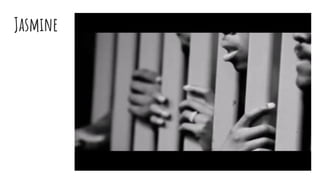
Jasmine’s story
Ethical frameworks
- IRB process
- Guidelines
- Ethic of care
- Posthuman ethics
Digital storytelling at CPUT & UMIch
CPUT
- Since 2010
- From Education spread into
other faculties
- Across variety of disciplines
and contexts
- More or less supported /
structured
- More or less personal
- Some training, but not enough
- Ethical questions more and more
urgent
UMICH
-Since 2011
-Utilized in a writing classroom /
16 week critical practice
-Students respond to “Being Human
Today” prompt
-Choice in response / to share &
not to share
-Flexible assessment
-Used to build relationships
Jasmine
Questions...
How do I keep the storyteller safe?
Family safe?
How will I respond?
How will the audience/class respond?
How on earth should I assess this story?
Who else should (should not) see the
story?
Where should the story be shared?
….
Current process of ethics applications
● Research proposal
● Normative ethics
● Often has YES/NO responses
● Checklist
● Once off application (at the beginning of the project)
○ Informed consent
○ Sampling
○ Rights of the participants
○ Data collection instruments
○ Confidentiality and anonymity - participant and data
○ Data management
○ Usual output - journal article
Storycenter principles of ethical practice
- Storyteller’s wellbeing
- Expanding consent / Continual process
- Knowledge production and ownership
- Local relevance
- Distribution
- Does not tackle DST in educational
contexts
- Fuzzy boundaries
- Recruitment and consent to
participate
- Power of shaping
- Representation and harm
- Confidentiality
- Release of materials
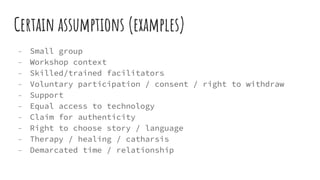
Certain assumptions (examples)
- Small group
- Workshop context
- Skilled/trained facilitators
- Voluntary participation / consent / right to withdraw
- Support
- Equal access to technology
- Claim for authenticity
- Right to choose story / language
- Therapy / healing / catharsis
- Demarcated time / relationship
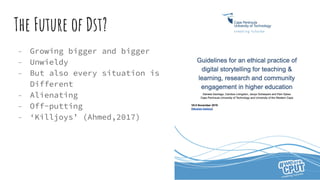
The Future of Dst?
- Growing bigger and bigger
- Unwieldy
- But also every situation is
Different
- Alienating
- Off-putting
- ‘Killjoys’ (Ahmed,2017)
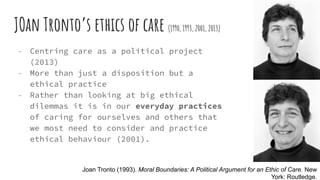
JOan Tronto’s ethics of care (1990, 1993, 2001, 2013)
- Centring care as a political project
(2013)
- More than just a disposition but a
ethical practice
- Rather than looking at big ethical
dilemmas it is in our everyday practices
of caring for ourselves and others that
we most need to consider and practice
ethical behaviour (2001).
Joan Tronto (1993). Moral Boundaries: A Political Argument for an Ethic of Care. New
York: Routledge.
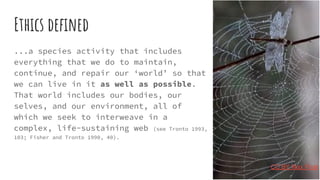
Ethics defined
...a species activity that includes
everything that we do to maintain,
continue, and repair our ‘world’ so that
we can live in it as well as possible.
That world includes our bodies, our
selves, and our environment, all of
which we seek to interweave in a
complex, life-sustaining web (see Tronto 1993,
103; Fisher and Tronto 1990, 40).
CC BY Max Pixel
JASMINE’S STORY THROUGH
AN ETHIC OF CARE Lense
- Web of relationships
- Power relations in care
- Focus on the vulnerable - responsibility
to care on part of the person in power
(i.e. lecturer)
- Dangers of care
- Human focused
- Human are still responsible and
in control (Taylor, 2018)
Posthuman ethics
Knowledge as co-produced and assembled (MacClure, 2015); knowledge creation
does not take place in isolated events as it is informed by ontological
paradigms of matter, materiality, and student bodies co-existing within these
entanglements (Barad, 2007).
How we move through the world and act within in operates as an apparatus in
their knowing, understanding, and meaning making processes (Barad, 2007).
Ethics as integral to ‘world making’ (Haraway, 1997).
Shifts from an ethics of care to an ethic of concern, ‘a shift from
responsibility to response-ability’ (Taylor, 2019, p. 88).
Jasmine’s story through a Posthuman ethics Lense
- Context of entanglements-- in Jasmine’s story white people (including us)
are already and always implicated (i.e., entangled in her narrative).
- We are already in relationship (but what kind of relationship?) - what new
patterns of difference emerge in this moment?
- The “world” that was created in that moment was seemingly unexpected and
students unprepared. No pre-defined identity--the class “became” with each
other in that moment.
- No world is the same - how can there be guidelines for all these different
worlds?
- The assemblage of this intra-action was that Jasmine was uncared for in
that moment. The power to affect/ be affected was lost.
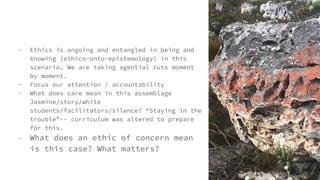
- Ethics is ongoing and entangled in being and
knowing (ethico-onto-epistemology) in this
scenario. We are taking agential cuts moment
by moment.
- Focus our attention / accountability
- What does care mean in this assemblage
Jasmine/story/white
students/facilitators/silence? “Staying in the
trouble”-- curriculum was altered to prepare
for this.
- What does an ethic of concern mean
is this case? What matters?
What matters?
references/REsources
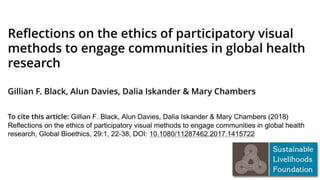
Black, G.F. et al., 2018. Reflections on the ethics of participatory visual methods to engage communities in
global health research. Global Bioethics, 29(1), pp.22–38. Available at:
https://www.tandfonline.com/doi/full/10.1080/11287462.2017.1415722.
Gachago, D. & Sykes, P., 2017. Navigating Ethical Boundaries When Adopting Digital Storytelling in Higher
Education. In G. Jamisson et al., eds. Digital Storytelling in Higher Education. Cham: Palgrave Macmillan,
pp. 91–106.
Gubrium, A.C., Hill, A.L. & Flicker, S., 2014. A situated practice of ethics for participatory visual and
digital methods in public health research and practice: A focus on digital storytelling. American Journal of
Public Health, 104(9), pp.1606–1614.
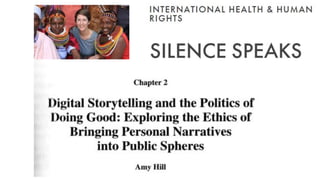
Hill, A., 2014. Digital Storytelling and the Politics of Doing Good: Exploring the Ethics of Bringing
Personal Narratives into Public Spheres. In H. Pleasants & D. E. Salter, eds. Community-based Multiliteracies
and Digital Media Projects. Peter Lang Publishing, pp. 174–178.
Stewart, K.D. & Ivala, E., 2017. Silence, voice, and “other languages”: Digital storytelling as a site for
resistance and restoration in a South African higher education classroom. British Journal of Educational
Technology. Available at: http://doi.wiley.com/10.1111/bjet.12540.

Response-able digital storytelling

  • 1.
    Response-able Digital Storytelling toReimagine HE Classrooms Practices Kristian Stewart, University of Michigan Dearborn Daniela Gachago, Cape Peninsula University of Technology
  • 2.
    Our j0urney Unpacking digitalstorytelling Jasmine’s story Ethical frameworks - IRB process - Guidelines - Ethic of care - Posthuman ethics
  • 3.
    Digital storytelling atCPUT & UMIch CPUT - Since 2010 - From Education spread into other faculties - Across variety of disciplines and contexts - More or less supported / structured - More or less personal - Some training, but not enough - Ethical questions more and more urgent UMICH -Since 2011 -Utilized in a writing classroom / 16 week critical practice -Students respond to “Being Human Today” prompt -Choice in response / to share & not to share -Flexible assessment -Used to build relationships
  • 4.
  • 6.
    Questions... How do Ikeep the storyteller safe? Family safe? How will I respond? How will the audience/class respond? How on earth should I assess this story? Who else should (should not) see the story? Where should the story be shared? ….
  • 7.
    Current process ofethics applications ● Research proposal ● Normative ethics ● Often has YES/NO responses ● Checklist ● Once off application (at the beginning of the project) ○ Informed consent ○ Sampling ○ Rights of the participants ○ Data collection instruments ○ Confidentiality and anonymity - participant and data ○ Data management ○ Usual output - journal article
  • 8.
    Storycenter principles ofethical practice - Storyteller’s wellbeing - Expanding consent / Continual process - Knowledge production and ownership - Local relevance - Distribution - Does not tackle DST in educational contexts
  • 9.
    - Fuzzy boundaries -Recruitment and consent to participate - Power of shaping - Representation and harm - Confidentiality - Release of materials
  • 12.
    Certain assumptions (examples) -Small group - Workshop context - Skilled/trained facilitators - Voluntary participation / consent / right to withdraw - Support - Equal access to technology - Claim for authenticity - Right to choose story / language - Therapy / healing / catharsis - Demarcated time / relationship
  • 13.
    The Future ofDst? - Growing bigger and bigger - Unwieldy - But also every situation is Different - Alienating - Off-putting - ‘Killjoys’ (Ahmed,2017)
  • 14.
    JOan Tronto’s ethicsof care (1990, 1993, 2001, 2013) - Centring care as a political project (2013) - More than just a disposition but a ethical practice - Rather than looking at big ethical dilemmas it is in our everyday practices of caring for ourselves and others that we most need to consider and practice ethical behaviour (2001). Joan Tronto (1993). Moral Boundaries: A Political Argument for an Ethic of Care. New York: Routledge.
  • 15.
    Ethics defined ...a speciesactivity that includes everything that we do to maintain, continue, and repair our ‘world’ so that we can live in it as well as possible. That world includes our bodies, our selves, and our environment, all of which we seek to interweave in a complex, life-sustaining web (see Tronto 1993, 103; Fisher and Tronto 1990, 40). CC BY Max Pixel
  • 16.
    JASMINE’S STORY THROUGH ANETHIC OF CARE Lense - Web of relationships - Power relations in care - Focus on the vulnerable - responsibility to care on part of the person in power (i.e. lecturer) - Dangers of care - Human focused - Human are still responsible and in control (Taylor, 2018)
  • 17.
    Posthuman ethics Knowledge asco-produced and assembled (MacClure, 2015); knowledge creation does not take place in isolated events as it is informed by ontological paradigms of matter, materiality, and student bodies co-existing within these entanglements (Barad, 2007). How we move through the world and act within in operates as an apparatus in their knowing, understanding, and meaning making processes (Barad, 2007). Ethics as integral to ‘world making’ (Haraway, 1997). Shifts from an ethics of care to an ethic of concern, ‘a shift from responsibility to response-ability’ (Taylor, 2019, p. 88).
  • 18.
    Jasmine’s story througha Posthuman ethics Lense - Context of entanglements-- in Jasmine’s story white people (including us) are already and always implicated (i.e., entangled in her narrative). - We are already in relationship (but what kind of relationship?) - what new patterns of difference emerge in this moment? - The “world” that was created in that moment was seemingly unexpected and students unprepared. No pre-defined identity--the class “became” with each other in that moment. - No world is the same - how can there be guidelines for all these different worlds? - The assemblage of this intra-action was that Jasmine was uncared for in that moment. The power to affect/ be affected was lost.
  • 19.
    - Ethics isongoing and entangled in being and knowing (ethico-onto-epistemology) in this scenario. We are taking agential cuts moment by moment. - Focus our attention / accountability - What does care mean in this assemblage Jasmine/story/white students/facilitators/silence? “Staying in the trouble”-- curriculum was altered to prepare for this. - What does an ethic of concern mean is this case? What matters?
  • 20.
  • 21.
    references/REsources Black, G.F. etal., 2018. Reflections on the ethics of participatory visual methods to engage communities in global health research. Global Bioethics, 29(1), pp.22–38. Available at: https://www.tandfonline.com/doi/full/10.1080/11287462.2017.1415722. Gachago, D. & Sykes, P., 2017. Navigating Ethical Boundaries When Adopting Digital Storytelling in Higher Education. In G. Jamisson et al., eds. Digital Storytelling in Higher Education. Cham: Palgrave Macmillan, pp. 91–106. Gubrium, A.C., Hill, A.L. & Flicker, S., 2014. A situated practice of ethics for participatory visual and digital methods in public health research and practice: A focus on digital storytelling. American Journal of Public Health, 104(9), pp.1606–1614. Hill, A., 2014. Digital Storytelling and the Politics of Doing Good: Exploring the Ethics of Bringing Personal Narratives into Public Spheres. In H. Pleasants & D. E. Salter, eds. Community-based Multiliteracies and Digital Media Projects. Peter Lang Publishing, pp. 174–178. Stewart, K.D. & Ivala, E., 2017. Silence, voice, and “other languages”: Digital storytelling as a site for resistance and restoration in a South African higher education classroom. British Journal of Educational Technology. Available at: http://doi.wiley.com/10.1111/bjet.12540.