PROTOCOL-SNAKE BITE
PRESENTER: Dr.Shivaraja A
MODERATOR: Dr.Jaidev M.D
18 January 2017 1
OVERVIEW
• INTRODUCTION
• HISTORY
• DIAGNOSIS
• TREATMENT
• SUMMARY
18 January 2017 2
INTRODUCTION
• Neglected tropical disease
• Highest burden in south east asia
• Under reported
• Occupational, climatic hazard
• 2/3 of snake bite have no signs of
envenomation
• Costly treatment and limited resources
18 January 2017 3
HISTORY
• Duration:
>24hr, no symptoms= unlikely to develop
envenomation,
>24hr with signs and symptoms= difficult to
treat
• Identify snake: venomous/nonvenomous
• Treatment received: allopathic/alternative,
First aid
18 January 2017 4
• Victim activities during bite: grass cutting,
animal feeding=attract rat= attract snake
• Day/night: krait is nocturnal. Repairing shed,
edge of rice field=disturbed sleeping krait in
morning
• Past history of snakebites
• Allergy to egg, sera
18 January 2017 5
COBRA
SEA SNAKE
HUMP NOSED VIPER18 January 2017 6
RUSSELS VIPER
KRAIT
SAW SCALED
VIPER
18 January 2017 7
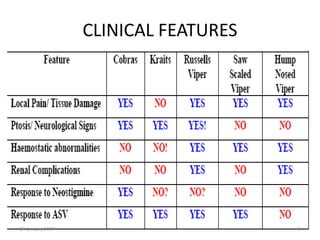
CLINICAL FEATURES
18 January 2017 8
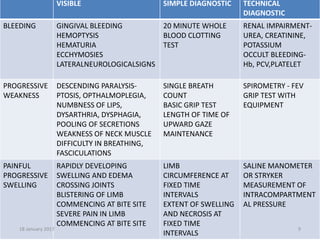
VISIBLE SIMPLE DIAGNOSTIC TECHNICAL
DIAGNOSTIC
BLEEDING GINGIVAL BLEEDING
HEMOPTYSIS
HEMATURIA
ECCHYMOSIES
LATERALNEUROLOGICALSIGNS
20 MINUTE WHOLE
BLOOD CLOTTING
TEST
RENAL IMPAIRMENT-
UREA, CREATININE,
POTASSIUM
OCCULT BLEEDING-
Hb, PCV,PLATELET
PROGRESSIVE
WEAKNESS
DESCENDING PARALYSIS-
PTOSIS, OPTHALMOPLEGIA,
NUMBNESS OF LIPS,
DYSARTHRIA, DYSPHAGIA,
POOLING OF SECRETIONS
WEAKNESS OF NECK MUSCLE
DIFFICULTY IN BREATHING,
FASCICULATIONS
SINGLE BREATH
COUNT
BASIC GRIP TEST
LENGTH OF TIME OF
UPWARD GAZE
MAINTENANCE
SPIROMETRY - FEV
GRIP TEST WITH
EQUIPMENT
PAINFUL
PROGRESSIVE
SWELLING
RAPIDLY DEVELOPING
SWELLING AND EDEMA
CROSSING JOINTS
BLISTERING OF LIMB
COMMENCING AT BITE SITE
SEVERE PAIN IN LIMB
COMMENCING AT BITE SITE
LIMB
CIRCUMFERENCE AT
FIXED TIME
INTERVALS
EXTENT OF SWELLING
AND NECROSIS AT
FIXED TIME
INTERVALS
SALINE MANOMETER
OR STRYKER
MEASUREMENT OF
INTRACOMPARTMENT
AL PRESSURE
18 January 2017 9
Syndromic approach
• Syndrome 1
• Local envenomation with bleeding/clotting
disturbance- Viperidae(all species).
• Syndrome 2
• Local envenomation with bleeding/clotting
disturbance,shock, acute kidney injury- Russels viper,
humpnosed viper, Srilanka, South-west India.
• With conjuctival edema, acute kidney injury- Russels
viper,Myanmar.
• With ptosis, external ophthalmoplegia,facial paralysis,
dark brown urine- Russels viper, Srilanka, South-west
India.
18 January 2017 10
• Syndrome 3
• Local envenomation with paralysis- King cobra
or cobra
• Syndrome 4
• Paralysis with minimal/no Local envenoming
Bitten on land while sleeping on ground-krait
Bitten in sea, estuary, fresh water lakes- sea
snake
18 January 2017 11
• Syndrome 5
• Paralysis with dark brown urine, acute kidney
injury-
Bitten on land with bleeding or clotting
disturbance- Russels viper, humpnosed viper,
Srilanka, South India.
Bitten on land while sleeping indoors-Krait
Bitten in sea, estuary, fresh water lakes(with no
bleeding or clotting disturbance)- sea snake
18 January 2017 12
HISTORY OF SNAKE BITE-
NO DEAD SNAKE OR
DISCRIPTION OR SNAKE
INCOAGULABLE BLOOD
OR SPONTANEOUS
SYSTEMIC BLEEDING
NEUROTOXIC SIGNS
MARKED LOCAL
SWELLING
NEUROTOXIC
SIGNS
INCOAGULABLE BLOOD
OR SPONTANEOUS
SYSTEMIC BLEEDING
NEUROTOXIC SIGNS
ACUTE RENAL
FAILURE
ACUTE
RENAL
FAILURE
BITTEN IN
SEA
HUMP
NOSED
VIPER
BITE
EARLY
BLISTERING/
NECROSIS
BITTEN IN LAND,
SLEEPING ON
FLOOR OF
HOUSE
SAW
SCALED
VIPER
BITE
COBRA
BITE KRAIT BITE
SEA
SNAKE
BITE
RUSSELS
VIPER BITE
YES
NO
YES
NO
YES
YES
YES NO
NO YES
YES
18 January 2017 13
20 MIN WBCT
• 2ml of freshly sampled venous blood in small,
new or heat cleaned, glass vessel.
• Leave undisturbed for 20 minutes at ambient
temperature.
• Tip the blood once, if blood is still liquid and
runs out, indicates hypofibrinogenemia due to
venom induced consumption coagulopathy.
18 January 2017 14
TREATMENT
• First aid
• Antisnake venom
• Neostigmine
• Non specific treatment
• Summary
18 January 2017 15
FIRST AID- RIGHT
• Reassure the patient
• Immobilise the limbs
• Get To Hospital immediately
• Tell the doctor of any systemic symptoms
18 January 2017 16
ANTISNAKE VENOM
• Equine hyperimmune response, purified by
papain/pepsin.
• Lyophilised or liquid
• Monovalent or polyvalent
• Binds and neutralises circulating venom
18 January 2017 17
ANTISNAKE VENOM
• Each vial neutralises a given amount of venom
from the species against which it is effective
• Same dosing schedule in repeated snake bite
or repeat dose
• Same dose in children and adults
• Cannot reverse renal failure, coagulopathy,
necrosis, swelling,presynaptic envenoming
18 January 2017 18
ANTISNAKE VENOM
• Lyophilised vials to be reconstituted with 10ml
of distilled water
• Each ml after reconstitution, neutralises
• 0.6mg of Cobra(Naja naja) venom
• 0.6mg of Russel’s viper(Vipera russeli) venom
• 0.45mg of Sawscaled viper(Echis carinatus)
venom
• 0.45mg of Krait (Bungareus caeruleus) venom
18 January 2017 19
AVAILABLE PRODUCTS
PRODUCED BY COUNTRIES SPECIES INITIAL
DOSE
MAXIMUM
DOSE
18 January 2017 20
CRITERIA FOR ASV ADMINISTRATION
BLEEDING PROGRESSIVE WEAKNESS PAINFUL PROGRESSIVE
SWELLING
•INCOAGULABLE
BLOOD(WBCT)
•SYSTEMIC BLEEDING, NO
LOCAL BRUISING
•LAB EVIDENCE OF
COAGULOPATHY
•HEMATURIA-
MYOGLOBINURIA
•PTOSIS
•OPTHALMOPLEGIA
•EXCESSIVE SALIVATION
•BULBAR PARALYSIS
•DYSPHAGIA
• METALLIC TASTE
• RESPIRATORY DISTRESS
•SWELLING REACHING >15cm
FOR 1 HOUR
•SWELLING AFTER BITES TO
EXTREMITIES REACHING KNEE
OR ELBOW BY 4 HRS, WHOLE
LIMB WITHIN 8 HRS,
EXTENDING INTO TRUNK
•AIRWAY COMPROMISE OR
RESPIRATORY DISTRESS
•COMPARTMENT SYNDROME
OR MAJOR VESSEL
ENTRAPMENT
REQUIRED ASV= VENOM INJECTED-BOUND VENOM
18 January 2017 21
REPEAT ASV
BLEEDING PROGRESSIVE WEAKNESS PAINFUL PROGRESSIVE
SWELLING
CHECK WBCT- 6HOUR
AFTER LAST DOSE OF ASV.
CONTINUE ASV TILL
RESTORING COAGULATION,
OR MAXIMUM VIALS
REACHED.
REASSESS EVERY 1 HOUR.
IF WORSENING, GIVE
SECOND DOSE-SAME
AMOUNT.
IF NO WORSENING- ASSESS
AFTER ANOTHER 1 HOUR.
ONLY 2 DOSES OF ASV- NO
CIRULATING VENOM
AFTERWARDS, GIVE
SUPPORTIVE TREATMENT
INDIVIDUALISED (NO
CIRCULATING VENOM,
CANNOT CROSS BLOOD
TISSUE BARRIER)
REQUIRED ASV= VENOM INJECTED-BOUND VENOM
18 January 2017 22
ADMINISTRATION OF ASV
• No test dose
• Prophylactic adrenaline and antihistaminics.
• IV injection- slow iv injection-2ml/min
• Infusion- liquid or reconstituted ASV is diluted
in 5-10ml/kg of body weight of isotonic saline
or glucose. Infused at a constant rate over 1
hour.
18 January 2017 23
COMPLICATIONS OF ASV
• Urticaria
• Itching
• Fever
• Nausea, vomiting
• Diarrhea
• Abdominal cramps
• Tachycardia, hypotension
• Bronchospasm
• Angioedema
18 January 2017 24
• Indian ASV- average time of onset of reactions
is 20min.
• Stop ASV at first sign of reaction.
• Give im adrenaline 0.01ml/kg (Reaches peak
effect by 8min), if no response/worsening,
repeat im adrenaline.
18 January 2017 25
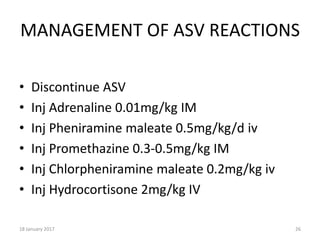
MANAGEMENT OF ASV REACTIONS
• Discontinue ASV
• Inj Adrenaline 0.01mg/kg IM
• Inj Pheniramine maleate 0.5mg/kg/d iv
• Inj Promethazine 0.3-0.5mg/kg IM
• Inj Chlorpheniramine maleate 0.2mg/kg iv
• Inj Hydrocortisone 2mg/kg IV
18 January 2017 26
NEOSTIGMINE
• 0.6mg of atropine sulphate IV (0.05mg/kg)(0.6mg/ml)
• 1.5-2mg of neostigmine IM(0.04mg/kg)
(0.5mg/ml,2.5mg/ml)
• INDICATIONS
• DESCENDING PARALYSIS- PTOSIS, OPTHALMOPLEGIA,
NUMBNESS OF LIPS, DYSARTHRIA, DYSPHAGIA,
POOLING OF SECRETIONS
• WEAKNESS OF NECK MUSCLE
• DIFFICULTY IN BREATHING, FASCICULATIONS
18 January 2017 27
• Observe for 20min-
o Single breath count
o Amount of iris uncovered(mm)
o Interincisor distance
o Length of time upward gaze can be maintained
o Spirometry
• If improvement present, repeat atropine and
neostigmine every 30 minutes, till recovery or
upto 8 hours.
18 January 2017 28
NONSPECIFIC TREATMENT
• ANALGESIA- Paracetamol 10mg/kg/dose 4-6
hr, Tramadol. Avoid Aspirin.
• ANTIBIOTICS- if local tissue necrosis.
• ANXIETY- Reassurance.
• COMPLICATIONS- supportive therapies-
dialysis, ventilatory care, blood and blood
product transfusion.
18 January 2017 29
SNAKE BITE
NON SPECIFIC
HISTORY
TIME AFTER BITE
VICTIM ACTIVITIES DURING BITE
TIME OF BITE DAY/NIGHT
SITE/NUMBER OF BITE
PAST HISTORY OF SNAKE BITE
TREATMENT RECEIVED-
ALLOPATHY/ALTERNATIVE
NON LIFE
THREATENING
SPECIFIC
•ANALGESIA-
PARACETAMOL.
(avoid aspirin)
•ANTIBIOTICS- if
local tissue
necrosis
•SUPPORTIVE-
Dialysis,
ventilation, blood
product
transfusion
LIFE THREATENING
AIRWAY, BREATHING,
CIRCULATION,DISABILITY/
DRUGS
18 January 2017 30
BLEEDING
NON LIFE
THREATENING
CHECK WBCT 6 HR
AFTER
COMPLETING ASV
PROGRESSIVE
WEAKNESS
PAINFUL
PROGRESSIVE
SWELLING
REPEAT ASV
INDIVIDUALISED
ASV 8-10VIALS
COAGULABLE
BLOOD
REPEAT
ASV(MAX.30VIALS)
INCOAGULABLE
BLOOD
FFP IF
INCOAGULABLE
AFTER 6 HR
WORSENING
NO WORSENING
SUPPORTIVE MEASURES
IF WORSENING
REPEAT
ASV(MAX.20VIA
LS ASSESS EVERY
HOUR
WBCT EVERY
6 HR, WATCH
FOR
BLEEDING
NEOSTIGMINE
18 January 2017 31
SUMMARY
• No test dose
• Give Prophylactic
adrenaline and
antihistaminics
• Slow iv injection-2ml/min
• Infusion-
liquid/reconstituted ASV
diluted in 5-10ml/kg of
isotonic saline or glucose
infused at constant rate
over 1 hour.
DRUG DOSE ROUTE
ADRENALINE(1mg/
ml)
0.01mg/kg im
PHENIRAMINE
MALEATE (22.
75mg/ml)
0.5mg/kg iv
PROMETHAZINE(2
5mg/ml)
0.3-0.5
mg/kg
im
HYDROCORTISONE
(100mg/ml)
2mg/kg iv
DRUGS FOR ASV REACTIONSASV administration
18 January 2017 32
REFERENCES
• Government of India.National Snake bite
protocol. Newdelhi: Helath and Family Welfare
department: 2007
• Warrel D.A: WHO/SEARO Guidelines for the
management of snakebites,2010
• Simpson I.D: A2 Snakebite management in Asia
and Africa. Available from
http://www.pmrc.org.pk/A2%20Snakebite/20Ma
nagementin%20Asia%20and%20Africa.pdf.pdf
18 January 2017 33
18 January 2017 34
18 January 2017 35
18 January 2017 36
18 January 2017 37
18 January 2017 38
DIAGNOSIS
18 January 2017 39
18 January 2017 40
18 January 2017 41
18 January 2017 42
18 January 2017 43
18 January 2017 44

Snake bite protocol

  • 1.
    PROTOCOL-SNAKE BITE PRESENTER: Dr.ShivarajaA MODERATOR: Dr.Jaidev M.D 18 January 2017 1
  • 2.
    OVERVIEW • INTRODUCTION • HISTORY •DIAGNOSIS • TREATMENT • SUMMARY 18 January 2017 2
  • 3.
    INTRODUCTION • Neglected tropicaldisease • Highest burden in south east asia • Under reported • Occupational, climatic hazard • 2/3 of snake bite have no signs of envenomation • Costly treatment and limited resources 18 January 2017 3
  • 4.
    HISTORY • Duration: >24hr, nosymptoms= unlikely to develop envenomation, >24hr with signs and symptoms= difficult to treat • Identify snake: venomous/nonvenomous • Treatment received: allopathic/alternative, First aid 18 January 2017 4
  • 5.
    • Victim activitiesduring bite: grass cutting, animal feeding=attract rat= attract snake • Day/night: krait is nocturnal. Repairing shed, edge of rice field=disturbed sleeping krait in morning • Past history of snakebites • Allergy to egg, sera 18 January 2017 5
  • 6.
    COBRA SEA SNAKE HUMP NOSEDVIPER18 January 2017 6
  • 7.
  • 8.
  • 9.
    VISIBLE SIMPLE DIAGNOSTICTECHNICAL DIAGNOSTIC BLEEDING GINGIVAL BLEEDING HEMOPTYSIS HEMATURIA ECCHYMOSIES LATERALNEUROLOGICALSIGNS 20 MINUTE WHOLE BLOOD CLOTTING TEST RENAL IMPAIRMENT- UREA, CREATININE, POTASSIUM OCCULT BLEEDING- Hb, PCV,PLATELET PROGRESSIVE WEAKNESS DESCENDING PARALYSIS- PTOSIS, OPTHALMOPLEGIA, NUMBNESS OF LIPS, DYSARTHRIA, DYSPHAGIA, POOLING OF SECRETIONS WEAKNESS OF NECK MUSCLE DIFFICULTY IN BREATHING, FASCICULATIONS SINGLE BREATH COUNT BASIC GRIP TEST LENGTH OF TIME OF UPWARD GAZE MAINTENANCE SPIROMETRY - FEV GRIP TEST WITH EQUIPMENT PAINFUL PROGRESSIVE SWELLING RAPIDLY DEVELOPING SWELLING AND EDEMA CROSSING JOINTS BLISTERING OF LIMB COMMENCING AT BITE SITE SEVERE PAIN IN LIMB COMMENCING AT BITE SITE LIMB CIRCUMFERENCE AT FIXED TIME INTERVALS EXTENT OF SWELLING AND NECROSIS AT FIXED TIME INTERVALS SALINE MANOMETER OR STRYKER MEASUREMENT OF INTRACOMPARTMENT AL PRESSURE 18 January 2017 9
  • 10.
    Syndromic approach • Syndrome1 • Local envenomation with bleeding/clotting disturbance- Viperidae(all species). • Syndrome 2 • Local envenomation with bleeding/clotting disturbance,shock, acute kidney injury- Russels viper, humpnosed viper, Srilanka, South-west India. • With conjuctival edema, acute kidney injury- Russels viper,Myanmar. • With ptosis, external ophthalmoplegia,facial paralysis, dark brown urine- Russels viper, Srilanka, South-west India. 18 January 2017 10
  • 11.
    • Syndrome 3 •Local envenomation with paralysis- King cobra or cobra • Syndrome 4 • Paralysis with minimal/no Local envenoming Bitten on land while sleeping on ground-krait Bitten in sea, estuary, fresh water lakes- sea snake 18 January 2017 11
  • 12.
    • Syndrome 5 •Paralysis with dark brown urine, acute kidney injury- Bitten on land with bleeding or clotting disturbance- Russels viper, humpnosed viper, Srilanka, South India. Bitten on land while sleeping indoors-Krait Bitten in sea, estuary, fresh water lakes(with no bleeding or clotting disturbance)- sea snake 18 January 2017 12
  • 13.
    HISTORY OF SNAKEBITE- NO DEAD SNAKE OR DISCRIPTION OR SNAKE INCOAGULABLE BLOOD OR SPONTANEOUS SYSTEMIC BLEEDING NEUROTOXIC SIGNS MARKED LOCAL SWELLING NEUROTOXIC SIGNS INCOAGULABLE BLOOD OR SPONTANEOUS SYSTEMIC BLEEDING NEUROTOXIC SIGNS ACUTE RENAL FAILURE ACUTE RENAL FAILURE BITTEN IN SEA HUMP NOSED VIPER BITE EARLY BLISTERING/ NECROSIS BITTEN IN LAND, SLEEPING ON FLOOR OF HOUSE SAW SCALED VIPER BITE COBRA BITE KRAIT BITE SEA SNAKE BITE RUSSELS VIPER BITE YES NO YES NO YES YES YES NO NO YES YES 18 January 2017 13
  • 14.
    20 MIN WBCT •2ml of freshly sampled venous blood in small, new or heat cleaned, glass vessel. • Leave undisturbed for 20 minutes at ambient temperature. • Tip the blood once, if blood is still liquid and runs out, indicates hypofibrinogenemia due to venom induced consumption coagulopathy. 18 January 2017 14
  • 15.
    TREATMENT • First aid •Antisnake venom • Neostigmine • Non specific treatment • Summary 18 January 2017 15
  • 16.
    FIRST AID- RIGHT •Reassure the patient • Immobilise the limbs • Get To Hospital immediately • Tell the doctor of any systemic symptoms 18 January 2017 16
  • 17.
    ANTISNAKE VENOM • Equinehyperimmune response, purified by papain/pepsin. • Lyophilised or liquid • Monovalent or polyvalent • Binds and neutralises circulating venom 18 January 2017 17
  • 18.
    ANTISNAKE VENOM • Eachvial neutralises a given amount of venom from the species against which it is effective • Same dosing schedule in repeated snake bite or repeat dose • Same dose in children and adults • Cannot reverse renal failure, coagulopathy, necrosis, swelling,presynaptic envenoming 18 January 2017 18
  • 19.
    ANTISNAKE VENOM • Lyophilisedvials to be reconstituted with 10ml of distilled water • Each ml after reconstitution, neutralises • 0.6mg of Cobra(Naja naja) venom • 0.6mg of Russel’s viper(Vipera russeli) venom • 0.45mg of Sawscaled viper(Echis carinatus) venom • 0.45mg of Krait (Bungareus caeruleus) venom 18 January 2017 19
  • 20.
    AVAILABLE PRODUCTS PRODUCED BYCOUNTRIES SPECIES INITIAL DOSE MAXIMUM DOSE 18 January 2017 20
  • 21.
    CRITERIA FOR ASVADMINISTRATION BLEEDING PROGRESSIVE WEAKNESS PAINFUL PROGRESSIVE SWELLING •INCOAGULABLE BLOOD(WBCT) •SYSTEMIC BLEEDING, NO LOCAL BRUISING •LAB EVIDENCE OF COAGULOPATHY •HEMATURIA- MYOGLOBINURIA •PTOSIS •OPTHALMOPLEGIA •EXCESSIVE SALIVATION •BULBAR PARALYSIS •DYSPHAGIA • METALLIC TASTE • RESPIRATORY DISTRESS •SWELLING REACHING >15cm FOR 1 HOUR •SWELLING AFTER BITES TO EXTREMITIES REACHING KNEE OR ELBOW BY 4 HRS, WHOLE LIMB WITHIN 8 HRS, EXTENDING INTO TRUNK •AIRWAY COMPROMISE OR RESPIRATORY DISTRESS •COMPARTMENT SYNDROME OR MAJOR VESSEL ENTRAPMENT REQUIRED ASV= VENOM INJECTED-BOUND VENOM 18 January 2017 21
  • 22.
    REPEAT ASV BLEEDING PROGRESSIVEWEAKNESS PAINFUL PROGRESSIVE SWELLING CHECK WBCT- 6HOUR AFTER LAST DOSE OF ASV. CONTINUE ASV TILL RESTORING COAGULATION, OR MAXIMUM VIALS REACHED. REASSESS EVERY 1 HOUR. IF WORSENING, GIVE SECOND DOSE-SAME AMOUNT. IF NO WORSENING- ASSESS AFTER ANOTHER 1 HOUR. ONLY 2 DOSES OF ASV- NO CIRULATING VENOM AFTERWARDS, GIVE SUPPORTIVE TREATMENT INDIVIDUALISED (NO CIRCULATING VENOM, CANNOT CROSS BLOOD TISSUE BARRIER) REQUIRED ASV= VENOM INJECTED-BOUND VENOM 18 January 2017 22
  • 23.
    ADMINISTRATION OF ASV •No test dose • Prophylactic adrenaline and antihistaminics. • IV injection- slow iv injection-2ml/min • Infusion- liquid or reconstituted ASV is diluted in 5-10ml/kg of body weight of isotonic saline or glucose. Infused at a constant rate over 1 hour. 18 January 2017 23
  • 24.
    COMPLICATIONS OF ASV •Urticaria • Itching • Fever • Nausea, vomiting • Diarrhea • Abdominal cramps • Tachycardia, hypotension • Bronchospasm • Angioedema 18 January 2017 24
  • 25.
    • Indian ASV-average time of onset of reactions is 20min. • Stop ASV at first sign of reaction. • Give im adrenaline 0.01ml/kg (Reaches peak effect by 8min), if no response/worsening, repeat im adrenaline. 18 January 2017 25
  • 26.
    MANAGEMENT OF ASVREACTIONS • Discontinue ASV • Inj Adrenaline 0.01mg/kg IM • Inj Pheniramine maleate 0.5mg/kg/d iv • Inj Promethazine 0.3-0.5mg/kg IM • Inj Chlorpheniramine maleate 0.2mg/kg iv • Inj Hydrocortisone 2mg/kg IV 18 January 2017 26
  • 27.
    NEOSTIGMINE • 0.6mg ofatropine sulphate IV (0.05mg/kg)(0.6mg/ml) • 1.5-2mg of neostigmine IM(0.04mg/kg) (0.5mg/ml,2.5mg/ml) • INDICATIONS • DESCENDING PARALYSIS- PTOSIS, OPTHALMOPLEGIA, NUMBNESS OF LIPS, DYSARTHRIA, DYSPHAGIA, POOLING OF SECRETIONS • WEAKNESS OF NECK MUSCLE • DIFFICULTY IN BREATHING, FASCICULATIONS 18 January 2017 27
  • 28.
    • Observe for20min- o Single breath count o Amount of iris uncovered(mm) o Interincisor distance o Length of time upward gaze can be maintained o Spirometry • If improvement present, repeat atropine and neostigmine every 30 minutes, till recovery or upto 8 hours. 18 January 2017 28
  • 29.
    NONSPECIFIC TREATMENT • ANALGESIA-Paracetamol 10mg/kg/dose 4-6 hr, Tramadol. Avoid Aspirin. • ANTIBIOTICS- if local tissue necrosis. • ANXIETY- Reassurance. • COMPLICATIONS- supportive therapies- dialysis, ventilatory care, blood and blood product transfusion. 18 January 2017 29
  • 30.
    SNAKE BITE NON SPECIFIC HISTORY TIMEAFTER BITE VICTIM ACTIVITIES DURING BITE TIME OF BITE DAY/NIGHT SITE/NUMBER OF BITE PAST HISTORY OF SNAKE BITE TREATMENT RECEIVED- ALLOPATHY/ALTERNATIVE NON LIFE THREATENING SPECIFIC •ANALGESIA- PARACETAMOL. (avoid aspirin) •ANTIBIOTICS- if local tissue necrosis •SUPPORTIVE- Dialysis, ventilation, blood product transfusion LIFE THREATENING AIRWAY, BREATHING, CIRCULATION,DISABILITY/ DRUGS 18 January 2017 30
  • 31.
    BLEEDING NON LIFE THREATENING CHECK WBCT6 HR AFTER COMPLETING ASV PROGRESSIVE WEAKNESS PAINFUL PROGRESSIVE SWELLING REPEAT ASV INDIVIDUALISED ASV 8-10VIALS COAGULABLE BLOOD REPEAT ASV(MAX.30VIALS) INCOAGULABLE BLOOD FFP IF INCOAGULABLE AFTER 6 HR WORSENING NO WORSENING SUPPORTIVE MEASURES IF WORSENING REPEAT ASV(MAX.20VIA LS ASSESS EVERY HOUR WBCT EVERY 6 HR, WATCH FOR BLEEDING NEOSTIGMINE 18 January 2017 31
  • 32.
    SUMMARY • No testdose • Give Prophylactic adrenaline and antihistaminics • Slow iv injection-2ml/min • Infusion- liquid/reconstituted ASV diluted in 5-10ml/kg of isotonic saline or glucose infused at constant rate over 1 hour. DRUG DOSE ROUTE ADRENALINE(1mg/ ml) 0.01mg/kg im PHENIRAMINE MALEATE (22. 75mg/ml) 0.5mg/kg iv PROMETHAZINE(2 5mg/ml) 0.3-0.5 mg/kg im HYDROCORTISONE (100mg/ml) 2mg/kg iv DRUGS FOR ASV REACTIONSASV administration 18 January 2017 32
  • 33.
    REFERENCES • Government ofIndia.National Snake bite protocol. Newdelhi: Helath and Family Welfare department: 2007 • Warrel D.A: WHO/SEARO Guidelines for the management of snakebites,2010 • Simpson I.D: A2 Snakebite management in Asia and Africa. Available from http://www.pmrc.org.pk/A2%20Snakebite/20Ma nagementin%20Asia%20and%20Africa.pdf.pdf 18 January 2017 33
  • 34.
  • 35.
  • 36.
  • 37.
  • 38.
  • 39.
  • 40.
  • 41.
  • 42.
  • 43.
  • 44.