Get Answers of following Questions on www,smuhelp.com
Master of Business Administration- MBA Semester 1 Winter 2013
MB0038 - Management Process and Organizational Behaviour
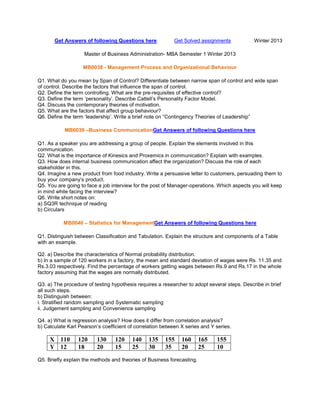
Q1. What do you mean by Span of Control? Differentiate between narrow span of control and wide span
of control. Describe the factors that influence the span of control.
Q2. Define the term controlling. What are the pre-requisites of effective control?
Q3. Define the term „personality‟. Describe Cattell‟s Personality Factor Model.
Q4. Discuss the contemporary theories of motivation.
Q5. What are the factors that affect group behaviour?
Q6. Define the term „leadership‟. Write a brief note on “Contingency Theories of Leadership”
MB0039 –Business Communication Answers available on www.smuHelp.com
Q1. As a speaker you are addressing a group of people. Explain the elements involved in this
communication.
Q2. What is the importance of Kinesics and Proxemics in communication? Explain with examples.
Q3. How does internal business communication affect the organization? Discuss the role of each
stakeholder in this.
Q4. Imagine a new product from food industry. Write a persuasive letter to customers, persuading them to
buy your company‟s product.
Q5. You are going to face a job interview for the post of Manager-operations. Which aspects you will keep
in mind while facing the interview?
Q6. Write short notes on:
a) SQ3R technique of reading
b) Circulars
MB0040 – Statistics for ManagementAnswers available on www.smuHelp.com
Q1. Distinguish between Classification and Tabulation. Explain the structure and components of a Table
with an example.
Q2. a) Describe the characteristics of Normal probability distribution.
b) In a sample of 120 workers in a factory, the mean and standard deviation of wages were Rs. 11.35 and
Rs.3.03 respectively. Find the percentage of workers getting wages between Rs.9 and Rs.17 in the whole
factory assuming that the wages are normally distributed.
Q3. a) The procedure of testing hypothesis requires a researcher to adopt several steps. Describe in brief
all such steps.
b) Distinguish between:
i. Stratified random sampling and Systematic sampling
ii. Judgement sampling and Convenience sampling
Q4. a) What is regression analysis? How does it differ from correlation analysis?
b) Calculate Karl Pearson‟s coefficient of correlation between X series and Y series.

X 110
Y 12

120
18

130
20

120
15

140
25

135
30

155
35

160
20

Q5. Briefly explain the methods and theories of Business forecasting.

165
25

155
10
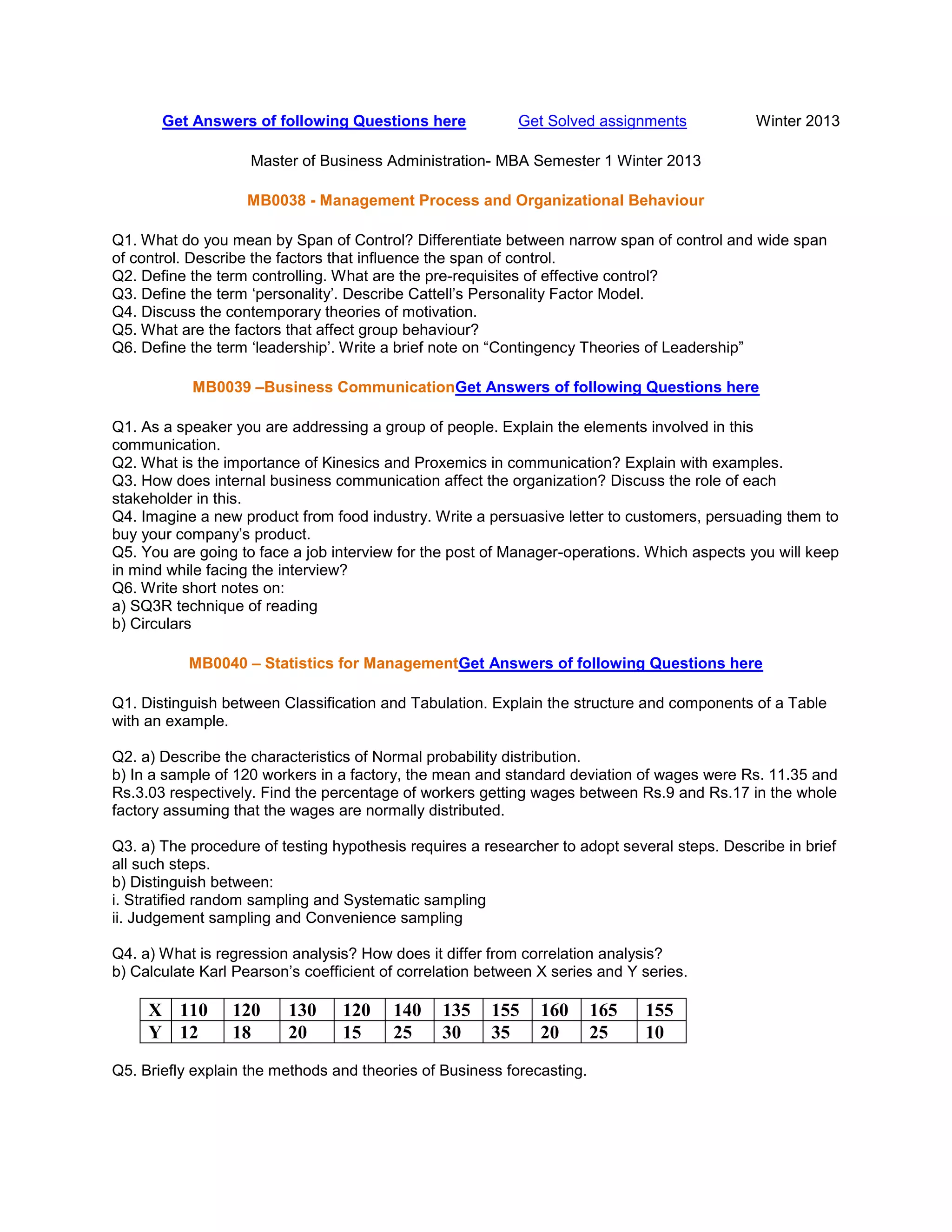
Q6. Construct Fisher‟s Ideal Index for the given information and check whether Fisher‟s formula satisfies
Time Reversal and Factor Reversal Tests.

Items
A
B
C
D
E
F

P0
16
12
14
20
80
40

Q0
5
10
8
6
3
2

P1
20
18
16
22
90
50

Q1
6
12
10
10
5
5

MB0041 – Financial and Management AccountingAnswers available on www.smuHelp.com
Q1. Give the classification of Accounts according to accounting equation approach with its meaning and
examples. Compare the traditional approach with modern approach of accounting equation approach.
Analyze the transaction under traditional approach.
a. 20.1.2011 Paid salary Rs. 30,000
b. 20.1.2011 Paid rent by chequeRs. 8,000
c. 21.1.2011 Goods withdrawn for personal use Rs. 5,000
d. 25.1.2011 Paid an advance to suppliers of goods Rs. 1,00,000
e. 26.1.2011 Received an advance from customers Rs. 3,00,000
f. 31.1.2011 Paid interest on loan Rs. 5,000
g. 31.1.2011 Paid instalment of loan Rs. 25,000
h. 31.1.2011 Interest allowed by bank Rs. 8,000
Q2. The following trial balance was extracted from the books of Chetan, a small businessman. Do you
think it is correct? If not, rewrite it in the correct form.
Debits

Rs.

Credits

Rs.

Stock
Purchases
Returns outwards
Discount received
Wages and salaries
Rent and rates
Sundry debtors
Bank Overdraft

8250
12750
700
800
2500
1850
7600
2450

Capital
Sales
Returns inwards
Discount allowed
Scooty
Carriage charges
Sundry creditors
Bills payable

10000
15900
1590
800
1750
700
7250
690

Q3. From the given trial balance draft an Adjusted Trial Balance.
Trial Balance as on 31.03.2011
Debit balances
Rs.
Furniture
and
10000
Fittings
Buildings
500000
Sales Returns
1000
Bad Debts
2000

Credit balances
Bank Over Draft

Rs.
16000

Capital Account
400000
Purchase Returns 4000
Sundry Creditors 30000
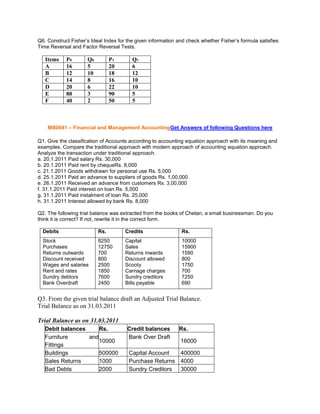
Sundry Debtors
25000
Purchases
90000
Advertising
20000
Cash
10000
Taxes and Insurance 5000
General Expenses 7000
Salaries
20000
TOTAL
690000

Commission
Sales

5000
235000

TOTAL

695000

Adjustments:
1. Charge depreciation at 10% on Buildings and Furniture and fittings.
2. Write off further bad debts 1000
3. Taxes and Insurance prepaid 2000
4. Outstanding salaries 5000
5. Commission received in advance1000
Q4. Compute trend ratios and comment on the financial performance of Infosys
Technologies Ltd. from the following extract of its income statements of five years.
(inRs. Crore)

Particulars
2010-11
2009-10
2008-09
Revenue
27,501
22,742
21,693
Operating
8,968
7,861
7,195
Profit
(PBIDT)
PAT from
6,835
6,218
5,988
ordinary
activities
(Source: Infosys Technologies Ltd. – Annual Report)

2007-08
16,692
5,238

2006-07
13,893
4,391

4,659

3,856

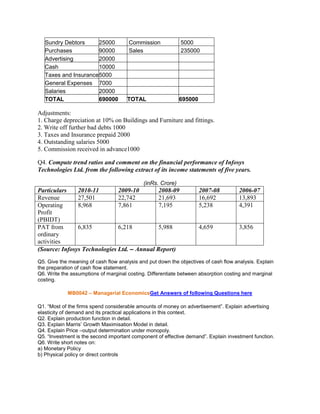
Q5. Give the meaning of cash flow analysis and put down the objectives of cash flow analysis. Explain
the preparation of cash flow statement.
Q6. Write the assumptions of marginal costing. Differentiate between absorption costing and marginal
costing.
MB0042 – Managerial EconomicsAnswers available on www.smuHelp.com
Q1. “Most of the firms spend considerable amounts of money on advertisement”. Explain advertising
elasticity of demand and its practical applications in this context.
Q2. Explain production function in detail.
Q3. Explain Marris‟ Growth Maximisation Model in detail.
Q4. Explain Price –output determination under monopoly.
Q5. “Investment is the second important component of effective demand”. Explain investment function.
Q6. Write short notes on:
a) Monetary Policy
b) Physical policy or direct controls
MB0043 – Human Resource ManagementAnswers available on www.smuHelp.com
Q1. What do you mean by Human Resource Management? Describe the functions of Human Resource
Management.
Q2. Give an overview of the Human Resource Management (HRM) in India. Explain the HRM challenges
faced by HR Managers.
Q3. What do you mean by HRIS? Explain the components of HRIS. Describe the different applications of
HRIS in Human Resource Management.
Q4. “Discipline in the broad sense means orderliness-the opposite of confusion.” What do you mean by
Discipline? Explain the basic guidelines of a Disciplinary policy
Q5. Suppose you have joined as an HR and you have been assigned a task to carry out the grievance
handling procedure in your organization. What according to you are the causes of Grievance? Describe in
detail the Grievance handling procedure
Q6. Write short notes on the following :
a)Competency Mapping
b)Flexi Time
Answers available on www.smuHelp.com

Smu mba sem1 assignments winter 2013

  • 1.
    Get Answers offollowing Questions on www,smuhelp.com Master of Business Administration- MBA Semester 1 Winter 2013 MB0038 - Management Process and Organizational Behaviour Q1. What do you mean by Span of Control? Differentiate between narrow span of control and wide span of control. Describe the factors that influence the span of control. Q2. Define the term controlling. What are the pre-requisites of effective control? Q3. Define the term „personality‟. Describe Cattell‟s Personality Factor Model. Q4. Discuss the contemporary theories of motivation. Q5. What are the factors that affect group behaviour? Q6. Define the term „leadership‟. Write a brief note on “Contingency Theories of Leadership” MB0039 –Business Communication Answers available on www.smuHelp.com Q1. As a speaker you are addressing a group of people. Explain the elements involved in this communication. Q2. What is the importance of Kinesics and Proxemics in communication? Explain with examples. Q3. How does internal business communication affect the organization? Discuss the role of each stakeholder in this. Q4. Imagine a new product from food industry. Write a persuasive letter to customers, persuading them to buy your company‟s product. Q5. You are going to face a job interview for the post of Manager-operations. Which aspects you will keep in mind while facing the interview? Q6. Write short notes on: a) SQ3R technique of reading b) Circulars MB0040 – Statistics for ManagementAnswers available on www.smuHelp.com Q1. Distinguish between Classification and Tabulation. Explain the structure and components of a Table with an example. Q2. a) Describe the characteristics of Normal probability distribution. b) In a sample of 120 workers in a factory, the mean and standard deviation of wages were Rs. 11.35 and Rs.3.03 respectively. Find the percentage of workers getting wages between Rs.9 and Rs.17 in the whole factory assuming that the wages are normally distributed. Q3. a) The procedure of testing hypothesis requires a researcher to adopt several steps. Describe in brief all such steps. b) Distinguish between: i. Stratified random sampling and Systematic sampling ii. Judgement sampling and Convenience sampling Q4. a) What is regression analysis? How does it differ from correlation analysis? b) Calculate Karl Pearson‟s coefficient of correlation between X series and Y series. X 110 Y 12 120 18 130 20 120 15 140 25 135 30 155 35 160 20 Q5. Briefly explain the methods and theories of Business forecasting. 165 25 155 10
  • 2.
    Q6. Construct Fisher‟sIdeal Index for the given information and check whether Fisher‟s formula satisfies Time Reversal and Factor Reversal Tests. Items A B C D E F P0 16 12 14 20 80 40 Q0 5 10 8 6 3 2 P1 20 18 16 22 90 50 Q1 6 12 10 10 5 5 MB0041 – Financial and Management AccountingAnswers available on www.smuHelp.com Q1. Give the classification of Accounts according to accounting equation approach with its meaning and examples. Compare the traditional approach with modern approach of accounting equation approach. Analyze the transaction under traditional approach. a. 20.1.2011 Paid salary Rs. 30,000 b. 20.1.2011 Paid rent by chequeRs. 8,000 c. 21.1.2011 Goods withdrawn for personal use Rs. 5,000 d. 25.1.2011 Paid an advance to suppliers of goods Rs. 1,00,000 e. 26.1.2011 Received an advance from customers Rs. 3,00,000 f. 31.1.2011 Paid interest on loan Rs. 5,000 g. 31.1.2011 Paid instalment of loan Rs. 25,000 h. 31.1.2011 Interest allowed by bank Rs. 8,000 Q2. The following trial balance was extracted from the books of Chetan, a small businessman. Do you think it is correct? If not, rewrite it in the correct form. Debits Rs. Credits Rs. Stock Purchases Returns outwards Discount received Wages and salaries Rent and rates Sundry debtors Bank Overdraft 8250 12750 700 800 2500 1850 7600 2450 Capital Sales Returns inwards Discount allowed Scooty Carriage charges Sundry creditors Bills payable 10000 15900 1590 800 1750 700 7250 690 Q3. From the given trial balance draft an Adjusted Trial Balance. Trial Balance as on 31.03.2011 Trial Balance as on 31.03.2011 Debit balances Rs. Furniture and 10000 Fittings Buildings 500000 Sales Returns 1000 Bad Debts 2000 Credit balances Bank Over Draft Rs. 16000 Capital Account 400000 Purchase Returns 4000 Sundry Creditors 30000
  • 3.
    Sundry Debtors 25000 Purchases 90000 Advertising 20000 Cash 10000 Taxes andInsurance 5000 General Expenses 7000 Salaries 20000 TOTAL 690000 Commission Sales 5000 235000 TOTAL 695000 Adjustments: 1. Charge depreciation at 10% on Buildings and Furniture and fittings. 2. Write off further bad debts 1000 3. Taxes and Insurance prepaid 2000 4. Outstanding salaries 5000 5. Commission received in advance1000 Q4. Compute trend ratios and comment on the financial performance of Infosys Technologies Ltd. from the following extract of its income statements of five years. (inRs. Crore) Particulars 2010-11 2009-10 2008-09 Revenue 27,501 22,742 21,693 Operating 8,968 7,861 7,195 Profit (PBIDT) PAT from 6,835 6,218 5,988 ordinary activities (Source: Infosys Technologies Ltd. – Annual Report) 2007-08 16,692 5,238 2006-07 13,893 4,391 4,659 3,856 Q5. Give the meaning of cash flow analysis and put down the objectives of cash flow analysis. Explain the preparation of cash flow statement. Q6. Write the assumptions of marginal costing. Differentiate between absorption costing and marginal costing. MB0042 – Managerial EconomicsAnswers available on www.smuHelp.com Q1. “Most of the firms spend considerable amounts of money on advertisement”. Explain advertising elasticity of demand and its practical applications in this context. Q2. Explain production function in detail. Q3. Explain Marris‟ Growth Maximisation Model in detail. Q4. Explain Price –output determination under monopoly. Q5. “Investment is the second important component of effective demand”. Explain investment function. Q6. Write short notes on: a) Monetary Policy b) Physical policy or direct controls
  • 4.
    MB0043 – HumanResource ManagementAnswers available on www.smuHelp.com Q1. What do you mean by Human Resource Management? Describe the functions of Human Resource Management. Q2. Give an overview of the Human Resource Management (HRM) in India. Explain the HRM challenges faced by HR Managers. Q3. What do you mean by HRIS? Explain the components of HRIS. Describe the different applications of HRIS in Human Resource Management. Q4. “Discipline in the broad sense means orderliness-the opposite of confusion.” What do you mean by Discipline? Explain the basic guidelines of a Disciplinary policy Q5. Suppose you have joined as an HR and you have been assigned a task to carry out the grievance handling procedure in your organization. What according to you are the causes of Grievance? Describe in detail the Grievance handling procedure Q6. Write short notes on the following : a)Competency Mapping b)Flexi Time Answers available on www.smuHelp.com