SMS & MMS
Technologies
Key Concepts
The Digital Wireless Telephony
comprise of two main working
technologies:
 GSM which stands for Global System
for Mobile Communication.
 CDMA which stands for Code Division
Multiple Access.
GSM Technology
More than 690 mobile networks provide GSM
services in more than 213 countries which
means in total 82.4% people globally uses
GSM mobile connections.
China being on the top followed by Russia,
India & USA.
GSM is a “ time division” system, thus
sometimes called as TDMA.
CDMA Technology
 Both GSM and CDMA are multiple access
technologies.
 CDMA employs spread-spectrum technology
and a special coding scheme (where each
transmitter is assigned a code).
 Spread spectrum is a form of wireless
communications in which the frequency of the
transmitted signal is deliberately varied. This
results in a much greater bandwidth than the
signal would have if its frequency were not
varied.
Difference between the two
 In CDMAs, there is one physical channel and a
special code for every device in the coverage
network. Using this code, the signal of the
device is multiplexed, and the same physical
channel is used to send the signal.
 In GSMs, every cell has a corresponding
network tower, which serves the mobile
phones in that cellular area which in turn
makes GSMs more accessible as they work on
multiple frequency bands
(850/900/1800/1900MHz).
 Network services in CDMAs are Handset-Specific
whereas in GSMs are SIM-Specific. User has option
to select handset of his choice.
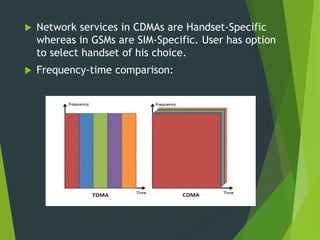
 Frequency-time comparison:
SMS, what is it ?
 Short Message Service (SMS) is a text messaging
service component of phone, Web, or mobile
communication systems. It uses standardized
communication protocols to allow fixed-line or
mobile phone devices to exchange short text
messages.
 Short message service is a mechanism of delivery
of short messages over the mobile networks. It is
a store and forward way of transmitting
messages to and from mobiles.
How Does It Works ?
 The message (text only) from the sending mobile is stored in a
central short message center (SMC) which then forwards it to the
destination mobile. This means that in the case that the recipient is
not available, the short message is stored and can be sent later.
 Each short message can be no longer than 160 characters. These
characters can be text (alphanumeric) or binary Non-Text Short
messages. An interesting feature of SMS is return receipts. This
means that the sender, if wishes, can get a small message notifying
if the short message was delivered to the intended recipient.
 Since SMS used signaling channel as opposed to dedicated
channels, these messages can be sent/received simultaneously with
the voice/data/fax service over a GSM network.
 SMS supports national and international roaming. This means that
you can send short messages to any other GSM mobile user around
the world. With the PCS networks based on all the three
technologies, GSM, CDMA and TDMA supporting SMS, SMS is more or
less a universal mobile data service.
 SME - Short Message Entity
 SMC – Short Message Center
 GMSC – Gateway MSC
 MSC – Message Switching Center
 HLR – Home Location Register
 VLR – Visitor Location Register
 BSS – Base Station System
 The SME (Short Message Entity) which can be located in the fixed
network or a mobile station, receives and sends short messages.
 The SMC (Short Message Center) is the entity which does the job of
store and forward of messages to and from the mobile station.
 The GWMS (SMS gateway MSC) is a gateway MSC that can also
receive short messages. The gateway MSC is a mobile network’s
point of contact with other networks. On receiving the short
message from the short message center, GMSC uses the SS7
network to interrogate the current position of the mobile station
form the HLR, the home location register.
 HLR is the main database in a mobile network. It holds information
of the subscription profile of the mobile and also about the routing
information for the subscriber, i.e. the area (covered by a MSC)
where the mobile is currently situated. The GMSC is thus able to
pass on the message to the correct MSC.
 MSC (Mobile Switching Center) is the entity in a GSM network
which does the job of switching connections between mobile
stations or between mobile stations and the fixed network.
 A VLR (Visitor Location Register) corresponds to each MSC and
contains temporary information about the mobile, information
like mobile identification and the cell (or a group of cells) where
the mobile is currently situated.
 Using information form the VLR the MSC is able to switch the
information (short message) to the corresponding BSS (Base
Station System), which transmits the short message to the
mobile.
 The BSS consists of transceivers, which send and receive
information over the air interface, to and from the mobile
station.
 This information is passed over the signaling
channels so the mobile can receive messages
even if a voice or data call is going on.
Advantages & Disadvantages
 PROs :
1. You can send then any time – Day or Night.
2. Person you are sending it to do not have to have
their mobile phones switched on.
3. It can save time. Rather than interrupting them
with calls you can simply message them.
4. SMS are good for Informal messaging.
5. SMS is personal. It goes straight to the
recipient’s mobile phone. The message is
literally delivered directly into their hand.
 CONs :
1. Messages are plain vanilla in nature. You can only
send simple text messages. There is no scope for
any graphics or audio.
2. The messages are limited by size. An SMS message
can’t exceed 160 characters (70 Characters if
Arabic, Chinese languages are used).
3. Could not be used for Formal Messaging.
4. SMS need Basic Typing Skills.
5. Delivery Failure - Unfortunately with bulk SMS
marketing, service interruption occasionally
occurs. Thus results in delivery failure. SMS is
simply not as reliable as email yet, regardless of
the provider.
Okay ! Now on to MMS
 MMS Stands for Multimedia Messaging Service.
 It is a communications technology developed by
3GPP (Third Generation Partnership Project)
that allows users to exchange multimedia
communications between capable mobile phones
and other devices.
 To send or receive an MMS message, the phone
makes a GPRS connection (to a GPRS APN). It
then usually connects to the MMSC for
sending/receiving messages through a WAP
proxy/gateway.
 An extension to the Short Message Service, MMS defines a
way to send and receive, almost instantaneously, wireless
messages that include images, audio, and video clips in
addition to text.
 When the technology has been fully developed, it will
support the transmission of streaming video. A common
current application of MMS messaging is picture messaging
(the use of camera phones to take photos for immediate
delivery to a mobile recipient). Other possibilities include
animations and graphic presentations of stock quotes,
sports news, and weather reports.
 There are two important standards that define MMS
technology, one published by the 3GPP (3GPP TS 23.140),
and the other a series of MMS specifications published by
the Open Mobile Alliance (OMA). These two standard
bodies cooperate to define the MMS protocols.
Protocols Defined
 When MMS is discussed, We will often hear details of different MMS
related protocols, such as MM1, MM3, MM4, MM7.
 MM1 is the protocol that is used between a mobile device and the
MMSC Messaging Server. It defines how mobile phones send and
receive messages through the MMSC.
 MM3 is the protocol that is used between an MMSC and other
messaging systems. It is not so much a protocol, as much as a
definition of requirements for how an MMSC must be able to
interoperate with other messaging systems. In the real world, this
is primarily done via the SMTP e-mail protocol.
 MM4 is the protocol that is used to interconnect MMSCs. It is an
SMTP-based protocol with additional headers defined.
 MM7 is the protocol that is used to allow Value Added Service
Provider (VASP) applications to send and receive MMS messages via
an MMSC.
MMS is developed in two separate phases.
 Based on General Packet Radio Services (GPRS),
the currently available MMS is similar to a brief
PowerPoint presentation.
 The second phase of MMS will require a 3G network
to enable streaming video.
How does it works ?
 The sending phone initiates a data connection that provides TCP/IP
network connectivity, usually over GPRS.
 The sending phone performs an HTTP POST to an MMSC of the MMS
message encoding in the MMS Encapsulation Format, as defined by
the Open Mobile Alliance. The encoded MMS message includes all of the
content of the MMS message, as well as header information, including a
list of intended recipients for the message.
 The MMSC receives the MMS message submission and validates the
message sender.
 The MMSC stores the content of the MMS message and makes it available
as a dynamically generated URL link.
 The MMSC generates an MMS notification message, which is sent via
WAP Push over SMS to the message recipient(s). This MMS notification
message contains a URL pointer to the dynamically generated MMS
content.
 The recipient receives the MMS notification message. It then initiates a
data connection that provides TCP/IP network connectivity (usually over
GPRS).
 The recipient phone performs an HTTP get to retrieve the MMS message
content URL from the MMSC.
Advantages & Disadvantages
 PROs :
1. whereas MMS supports images, videos and audio in your
message. MMS messages can include photos and videos
recorded on your phone or media added to your phone
from your computer. On some phones you can use
emoticons via MMS. This higher level of personalization
allows you to deliver voice messages and add more context
to your message than using text alone.
2. SMS messaging limits your messages to 160 characters --
including spaces and punctuation. MMS messaging not only
allows you to embed more styles and format your text, but
also allows significantly longer messages between phones.
There is not a set character limit for MMS, though your
phone may apply one.
 CONs :
1. MMS created by one brand phone may not be compatible
with another brand of phone’s capabilities.
2. Some phones may be configured poorly leading to the
failure of MMS delivery.
3. Because of the large amount of transferring of MMS to
different networks, sending to a large group of customers
can be slow.
HAPPY LEARNING !
Arun Shukla
arun.shukla2694@gmail.com
Thank you All

SMS & MMS Technologies

  • 1.
  • 2.
    Key Concepts The DigitalWireless Telephony comprise of two main working technologies:  GSM which stands for Global System for Mobile Communication.  CDMA which stands for Code Division Multiple Access.
  • 3.
    GSM Technology More than690 mobile networks provide GSM services in more than 213 countries which means in total 82.4% people globally uses GSM mobile connections. China being on the top followed by Russia, India & USA. GSM is a “ time division” system, thus sometimes called as TDMA.
  • 4.
    CDMA Technology  BothGSM and CDMA are multiple access technologies.  CDMA employs spread-spectrum technology and a special coding scheme (where each transmitter is assigned a code).  Spread spectrum is a form of wireless communications in which the frequency of the transmitted signal is deliberately varied. This results in a much greater bandwidth than the signal would have if its frequency were not varied.
  • 5.
    Difference between thetwo  In CDMAs, there is one physical channel and a special code for every device in the coverage network. Using this code, the signal of the device is multiplexed, and the same physical channel is used to send the signal.  In GSMs, every cell has a corresponding network tower, which serves the mobile phones in that cellular area which in turn makes GSMs more accessible as they work on multiple frequency bands (850/900/1800/1900MHz).
  • 6.
     Network servicesin CDMAs are Handset-Specific whereas in GSMs are SIM-Specific. User has option to select handset of his choice.  Frequency-time comparison:
  • 7.
    SMS, what isit ?  Short Message Service (SMS) is a text messaging service component of phone, Web, or mobile communication systems. It uses standardized communication protocols to allow fixed-line or mobile phone devices to exchange short text messages.  Short message service is a mechanism of delivery of short messages over the mobile networks. It is a store and forward way of transmitting messages to and from mobiles.
  • 8.
    How Does ItWorks ?  The message (text only) from the sending mobile is stored in a central short message center (SMC) which then forwards it to the destination mobile. This means that in the case that the recipient is not available, the short message is stored and can be sent later.  Each short message can be no longer than 160 characters. These characters can be text (alphanumeric) or binary Non-Text Short messages. An interesting feature of SMS is return receipts. This means that the sender, if wishes, can get a small message notifying if the short message was delivered to the intended recipient.  Since SMS used signaling channel as opposed to dedicated channels, these messages can be sent/received simultaneously with the voice/data/fax service over a GSM network.  SMS supports national and international roaming. This means that you can send short messages to any other GSM mobile user around the world. With the PCS networks based on all the three technologies, GSM, CDMA and TDMA supporting SMS, SMS is more or less a universal mobile data service.
  • 9.
     SME -Short Message Entity  SMC – Short Message Center  GMSC – Gateway MSC  MSC – Message Switching Center  HLR – Home Location Register  VLR – Visitor Location Register  BSS – Base Station System
  • 10.
     The SME(Short Message Entity) which can be located in the fixed network or a mobile station, receives and sends short messages.  The SMC (Short Message Center) is the entity which does the job of store and forward of messages to and from the mobile station.  The GWMS (SMS gateway MSC) is a gateway MSC that can also receive short messages. The gateway MSC is a mobile network’s point of contact with other networks. On receiving the short message from the short message center, GMSC uses the SS7 network to interrogate the current position of the mobile station form the HLR, the home location register.  HLR is the main database in a mobile network. It holds information of the subscription profile of the mobile and also about the routing information for the subscriber, i.e. the area (covered by a MSC) where the mobile is currently situated. The GMSC is thus able to pass on the message to the correct MSC.  MSC (Mobile Switching Center) is the entity in a GSM network which does the job of switching connections between mobile stations or between mobile stations and the fixed network.
  • 11.
     A VLR(Visitor Location Register) corresponds to each MSC and contains temporary information about the mobile, information like mobile identification and the cell (or a group of cells) where the mobile is currently situated.  Using information form the VLR the MSC is able to switch the information (short message) to the corresponding BSS (Base Station System), which transmits the short message to the mobile.  The BSS consists of transceivers, which send and receive information over the air interface, to and from the mobile station.  This information is passed over the signaling channels so the mobile can receive messages even if a voice or data call is going on.
  • 12.
    Advantages & Disadvantages PROs : 1. You can send then any time – Day or Night. 2. Person you are sending it to do not have to have their mobile phones switched on. 3. It can save time. Rather than interrupting them with calls you can simply message them. 4. SMS are good for Informal messaging. 5. SMS is personal. It goes straight to the recipient’s mobile phone. The message is literally delivered directly into their hand.
  • 13.
     CONs : 1.Messages are plain vanilla in nature. You can only send simple text messages. There is no scope for any graphics or audio. 2. The messages are limited by size. An SMS message can’t exceed 160 characters (70 Characters if Arabic, Chinese languages are used). 3. Could not be used for Formal Messaging. 4. SMS need Basic Typing Skills. 5. Delivery Failure - Unfortunately with bulk SMS marketing, service interruption occasionally occurs. Thus results in delivery failure. SMS is simply not as reliable as email yet, regardless of the provider.
  • 14.
    Okay ! Nowon to MMS  MMS Stands for Multimedia Messaging Service.  It is a communications technology developed by 3GPP (Third Generation Partnership Project) that allows users to exchange multimedia communications between capable mobile phones and other devices.  To send or receive an MMS message, the phone makes a GPRS connection (to a GPRS APN). It then usually connects to the MMSC for sending/receiving messages through a WAP proxy/gateway.
  • 15.
     An extensionto the Short Message Service, MMS defines a way to send and receive, almost instantaneously, wireless messages that include images, audio, and video clips in addition to text.  When the technology has been fully developed, it will support the transmission of streaming video. A common current application of MMS messaging is picture messaging (the use of camera phones to take photos for immediate delivery to a mobile recipient). Other possibilities include animations and graphic presentations of stock quotes, sports news, and weather reports.  There are two important standards that define MMS technology, one published by the 3GPP (3GPP TS 23.140), and the other a series of MMS specifications published by the Open Mobile Alliance (OMA). These two standard bodies cooperate to define the MMS protocols.
  • 16.
    Protocols Defined  WhenMMS is discussed, We will often hear details of different MMS related protocols, such as MM1, MM3, MM4, MM7.  MM1 is the protocol that is used between a mobile device and the MMSC Messaging Server. It defines how mobile phones send and receive messages through the MMSC.  MM3 is the protocol that is used between an MMSC and other messaging systems. It is not so much a protocol, as much as a definition of requirements for how an MMSC must be able to interoperate with other messaging systems. In the real world, this is primarily done via the SMTP e-mail protocol.  MM4 is the protocol that is used to interconnect MMSCs. It is an SMTP-based protocol with additional headers defined.  MM7 is the protocol that is used to allow Value Added Service Provider (VASP) applications to send and receive MMS messages via an MMSC.
  • 17.
    MMS is developedin two separate phases.  Based on General Packet Radio Services (GPRS), the currently available MMS is similar to a brief PowerPoint presentation.  The second phase of MMS will require a 3G network to enable streaming video.
  • 18.
    How does itworks ?  The sending phone initiates a data connection that provides TCP/IP network connectivity, usually over GPRS.  The sending phone performs an HTTP POST to an MMSC of the MMS message encoding in the MMS Encapsulation Format, as defined by the Open Mobile Alliance. The encoded MMS message includes all of the content of the MMS message, as well as header information, including a list of intended recipients for the message.  The MMSC receives the MMS message submission and validates the message sender.  The MMSC stores the content of the MMS message and makes it available as a dynamically generated URL link.  The MMSC generates an MMS notification message, which is sent via WAP Push over SMS to the message recipient(s). This MMS notification message contains a URL pointer to the dynamically generated MMS content.  The recipient receives the MMS notification message. It then initiates a data connection that provides TCP/IP network connectivity (usually over GPRS).  The recipient phone performs an HTTP get to retrieve the MMS message content URL from the MMSC.
  • 19.
    Advantages & Disadvantages PROs : 1. whereas MMS supports images, videos and audio in your message. MMS messages can include photos and videos recorded on your phone or media added to your phone from your computer. On some phones you can use emoticons via MMS. This higher level of personalization allows you to deliver voice messages and add more context to your message than using text alone. 2. SMS messaging limits your messages to 160 characters -- including spaces and punctuation. MMS messaging not only allows you to embed more styles and format your text, but also allows significantly longer messages between phones. There is not a set character limit for MMS, though your phone may apply one.
  • 20.
     CONs : 1.MMS created by one brand phone may not be compatible with another brand of phone’s capabilities. 2. Some phones may be configured poorly leading to the failure of MMS delivery. 3. Because of the large amount of transferring of MMS to different networks, sending to a large group of customers can be slow.
  • 21.
    HAPPY LEARNING ! ArunShukla arun.shukla2694@gmail.com Thank you All