MOBILE COMMUNICATION
A.SHRADHA
ECE-2
18265A0413
CONTENTS:
Introduction to Mobile Communication
What is Mobile, Mobile Phone?
Basics of Cell Phone
Inside the Cell Phone
History of Mobile Phone
 How Mobile Phone Works?
How Does SMS,MMS, Service Works?
Cellular Mobile Communication
Evolution of Cellular Network
What is GSM ?
GSM Architecture
Applications
Advantages and Disadvantages
Future Scope of Mobile Communication
Conclusion
WHAT IS MOBILE COMMUNICATION
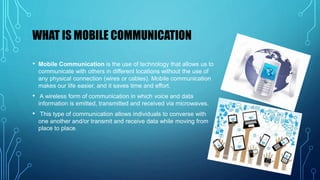
• Mobile Communication is the use of technology that allows us to
communicate with others in different locations without the use of
any physical connection (wires or cables). Mobile communication
makes our life easier, and it saves time and effort.
• A wireless form of communication in which voice and data
information is emitted, transmitted and received via microwaves.
• This type of communication allows individuals to converse with
one another and/or transmit and receive data while moving from
place to place.
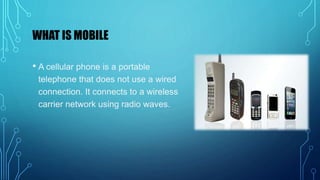
WHAT IS MOBILE
• A cellular phone is a portable
telephone that does not use a wired
connection. It connects to a wireless
carrier network using radio waves.
WHAT IS MOBILE PHONE :
• The mobile phone or cell phone is a long-range, portable
electronic device used for mobile communication. In addition to
the standard voice function of a telephone, current mobile
phones can support many additional services such as SMS for
text messaging, email, packet switching for access to the
Internet, and MMS for sending and receiving photos and video.
Most current mobile phones connect to a cellular network of
base stations (cell sites), which is in turn interconnected to the
public switched telephone network (PSTN)
BASICS OF CELL PHONE :
• Cellular phone is a portable telephone that does not use a
wired connection.
• A cellular phone network uses a number of shortrange radio
transmitter-receivers to communicate.
• The wireless network is connected to the public telephone
system, another wireless carrier network or the Internet for
completing calls to another phone or to a computer.
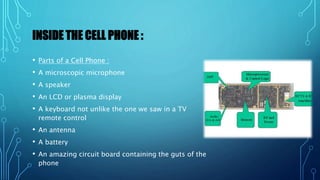
INSIDE THE CELL PHONE :
• Parts of a Cell Phone :
• A microscopic microphone
• A speaker
• An LCD or plasma display
• A keyboard not unlike the one we saw in a TV
remote control
• An antenna
• A battery
• An amazing circuit board containing the guts of the
phone
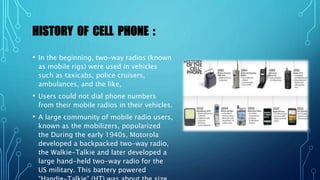
HISTORY OF CELL PHONE :
• In the beginning, two-way radios (known
as mobile rigs) were used in vehicles
such as taxicabs, police cruisers,
ambulances, and the like,
• Users could not dial phone numbers
from their mobile radios in their vehicles.
• A large community of mobile radio users,
known as the mobilizers, popularized
the During the early 1940s, Motorola
developed a backpacked two-way radio,
the Walkie-Talkie and later developed a
large hand-held two-way radio for the
US military. This battery powered
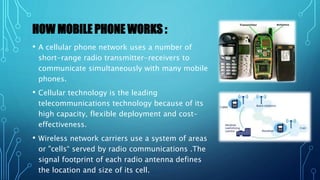
HOW MOBILE PHONE WORKS :
• A cellular phone network uses a number of
short-range radio transmitter-receivers to
communicate simultaneously with many mobile
phones.
• Cellular technology is the leading
telecommunications technology because of its
high capacity, flexible deployment and cost-
effectiveness.
• Wireless network carriers use a system of areas
or "cells“ served by radio communications .The
signal footprint of each radio antenna defines
the location and size of its cell.
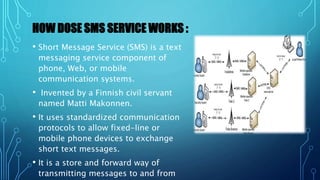
HOW DOSE SMS SERVICE WORKS :
• Short Message Service (SMS) is a text
messaging service component of
phone, Web, or mobile
communication systems.
• Invented by a Finnish civil servant
named Matti Makonnen.
• It uses standardized communication
protocols to allow fixed-line or
mobile phone devices to exchange
short text messages.
• It is a store and forward way of
transmitting messages to and from
HOW DOES MMS SERVICE WORK:
• MMS Stands for Multimedia Messaging Service.
• Messages are sent with a "store-and-forward"
mechanism.
• It is a communications technology developed by
3GPP that allows users to exchange multimedia
communications between capable mobile phones
and other devices.
• To send or receive an MMS message, the phone
makes a GPRS connection . It then usually
connects to the MMSC for sending/receiving
messages through a WAP proxy/gateway.
CELLULAR MOBILE COMMUNICATION:
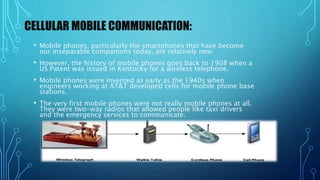
• Mobile phones, particularly the smartphones that have become
our inseparable companions today, are relatively new.
• However, the history of mobile phones goes back to 1908 when a
US Patent was issued in Kentucky for a wireless telephone.
• Mobile phones were invented as early as the 1940s when
engineers working at AT&T developed cells for mobile phone base
stations.
• The very first mobile phones were not really mobile phones at all.
They were two-way radios that allowed people like taxi drivers
and the emergency services to communicate.
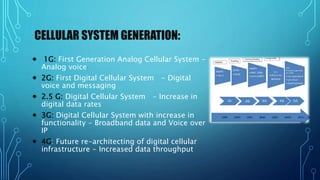
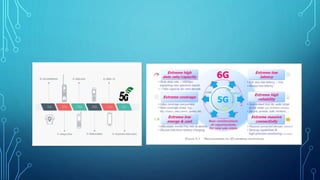
CELLULAR SYSTEM GENERATION:
 1G: First Generation Analog Cellular System -
Analog voice
 2G: First Digital Cellular System - Digital
voice and messaging
 2.5 G: Digital Cellular System - Increase in
digital data rates
 3G: Digital Cellular System with increase in
functionality - Broadband data and Voice over
IP
 4G: Future re-architecting of digital cellular
infrastructure - Increased data throughput
WHAT IS GSM ?
• Global System for Mobile (GSM) is a second
generation cellular standard developed to cater
voice services and data delivery using digital
modulation .
• In GSM, the signalling and speech channels are
digital, therefore GSM is considered a 2G system.
This helps wide-spread implementation of data
communication applications. There are five
different cell sizes in a GSM network These are
macro, micro, Pico, femto and umbrella cells.
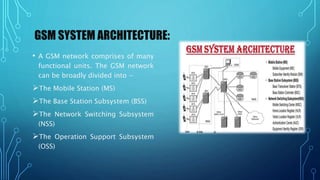
GSM SYSTEM ARCHITECTURE:
• A GSM network comprises of many
functional units. The GSM network
can be broadly divided into −
The Mobile Station (MS)
The Base Station Subsystem (BSS)
The Network Switching Subsystem
(NSS)
The Operation Support Subsystem
(OSS)
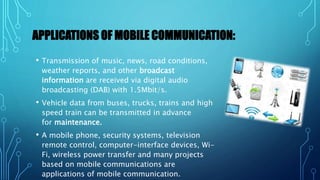
APPLICATIONS OF MOBILE COMMUNICATION:
• Transmission of music, news, road conditions,
weather reports, and other broadcast
information are received via digital audio
broadcasting (DAB) with 1.5Mbit/s.
• Vehicle data from buses, trucks, trains and high
speed train can be transmitted in advance
for maintenance.
• A mobile phone, security systems, television
remote control, computer-interface devices, Wi-
Fi, wireless power transfer and many projects
based on mobile communications are
applications of mobile communication.
ADVANTAGES AND DISADVANTAGES :
Advantages:
• You can carry a mobile phone with you so you don't miss
important calls.
• If you are lost, you can call for directions.
• If you are in an accident, you can call the police or ambulance.
Disadvantages:
• Mobile phones can be expensive.
• They can damage your ear Sometimes the reception is poor in
some areas, limiting your connectivity .
• People use the phone while they are driving, and this can cause
problems.
FUTURE SCOPE OF MOBILE COMMUNICATION:
• Even though many mobile and wireless devices are available, there will be
many more devices in the future. The following list of given examples of
mobile and wireless devices graded by increasing performance (CPU,
memory, display, input devices, etc.)
• Sensor: Wireless device is represented by a sensor transmitting state
information.
• Embedded Controller: Many applications already contain a simple or
sometimes more complex controller. Keyboards, mouse, headsets, washing
machines, coffee machines, hair dryers and TV sets are just some examples.
• Pager: As a very simple receiver, a pager can only display short text
messages, has a tiny display, and cannot send any messages.
• Personal Digital Assistant: PDAs typically accompany a user and offer simple
versions of office software (calendar, notepad, mail).
CONCLUSION:
• Mobile phones have become an essential communication tool for almost
every individual worldwide to update with technologies.
• Mobile banking helps the customers to perform a lot of wide range of
transactions through mobile phones. To avail the facilities of mobile
banking, customers can ask either through SMS or by using WAP (Wireless
Application Protocol) technology, which allows online access of the web
using mobile device. This technology serves to check details on issue of new
cheque book, payment of bills, instruction to stop payment and other value-
added services. This system makes banking location independent. It
provides 24 hours banking facility to the customers with no time and
location constraints at banking environment.
• It is also a time saving facility and banks are beneficiary to earn good
amount of income and gain image in the market.

Mobile Communication final 4-2- Copy.pptx

  • 1.
  • 2.
    CONTENTS: Introduction to MobileCommunication What is Mobile, Mobile Phone? Basics of Cell Phone Inside the Cell Phone History of Mobile Phone  How Mobile Phone Works? How Does SMS,MMS, Service Works? Cellular Mobile Communication Evolution of Cellular Network What is GSM ? GSM Architecture Applications Advantages and Disadvantages Future Scope of Mobile Communication Conclusion
  • 3.
    WHAT IS MOBILECOMMUNICATION • Mobile Communication is the use of technology that allows us to communicate with others in different locations without the use of any physical connection (wires or cables). Mobile communication makes our life easier, and it saves time and effort. • A wireless form of communication in which voice and data information is emitted, transmitted and received via microwaves. • This type of communication allows individuals to converse with one another and/or transmit and receive data while moving from place to place.
  • 4.
    WHAT IS MOBILE •A cellular phone is a portable telephone that does not use a wired connection. It connects to a wireless carrier network using radio waves.
  • 5.
    WHAT IS MOBILEPHONE : • The mobile phone or cell phone is a long-range, portable electronic device used for mobile communication. In addition to the standard voice function of a telephone, current mobile phones can support many additional services such as SMS for text messaging, email, packet switching for access to the Internet, and MMS for sending and receiving photos and video. Most current mobile phones connect to a cellular network of base stations (cell sites), which is in turn interconnected to the public switched telephone network (PSTN)
  • 6.
    BASICS OF CELLPHONE : • Cellular phone is a portable telephone that does not use a wired connection. • A cellular phone network uses a number of shortrange radio transmitter-receivers to communicate. • The wireless network is connected to the public telephone system, another wireless carrier network or the Internet for completing calls to another phone or to a computer.
  • 7.
    INSIDE THE CELLPHONE : • Parts of a Cell Phone : • A microscopic microphone • A speaker • An LCD or plasma display • A keyboard not unlike the one we saw in a TV remote control • An antenna • A battery • An amazing circuit board containing the guts of the phone
  • 8.
    HISTORY OF CELLPHONE : • In the beginning, two-way radios (known as mobile rigs) were used in vehicles such as taxicabs, police cruisers, ambulances, and the like, • Users could not dial phone numbers from their mobile radios in their vehicles. • A large community of mobile radio users, known as the mobilizers, popularized the During the early 1940s, Motorola developed a backpacked two-way radio, the Walkie-Talkie and later developed a large hand-held two-way radio for the US military. This battery powered
  • 9.
    HOW MOBILE PHONEWORKS : • A cellular phone network uses a number of short-range radio transmitter-receivers to communicate simultaneously with many mobile phones. • Cellular technology is the leading telecommunications technology because of its high capacity, flexible deployment and cost- effectiveness. • Wireless network carriers use a system of areas or "cells“ served by radio communications .The signal footprint of each radio antenna defines the location and size of its cell.
  • 10.
    HOW DOSE SMSSERVICE WORKS : • Short Message Service (SMS) is a text messaging service component of phone, Web, or mobile communication systems. • Invented by a Finnish civil servant named Matti Makonnen. • It uses standardized communication protocols to allow fixed-line or mobile phone devices to exchange short text messages. • It is a store and forward way of transmitting messages to and from
  • 11.
    HOW DOES MMSSERVICE WORK: • MMS Stands for Multimedia Messaging Service. • Messages are sent with a "store-and-forward" mechanism. • It is a communications technology developed by 3GPP that allows users to exchange multimedia communications between capable mobile phones and other devices. • To send or receive an MMS message, the phone makes a GPRS connection . It then usually connects to the MMSC for sending/receiving messages through a WAP proxy/gateway.
  • 12.
    CELLULAR MOBILE COMMUNICATION: •Mobile phones, particularly the smartphones that have become our inseparable companions today, are relatively new. • However, the history of mobile phones goes back to 1908 when a US Patent was issued in Kentucky for a wireless telephone. • Mobile phones were invented as early as the 1940s when engineers working at AT&T developed cells for mobile phone base stations. • The very first mobile phones were not really mobile phones at all. They were two-way radios that allowed people like taxi drivers and the emergency services to communicate.
  • 13.
    CELLULAR SYSTEM GENERATION: 1G: First Generation Analog Cellular System - Analog voice  2G: First Digital Cellular System - Digital voice and messaging  2.5 G: Digital Cellular System - Increase in digital data rates  3G: Digital Cellular System with increase in functionality - Broadband data and Voice over IP  4G: Future re-architecting of digital cellular infrastructure - Increased data throughput
  • 15.
    WHAT IS GSM? • Global System for Mobile (GSM) is a second generation cellular standard developed to cater voice services and data delivery using digital modulation . • In GSM, the signalling and speech channels are digital, therefore GSM is considered a 2G system. This helps wide-spread implementation of data communication applications. There are five different cell sizes in a GSM network These are macro, micro, Pico, femto and umbrella cells.
  • 16.
    GSM SYSTEM ARCHITECTURE: •A GSM network comprises of many functional units. The GSM network can be broadly divided into − The Mobile Station (MS) The Base Station Subsystem (BSS) The Network Switching Subsystem (NSS) The Operation Support Subsystem (OSS)
  • 17.
    APPLICATIONS OF MOBILECOMMUNICATION: • Transmission of music, news, road conditions, weather reports, and other broadcast information are received via digital audio broadcasting (DAB) with 1.5Mbit/s. • Vehicle data from buses, trucks, trains and high speed train can be transmitted in advance for maintenance. • A mobile phone, security systems, television remote control, computer-interface devices, Wi- Fi, wireless power transfer and many projects based on mobile communications are applications of mobile communication.
  • 18.
    ADVANTAGES AND DISADVANTAGES: Advantages: • You can carry a mobile phone with you so you don't miss important calls. • If you are lost, you can call for directions. • If you are in an accident, you can call the police or ambulance. Disadvantages: • Mobile phones can be expensive. • They can damage your ear Sometimes the reception is poor in some areas, limiting your connectivity . • People use the phone while they are driving, and this can cause problems.
  • 19.
    FUTURE SCOPE OFMOBILE COMMUNICATION: • Even though many mobile and wireless devices are available, there will be many more devices in the future. The following list of given examples of mobile and wireless devices graded by increasing performance (CPU, memory, display, input devices, etc.) • Sensor: Wireless device is represented by a sensor transmitting state information. • Embedded Controller: Many applications already contain a simple or sometimes more complex controller. Keyboards, mouse, headsets, washing machines, coffee machines, hair dryers and TV sets are just some examples. • Pager: As a very simple receiver, a pager can only display short text messages, has a tiny display, and cannot send any messages. • Personal Digital Assistant: PDAs typically accompany a user and offer simple versions of office software (calendar, notepad, mail).
  • 20.
    CONCLUSION: • Mobile phoneshave become an essential communication tool for almost every individual worldwide to update with technologies. • Mobile banking helps the customers to perform a lot of wide range of transactions through mobile phones. To avail the facilities of mobile banking, customers can ask either through SMS or by using WAP (Wireless Application Protocol) technology, which allows online access of the web using mobile device. This technology serves to check details on issue of new cheque book, payment of bills, instruction to stop payment and other value- added services. This system makes banking location independent. It provides 24 hours banking facility to the customers with no time and location constraints at banking environment. • It is also a time saving facility and banks are beneficiary to earn good amount of income and gain image in the market.