Simple and Powerful Method To
Troubleshoot And Repair Any Types Of SMPS
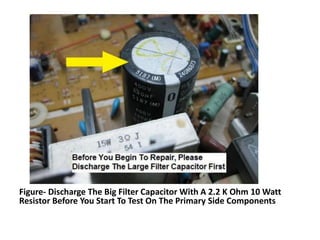
Figure- Discharge The Big Filter Capacitor With A 2.2 K Ohm 10 Watt
Resistor Before You Start To Test On The Primary Side Components
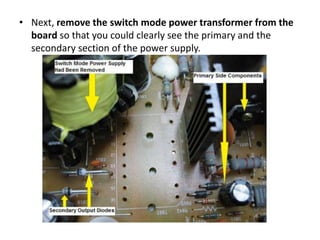
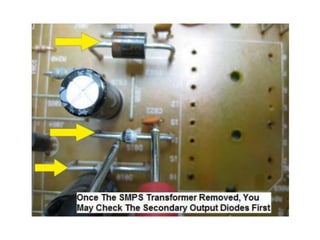
• Next, remove the switch mode power transformer from the
board so that you could clearly see the primary and the
secondary section of the power supply.
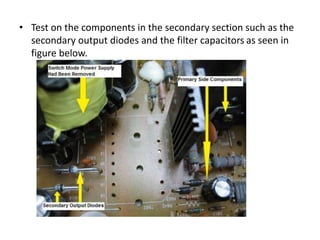
• Test on the components in the secondary section such as the
secondary output diodes and the filter capacitors as seen in
figure below.
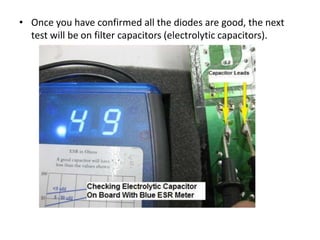
• Once you have confirmed all the diodes are good, the next
test will be on filter capacitors (electrolytic capacitors).
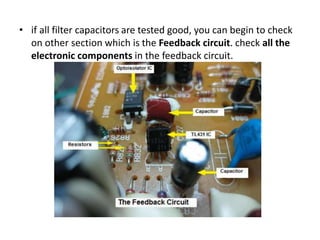
• if all filter capacitors are tested good, you can begin to check
on other section which is the Feedback circuit. check all the
electronic components in the feedback circuit.
• Now, you have completed
checking the components in the
secondary side and let’s move on
to test the components in the
primary side of the power supply.
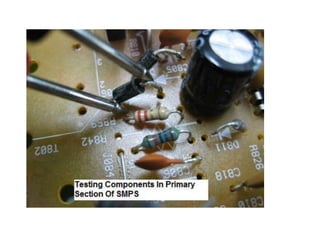
• Checking the primary section is easy, just
solder out(remove at least one lead) all
of the electronic components and test
one by one until you have found the bad
or the defective components.
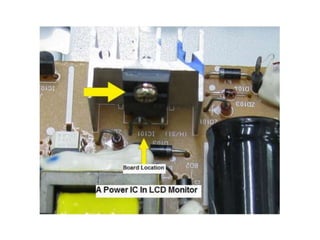
• If you did not find any bad components
in the primary section, then suspect the
power IC. Directly replace the power IC
and retest again the power supply.
Usually the power supply will work since
you have confirmed all of the primary
and the secondary component are good!
• Do you know that it can be more than one bad
component in the power section?
• You will find lots of components burnt especially
if the power supply hit by lightning or by a power
surge. The fuse, bridge rectifier, current sense
resistor, power FET, zener diode and power IC
could blow and this will usually takes you about
an hour or so to complete the troubleshooting
job.
Besides electronic components, you
are also required to check for
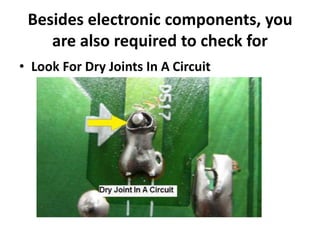
• Look For Dry Joints In A Circuit
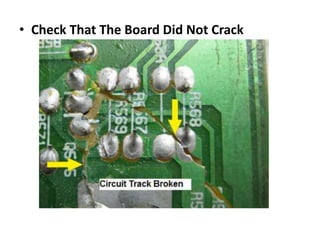
• Check That The Board Did Not Crack
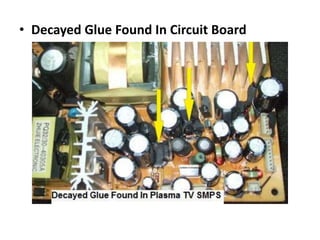
• Decayed Glue Found In Circuit Board

smps last.pptx

  • 1.
    Simple and PowerfulMethod To Troubleshoot And Repair Any Types Of SMPS
  • 2.
    Figure- Discharge TheBig Filter Capacitor With A 2.2 K Ohm 10 Watt Resistor Before You Start To Test On The Primary Side Components
  • 3.
    • Next, removethe switch mode power transformer from the board so that you could clearly see the primary and the secondary section of the power supply.
  • 4.
    • Test onthe components in the secondary section such as the secondary output diodes and the filter capacitors as seen in figure below.
  • 7.
    • Once youhave confirmed all the diodes are good, the next test will be on filter capacitors (electrolytic capacitors).
  • 8.
    • if allfilter capacitors are tested good, you can begin to check on other section which is the Feedback circuit. check all the electronic components in the feedback circuit.
  • 9.
    • Now, youhave completed checking the components in the secondary side and let’s move on to test the components in the primary side of the power supply.
  • 10.
    • Checking theprimary section is easy, just solder out(remove at least one lead) all of the electronic components and test one by one until you have found the bad or the defective components.
  • 12.
    • If youdid not find any bad components in the primary section, then suspect the power IC. Directly replace the power IC and retest again the power supply. Usually the power supply will work since you have confirmed all of the primary and the secondary component are good!
  • 14.
    • Do youknow that it can be more than one bad component in the power section? • You will find lots of components burnt especially if the power supply hit by lightning or by a power surge. The fuse, bridge rectifier, current sense resistor, power FET, zener diode and power IC could blow and this will usually takes you about an hour or so to complete the troubleshooting job.
  • 15.
    Besides electronic components,you are also required to check for • Look For Dry Joints In A Circuit
  • 16.
    • Check ThatThe Board Did Not Crack
  • 17.
    • Decayed GlueFound In Circuit Board