Types and operation of DC
Machine
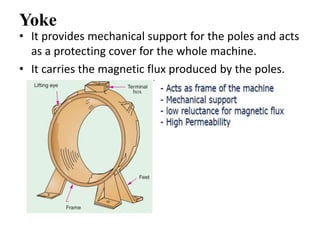
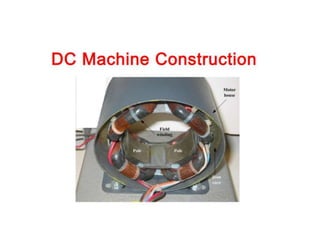
Yoke
• It provides mechanical support for the poles and acts
as a protecting cover for the whole machine.
• It carries the magnetic flux produced by the poles.
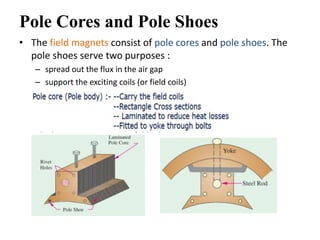
Pole Cores and Pole Shoes
• The field magnets consist of pole cores and pole shoes. The
pole shoes serve two purposes :
– spread out the flux in the air gap
– support the exciting coils (or field coils)
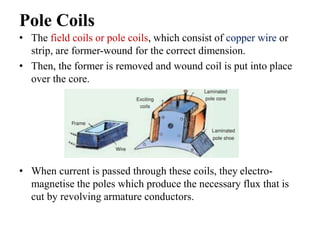
Pole Coils
• The field coils or pole coils, which consist of copper wire or
strip, are former-wound for the correct dimension.
• Then, the former is removed and wound coil is put into place
over the core.
• When current is passed through these coils, they electro-
magnetise the poles which produce the necessary flux that is
cut by revolving armature conductors.
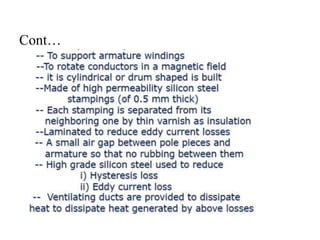
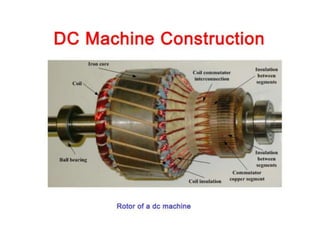
Armature Core
• It houses the armature conductors or coils and causes
them to rotate and hence cut the magnetic flux of the
field magnets.
• It provides a path of very low reluctance to the flux
through the armature from a N-pole to a S-pole.
Cont…
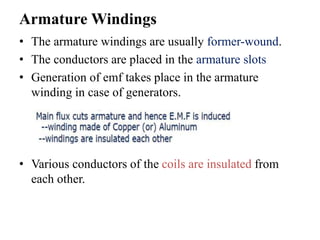
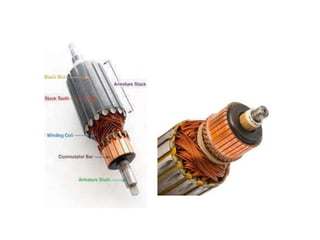
Armature Windings
• The armature windings are usually former-wound.
• The conductors are placed in the armature slots
• Generation of emf takes place in the armature
winding in case of generators.
• Various conductors of the coils are insulated from
each other.
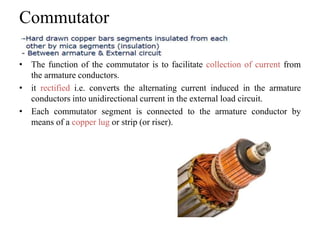
Commutator
• The function of the commutator is to facilitate collection of current from
the armature conductors.
• it rectified i.e. converts the alternating current induced in the armature
conductors into unidirectional current in the external load circuit.
• Each commutator segment is connected to the armature conductor by
means of a copper lug or strip (or riser).
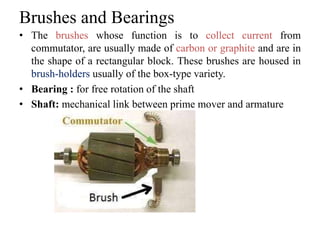
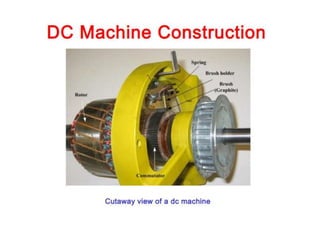
Brushes and Bearings
• The brushes whose function is to collect current from
commutator, are usually made of carbon or graphite and are in
the shape of a rectangular block. These brushes are housed in
brush-holders usually of the box-type variety.
• Bearing : for free rotation of the shaft
• Shaft: mechanical link between prime mover and armature
construction of dc generator.pptx

construction of dc generator.pptx

  • 1.
    Types and operationof DC Machine
  • 2.
    Yoke • It providesmechanical support for the poles and acts as a protecting cover for the whole machine. • It carries the magnetic flux produced by the poles.
  • 3.
    Pole Cores andPole Shoes • The field magnets consist of pole cores and pole shoes. The pole shoes serve two purposes : – spread out the flux in the air gap – support the exciting coils (or field coils)
  • 4.
    Pole Coils • Thefield coils or pole coils, which consist of copper wire or strip, are former-wound for the correct dimension. • Then, the former is removed and wound coil is put into place over the core. • When current is passed through these coils, they electro- magnetise the poles which produce the necessary flux that is cut by revolving armature conductors.
  • 5.
    Armature Core • Ithouses the armature conductors or coils and causes them to rotate and hence cut the magnetic flux of the field magnets. • It provides a path of very low reluctance to the flux through the armature from a N-pole to a S-pole.
  • 6.
  • 7.
    Armature Windings • Thearmature windings are usually former-wound. • The conductors are placed in the armature slots • Generation of emf takes place in the armature winding in case of generators. • Various conductors of the coils are insulated from each other.
  • 9.
    Commutator • The functionof the commutator is to facilitate collection of current from the armature conductors. • it rectified i.e. converts the alternating current induced in the armature conductors into unidirectional current in the external load circuit. • Each commutator segment is connected to the armature conductor by means of a copper lug or strip (or riser).
  • 10.
    Brushes and Bearings •The brushes whose function is to collect current from commutator, are usually made of carbon or graphite and are in the shape of a rectangular block. These brushes are housed in brush-holders usually of the box-type variety. • Bearing : for free rotation of the shaft • Shaft: mechanical link between prime mover and armature