What Is aPower Supply?
The power supply converts the power from
the source into the correct format and voltage.
Because various options exist, the specific
power supply function depends on whether it
needs to regulate energy or convert power.
6.
What Does aPower Supply Do?
Power supplies have essential functions found in all
models with additional operations added
depending on the device type. Power supplies may
need to change voltage up or down, convert power
to direct current, or regulate power for smoother
outgoing voltage.
7.
1. Power SuppliesChange Voltage
Power supplies are primarily used for changing
voltage. The power source has a steady output,
regardless of the device that must be used. To
prevent overload, power supplies step down
the voltage—or, conversely, step it up—to
match the device’s requirements.
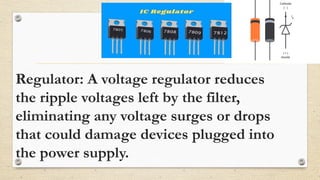
8.
2. Power SuppliesConvert Power
Two types of power supplies exist: DC-DC and AC-
DC.
The most common type is the AC-DC type. Electrical
outlets deliver alternating current, or AC, power.
Most electrical devices require direct current to
function. A power supply converts AC to DC.
9.
3. Power SuppliesRegulate Power
Most electronics require regulated power. When
a power supply changes the voltage and type of
power, the result is not always a steady output.
Though it does not turn on and off completely,
fluctuations in the outcoming voltage still occur
without regulation.
10.
TYPES OF POWERSUPPLY
1. Linear Power Supplies:
Linear power supplies use a series of
transformers, diodes, and regulators to output
input energy as direct current (DC). They offer
good regulation and low noise levels.
11.
2. Switching PowerSupplies:
• Switching power supplies use switching circuits that
provide high energy efficiency.
• It uses high-frequency switching to convert AC input
to DC.
• They can be lighter , more compact and efficient.
Because they operate at high frequencies, they can
produce electromagnetic noise.
12.
3. Constant CurrentPower Supplies:
Constant current power supplies provide a
constant current level at their output.
They are widely used in fields such as LED
lighting, electroplating and laboratory
applications.
13.
4. Constant VoltagePower Supplies:
Constant voltage power supplies provide a
constant voltage level at their output.
They are used as power sources for many devices
such as electronic devices, computers and mobile
phones.
14.
5. Programmable PowerSupplies:
Programmable power supplies have features
that allow users to adjust and program the
output voltage and current as they wish.
They are used in applications such as
laboratory testing and electronic prototyping.
15.
6. Backup BatterySources:
Backup battery sources are used to provide
electrical energy during power outages.
They are called UPS (Uninterruptible
Power Supply) and are used for critical
systems such as computers and servers.
16.
7. Portable Chargers:
Portablechargers are used to charge cell
phones, tablets, and other portable
electronic devices.
They are usually battery-powered and
power devices via USB or other ports.
17.
8. Industrial PowerSupplies:
It is designed for heavy-duty applications
such as industrial power supplies,
industrial automation, and production
systems.
They offer high power capacity and
durability.
19.
PARTS OF POWERSUPPLY
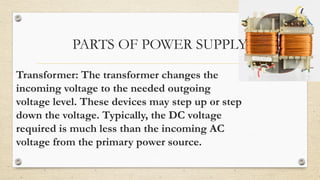
Transformer: The transformer changes the
incoming voltage to the needed outgoing
voltage level. These devices may step up or step
down the voltage. Typically, the DC voltage
required is much less than the incoming AC
voltage from the primary power source.
20.
Rectifier: The powersupply uses a
rectifier, which may be half-wave,
full-wave, or bridge, to convert the
incoming power from AC to DC.
21.
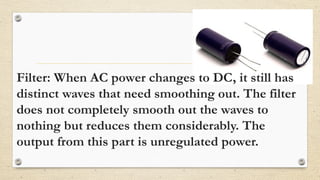
Filter: When ACpower changes to DC, it still has
distinct waves that need smoothing out. The filter
does not completely smooth out the waves to
nothing but reduces them considerably. The
output from this part is unregulated power.
22.
Regulator: A voltageregulator reduces
the ripple voltages left by the filter,
eliminating any voltage surges or drops
that could damage devices plugged into
the power supply.
23.
MOST COMMON DEFECTSOF PSU
1. Overheating
One of the most common power supply problems is overheating.
PSUs can get hot, especially if they’re under a heavy load, and if
they get too hot, they can shut down or even fail completely.
Overheating can be caused by a variety of factors, including poor
ventilation, dust buildup, or a faulty fan. To prevent overheating,
ensure your PSU is well-ventilated and clean, and consider adding
cooling fans if necessary.
24.
2. Power Surges
Powersurges occur when the voltage in your home or office
suddenly spikes, and this can damage your electronics,
including your PSU. The surges cause equipment to suffer
premature failure. However, power surges may not be
noticeable until failure though the heat can be a sign. Power
surges can be caused by lightning strikes, power outages, or
faulty wiring, among other things. To protect your PSU
from power surges, consider investing in a surge protector
or an uninterruptible power supply (UPS).
25.
3. Underpowered PSU
Anunderpowered PSU won’t be able to provide enough
power to your system, which can lead to various
problems, including crashes, freezes, and even hardware
damage. To prevent this, make sure to check the power
requirements of your system before purchasing a PSU.
If you’re upgrading an older system, consider
upgrading your PSU to ensure it can handle the
increased power requirements.
26.
4. Loose Connections
Looseconnections are another common power supply
problem that can occur due to faulty cables or loose
connections between devices. Loose connections can
lead to power loss, device malfunction, and even
electrical shocks. To avoid loose connections, always
ensure that your cables are plugged in securely and
regularly inspect your cables for wear and tear.
27.
•5. Reversed Polarity
Reversedpolarity occurs when the positive and negative
inputs or outputs of a power supply are improperly
connected. Certain components, such as electrolytic
capacitors, are intolerant of this and can fail as a result. If
the output connections of the power supply are reversed,
the load may be damaged, potentially causing power
supply failure and worst-case scenarios like damaged
circuits or electrical fires.
28.
1. The primaryfunction of a power supply is to:
a) Amplify a signal
b) Convert AC voltage from a wall outlet to a
stable DC voltage
c) Store electrical energy for backup
d) Control the speed of a motor
29.
2. Which ofthe following is the standard
form of electricity provided by a wall outlet?
a) Direct Current (DC)
b) Alternating Current (AC)
c) Pulsating Direct Current (PDC)
d) Static Electricity
30.
3. The firststage in a basic AC-to-DC power
supply is usually a:
a) Voltage Regulator
b) Transformer
c) Rectifier
d) Filter Capacitor
31.
4. A componentthat changes the AC voltage
level (steps it up or down) is the:
a) Rectifier
b) Transformer
c) Filter
d) Regulator
32.
5. A bridgerectifier circuit is used to:
a) Convert pulsating DC into smooth DC
b) Convert AC into pulsating DC
c) Stabilize the output voltage
d) Change the voltage level
33.
6. A largecapacitor placed after the rectifier serves
to:
a) Increase the voltage
b) Smooth out the rectified pulses into a steadier
DC voltage
c) Convert DC back to AC
d) Protect against power surges
34.
7. A voltageregulator is crucial because it:
a) Makes the power supply more efficient
b) Provides a constant output voltage regardless
of changes in input voltage or load current
c) Increases the maximum available current
d) Converts more power to heat
35.
8. Which typeof modern power supply is
typically more efficient, smaller, and lighter?
a) Linear Power Supply
b) Switched-Mode Power Supply (SMPS)
c) Transformer-based Supply
d) Unregulated Power Supply
Scenario: You arebuilding a small electronic project
that uses a microcontroller and sensors. The project
needs a clean, stable 5V DC supply and can draw up
to 1 Amp. You have a 12V DC, 2A "wall wart"
adapter.
13-15. Can you use the 12V adapter directly? Why or
why not?
38.
16-20. If adevice requires 12V DC
and 2A of current, what is the
minimum Power Rating (in Watts)
the power supply should have?
Show your SOLUTION.
39.
21 - 23Types of Power
Supply
24 - 25 Most common
defects of Power Supply Unit
Editor's Notes
#1 “What magic box is inside this charger that changes AC into smooth, usable DC?” That “magic box” inside your charger is actually a Power Supply Circuit.It’s not one single component, but a combination of parts that work together to convert the dangerous, alternating current (AC) from the outlet into safe, stable direct current (DC) for your device. “Why can’t we connect our phones directly to AC power?” We can’t connect our phones directly to AC power because it’s too high in voltage, changes direction, and would instantly damage the phone, which only needs low, steady DC Tell students: “Imagine drinking water directly from a fire hydrant (AC mains). Too strong, dangerous, and uncontrollable! A power supply acts like a purifier and regulator—it tames the raw flow into something safe and usable.”
#2 (Examples: TV, laptop, Wi-Fi router, LED lights). Just as our bodies need clean and safe food, electronic devices need clean and stable DC power. Today, we’ll study how a power supply circuit works step by step—transformer, rectifier, filter, and regulator—so that sensitive electronics can run safely and reliably
#5 Do not confuse a power supply with a power source. The source is the origin of incoming electricity. The electricity source is usually an outlet, battery, or generator. The power supply converts the power from the source into the correct format and voltage. Because various options exist, the specific power supply function depends on whether it needs to regulate energy or convert power.
#6 These functions will help you choose which supply you need for your electrical needs. Getting a device with too many features could cost you more money than you need, but if you don’t get the features you require, you could damage the devices you need to power.
#7 Too much power from a power supply can severely damage a device, but if it does not deliver enough voltage, the device will not operate as it should. Energy changing is the main task of power supplies, and the bulk of their construction comes from the transformer used to move the voltage up or down as needed.
#8 Power conversion converts the incoming electricity to a format that the electrical device can use. Two types of power supplies exist: DC-DC and AC-DC. DC-DC power supplies allow you to plug electrical devices into car outlets or similar sources that supply direct current, or DC, power. These power supplies are not the most commonly used, though.
Browse DC-DC Power Supplies
While DC-DC power supplies exist, the most common type is the AC-DC type. Electrical outlets deliver alternating current, or AC, power. Most electrical devices require direct current to function. A power supply converts AC to DC. During this conversion, the output may waver, occasionally requiring regulation. However, for general use, you may not need regulated power supplies. AC-DC converters are electronic circuits that convert alternating current (AC) into direct current (DC). These converters are widely used in electronic devices that require DC power, such as computers, televisions, and smartphones.
#9 An unregulated power supply can deliver more power than expected. Such a surge fed to delicate electronics like computers and televisions could cause severe damage to the parts or even permanent harm that could cause damage beyond repair.
The added function of regulating power increases the cost of the device. Still, it can save you the price of purchasing new electronics to replace those ruined by unregulated voltage overwhelming them. To save money while powering devices with loads that closely match the power supply’s output, use unregulated power supplies. But electronics require regulated power. Don’t make the mistake of selecting the wrong supply.
#10 They offer good regulation and low noise levels.
However, energy efficiency is often low and large energy losses may occur.
Some examples of applications that may require a linear power supply are communication equipment, medical equipment, low-noise amplifiers, signal processing, data acquisition, including sensors, multiplexers, A/D converters, sample-and-hold circuits, automatic test equipment, laboratory test equipment,
They can be more efficient at light loads. Commonly used in communications , medical and laboratory. Operates by dissipating excess power as heat to regulate voltage. Simple, low noise, but inefficient and bulky.
#11 Manufacturing, mobile station, shipboard,aviation
#12 Electroplating is the process of using electrodeposition to coat an object in a layer of metal(s). Engineers use controlled electrolysis to transfer the desired metal coating from an anode (a part containing the metal that will be used as the plating) to a cathode (the part to be plated). For example, silver-plated cutlery is electroplated to help retain its shiny appearance and prevent tarnishing.
#14 It entails creating circuits with designs, including a breadboard, stripboard, or perf-board. Prototyping boards have holes that will help you to build your electronic components and affix them, the components can be attached through soldering and will depend on the type of board.
#19 The power supply transformer raises or lowers the voltage as needed. Most devices require stepped down voltage from standard AC outlets, which output 100 to 240 volts, to a much lower amount. Some transformers, however, will step up the voltage and isolate the incoming and outgoing circuits.
Incoming power enters the transformer through the primary winding, and outgoing electricity connects to the secondary winding. These two windings have no physical connection, which ensures the safety of the transformer. Faraday’s Law allows electromagnetic energy to be induced on the secondary winding from the primary winding without the need for contact between these parts.
Once finished stepping up or down the voltage, the transformer sends the outgoing power to a rectifier to convert the alternating current into direct current.
#20 Part of how an AC-to-DC power supply works is the rectifier in the unit that changes the current type. Power supply creators choose from three types of silicon diode rectifiers to convert AC power to DC. Each model has its operation and benefits.
Half wave: The lowest-cost rectifier uses a single silicon diode, but it only converts half of the AC wave. This half-wave conversion results in a greater ripple, which is more difficult to remove with a regulator. Additionally, half-wave rectifiers do not perform as efficiently as other models and only work for supplying power to low-importance devices.
Full wave: A full-wave rectifier requires a center tap in the secondary winding. Because these rectifiers need a specialized transformer, they typically appear in power supplies more expensive, though more efficient. These models also produce less ripple after conversion into DC power, which is easier for a regulator to remove.
Bridge: The most efficient rectifier blends the best half- and full-wave types. The bridge model uses four diodes to convert a full AC wave without needing a special center-tapped transformer.
See Our 28V AC-DC Power Supply
#21 After conversion, most DC power will still have output ripple. A capacitor directly filters out the worst of the ripple as the electricity leaves the rectifier.
Capacitors hold electrons until needed. As the current passes through the capacitor, it moves in waves. The peaks already have enough electrons, but the troughs represent lower amounts of electricity that correspond to lower levels of electrons. As the current waves drop, the need for extra electrons increases. The capacitor feeds electrons into the current, making the waves smoother. Smoother waves provide more even electricity without ebbs and surges.
While capacitors do not create utterly smooth power, they do reduce the highs and lows that leave a rectifier. If you need a consistent flow of electricity, you must have a regulated power supply. These devices fill in the remaining troughs left after the current leaves the capacitor. Power supplies that connect to electronics require regulators to protect the delicate circuitry of such devices.
#22 After the current leaves the filter, the power supply’s task ends in an unregulated model. While unregulated power supplies suffice for general use, when you need entirely stable electricity that does not change when the load does, you need regulated power. Regulated power supplies come in two forms based on how they regulate energy — linear and switching. Many simple DC power supplies regulate the voltage using either series or shunt regulators, but most apply a voltage reference using a shunt regulator such as a Zener diode, avalanche breakdown diode, or voltage regulator tube.





















![REGULATED_POWER_SUPPLY-1[1].pptx](https://cdn.slidesharecdn.com/ss_thumbnails/regulatedpowersupply-11-220731133419-9084246e-thumbnail.jpg?width=640&height=640&fit=bounds)


