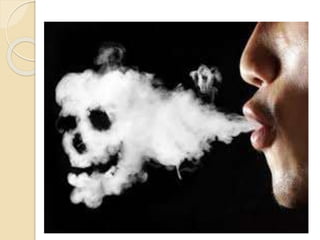
SMOKING
BE SMART
AND
DON’T START
People start smoking
for a variety of different reasons.
Some think it looks cool.
Others start because their family members
or friends smoke.
Statistics show that about 9 out of 10 tobacco
users start before they're 18 years old.
Most adults who started smoking in their
teens never expected to become addicted.
That's why people say it's just so much
easier to not start smoking at all.
In 2010, a ban on smoking in public places.
Inhalation of tobacco smoke from a cigarette
smoked by another person in the same room
is particularly hazardous to health, as side stream smoke
contains from 5 to 15 times the carbon monoxide
and from 2 to 20 times more nicotine than the smoke inhaled by smokers.
Inhalation of smoke exhaled by smokers,
increases the risk of lung cancer and heart disease by non-smokers.
Substances contained in cigarettes
There are over 4,000 chemicals in tobacco smoke.
At least 69 of those chemicals
are known to cause cancer.
This chemicals expose smokers and even
non-smokers, if they inhale this smoke,
to serious risk.
Do you know
what from chemicals
we can find in cigarettes?
NICOTINE
(Nikotyna) C10H14N2
Nicotine is a very potent neurotoxin.
BENZOPYREN
(Benzopiren) C20H12
It is a potent carcinogenic agent.
ARSENIC
(Arsen) As
This is a strong poison. It has carcinogenic properties.
CADMIUM
(Kadm) Cd
Cadmium is highly toxic
(much more than arsen).
The use of, for example:
 metallurgy
- in interest bearing
- as protective coatings of other metals
 power
- in nickel-cadmium batteries
- in nuclear reactors, for example for the manufacture of control rods
chain reaction
- nuclear physics
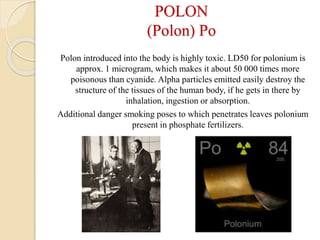
POLON
(Polon) Po
Polon introduced into the body is highly toxic. LD50 for polonium is
approx. 1 microgram, which makes it about 50 000 times more
poisonous than cyanide. Alpha particles emitted easily destroy the
structure of the tissues of the human body, if he gets in there by
inhalation, ingestion or absorption.
Additional danger smoking poses to which penetrates leaves polonium
present in phosphate fertilizers.
HYDROGEN CYANIDE
(Cyjanowodór) HCN
 A chemical compound that is a colorless, volatile and highly poisonous liquid.
 During the Second World War was used by the Germans under the trade name
„Zyklon B” in mass executions in concentration camps.
 It is now included on list 3. Convention chemical weapons.
CARBON MONOXIDE
(Tlenek węgla) CO
It is a component of:
 gas generator
 water gas
 blast furnace gas
 gas light
STEARIC ACID
(Kwas stearynowy) C18H36O2
 shaving foam
 creams
 candles
 crayons
 drugs
 lotions
 soaps
HAXAMINE
(Urotropina) C6H12N4
 In the form of tablets used as fuel for heating food travel in the field
 Used in the plastics industry for the production of bakelite.
 Is an intermediate in the preparation of explosives
 Also used as a corrosion inhibitor in acid pickling baths and
cleaning.
BUTANE
(Butan) C4H10
 propellant
 used for production of synthetic gasoline
 one of the components of vehicle gas LPG
 filling gas lighters
 refrigerant used in refrigerators (R-600)
METHANE
(Metan) CH4
 motor fuel
 raw material for plastics
 energy industry
TOLUENE
(Toluen) C7H8
 Toluen jest szkodliwy dla układu oddechowego, krwionośnego,
rozrodczego, nerwowego i immunologicznego, nerek i wątroby.
Obniża zdolność uczenia się. Może wywoływać podrażnienia oczu
oraz skóry, a także uszkodzenia mózgu.
 It is used as a raw material and solvent in many areas of the organic
industry, pharmaceuticals, plastics to manufacture explosives
(TNT), dyes, detergents and perfumes and as a component of high-
octane aviation fuel.
 It is also used to produce gels, sprays, hair dyes and nail polishes.
AMMONIA
(Amoniak) NH3
 The largest amounts of ammonia are consumed in industry for the
production of fertilizers, explosives, cyanide, synthetic fabrics, etc.
 Because of its thermodynamic properties of the ammonia is used as a
refrigerant (R717), especially in large cooling devices.
METHANOL
(Metanol) CH4O
 Methanol has a high toxicity in humans. It is a strong poison.
 It is easily soluble in water
 Drinking or breathing methanol may result in death or serious disability
 8-10 g of methanol causes blindness, a greater amount of – death.
PHENOL
(Fenol) C6H6O
Phenol is a toxic substance.
The starting product of many chemical syntheses.
It is used for the production of polyamide fibers, phenolics, dyes,
pharmaceuticals, explosives.
Disinfectant and preservative.
NAPHTHYLAMINE
(Naftyloamina) C10H7NH2
Substance, used primarily to produce dye,
was also used in the detection of nitrates
NAPHTALENE
(Naftalen) C10H8
It occurs in coal tar, crude oil and essential oils.
It is used for the synthesis of various chemicals,
dyes ftaleinowych,
indigo, insecticides (such as mothballs) and
explosives, solvents, synthetic resins and tannins.
VINYL CHLORIDE
(Chlorek winylu) C2H3Cl
This polymer is used in various industries:
 for the manufacture of flooring, window and door frames,
accessories (in the form of various trims), pipes and fittings to perform
installations in buildings, wall cladding (siding), films, electric
insulation
 in Medicine drainage tubes, probes, catheters, syringes
for the manufacture of packaging, items of equipment, gramophone
records
 sports surface coating and other, hidden and open (sometimes as
plastic covering)
NOW WHEN YOU KNOW
WHAT CIGARRETES CONTAIN
DO YOU REALLY WANT
TO PUT YOUR HEALTH
IN SUCH A DANGER?
MAKE A RIGHT CHOICE.
This project is realized thanks to the European Commission funding
under the " Lifelong Learning Programme".
Content of this publication is entirely the responsibility of the author.
The European Commission is not responsible for the use of the data contained herein.
Source: https://pl.wikipedia.org

Smoking

  • 1.
  • 3.
    People start smoking fora variety of different reasons. Some think it looks cool. Others start because their family members or friends smoke. Statistics show that about 9 out of 10 tobacco users start before they're 18 years old. Most adults who started smoking in their teens never expected to become addicted. That's why people say it's just so much easier to not start smoking at all.
  • 5.
    In 2010, aban on smoking in public places. Inhalation of tobacco smoke from a cigarette smoked by another person in the same room is particularly hazardous to health, as side stream smoke contains from 5 to 15 times the carbon monoxide and from 2 to 20 times more nicotine than the smoke inhaled by smokers. Inhalation of smoke exhaled by smokers, increases the risk of lung cancer and heart disease by non-smokers.
  • 7.
    Substances contained incigarettes There are over 4,000 chemicals in tobacco smoke. At least 69 of those chemicals are known to cause cancer. This chemicals expose smokers and even non-smokers, if they inhale this smoke, to serious risk. Do you know what from chemicals we can find in cigarettes?
  • 9.
    NICOTINE (Nikotyna) C10H14N2 Nicotine isa very potent neurotoxin. BENZOPYREN (Benzopiren) C20H12 It is a potent carcinogenic agent. ARSENIC (Arsen) As This is a strong poison. It has carcinogenic properties.
  • 10.
    CADMIUM (Kadm) Cd Cadmium ishighly toxic (much more than arsen). The use of, for example:  metallurgy - in interest bearing - as protective coatings of other metals  power - in nickel-cadmium batteries - in nuclear reactors, for example for the manufacture of control rods chain reaction - nuclear physics
  • 11.
    POLON (Polon) Po Polon introducedinto the body is highly toxic. LD50 for polonium is approx. 1 microgram, which makes it about 50 000 times more poisonous than cyanide. Alpha particles emitted easily destroy the structure of the tissues of the human body, if he gets in there by inhalation, ingestion or absorption. Additional danger smoking poses to which penetrates leaves polonium present in phosphate fertilizers.
  • 12.
    HYDROGEN CYANIDE (Cyjanowodór) HCN A chemical compound that is a colorless, volatile and highly poisonous liquid.  During the Second World War was used by the Germans under the trade name „Zyklon B” in mass executions in concentration camps.  It is now included on list 3. Convention chemical weapons. CARBON MONOXIDE (Tlenek węgla) CO It is a component of:  gas generator  water gas  blast furnace gas  gas light
  • 13.
    STEARIC ACID (Kwas stearynowy)C18H36O2  shaving foam  creams  candles  crayons  drugs  lotions  soaps
  • 14.
    HAXAMINE (Urotropina) C6H12N4  Inthe form of tablets used as fuel for heating food travel in the field  Used in the plastics industry for the production of bakelite.  Is an intermediate in the preparation of explosives  Also used as a corrosion inhibitor in acid pickling baths and cleaning.
  • 15.
    BUTANE (Butan) C4H10  propellant used for production of synthetic gasoline  one of the components of vehicle gas LPG  filling gas lighters  refrigerant used in refrigerators (R-600) METHANE (Metan) CH4  motor fuel  raw material for plastics  energy industry
  • 16.
    TOLUENE (Toluen) C7H8  Toluenjest szkodliwy dla układu oddechowego, krwionośnego, rozrodczego, nerwowego i immunologicznego, nerek i wątroby. Obniża zdolność uczenia się. Może wywoływać podrażnienia oczu oraz skóry, a także uszkodzenia mózgu.  It is used as a raw material and solvent in many areas of the organic industry, pharmaceuticals, plastics to manufacture explosives (TNT), dyes, detergents and perfumes and as a component of high- octane aviation fuel.  It is also used to produce gels, sprays, hair dyes and nail polishes.
  • 17.
    AMMONIA (Amoniak) NH3  Thelargest amounts of ammonia are consumed in industry for the production of fertilizers, explosives, cyanide, synthetic fabrics, etc.  Because of its thermodynamic properties of the ammonia is used as a refrigerant (R717), especially in large cooling devices. METHANOL (Metanol) CH4O  Methanol has a high toxicity in humans. It is a strong poison.  It is easily soluble in water  Drinking or breathing methanol may result in death or serious disability  8-10 g of methanol causes blindness, a greater amount of – death.
  • 18.
    PHENOL (Fenol) C6H6O Phenol isa toxic substance. The starting product of many chemical syntheses. It is used for the production of polyamide fibers, phenolics, dyes, pharmaceuticals, explosives. Disinfectant and preservative.
  • 19.
    NAPHTHYLAMINE (Naftyloamina) C10H7NH2 Substance, usedprimarily to produce dye, was also used in the detection of nitrates NAPHTALENE (Naftalen) C10H8 It occurs in coal tar, crude oil and essential oils. It is used for the synthesis of various chemicals, dyes ftaleinowych, indigo, insecticides (such as mothballs) and explosives, solvents, synthetic resins and tannins.
  • 20.
    VINYL CHLORIDE (Chlorek winylu)C2H3Cl This polymer is used in various industries:  for the manufacture of flooring, window and door frames, accessories (in the form of various trims), pipes and fittings to perform installations in buildings, wall cladding (siding), films, electric insulation  in Medicine drainage tubes, probes, catheters, syringes for the manufacture of packaging, items of equipment, gramophone records  sports surface coating and other, hidden and open (sometimes as plastic covering)
  • 22.
    NOW WHEN YOUKNOW WHAT CIGARRETES CONTAIN DO YOU REALLY WANT TO PUT YOUR HEALTH IN SUCH A DANGER? MAKE A RIGHT CHOICE. This project is realized thanks to the European Commission funding under the " Lifelong Learning Programme". Content of this publication is entirely the responsibility of the author. The European Commission is not responsible for the use of the data contained herein. Source: https://pl.wikipedia.org