Mr. Ilko
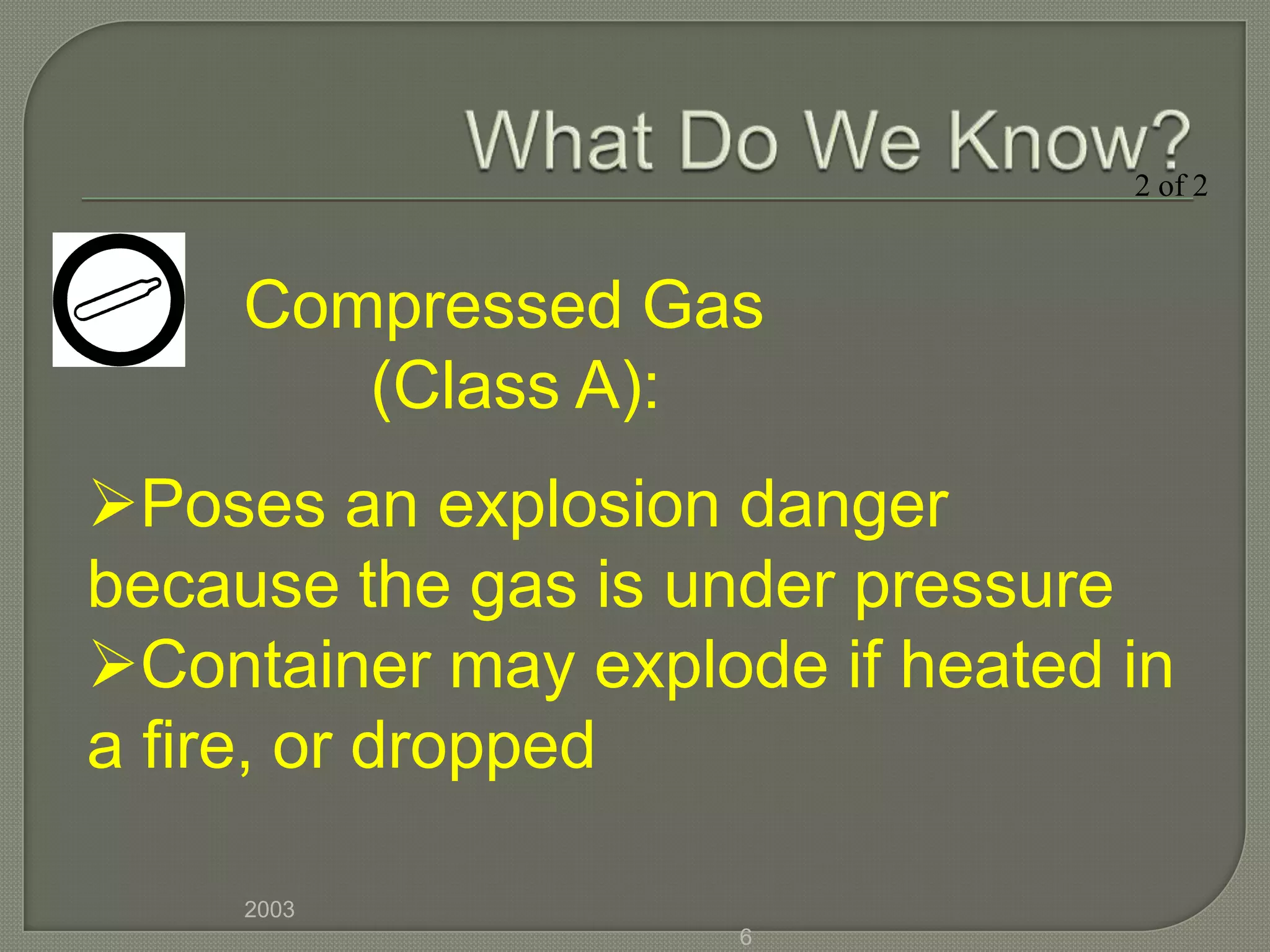
Class A: Compressed Gas
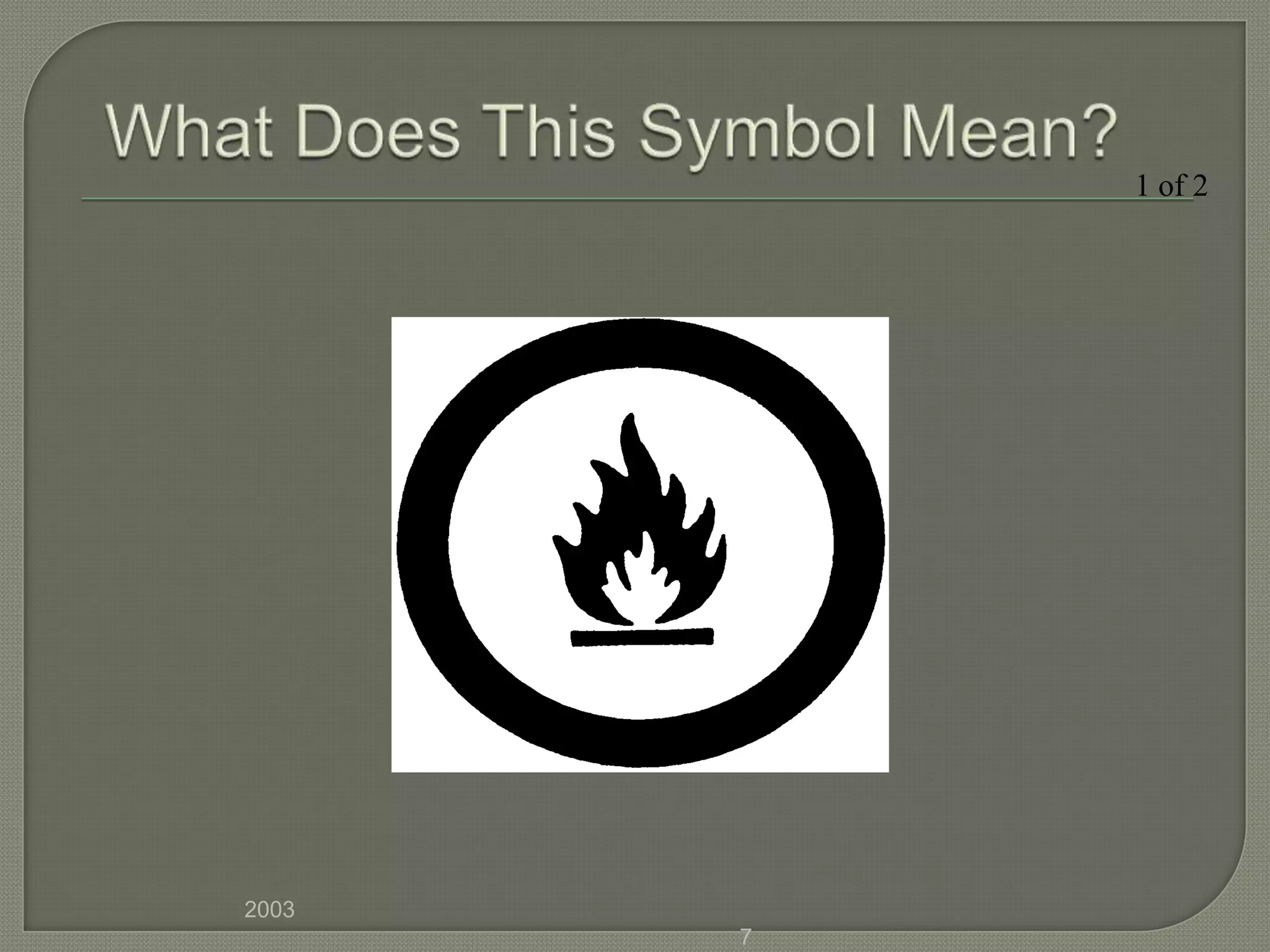
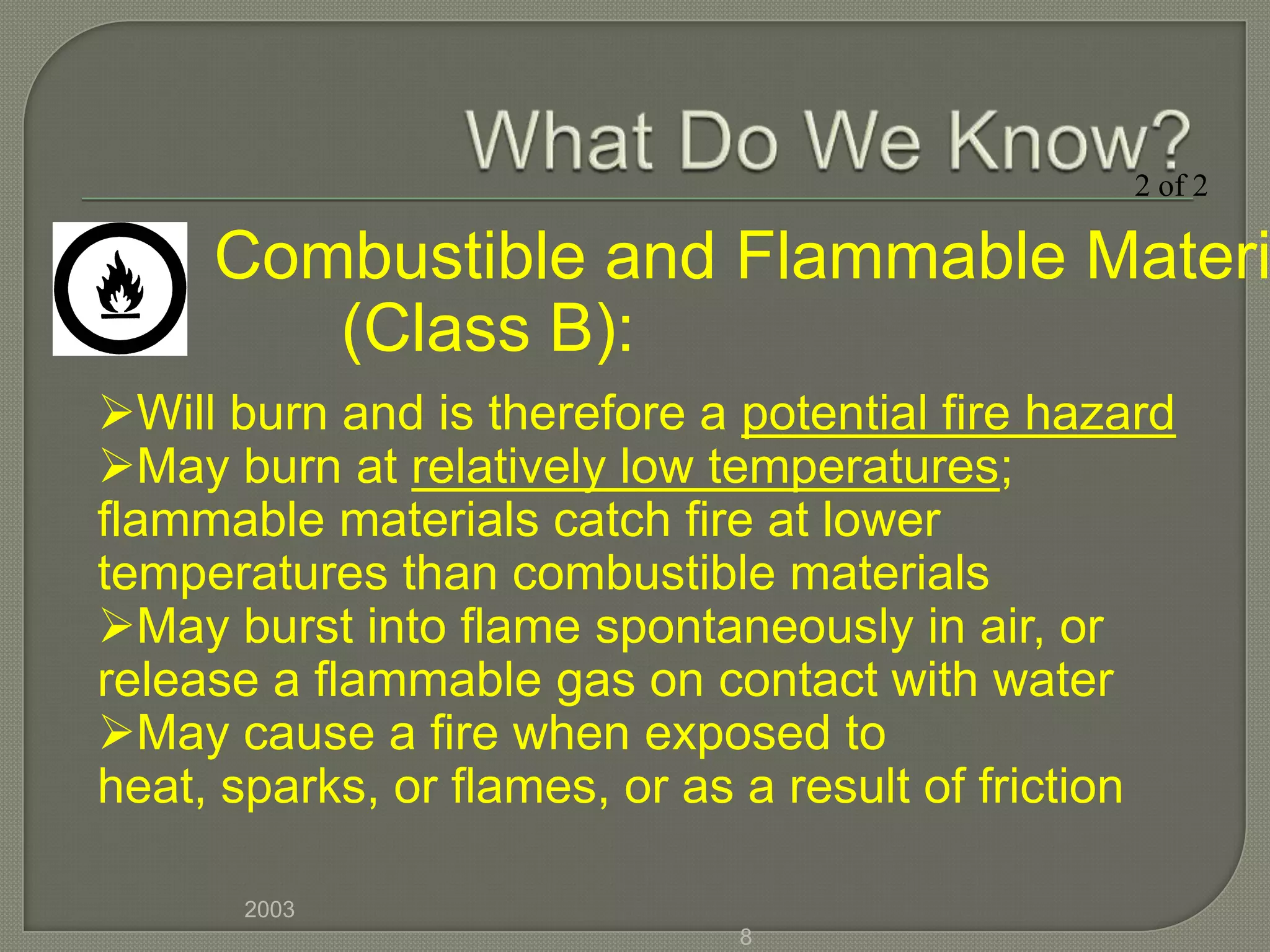
Class B: Flammable and Combustible Ma
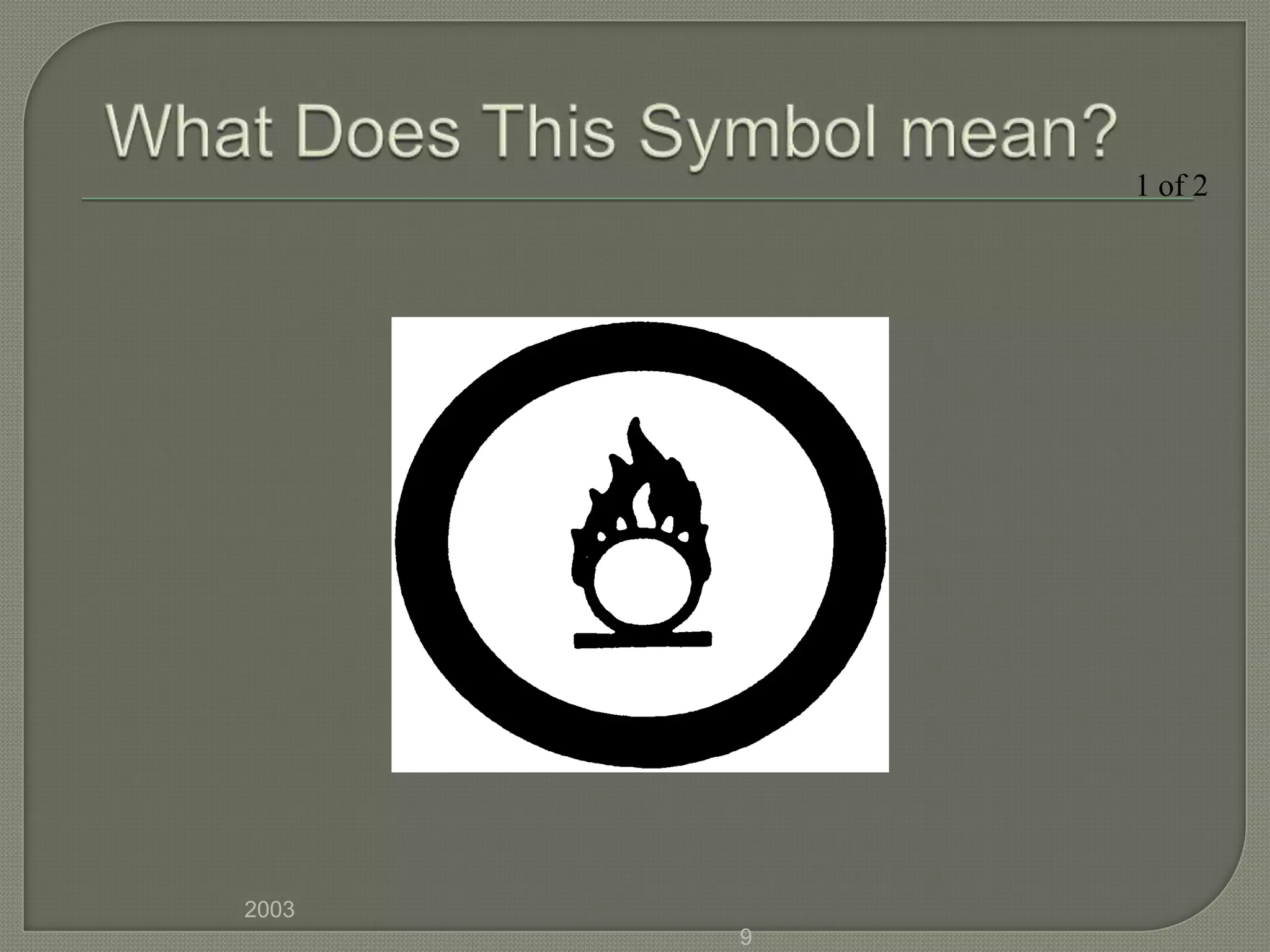
Class C: Oxidizing Material
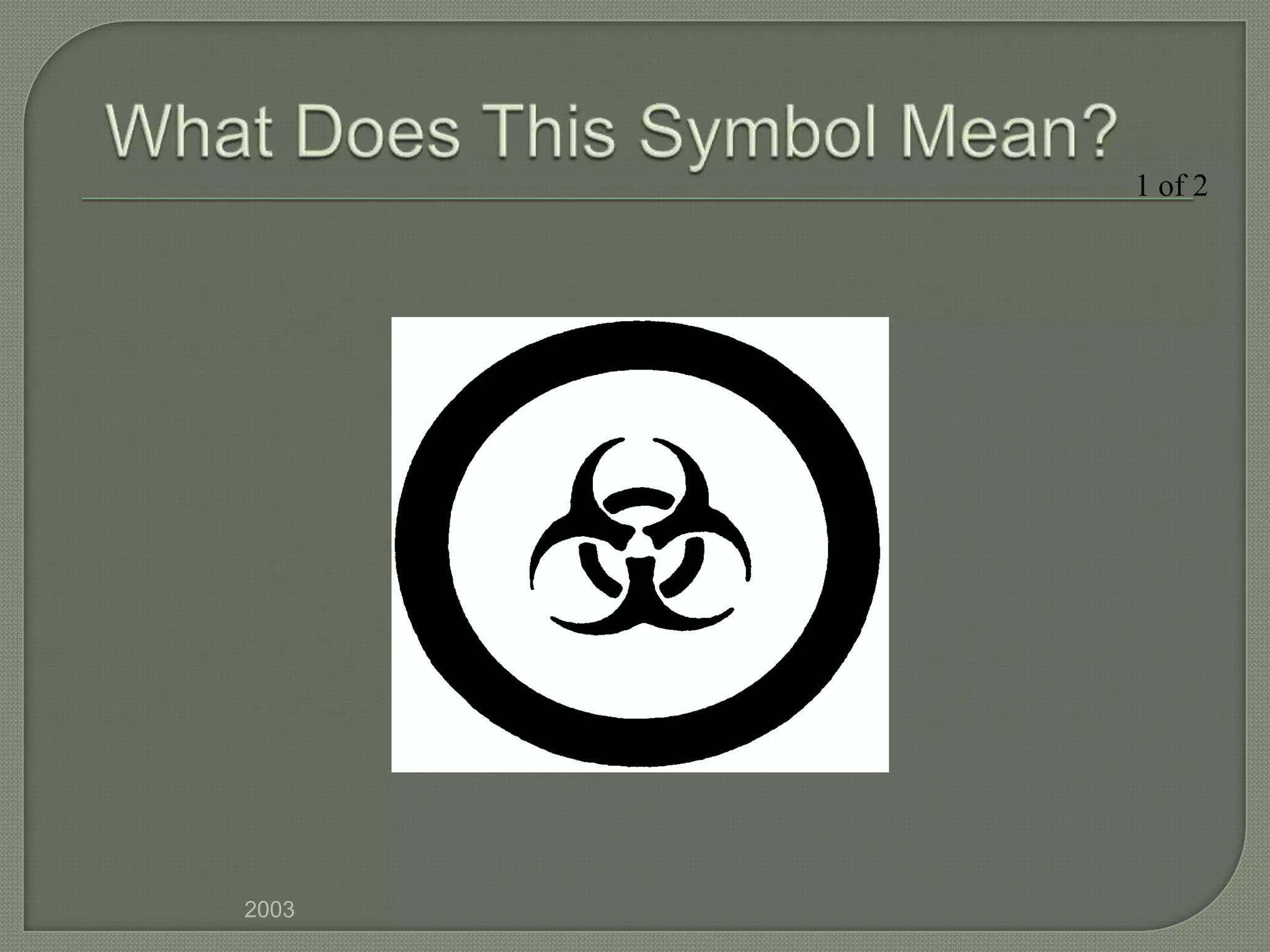
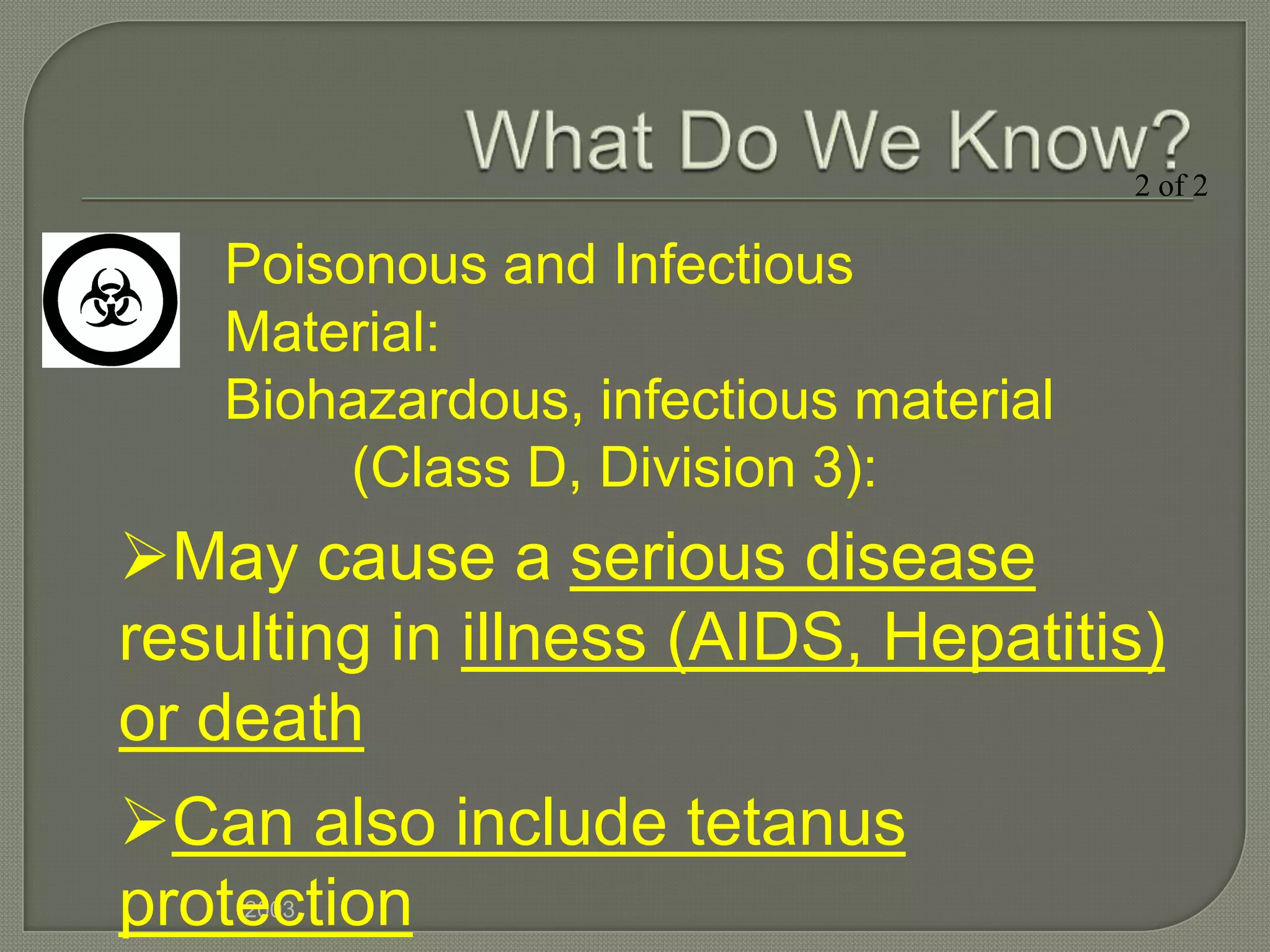
Class D: Poisonous and Infectious Materia
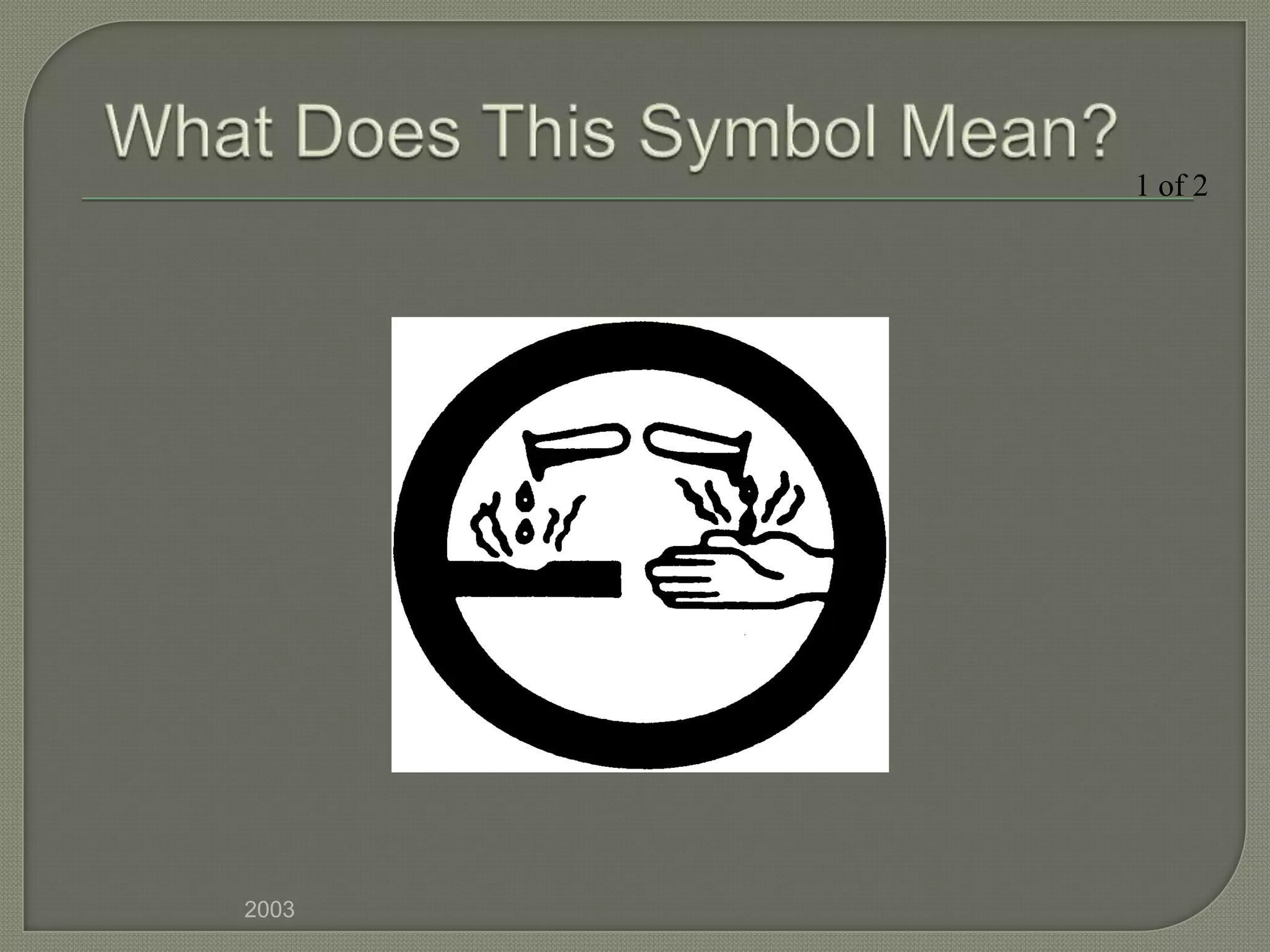
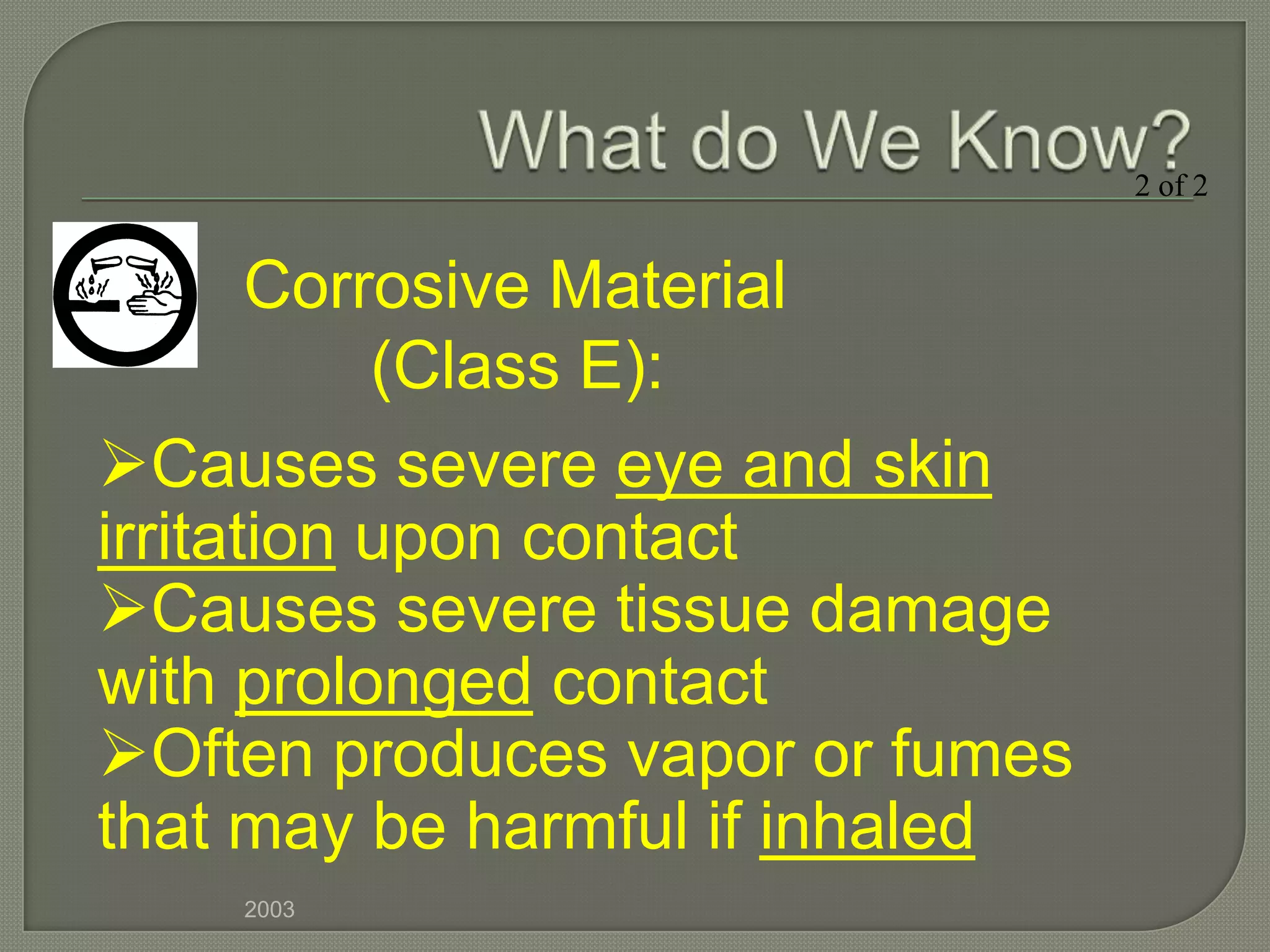
Class E: Corrosive Material
Class F: Dangerously Reactive Material
      2003
                      3
HAZARD SYMBOLS!
2003
               4
1 of 2


2003
       5
2 of 2


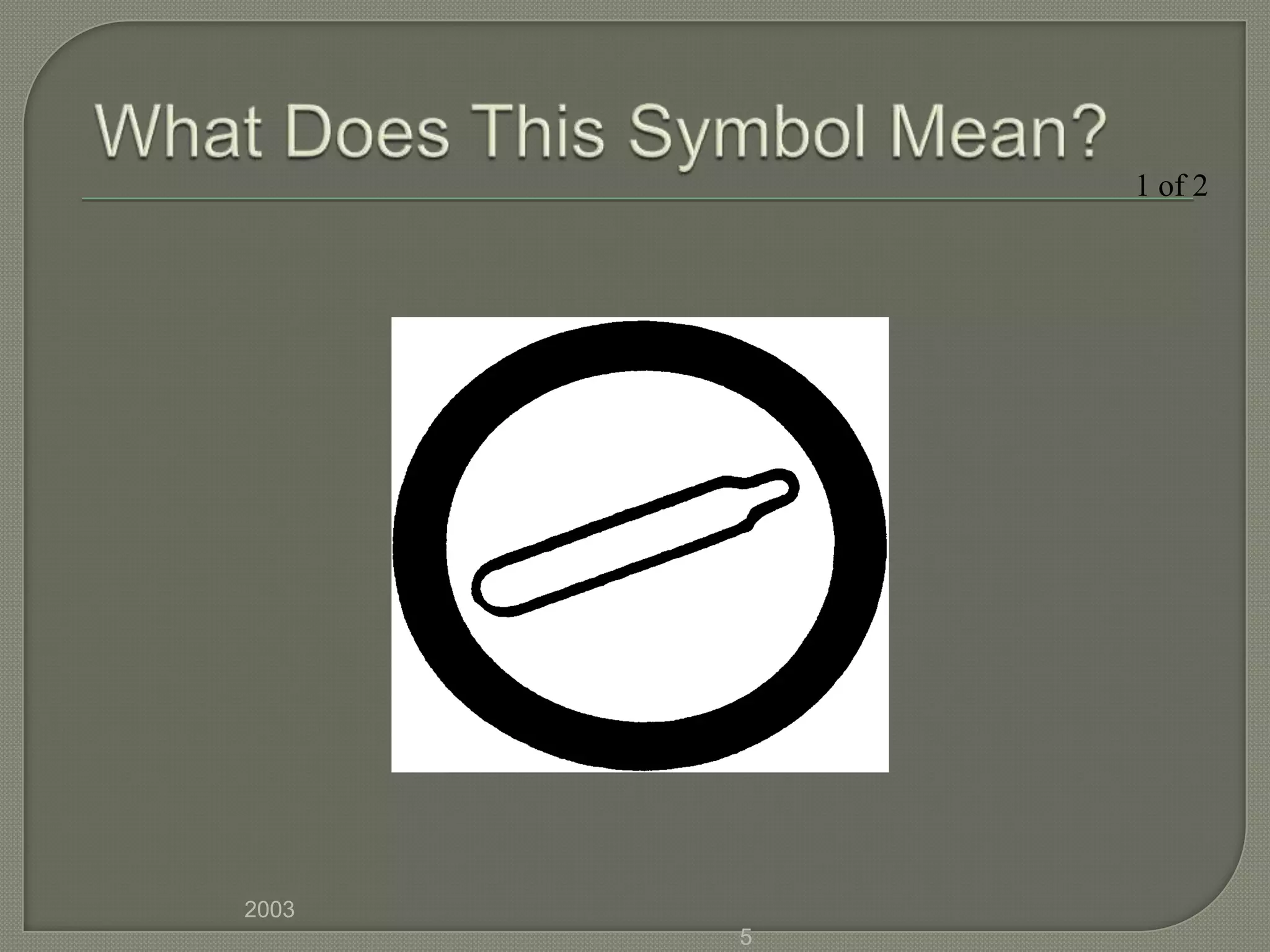
     Compressed Gas
        (Class A):
Poses an explosion danger
because the gas is under pressure
Container may explode if heated in
a fire, or dropped

     2003
                    6
1 of 2


2003
       7
2 of 2

     Combustible and Flammable Materi
        (Class B):
Will burn and is therefore a potential fire hazard
May burn at relatively low temperatures;
flammable materials catch fire at lower
temperatures than combustible materials
May burst into flame spontaneously in air, or
release a flammable gas on contact with water
May cause a fire when exposed to
heat, sparks, or flames, or as a result of friction

      2003
                              8
1 of 2


2003
       9
2 of 2


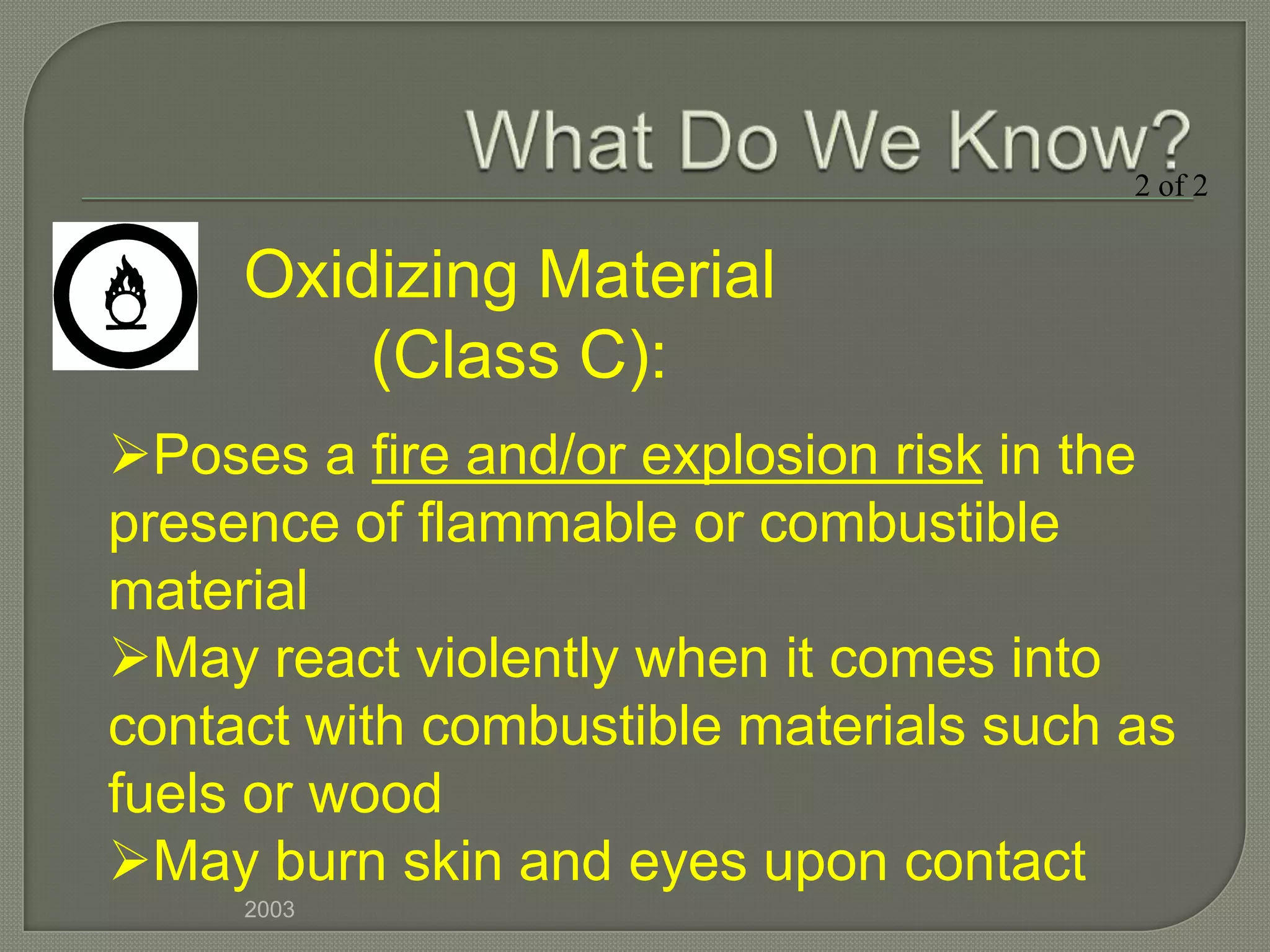
     Oxidizing Material
         (Class C):
Poses a fire and/or explosion risk in the
presence of flammable or combustible
material
May react violently when it comes into
contact with combustible materials such as
fuels or wood
May burn skin and eyes upon contact
     2003
1 of 2


2003
2 of 2


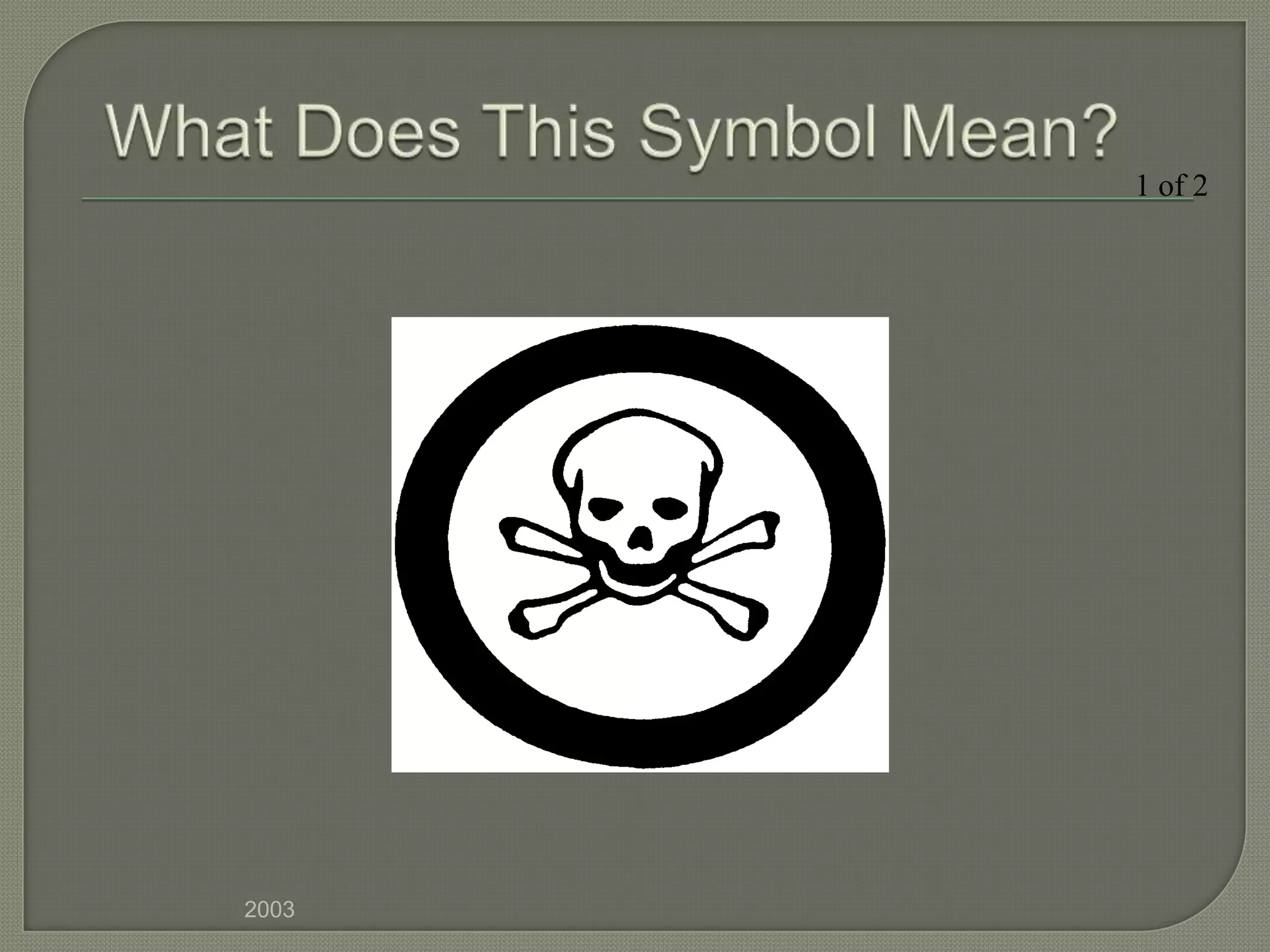
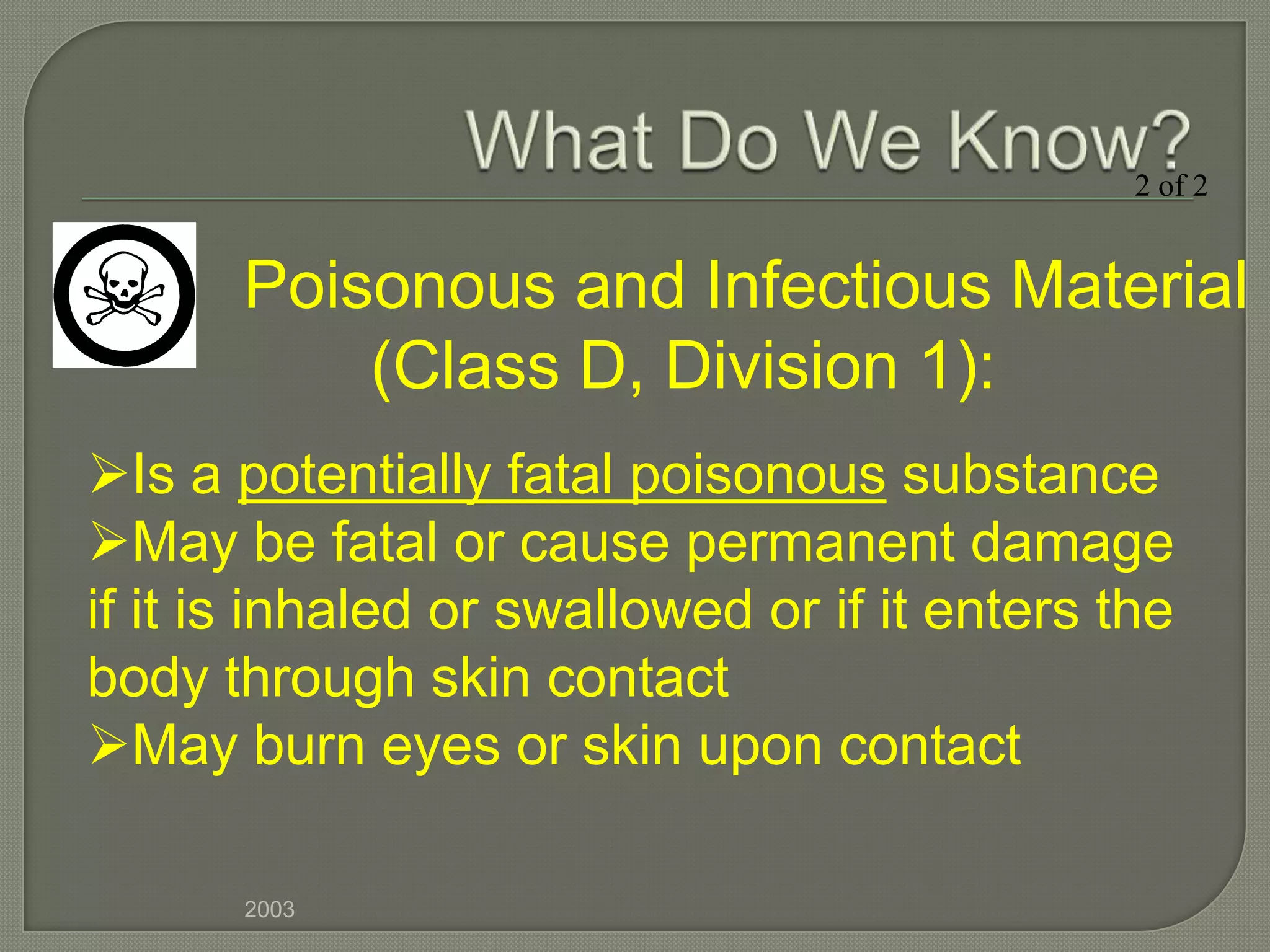
       Poisonous and Infectious Material
           (Class D, Division 1):
Is a potentially fatal poisonous substance
May be fatal or cause permanent damage
if it is inhaled or swallowed or if it enters the
body through skin contact
May burn eyes or skin upon contact

       2003
1 of 2


2003
2 of 2

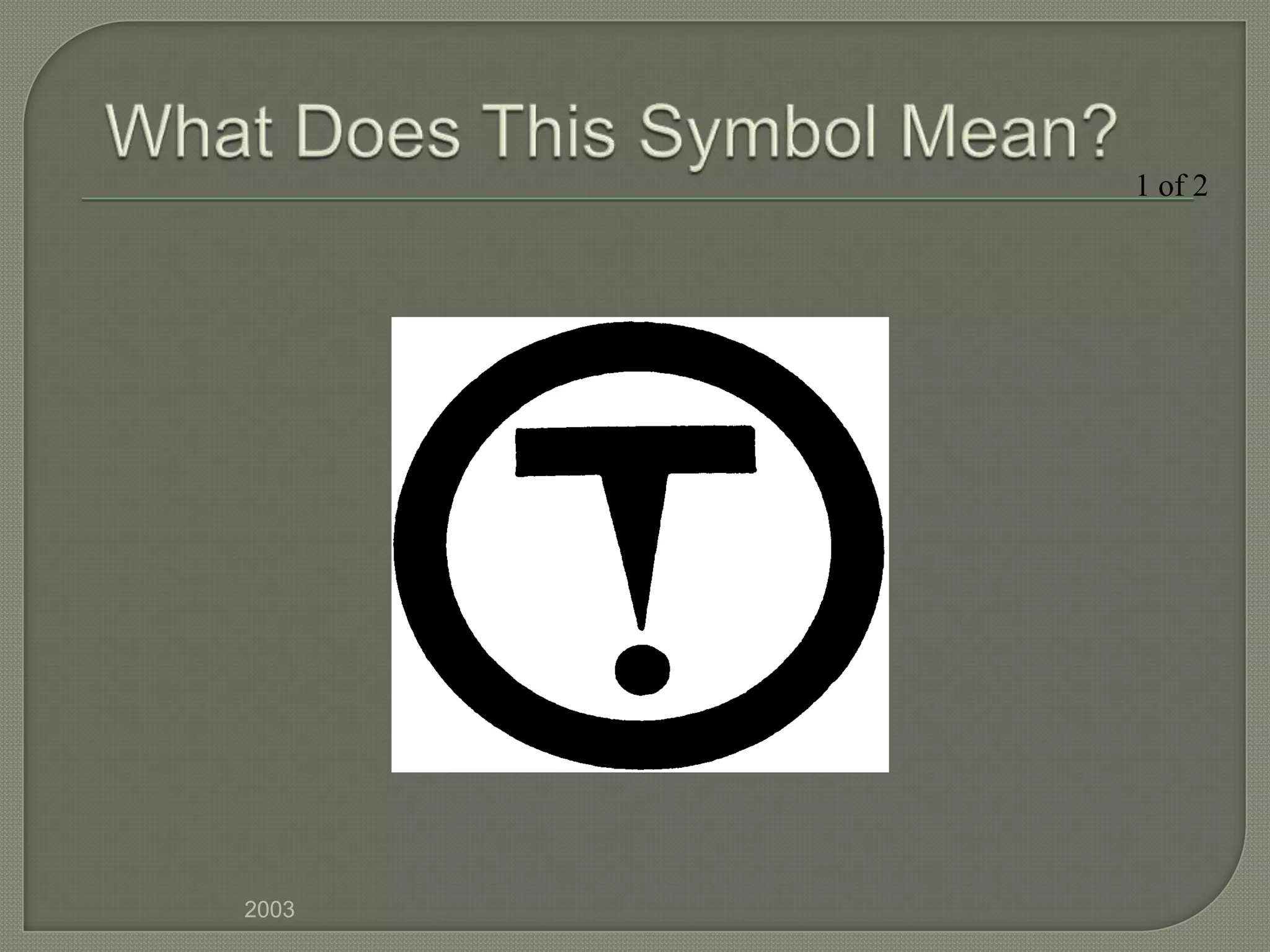
       Poisonous and Infectious Material:
       Other Toxic Effects (Class
       D, Division 2):
Not immediately dangerous to health
May cause death or permanent damage as a
result of repeated exposure over time
May be a sensitizer, which produces an
allergy
May cause cancer, birth defects, or sterility
        2003
1 of 2


2003
2 of 2

   Poisonous and Infectious
   Material:
   Biohazardous, infectious material
        (Class D, Division 3):
May cause a serious disease
resulting in illness (AIDS, Hepatitis)
or death
Can also include tetanus
protection
    2003
1 of 2


2003
2 of 2


       Corrosive Material
           (Class E):
Causes severe eye and skin
irritation upon contact
Causes severe tissue damage
with prolonged contact
Often produces vapor or fumes
that may be harmful if inhaled
    2003
1 of 2


2003
2 of 2


      Dangerously Reactive Material
         (Class F):
Is very unstable
May react with water to release a toxic
or flammable gas
May explode as a result of
shock, friction or an increase in
temperature
May explode if heated when in a closed
container
      2003
DANGE
R
WARNING
CAUTION
A pure substance is a material whose
 properties are not a blend and are always
 the same

 Ex.   Gold, Silver

Apure substance must be
 HOMOGENEOUS
 Allpure substances are homogeneous, but
 all homogeneous mixtures are not pure
 substances

 There   are two types of materials;

  • Homogeneous
  • Heterogeneous
 Homogeneous        – Mixture that looks like it is
 one material
  • Coke – Cola, Milk


 Heterogeneous      – when the parts are
 visibly different
  • Chocolate Chip Cookie
    A mixture that looks like one material but
    is very difficult to separate
    • Ketchup, Milk
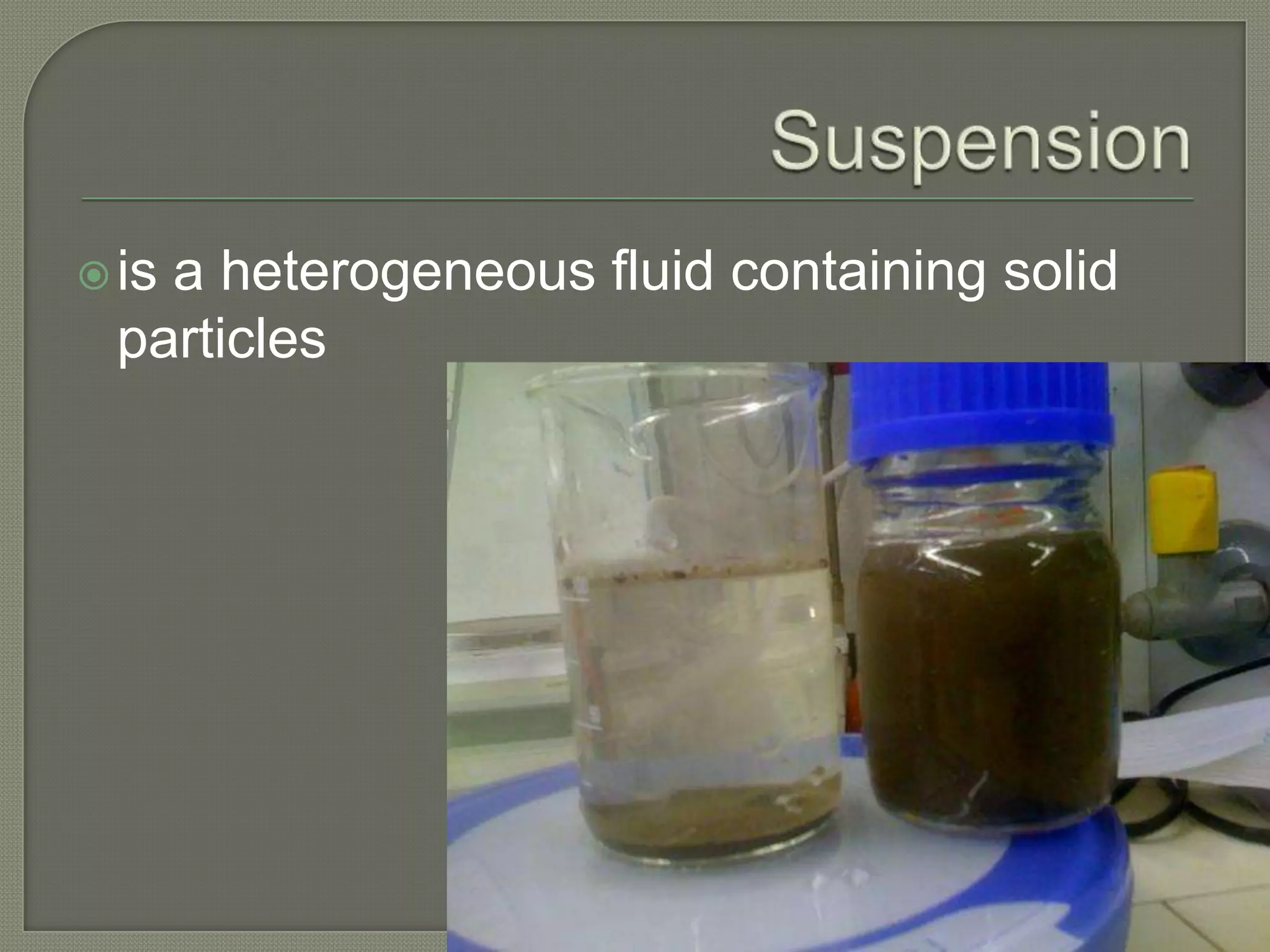
 is
   a heterogeneous fluid containing solid
 particles
 The solubility of a substance is the amount
 of that substance that will dissolve in a
 given amount of solvent

 Has   two parts;
  • Solute -- What is being dissolved
  • Solvent – The dissolving substance
 Thepoint where no more solute can be
 dissolved into a given solvent at room
 temperature

 Super-Saturation – When more solute is
 dissolved in a solvent than normal
 Temperature
  • When the temp. goes up in a liquid so does the
    solubility
  • When temp goes up in a gas, the solubility goes
    down
 ACRONYMN        to remember it

S  – Spaces between particles
 P – Particles – all matter is made of it
 A – Attraction – attracted or bonded to each other
 M – Movement of particles (always
  moving)
 Thehigher the viscosity the thicker the
 substance is

 Thelower the viscosity the thinner the
 substance is
 Liquidcannot be as compressed as much
 as gas because the spaces between the
 particles are not as far apart.
 Divide
      the amount of your solute into your
 amount of solvent

 Ex.
    13g of salt is dissolved into 50ml of
 water

 13g/50ml
 TO  solve for density you must use the
 following equation;

 Density   = mass/volume
 When     in a liquid, the force of gravity pulls it
  down,
   • The liquid releases an opposite force to gravity
       called BUOYANT FORCE, pushing the object
       upwards

 Ifthe liquid the object is in is more dense
  the buoyant force is greater than gravity
  and the object floats
   Means high pressure
 KNOW   ALL OF THE ORGAN SYSTEMS
 • Digestive
 • Respiratory
 • Circulatory
 • Excretory
 • Nervous
 Food   Passage
  • Mouth – Esophagus – Stomach – Small intestines
   – large intestines – anus

  • Villi – hair like projections in the intestines that
   catch nutrients
 Parts
  • Mouth – trachea – Bronchi tubes – bronchiole –
   alveoli

  • Gas transfer – Oxygen in, Carbon Dioxide Out


  • What are the concentrations of the gases in the
   alveoli
 Arteries   carry blood away from the heart

 Platelets   help form blood clot

 Pathway     of blood to the heart
  • Arteries – veins – right atrium – left ventricle –
   lungs – right ventricle – right atrium -- arteries
 Each   organ involved and what they do
  • Liver, kidneys, bladder, urethra, ureter


  • What is UREA – Waste products of the body
 Organs
  • Brain, Spinal cord, nerves, dendrites, axons


  • PNS/ CNS – organs that go with each
 Organelles   – specialized group of cells

 Organelles   to know
  • Mitochondria – power plant
  • Nucleus – biggest (cell brain)
  • Vacuoles (storage)
  • Cell membrane(animal)/Cell wall(plant) – Holds
    cell shape
  • Chloroplast (plant only) – captures sunlight
 Xylem    – dead cells that transport water in
 a plant

 Phloem – Living cells that transport food
 and nutrients throughout the plant
 Base
 Lens
 Coarse/fineadjustment knob
 Diaphragm (where the light gets in)
4   types –

 • Connective – connects one body part to another

 • Muscle – is able to contract and carry electrical
     impulses

 • Nervous – Makes up the CNS and PNS

 • Epithelial – Skin cells
 Diffusion– transports oxygen from your
 blood into your cells, and carbon dioxide
 from your cells into your blood

 Osmosis – Water going from high
 concentration to low concentration

           Permeable Membrane – a
 Selectively
 membrane that allows only certain
 substances through
 Plasma   is made up of;
 • The liquid portion of your blood,

Review of grade 8 science blog

  • 1.
  • 3.
    Class A: CompressedGas Class B: Flammable and Combustible Ma Class C: Oxidizing Material Class D: Poisonous and Infectious Materia Class E: Corrosive Material Class F: Dangerously Reactive Material 2003 3
  • 4.
  • 5.
  • 6.
    2 of 2 Compressed Gas (Class A): Poses an explosion danger because the gas is under pressure Container may explode if heated in a fire, or dropped 2003 6
  • 7.
  • 8.
    2 of 2 Combustible and Flammable Materi (Class B): Will burn and is therefore a potential fire hazard May burn at relatively low temperatures; flammable materials catch fire at lower temperatures than combustible materials May burst into flame spontaneously in air, or release a flammable gas on contact with water May cause a fire when exposed to heat, sparks, or flames, or as a result of friction 2003 8
  • 9.
  • 10.
    2 of 2 Oxidizing Material (Class C): Poses a fire and/or explosion risk in the presence of flammable or combustible material May react violently when it comes into contact with combustible materials such as fuels or wood May burn skin and eyes upon contact 2003
  • 11.
  • 12.
    2 of 2 Poisonous and Infectious Material (Class D, Division 1): Is a potentially fatal poisonous substance May be fatal or cause permanent damage if it is inhaled or swallowed or if it enters the body through skin contact May burn eyes or skin upon contact 2003
  • 13.
  • 14.
    2 of 2 Poisonous and Infectious Material: Other Toxic Effects (Class D, Division 2): Not immediately dangerous to health May cause death or permanent damage as a result of repeated exposure over time May be a sensitizer, which produces an allergy May cause cancer, birth defects, or sterility 2003
  • 15.
  • 16.
    2 of 2 Poisonous and Infectious Material: Biohazardous, infectious material (Class D, Division 3): May cause a serious disease resulting in illness (AIDS, Hepatitis) or death Can also include tetanus protection 2003
  • 17.
  • 18.
    2 of 2 Corrosive Material (Class E): Causes severe eye and skin irritation upon contact Causes severe tissue damage with prolonged contact Often produces vapor or fumes that may be harmful if inhaled 2003
  • 19.
  • 20.
    2 of 2 Dangerously Reactive Material (Class F): Is very unstable May react with water to release a toxic or flammable gas May explode as a result of shock, friction or an increase in temperature May explode if heated when in a closed container 2003
  • 21.
  • 22.
  • 23.
  • 24.
    A pure substanceis a material whose properties are not a blend and are always the same  Ex. Gold, Silver Apure substance must be HOMOGENEOUS
  • 25.
     Allpure substancesare homogeneous, but all homogeneous mixtures are not pure substances  There are two types of materials; • Homogeneous • Heterogeneous
  • 26.
     Homogeneous – Mixture that looks like it is one material • Coke – Cola, Milk  Heterogeneous – when the parts are visibly different • Chocolate Chip Cookie
  • 27.
    A mixture that looks like one material but is very difficult to separate • Ketchup, Milk
  • 28.
     is a heterogeneous fluid containing solid particles
  • 29.
     The solubilityof a substance is the amount of that substance that will dissolve in a given amount of solvent  Has two parts; • Solute -- What is being dissolved • Solvent – The dissolving substance
  • 30.
     Thepoint whereno more solute can be dissolved into a given solvent at room temperature  Super-Saturation – When more solute is dissolved in a solvent than normal
  • 31.
     Temperature • When the temp. goes up in a liquid so does the solubility • When temp goes up in a gas, the solubility goes down
  • 32.
     ACRONYMN to remember it S – Spaces between particles  P – Particles – all matter is made of it  A – Attraction – attracted or bonded to each other  M – Movement of particles (always moving)
  • 33.
     Thehigher theviscosity the thicker the substance is  Thelower the viscosity the thinner the substance is
  • 35.
     Liquidcannot beas compressed as much as gas because the spaces between the particles are not as far apart.
  • 36.
     Divide the amount of your solute into your amount of solvent  Ex. 13g of salt is dissolved into 50ml of water  13g/50ml
  • 37.
     TO solve for density you must use the following equation;  Density = mass/volume
  • 39.
     When in a liquid, the force of gravity pulls it down, • The liquid releases an opposite force to gravity called BUOYANT FORCE, pushing the object upwards  Ifthe liquid the object is in is more dense the buoyant force is greater than gravity and the object floats
  • 40.
    Means high pressure
  • 41.
     KNOW ALL OF THE ORGAN SYSTEMS • Digestive • Respiratory • Circulatory • Excretory • Nervous
  • 42.
     Food Passage • Mouth – Esophagus – Stomach – Small intestines – large intestines – anus • Villi – hair like projections in the intestines that catch nutrients
  • 43.
     Parts • Mouth – trachea – Bronchi tubes – bronchiole – alveoli • Gas transfer – Oxygen in, Carbon Dioxide Out • What are the concentrations of the gases in the alveoli
  • 44.
     Arteries carry blood away from the heart  Platelets help form blood clot  Pathway of blood to the heart • Arteries – veins – right atrium – left ventricle – lungs – right ventricle – right atrium -- arteries
  • 45.
     Each organ involved and what they do • Liver, kidneys, bladder, urethra, ureter • What is UREA – Waste products of the body
  • 46.
     Organs • Brain, Spinal cord, nerves, dendrites, axons • PNS/ CNS – organs that go with each
  • 47.
     Organelles – specialized group of cells  Organelles to know • Mitochondria – power plant • Nucleus – biggest (cell brain) • Vacuoles (storage) • Cell membrane(animal)/Cell wall(plant) – Holds cell shape • Chloroplast (plant only) – captures sunlight
  • 48.
     Xylem – dead cells that transport water in a plant  Phloem – Living cells that transport food and nutrients throughout the plant
  • 49.
     Base  Lens Coarse/fineadjustment knob  Diaphragm (where the light gets in)
  • 50.
    4 types – • Connective – connects one body part to another • Muscle – is able to contract and carry electrical impulses • Nervous – Makes up the CNS and PNS • Epithelial – Skin cells
  • 51.
     Diffusion– transportsoxygen from your blood into your cells, and carbon dioxide from your cells into your blood  Osmosis – Water going from high concentration to low concentration Permeable Membrane – a  Selectively membrane that allows only certain substances through
  • 52.
     Plasma is made up of; • The liquid portion of your blood,